Thursday, December 01, 2005

New Film: The Ice Harvest

Entering the final month of 2005, it has suddenly become clear to me just how atrocious this past eleven months have been for new American cinema. Aside from Canadian auteur David Cronenberg's masterful A History of Violence and German madman Werner Herzog's Grizzly Man, it seems reasonable to me that the modest virtues of Harold Ramis' The Ice Harvest may just make it the second or third runner-up on what is thus far a dismal list (save us Brokeback Mountain and The New World). Indeed, it is only the former that will figure on my year end's top ten list, not that that says anything for the relative quality of Hollywood. For 2002, for instance, I would not include a single American-financed film among my ten best (though again there is a Cronenberg film, Spider) even if I could name perhaps a half dozen very good films which I prefer to everything but A History of Violence and Grizzly Man this season. The point in this is that one, much of the best of world cinema happens outside the U.S.; and two, usually we fare quite a bit better -- Hollywood-wise -- than we have in 2005.

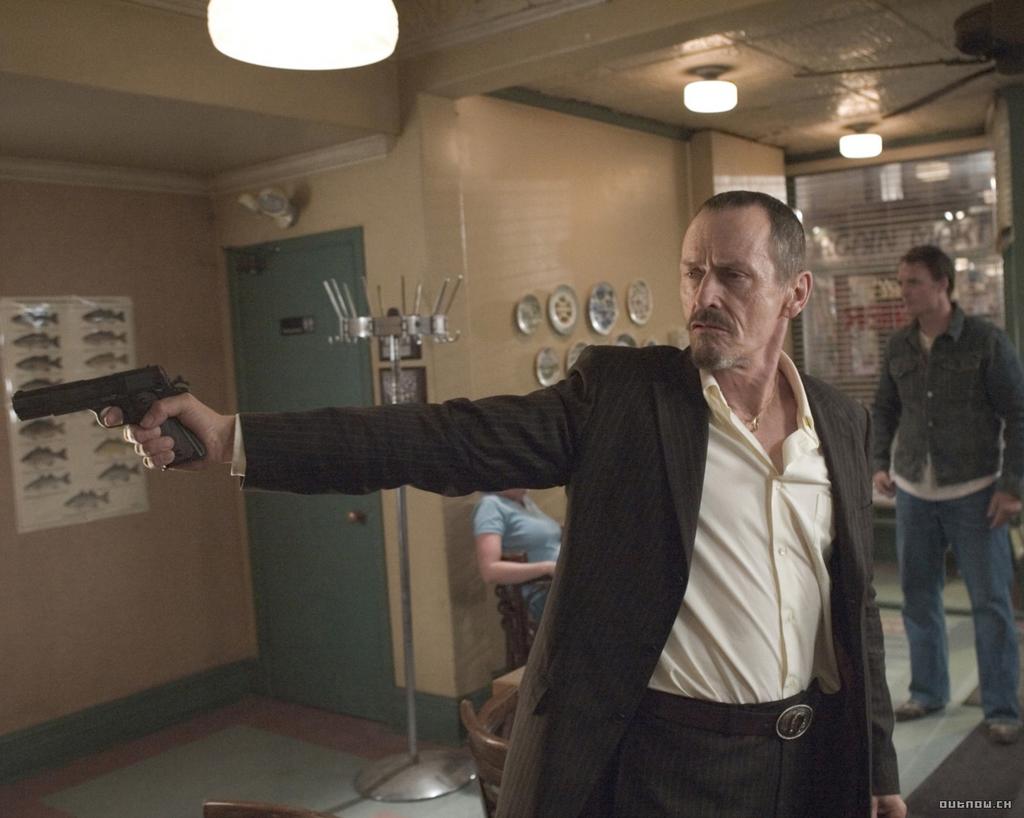
So, yes, if you've confined yourself to Hollywood pictures this year, by choice or circumstance, you most likely have convinced yourself that there are no good movies out there... and largely, you're correct. However, as I have said, there are modest virtues to be witnessed in the John Cusack-Billy Bob Thorton headliner, The Ice Harvest, which opened nationwide last week to below average reviews and an indifferent public -- judging by the poor box office. What critics and audiences have missed in passing over the über-cruel comedy cum neo-noir is this year's most extravagant reinterpretation of genre, in this case the Christmas film, even if the Ramis-helmer may at times seem like Bad Santa (2003) redux or a Coen Brothers retread.

In the Groundhog Day director's favor, however, is what might be judged to be the fuller reversal of genre (even if it can't equal Bad Santa's wicked pleasures) and the more generous picture, as it avoids the condescension of the Coen's, however nihilistic Ramis' perspective may be. The point is that The Ice Harvest operates according to a spatial logic that catalogues those places that Christmas movies tend to elide -- bars, strip-clubs... okay, lots of strip-clubs, etc. -- and a set of details that seem to cut against the holiday's mythical grain, be it Oliver Platt's Christmas Eve binge-drinking and subsequent purging, Thorton's porn video and even the (freezing) rainstorm itself, which Ramis snidely and economically introduces during the opening credit sequence with a few drops falling on a nativity Christ child. These are people and places which exist -- on Christmas just as they do anytime else -- but typically have no place in your typical Christmas movie... and rightfully so, one could argue.

Nevertheless, Ramis' Bad Santa set-up (which is surely the epochal film in this sub-subgenre) gives way to a Fargo (1996) or A Simple Plan (1998) without the accents -- or more importantly, given that we are talking about Witchita and not Minneapolis, the snow. Consequently, Ramis reminds us of his postmodern street-cred by giving us another generic mash-up, just as he presaged Pulp Fiction a decade earlier with his experimental Groundhog Day-time structure. Still, it is less the director's adept generic/tonal shift than it is the cohesiveness of his heterocosm that marks The Ice Harvest as noteworthy new Hollywood cinema. The very fact that The Ice Harvest engages our sense of narrative expectation, let alone the rigor of its conceit, provides its anomaly in the wasteland that has been 2005.

Monday, September 26, 2005

New Film: L'Enfant (The Child)

Jean-Pierre and Luc Dardenne's Cannes Palme d'Or winner, L'Enfant (The Child), deserves perhaps the highest praise that can be bestowed upon a work of art -- that it is true. To make this claim is not to suggest that it speaks from a right perspective or that it possesses a style that commensurately depicts its setting; rather, to say that L'Enfant is true is to acknowledge the verisimilitude of its psychological description. From this its viewpoint is to be judged, not vice versa.


That viewpoint, a Jamesian Christianity (as in the works-driven epistle), extends the logic of the brothers' previous masterpiece, The Son (2002). If the earlier film manifested an artisanal purity in the singularity of its purpose, both narratively and formally, the latter is a far messier affair, consistent with the titular adult lead's indirect path to salvation. His is not an easy attainment of maturity founded upon self-actualization, but is instead a reaffirmation of The Son's earlier claim that man is to be judged by his actions. It is not enough for one to be contrite in their words; genuine behavior modification must follow. That this is so is not simply a matter of a divine calculus but is instead reflective of self-absorption's power to destroy the lives of others, whether it is the emotional destruction of Sofia after he sells their newborn child or Bruno's abandonment of his weakened adolescent protege after a robbery. This is the true meaning of 'love thy neighbor.'

Of course, the film's inclusion of the theft and the subsequent theme of redemption through imprisonment reference the brothers' most consistent source, Robert Bresson, and particularly Pickpocket (1959) -- just as their Rosetta (1999) refashioned Mouchette (1967). (So too there exaggerated use of sound and extreme reduction of depth of field.) In this way, they continue to be the master's most loyal followers, updating his inimitable cinema with their own Jamesian variation. Moreover, the film's absence of arc befits their own revision in L'Enfant: it is no longer the struggling saint but instead the sinner who is now the subject of their allegory -- a Child, helpless without the love of his Father.

Saturday, September 24, 2005

New Film: The Weeping Meadow

There are anachronisms and then there are anachronisms. If in the past I have found it necessary to praise a director like Clint Eastwood for a technique more at home in 1962 than in its own age, I have done so with the feeling that for someone like him, form was only a means to an end. For Eastwood, style was (and is) never its own justification, but can be rather something to detract from the urgency of his narratives. To someone like Eastwood, modifications in form, rather than indicating some sort of aesthetic progress, possessed a danger in their potential to obscure his artistic intentions. At the same time, these same purposes were never themselves static, but instead experienced remolding in the image of their own particular moments. In short, while his technique stayed the same, his thought was evolving.

At first glance, Theo Angelopoulos might strike one as the same sort of figure. After all, The Weeping Meadow, whatever else it is, is a film from a different stylistic moment. Nonetheless, the ideas contained in The Weeping Meadow show the director's evolution from a Marxist historicism, focusing almost exclusively on Greek history (The Travelling Players, 1975), to a more existential consideration of Balkan realities (Ulysses' Gaze, 1995). Yet, there is one important difference between the aforementioned Eastwood and Angelopoulos: whereas invisibility of style is Eastwood's ultimate end, Angelopoulos has long foregrounded his own once dazzling technique.

 The problem is, it no longer seems as though the Greek auteur is utilizing his form to ask questions. If The Travelling Players established a fatal continuity to the exigencies of Greek history, via a camera that moved from figure grouping to figure grouping, often bridging temporal discontinuities over the course of a single tracking shot, The Weeping Meadow's continued employment of this same style, minus its formally radical employment, fails to remain self-justified. If anything, The Weeping Meadow is a film that should have been made twenty-five plus years ago, considering its scant modifications of his own modernist form. (Sparing use of music psychologically is in fact the only reevaluation of Angelopoulos' Travelling Players' technique.) This is, in other words, a profoundly dated text. Of course,The Weeping Meadow has its moments of beauty -- which Angelopoulos, as always, never allow his spectators to forget -- but the ability to photograph a Greek landscape poetically loses some of its appeal as the film drags on toward the three hour mark. Its one thing to watch Angelopoulos reinvent the medium for four continuous hours in The Travelling Players; it's yet another thing to see him copying himself -- poorly -- for three.

So again, there are anachronisms and there are anachronisms. Unfortunately, a thirty-year late re-tread of late modernism is not exactly the most enticing variety. If anything, The Weeping Meadow reconfirms the necessity to understand films at the moment of their creation. If we can forgive a film like The Birth of a Nation (1915) for its aberrant politics (by today's standards) it is likewise important to understand the inadequacy of a film like The Weeping Meadow on the basis of its historical moment -- which unfortunately for the director ended long ago.

Friday, September 23, 2005

New Film: A History of Violence

*WARNING - THERE WILL BE SPOILERS FROM THE FIFTH PARAGRAPH ONWARD IN THIS ANALYSIS*

David Cronenberg's A History of Violence is to date the best English-language film of 2005. That it should be so will come as no surprise to anyone who has paid attention to the director's work over the last decade. To a film, there is perhaps no corpus in the Anglo-Saxon cinema during this time which has continued to examine the mysterious depths of personality in the way that Cronenberg's has. For the countless scores of movies that seek to awe and entertain us -- and make no mistake, Cronenberg does both -- here is a body of work that foremost seeks to ask the most essential of questions, what is it to be human? Indeed, a film like A History of Violence makes us wonder why all films don't attempt something similar, given the ease with which the visceral and the thought-provoking commingle within the film.

But of course A History of Violence is a rarity for Hollywood. Then again, as much as we sometimes like to pretend otherwise, a film like Cronenberg's has always been a rarity in Hollywood. Why does Alfred Hitchcock -- Cronenberg's most obvious influence in A History of Violence -- continue to engender such a cultish following? Because he was unique, because he was better than most... and so too is Cronenberg.

Like Hitchcock, Cronenberg adapts the default form of Hollywood classicism to suit his own idiosyncratic narrative ends. 'Adapt' (rather than adopt) as his form, at times, evinces its own consubstantial logic quite apart from the basic codes of Hollywood storytelling. Perhaps the best example of Cronenberg's narratological flexibility occurs in the opening scene in which two outsider hoods "check out" of their motel. With the camera remaining outside their crummy roadside accommodations, Cronenberg introduces us to these characters by making a very important discursive point: they are cold-blooded killers. This point, indeed, is not made until Cronenberg cuts for the first time as the character who had remained outside the entire time enters the motel office. Inside we see, along with the indifferent henchman, that his protege has executed the two motel workers. That Cronenberg maintained the spatial and temporal continuity of the earlier shot confirms what has already been suggested: that he entered the space with the sole purpose of murdering the pair; that it was not accidental, that his execution did not involve a struggle or any sort of in-the-moment rationalization (had there been a cut, on the other hand, either would have been structurally possible). If this is not enough, the gentleman now in the room proceeds to kill a little girl who spots him looking through a cooler -- an on-screen variation of what had been already established through a singluar stylistic choice.

In the next shot we are introduced to the film's protagonists, Tom Stall (Viggo Mortensen), his beautiful wife (Maria Bello), his son and daughter. The screaming little girl is quickly reassured that there is no such thing as monsters as we are ominously introduced to this swath of small-town American perfection -- and their seemingly obvious future victimization. (Importantly, Cronenberg does not make fun of their ethos: visually he shows the natural beauty of the Midwest, while the couple's sexual life seems to indicate an uninhibited ideal.) However, before we get to this point, Cronenberg establishes the teenage son's victimhood -- to a high school bully -- giving us another character on whom we wish justice meted.

Subsequently, the two out-of-towners force their way into Tom's diner at closing time. Once it becomes clear that they are there to rob the establishment -- which we know will mean certain death for our protagonists -- and once one of the characters moves to rape the female waitress, Tom acts almost instinctively, killing the pair of assailants with breathless dexterity. Suffice to say that he is regarded as a hero and that we feel no sympathy for the dead, even if we might regret their physical pain (which Cronenberg carefully includes).

However, as any one who has ever seen a Cronenberg film knows, what follows is anything but straight narrative. Following Tom's heroic action, a mangled Ed Harris and a pair of his cronies arrive in the diner. Mr. Harris's character insists on calling Tom, Joey, which, for the naturalistic grace of Mortensen's performance, we find as odd as Tom evidently does. Regardless, the former persists, and Tom seems to have been thrust in a very Hitchcockian 'wrong man' scenario. As we soon learn, Harris is a mobster with a beef against this Joey who was responsible for carving up his face with barbed wire. Again, for those acclimated to the Cronenberg universe (think Spider, 2002) one begins to wonder if Tom is indeed Joey without knowing it -- that he is some kind of "schizo" as his wife wonders. Our answer comes shortly for this man who is strangely adept at killing, but who is nonetheless saved by his son at the last possible moment. (It is therefore implied that the young man might just share his father's violent acumen.)

The point is, whether or not Tom/Joey is aware of his past, that this violence exists within him, which is precisely where Cronenberg's big questions commence. Does Tom bare responsibility for Joey's past actions if he is not aware of them? Which is Tom/Joey's true personality? Can he be both of these people at once, and if so what makes him the person he is (if it is not a single personality)? Who is he, in other words, and what is it that makes him human if not a unified self?

Of course, there is another dimension in what would seem to be his suppressed former (perhaps true, though not necessarily) self: that there is violence living inside him. Indeed it is at this point that Cronenberg's film skips over any possible misreading as political allegory -- violence is a fact of life, or more precisely in the instance of this narrative, a former life. In fact, the history to which the title refers is that of Tom's self, a history which Cronenberg's narrative slight-of-hand shows to be in his everyman, and implicitly in all of us. That his physically timid son manifests the same violence (while finding a narrative causality in his genetics) reinforces the ubiquity of human violence. While it is true that Cronenberg is removing the too-perfect veneer of Middle America, it is of even greater importance that he is excoriating the illusory skin of human goodness. In this most perfectly ordered specimen there is untamed violence.

Wednesday, August 31, 2005

Quick take on Rossellini

Although Roberto Rossellini was indisputably one of the most influential of European directors, the fact that his influence was founded upon a philosophical or conceptual attitude rather than upon the imitation of stylistic devices or thematic preoccupations has meant that Anglo-American film historians in particular tend to pay little more than lip service to his achievement, when not ignoring it altogether. Yet such indifference constitutes a major injustice not merely to a director who redefined the parameters of the cinema but to one of the supreme "documenters," in any art form, of the latter half of the 20th century.

-Gilbert Adair

Roberto Rossellini is one of those curious figures in world cinema who seems to generate more respect than admiration. As Adair accurately points out, the reverence typically paid to the director is little more than tokenism. Certainly, his realist aesthetic -- location shooting, natural light, non-professional actors, longer-duration takes -- has benefited filmmakers of sparse means the world over. He is remembered as a figure of undeniable historical significance without being thought of as the equal to directors of a similar influence (such as Griffith, Renoir, Welles, Bresson, Godard). He certainly lacks the devotion many hold for his best-known countrymen, from Fellini to Antonioni to Bertolucci, among others. However, I would submit that he is at once their superior and the greatest of all Italian directors, without even making any allowance for his firm place in film history. This is to say that his corpus speaks for itself, outside of history, as one of the most beautiful and inspired that the medium has yet seen.

Yet, again he is underestimated. The reason for this, it would seem to me, is that Rossellini's style is too often considered for its historical circumstances, its facility for assimilation, and even for what he expresses through this style (or less opaquely, his themes) rather than for what this style says about the director's viewpoint. Indeed, it is in an examination of its conceptual genesis that a unity emerges to Rossellini's corpus, marking him as one of the medium's best.

Specifically, it seems to me that the key to appreciating Rossellini rests in his epistemological ideas. For Rossellini, the truth is evident on the surface of things. From his early, immediately post-war films (Rome, Open City [1945], Paisa [1946], Germany, Year Zero [1948]) to his Bergman cycle (including Stromboli [1950], Voyage in Italy [1953] and Fear [1954]), his historical recreations (The Flowers of St. Francis [1950] and The Rise to Power of Louis XIV [1966] among others) and more proper documentaries (such as India [1958]), what marks his entire body of mature work is a faith in humankind's perception of truth. Take the somewhat forgotten, small masterwork Fear: throughout the picture, Bergman's character attempts to conceal the truth of an adulterous affair. However, her body language belies the secret she is attempting to hide -- at one point her blackmailer asks rhetorically why she blushes, why her hands trembled and why she was so quick to give away her money. In other words, in spite of a shared Catholic faith with Robert Bresson, Rossellini departs from the Frenchmen (as well as from such directors as Michelangelo Antonioni, Wong Kar-wai, and even Eric Rohmer in Triple Agent [2004]) in the his view that psychology is discernible in gesture.

As it has been claimed, this basic understanding of the comprehensibility of truth is not limited in fact to the psychologically-intensive Bergman cycle, but manifests itself throughout his ouevre. The post-war texts offer their morals within the context (another key theme in Rossellini) of a war-ravaged Europe. In seeing the condition of Germany in the 1948 film, one understands the despair of the child protagonist. Surface reality discloses truth. Similarly, The Flowers of St. Francis, perhaps his greatest work, shows (key theme number three) the basic rhythm of a long-since extinct life -- a life lived absent of any goals other than the service of the Lord -- which as such reveals Christianity's distinct understanding of time; less abstractly, India proposes that its presentation of Indian life is sufficient to reveal essential truths of the nation.

In this basic understanding of epistemology, I would argue, Rossellini shows himself to be an artist seeking a form to express his ideas, not simply the innovator of a technique born of historical circumstance. It is in this consistency of viewpoint, manifesting itself in his form, that the beauty of his work becomes clear. Rossellini's cinema deserves to be appreciated not only for its historical value, but indeed for the beauty of its expression of content. In this lies its grace.

Friday, August 19, 2005

New Film: The 40-Year-Old Virgin & Grizzly Man

Judd Apatow's The 40-Year-Old Virgin does not hit screens without a certain amount of promise: after all, Apatow was the creator of the highly underrated television series "Undeclared" (2001), the follow-up to the exceptional "Freaks and Geeks" (1999), where he likewise worked in the capacities of both writer and director. Moreover, The 40-Year-Old Virgin seems to represent the belated break-through of its undeniably talented lead, Steve Carell, who has thus far shown brightest in his supporting roles in Anchorman (2004), as a correspondent on "The Daily Show," and most recently as America's answer to David Brent in NBC's remake of "The Office." While the latter may in fact come to fruition, The 40-Year-Old Virgin suffers most from its authorial viewpoint. To back-track, "Undeclared" is an under-appreciated series, to be sure, which hopefully will be remedied by its recent release on DVD, but this does not mean that it is without its deficiencies. Particularly, "Undeclared," like The 40 Year-Old-Virgin, showcases a lack of moral assessment when it comes to the sexual conduct of its character. If there is an ethos in Apatow's world -- of which "Freaks and Geeks" can be excluded on the basis that it is ultimately Paul Feig's creation -- it is that people will have sex, period. There is no moral reckoning based on abstract principles.

At this point, any viewer of The 40-Year-Old Virgin (or "Undeclared") might challenge this interpretation on the basis that Carell's character final contests that his prolonged virginity has found a meaning in his love for Trish (Catherine Keener, Being John Malkovich), leading them to a very family value-friendly consummation (in terms of its circumstances at least). Even so, up to this point, Carell's sojourn in the land of the untouched proceeded not from a moral calculus of his own but rather out of his particular romantic ineptitude -- he would have if he could have. In other words, Carell's character uses the convenience of his inadequacies to steak out a moral position: his virginity is an accident, meted by his peculiar character flaws. What all of this means is that Apatow has to find a way to redeem Carell, short of simply getting his character laid -- hence the recourse to a love of a lifetime, Firehouse-style.

On the level of conceit, what Apatow has on his hands is a sitcom plot, demanding a twenty-two minute narrative. At 110 minutes, our prolonged wait for Carell's loss of virginity might just resemble his own 40-year frustration. While Apatow deftly pulls off a Hitchcockian shift in audience desire -- we go from wanting to see the poor guy get some to hoping that he will not forsake his love for Trish -- he sure takes his time in getting there. When finally he does, we get one of the most singularly incompetent instances of cross-cutting I can remember in recent cinema -- somebody needs to bone-up on old Griffith. (Oh, and a memo to Judd, there is a difference between racism on-screen in 1915 and in 2005 -- you don't get the same pass that some of us are willing to extend to The Birth of a Nation, provided its very different social circumstances.) When you cut between two plot lines, conceivably to heighten tension and raise the possibility that things won't turn out the way we might like them to, it is best that they somehow intersect. Since it is Beth's (Elizabeth Banks) and not his apartment that they go back to, there is no danger that Trish will walk in on them, thereby deflating any potential for suspense in his use of a technique then generally connotes exactly that; the principle is so elementary, in fact, that one wonders how it is possible for a director with Apatow's experience to screw it up that badly.

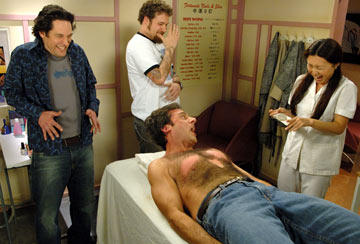
Really, though, it is not really Apatow's lack of a moral intelligence and his inadequate filmmaking that makes The 40-Year-Old Virgin frequently unpleasurable viewing. Instead, it is the film's unrelenting profanity and repetitiveness that truly tests the patience of its audience. The scene where Carell's chest hair is removed in one section after another seems to be the perfect metaphor for the viewer who might not automatically embrace Apatow's profane perspective. In the end, The 40-Year-Old Virgin shares its basic structure with another of this summer's most highly-anticipated comedy's, The Aristocrats: the same joke is repeated time and again, with only the slightest of modifications. What does Apatow call his act? The 40-Year-Old Virgin!
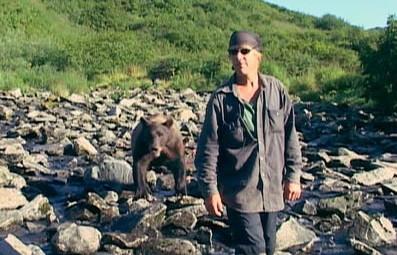
There is no similar limitation of scope to Werner Herzog's Grizzly Man, yet another major work from the poet laureate of ecological antagonism and civilizational abandonment. As the director himself puts it in his endlessly fascinating voice-over, nature is not the harmonious entity that the film's subject (and grizzly meal) Timothy Treadwell posits, but is instead characterized by "chaos, disharmony and murder." This is to say that in the story of Treadwell, Herzog has found a subject as comfortable in the director's archetypal universe as were Kaspar Hauser or Fitzcarraldo.

That story, of a man who has left civilization to record and protect Alaskan Brown Bears, only to himself to be devoured by one of the great creatures -- along with his girlfriend -- is presented in a series of home movies made by Treadwell and later assembled and narrated, with additional commentary footage and interviews, by Herzog. More than any other film in recent memory, Grizzly Man thus stands as a case study in the auteur theory: namely that the ultimate measure of a film consists not only in the text but in its extra-textual circumstances and relation to a broader corpus of work as well.

In other words, it gains value by virtue of its status within the director's body of work, which in this case is as a film that presents nature's passive indifference contraposed with a protagonist who thirsts for an escape from a cruel civilization. However it is precisely Treadwell's false, romanticized notions of the ecological other that precipitates his real-life killing: as one bumpkin-ish character notes, Treadwell seemed to treat these beasts as if they were human beings in bear suits rather than the soul-less creatures that Herzog himself memorably analyzes.

Indeed, Grizzly Man is filled with moments of such hermeneutical insight, showing not only the delusions of an individual who had been burnt one too many times by human order, but further of man's subjugation to the cosmos, particularly in this mode of existence. When Treadwell, in spite of his belief system, prays for divine intervention to save the creatures at a moment of ecological crisis, Herzog allows an interpretative space which would seem the only honest conveyance of a causality whose immaterial reality precludes a visual expression. This is to say that Herzog, in his clearly crafted re-presentation of the Treadwell story, does not simply tell, but indeed allows the viewer to contemplate the surfaces that comprise his art. In the end, the stare of the grizzly that Herzog fashions as disinterestedness -- surely the most reasonable explanation, mind you -- retains its inherent ambiguity by virtue of its surface materiality. This is a cinema, in other words, which could not exist in any other medium; this, we might observe, is the very opposite of Apatow's brand of comic filmmaking.

Sunday, August 14, 2005

Current Exhibition: Oteiza: Myth and Modernism

The Guggenheim's Oteiza: Myth and Modernism, running now through the 24th, is the first comprehensive survey of the Basque sculptor's work ever to be mounted in this country. That his art not only prefigures 1960s-era minimalism but even exceeds much of it in its theoretical complexity renders any Jorge Oteiza exhibition essential. Yet, because of his limited exposure, Oteiza's reputation isn't what it deserves to be: as one of the key sculptors of the twentieth century.

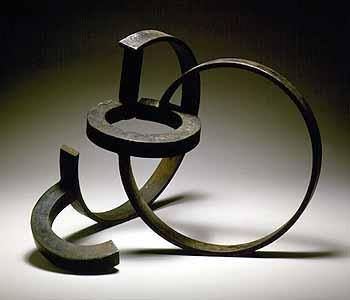
The corpus of Jorge Oteiza (1908-2003) represents an early expression of the minimalist aesthetic in sculpture, presaging the work of Donald Judd and Basque countryman Eduardo Chillida by more than a decade. Yet it is not simply his timing in art historical terms that lends Oteiza's art its substantial merit, but instead it is the success of his formal experimentation in finding an original idiom through which to express his spiritual content. To be sure, this is an art that seeks to express immaterial, metaphysical reality through the decidedly material means of the sculptural medium. However, it is less matter that dictates the tenor of his work, but rather space which defines Oteiza's aesthetic.Particularly, Oteiza, by the mid 1950s, sought to give life to the negative space that conditioned his craft: in carving slits and "light condensers" into slabs of marble and alabaster, Oteiza called attention to the spatial transformations undergone in the process of sculpture, and moreover, to the fact of an invisible presence in the location of a negative space. Oteiza's work instantiates a world unseen; in absence and through absence, Oteiza depicts presence.

Naturally, this formal idiom translates religious allegory to the extent that the latter is similarly concerned with the metaphysical. The fact that Oteiza's corpus features such titles as "You are Peter" and "Portrait of the Holy Ghost" confirms this confluence of formal concerns and religious subject matter. Yet, Oteiza's work retains a clear pedagogical dimension apart from its utilization for religious expression. First, there is its function in shaping one's perception of the medium: no longer is sculpture defined by matter, but instead by the space of which that matter is only a part.

Second, as with his alabaster works, the permeability of the sculptural surface is underscored. Then again, this instability of surfaces retains a certain spiritual resonance to the degree that it elicits a fluidity of visible and invisible reality that denies the false posturings of skepticism. To deny immaterial existence is to twine one's epistemology to the very limited sensory experience of seeing. By the limiting means of sculpture, Oteiza conveys a world that far exceeds its material dimension. This is spiritual art of the first order because it asks the necessary formal questions.

Thursday, August 11, 2005

Dimensions of Dialogue

With the DVD release of Jan Svankmajer's 12-minute animated bricolage Dimensions of Dialogue (1982) earlier this summer, one of the truly singular works of the animated cinema is finally available in the United States. Certainly, Svankmajer's reputation as one of the great Surrealists of his chosen medium was already secure with the wide availability of such recent major works as Conspirators of Pleasure (1996) and Little Otik (2000). However, it is with the relatively diminutive Dimensions of Dialogue that Svankmajer shows himself to be one of the three or four most important artists of the Communist twilight in Eastern Europe. Surely, for the brilliance of its form, the ambitiousness of its subject and the boldness of its critique, Dimensions of Dialogue deserves to be considered in the class of this epoch's greatest achievements and as Svankmajer's masterpiece to wit.

Divided into three separate dialogues entitled 'Exhaustive Discussion,' 'Passionate Discourse' and 'Factual Conversation,' Svankmajer indeed exhausts the subject of social interaction in this unbounded critique of human malfeasance. In the first dialogue, two anthropomorphized assemblages of food-stuffs and kitchen utensils respectively lurch towards one another with the latter devouring the former. In turn, this pattern is repeated when a collection of intellectual markers vies with the kitchen products destroying the returning collage with similarly ease. Next it is the now degraded food objects which sully the books, paints, etc., as though the two were mingling in some fictious trash bin. This process of disintegration continues with the resulting forms appearing closer and closer to the form of man himself.

The resulting clay human figure proceeds to spit out a facsimile of himself, as does the copy and so on. Consequently what this series of degradations finally produces is a human figure to be sure, but one lacking in any distinguishing characteristics. Given this lack of defining humanity, Svankmajer invites his spectator to read the inscribed process in negative terms: in turning over from one identity to the next there is a loss until ultimately, variation from one figure to the next ceases to exist. Moreover, the identities of these figures seem to cast light on the specificity of Svankmajer's critique -- the first seems to figure agrarianism, the second, industrialism, and the third a life of letters perhaps most closely associated with the bourgeoisie. In this series of revolutions, mankind destroys its uniqueness, which provides Svankmajer's 'Exhaustive Discussion' its critical heft; Marx's understanding of class antagonism is the subject of Svankmajer's critique.

Though it hardly seems possible, the second section of Dimensions of Dialogue exceeds even the first in its organic representation of critical discourse within an ostensibly analogical narrative. Here two clay figures, a man and a woman, commence an amorous affair. The two figures literally become indistinguishable from one another as Svankmajer manipulates the forms while utilizing his typical stop-motion technique (as he does in the first and third parts as well). In the midst of their passion, Svankmajer shows great economy depicting their love-making in such visuals as a hand and a breast alone amidst a large, amorphic blob of clay.

Once the pair finish, a small piece of their shared physical intercourse is left bouncing about on the table. Neither wishes to reclaim this lost substance, leading the pair to fling it -- their shared past -- at one another. This emerging antagonism becomes only a prelude as the two, now in full No Exit-mode, proceed to rip each other's faces out. What began as ecstatic passion ends in mutual annihilation; certainly, Svankmajer possesses no less skepticism towards the hope of romantic satisfaction than he does in the benefits of revolution seeded in class conflict.

The final section, 'Factual Conversation,' begins with the harmonious interaction of two male busts as they produce various complementary objects from their mouths. After this first concordant round, they produce objects that no longer work together, producing a relative absurdity and incongruence of interaction which is definitively surreal. Yet, their give-and-take does not stop here. The two continue in this exchange until their respective orifices begin to offer similar, competing objects, which eventually assures their mutual destruction. While it might be tempting to read part three, consequently, as a critique of capitalism -- which it may be -- the more compelling reading, given the film's historical circumstances and the undeniable tenor of the first part, would be as a breakdown of mutual benefit, thereby skewering socialism in equal measure. (Though it might also be tempting to view part three in light of the Cold War provided the above verbal analogy, the shared benefit inscribed would seem to rule out this possibility.)

Whatever the precise reading is of this third part, however, what does remain clear is that together, Svankmajer underlines the folly of human interaction on the levels of power (political), sex (interpersonal) and capital (financial).

Saturday, August 06, 2005

New Film: Broken Flowers and 2046

How much of Broken Flowers can be attributed to director Jim Jarmusch's contribution and how much to Bill Murray's? Though the auteur theory seems to have been made for corpuses like Jarmusch's -- as uniform as it is in style and point-of-view -- there can be no mistaking the consistency of Murray's performance in Broken Flowers with his recent work for directors as disparate as Jarmusch (also Coffee and Cigarettes, 2003), Sofia Coppola (Lost in Translation, 2003) and Wes Anderson (Rushmore, 1998; The Royal Tenenbaums, 2001; and The Life Aquatic with Steve Zissou, 2004). Increasingly, Mr. Murray looks as if he is little more than a Cossack away from starring in a series of lost Bresson features. Then again, performance style itself is meaningless without the manner in which the actors are framed and the quality of light that illuminates their gestures. Bill Murray may set a new standard for dead-pan in Broken Flowers, but without the over-arching structure and articulating style of the film, his performative restraint is meaningless.

So it is back to Jarmusch's contribution, which in terms of the work's style is unmistakable: typically, Broken Flowers features the director's use of fades to mark scene-changes, an often static camera, his frequent recourse to pillow shots -- especially in the film's numerous traveling sequences -- which once again mark the director as Ozu's clearest follower in the American cinema -- and even a Bressonian restraint which Murray brings flawlessly to screen. Collectively, these elements of style bring to life the story of Don Johnston -- not to be mistaken with, wait.. give me a second to catch my breath... Don Johnson -- an over-the-hill Don Juan (as we are told two hundred and forty-six times in the first ten minutes of the film) who discovers that he might have long-lost son from one of his many affairs. With Murray's Johnston being persistently brow-beaten by would-be private eye neighbor Jeffrey Wright, the former sets off in search of the mother of his potential off-spring, thereby mixing elements of detective fiction and the road movie, a favorite genre of the Stranger Than Paradise-auteur.

In terms of the women whom he visits -- played by Sharon Stone, Frances Conroy, Jessica Lange, and Tilda Swinton respectively -- Jarmusch tends towards schematics, producing something of a coiling miasma of Middle American banality: its not just that Jarmusch gets much of his financing from Europe, but no small portion of his perspective as well. Yet aside from this bit of slouching towards the Brothers Coen and a few flat jokes (including Sharon Stone's seductress daughter being named Lolita), the Director's typically-dry sense of humor remains in tact, which surely is a good thing given the work's dark denouement. In the end, Broken Flowers does offer a modicum of resolution even as it maintains the openness that has long signified the director's craft. Indeed, there is a fundamental relativity to his art which is best stated by Murray himself near the end of the film: "the past is gone... the future isn't here yet... so all there is is this, the present."

However, there does exist a fundamental flaw to Jarmusch's basic conceit: the present itself is the most unstable category of all, forever dying the moment it comes into existence. Wong Kar-wai's 2046 operates with this understanding, belying the impossibility of Jarmusch's philosophical gloss -- the present is never immune from the past, nor can the future escape an ever-constricting set of possibilities conditioned by what has already come into being. When Chow awakens to his feelings for Fei Wong's (Chungking Express, 1994) Wang, it becomes clear that they will never get together, not because she isn't interested, but rather for the fact that she is already in love. As the voice over narration states, "love is matter of timing; it is no use meeting the right person too early or too late."

Of course, Wang is not Chow's first love interest in 2046. She follows a series of one night-stands, her own incursion as a non-romantic presence, and Chow's fling with the incomparable Bai Ling (Zhang Ziyi, House of Flying Daggers). In Wong's universe, nothing lasts -- people come into our lives, move out of them, and in some cases reappear, as with Faye Wong's character. In Chow and Wang's case, it is not a matter of lovers reuniting, but rather casual acquaintances who become much closer during a second go-round. In this second turn, she begins to assist Chow in his writing. He in turn pens "2047," named after the room in which he lives, and in which they now work. While this text is ostensibly concerned with her absent Japanese lover, the narrator admits that Chow is the true subject of this oblique take on his own feelings for Wang. Importantly, this same Japanese lover is the protagonist in a second novel, "2046," thereby establishing that the film of the same name is also about its author: Wong.

At the end of the film's prequel In the Mood for Love (2000), Leung's character whispers a secret into a wall. 2046 overtly instantiates the substance of his feelings -- or rather Wong's -- not only at the moment of confession but over the course of the director's entire career, even if he sustains the same degree of mystery that "2047" purportedly does: to everyone but (perhaps) those involved. In this way, 2046 is not only the most self-reflexive work of the director's career, but is in fact the fulfillment of a trilogy begun with Days of Being Wild (1991) and continued in In the Mood for Love. Wong shares the secrets of his deepest feelings -- and those of his art -- though with the same degree of abstraction as his fictional science fiction novel "2046." Significantly, this choice of genre is an organically-chosen means for referring to the same obliqueness with which Wong narrates his own feelings.

Lest all of this makes 2046 seem overly-intellectual, the reality is that Wong remains the most purely visceral filmmaker alive today. If Abbas Kiarostami's films pose the great formal questions of our time, Wong makes us feel as no other director can. He is the great aesthete of his time, attuned to the curve of a woman's hip and how the slit in her skirt rides up the side of her leg as no one else is. Then again, his films offer a form that is both original and that breathlessly express his own anxieties: just as people move in and out of other's lives, so do the narratives of his seemingly aleatory art emerge and collapse. 2046 becomes all the more essential for its role in the clarifying this very process.

Friday, August 05, 2005

Recommended Propaganda: Went the Day Well?

Alberto Cavalcanti's Went the Day Well? (1942) is the sort of film that gives me pause concerning one of my firmer held beliefs: that the measure of a film's value lies not in what is said, but in how it says it. You see, Cavalcanti's picture is a piece of British war propaganda, made in 1942, which paints the British public as a noble fraternity -- duplicitous double agents aside -- sacrificing everything in order to defeat the common enemy. It is not just the men of Bramley Green who put their lives on the line to defeat their German captors, but the women and even the children who do so as well. Went the Day Well? does not shy away from the collateral costs of war nor does it merely schematize the Germans as a bumbling, easy to defeat opponent. This is a work of the highest level of integrity that no less than expected its spectators to show the same vigilance as those who gave their lives to defeat the enemy force. Cavalcanti's picture is a work of profound nobility.

Of course, some of what I have just mentioned is not strictly a matter of content, but is likewise attributable to the film's particular form. For instance, Cavalcanti's representation of the Germans as a competent military force -- not always the rule in the period's films -- proves essential in the film's discourse, and ultimately its strength as propaganda: they cannot be easily beaten; it will take extreme fortitude. On a visceral level, moreover, Went the Day Well? also benefits from Cavalcanti's dexterous manipulation of suspense. (This quality is also evident in his subsequent They Made Me a Fugitive (1947), perhaps the greatest British postwar thriller -- exceeding even Carol Reed's better-remembered classic, The Third Man [1949]). With Went the Day Well, one of the key components of his mastery of tension is his use of sound. In one of the key scenes, where the British civilians have escaped their German captors, Cavalcanti completely cuts the sound altogether, thereby translating this affected silence into the veil of night that the medium's visual mandate precludes. No film, after all, can represent action in complete darkness. So, in this way the distinction established at the outset -- between the telling and the message -- is moot. Went the Day Well? excels in both its form and its moral resoluteness.

Wednesday, August 03, 2005

Looking at Ford, Looking through Hawks

"I repeat myself in keeping with Orson Welles who after viewing Stagecoach 40 times before embarking on Citizen Kane said he was influenced by the old guys; the 'classical' film makers, by which he meant 'John Ford, John Ford and John Ford.' If the pantheon of classical music is 'the three Bs' (Bach, Beethoven and Brahms), then it is arguable there is only one true great in cinema - and that's the man who won more Academy Awards (five) than anyone before or since."

-Richard Franklin

"The problem lies in Hawks's apparent transparency, in a stylistic presence that is relentlessly invisible, self-effacing, difficult to see, and extremely difficult to analyze. The subtlety of Hawks's style is one of the most significant features of his work, but it is also the greatest obstacle to the widespread recognition of his talent as a film-maker."

-John Belton

Atop the pantheon of great Hollywood directors, three men tower above the rest -- and with all due deference to Richard Franklin, these men are not named John Ford, John Ford, and John Ford. Well, one of them is, but the other two preferred to go by their given names, Alfred Hitchcock and Howard Hawks. In the case of the former, no further allowances need be made at the present: few filmmaker's can claim an academic journal devoted entirely to the scholarly research of their career's as can the 'Master of Suspense' (for the record, the publication in question is the Hitchcock Annual, edited by a former professor of mine, Richard Allen). Hawks, on the other hand, remains the red-headed step child of the big three, never quite reaching the same level of international acclaim as the other two; his corpus seems to lack a Vertigo (1958) or a Searchers (1956), which is to say a single masterpiece generally considered to be not only his best, but further one of the great works of world cinema.

Again, much of the difficultly surrounding Hawks's work lies not so much in his choice of subjects or in his themes, but instead in the apparent invisibility of his style. Ford is the perfect counterpoint to the Hawks's visual schema. To paint the great director of western's in the broadest of brushstrokes, Ford's is a cinema devoted to a mythology of the West, whereby the wilderness is painstakingly brought under the thumb of civilization. This cursory explanation for his primary mega-theme is consequently translated into imagery that contraposes a nascent civilization and said wilds. Take for instance the adjacent image from My Darling Clementine (1946): here, Henry Fonda's Wyatt Earp reclines on a porch overlooking the wilderness that surrounds the ominously-named Tombstone. In so doing, Ford has visualized his principle theme, inasmuch as Earp (and Tombstone) itself) stands for an ordering force challenging a brutal nature. A second exact visual expression of Ford's ideas occurs in the sequence where a dance is staged at the site of the church's construction. With the half-built structure allowing a vantage out onto the surrounding desert, Ford effectively imparts his basic conflict visually: the wilderness is being tamed with the aid of society's bedrock institutions, the church and the law. Our understanding of his art is therefore deepened by our reading of his imagery. In the interplay of the foreground and background, Ford establishes his principle dialectic.

The opposite is true of the cinema of Howard Hawks: if we look at the screen in Ford, we look through it in Hawks. First, while Ford is primarily concerned with the mythology of the West, Hawks seems to have no similar predilection for this subject matter. Rather what is most remarkable about the latter's corpus, famously dispersed over a wide variety genres -- including the western -- is its uniform interest in homo-social groups of men (and occasionally the spare woman) who are continually shown at work. As Andrew Sarris once put it so succinctly, the basic thread running through his cinema is that "man is measured by his work... not in his ability to communicate with women." This concern, again, manifests across genre boundaries, becoming the key theme in his own great western, Rio Bravo (1959), where Dude (Dean Martin) struggles with his own alcoholism, finally finding redemption in his renewed professional ability.


Similarly, John Wayne's John T. Chance, in an explicit reversal of Fred Zinnemann's High Noon (1952) matrix, must depend upon the help of others, even as he attempts to go it alone. This dialectic between an individualist ethos and his dependence upon the group is no less profoundly American in its analysis... but I digress; the point is that Ford's themes are central to the genre of which he is the most famous practitioner, while Hawks's manifest themselves time and again, across a wide array of genres.

But what does this have to do with the visual substance of Hawks's work? For the director, form is subservient to the greater themes of the work -- no less than Ford, in fact, form and discourse are consubstantial. Their intermingling, however, is expressed in a very different fashion: whereas, once more, Ford communicates the garden-wilderness dichotomy visually, among other ways, Hawks explicates his themes with a style that expresses his ideas cleanly and without distraction. He shoots his human subjects straight-on (just below eye-level) in comparison with Ford's favored lower angles, looking up at his heroic subject matter. Hawks's figures are commonly staged within the same space -- in two's, etc. -- at a medium distance. When his group is larger than two or three persons, his staging tends to recede to a middle distance that allows his character's to interact in a unified space. Very little action occurs in the background, which varies in size depending upon his utilization of the middle ground, which again flows from the number of characters who populate the scene. In any case, the interactions occur quite near to the camera.

A perfect illustration of Hawks's style can be found in the brilliant opening scene of His Girl Friday (1940). Here, Hawks cuts only when the content precipitates a change in framing or when it is merited, in order to accentuate an important moment in the drama. An example of the latter would be Hawks's cut when Hildy reacts to Walter's off-handed proposal of (re)marriage.

In so rigorously maintaining this schema, Hawks effects an invisibility to the degree the camera, in following the action with a very plain compositional style, refuses to call attention to itself. Thematically, his perpendicular camera, staging of characters so that they are able to interact within a single space, and unobtrusive editing all instantiate formal corollaries to the director's egalitarian vision. The problem is, with regard to his work's formal comprehension, that each of these techniques makes his artistry disappear. Then again, his egalitarian world view demands nothing less than his unpretentious mise-en-scene.

Ultimately, we look past the visual art of Hawks, through to a broader set of themes and concerns that appear and reappear in work after work. The form of his cinema is independent of the content in terms of its relation to genre; then again, Hawks's camera work and editing precisely enacts the ideology contained in his art. The point is that his world view necessitates an essential artlessness, and is protean mastery of genre demands light stylistic footprints, provided that his work is to maintain a thematic unity.

Returning thus to the above comparison, whereas Ford uses the space of his art to juxtapose conflict, Hawks's space is the location of his enacted subject matter. That his individual shots are so profoundly unmemorable, therefore, becomes part of this matrix. Again, we see through Hawks's films, figuratively, to the content, while in Ford's graphic constructions we see his ideology. In this basic difference, we see the very substance of their art.

Sunday, July 31, 2005

Miroslav Tichý


This past month, the first ever exhibition of seventy-nine year old Moravian recluse Miroslav Tichý commenced at the Kunsthaus Zurich, thrusting a major new voice (in terms of the collective consciousness, at least) into the international art spotlight. For anyone interested in this "dissident" and "hermit" -- he spent eight years in Communist prisons and clinics for his nonconformity before building a camera out of trash as per his epic poverty -- let me commend Modern Painters' characteristically informative piece. (Though to read the piece in its entirety it is unfortunately necessary to purchase the publication; then again it is the best arts journal going, so just buy it!) I will also use the opportunity of this introduction to post photos on Tativille for the first time, which is perhaps not the best idea given his nude female subjects. Still, with the physical deterioration that he allows his images to suffer, there is an undeniable sense of the transience of physical beauty included in these exceptionally elegiac works. Their subject matter thus is not the nude figure alone -- thereby portending something other than pornography -- but rather beauty's passage, consequently reminding us all of life's evanescence. This is dimly-recalled eroticism, somehow closer to memory (making it all the more wistful) than it is to photographic reality. Take a look and see if you agree:


Saturday, July 30, 2005

The Limitations of Brilliance, Better than Perfection: The Conformist and Au hasard Balthazar

As with few other films, I envy the newcomer as I envy David Niven for having made love to Merle Oberon; that Bertolucci's masterpiece -- made when he was all of 29 -- will be the most revelatory experience a fortunate pilgrim will have in a theater this year is a foregone conclusion.

-Michael Atkinson, The Village Voice

Exactly. Then again, Bernardo Bertolucci's The Conformist (1970, Italy) may have something else in store for its more seasoned admirers: incipient indifference (albeit on the smallest of scales). Lucky for Bernardo, few spectators fall into this latter category. For reasons unknown, given especially the film's lyrical immediacy, The Conformist continues to be available only on an out-of-print, dubbed VHS format. Doing its best to rectify this grave want, the Film Forum will be screening Bertolucci's opus now through August 11th. And as Michael Atkinson notes, few films this year will be able to rival its potential impact.

From the flashing neon of the opening credits, The Conformist is awash in visual ideas. Or more precisely, so begins its rolodex of unforgettable images. Indeed, there is no final rule for Bertolucci and legendary cinematographer Vittorio Storaro's visual strategy other than that will it lean heavily on the indelible -- be it a whitewashed roof-top asylum, Jean-Louis Trintignant walking alongside a vintage automobile in a canted composition, fallen leaves swept up by a sudden gust, the beautiful Stefania Sandrelli dancing with the even more gorgeous Dominique Sanda, or the latter pounding on Trintignant's automobile window as he looks on impassively, The Conformist is the sum of its visual highlights.

It is also, of course, a parable about fascism, as is confirmed first by its literal-minded title. Then again, The Conformist is a film where everything is made clear, abundantly, whether by a score that highlights significant moments with a bull-horn's subtlety, or in a narrative that never allows its viewer to escape from its Marxist cum Freudian interpretative framework -- right up to a final plot twist straight out of the Psychopathology of Everyday Life. To be sure, The Conformist is a work of boundless talent, but it is also a film of limited mystery, born of the unrelenting certainty beget by Bertolucci's youthful brilliance. Even at its most formally unconventional -- i.e. its temporal leap-frogging -- Bertolucci psychologizes his character's actions (and inactions) so assiduously that there is no mistaking his intentions: a fascist is built according to the measure of his desire for an illusory normalcy corresponding to a supposed cultural normativity, full stop. Though The Conformist may resemble at first truly challenging film art, the clarity of this discourse as well as the directness of its pleasure argue otherwise. This is a work of simplicity, however ambitious, whose first taste will always be its sweetest. With that said, its sumptuousness is not to be missed.

The same spectatorial arc does not apply to another of this year's resurfaced masterpieces, Robert Bresson's Au hasard Balthazar (1966, France), released last month in the U.S. for the first time ever on home video. If The Conformist orchestrates the making of a fascist in its precise detailing of psychological causes, Au hasard Balthazar seems to encounter its protagonists' unawares, articulating the effects prior to and apart from their causes. In other words, Bresson's film showcases life as we witness life, uninformed of the immediate causes of events. However, it is not simply events or actions that Bresson is portraying in Au hasard Balthazar but rather sin; and consistent with the Christian notion of iniquity, it is not something to judge situationally. There are no causes, no justifications for the transgressions represented on-screen. Moreover, the concept is expressed in purely carnal terms -- sin is a matter of flesh; spirit is absent. (It is also of note that in spite of its coldness, Bresson's is a profoundly sensual film in the most literal of senses.)

Of course, absence is the key to Bresson's aesthetic, whether it is his denial of surface expression which calls attention to interiority through referential absence or in his mise-en-scene with its notoriously shallow focus -- rigorously depicted with a 50mm lens -- and tight, medium close-up framing. Similarly, this same austerity figures in his audio track which is as significant for its silences as it is for its amplified ambient sounds. Each unit of sound and image is a precisely modulated expression of what the director wishes to relay (less any superfluous detail). In this way, Bresson's past as a painter is drawn into particular focus inasmuch as his cinema manifests the same total control over his subject matter, even if there is not a single frame in Au hasard Balthazar that can rival the scores of unforgettable images in The Conformist. Then again, Bresson's film seeks nothing more than the representation of the ethereal in a medium beholden to the material. His is a reproduction of a life unseen. Even so, Bresson's cinema stands above all other's in its equitable presentation of sound and image. Au hasard Balthazar, along with works as A Man Escaped (1956) and the perfect Pickpocket (1959) -- which it nevertheless exceeds by virtue of the concreteness of its metaphor -- represent a cinema that has finally become fully itself (as Marguerite Duras once said), bringing into harmony its audio and visual components for the very first time.

But of course, Au hasard Balthazar is not form alone, but is instead the director's most carefully constructed Christian allegory. To begin with, the film's title character is a donkey -- a creature with its own special relationship to both the nativity and also the crucifixion narrative, named after one of the three wise men. After an idyllic youth spent with children in the French countryside, Balthazar becomes a beast of burden, used and abused by a series of owners. He is both a silent witness to their sin and a carrier of its weight, as when he is used to smuggle goods at night. Yet it is truly the former that best describes the animal's narrative agency: this is a film about the mankind for whose sins Christ died. When finally the animal's life comes to an end, Bresson makes the analogy precise surrounding the creature with sheep. Above all, Au hasard Balthazar is the great Christian allegory of the twentieth century.

Then again, given the director's refusal to explicate psychology in keeping with his programmatic realism, Au hasard Balthazar remains open to those who would deny this reference. By a subtle shift in emphasis, Bresson's film becomes a Marxist critique of capital or proof of God's death provided the picture's unending bleakness. Either way, it is for the audience to interpret, not the artist. Surely, Au hasard Balthazar is not so much reality itself as it is a mirror, calling all spectators to an act of spiritual evaluation -- with a Christ-figure at its core. The truth may be on-screen, as it is in life, but it is no easier to decipher. The depths and mysteries of Au hasard Balthazar are as deep as life itself.

Friday, July 22, 2005

New Film: Last Days, Bad News Bears & Wedding Crashers

Prior to his most recent renaissance -- culminating with the Palme d'Or-winner Elephant (2003) -- audiences could have been forgiven for assuming that Gus Van Sant's best work was behind him. After all, it was Van Sant who was responsible for the middle brow irrelevancy of Good Will Hunting (1997), exactly the sort of work that is mistaken for good by people who don't know anything about movies. What's worse, of course, is that this same film made the career of the pestilent Ben Affleck -- a sin for which no amount of good deeds can atone. If that leaves grace as Van Sant's only option, he got close with Elephant, which demonstrated a love of its adolescent character's otherwise unknown in contemporary cinema.

In his latest, Last Days, as much a biopic of the late Kurt Cobain's final moments as Elephant was a picture about Columbine -- that is in everything but name -- Van Sant again tackles adolescence: in this case of the prolonged variety, the twenty-something rock star. As his drug-addled subjects, Blake (the Cobain character played by Michael Pitt) and his hangers-on, drift through a dilapidated Pacific Northwest mansion, which organically showcases the same deterioration as befell Blake's psyche in these "last days," Van Sant portrays lives lacking the emotional compass required for self-preservation. Yet unlike his beautiful, awkward, and in the case of his killers, tragically-misguided teenagers in Elephant, there is nothing but ugliness on display in Last Days. However romantic the character of Blake may be, beauty is not part of the calculus; the universality of Elephant has been replaced with the particularity of Blake, which indeed mediates the discursive power of his tragic end. To have compassion for the characters in Elephant is to draw on our own recollections of our teenage years. To watch Blake and his live-in guests idyll is to witness something to which the majority of viewers cannot relate out of their own experience. At best, pity ensues; at worst, disgust. In either case this is no replacement for a compassion compelled by understanding.

Though Last Days does not therefore equal Elephant in its emotional scope, it does rival the prior work in its aesthetic ambitions. Here, again Van Sant fragments time, replacing an exact inscription of the final 90-plus minutes of his life with a dispersed impression of these "last days." Dispersed, that is, as other characters float in and out of the narrative in order to give shape to his isolation -- gestures of help and abandonment are combined to instantiate Blake's final fate.

Of course, Richard Linklater took the opposite approach in his wonderful Before Sunset (2004), where the duration of the story is replicated in a near facsimile to real time. No similar ambition, however, is on display in his latest, Bad News Bears, a remake of the classic ESPN Classic, The Bad News Bears (1976). While this does not preclude the film from possessing substantial value -- School of Rock (2003) is not exactly ambitious, and yet it remains eminently entertaining -- Bad News Bears is slight nevertheless. Rewritten by the same pair who scripted Bad Santa (2003, Terry Zwigoff) and starring that film's vile Kris Kringle, Billy Bob Thorton, clearly Bad News Bears was conceived as an update of the earlier Bears with a shade of the Zwigoff film. However, Linklater's Bears can not match the unrelenting vulgarity of the Santa picture, which in its sustained lack of propriety achieved its own form integrity and demonstrated a clear (if decidedly bleak) world view. The film's mitigation, in this respect, is in part a function of its PG-13 rating. Likewise, Linklater's own political correctness softens the work's vulgarity: sure we laugh at the wheel chaired-character zipping out to play right field, but Linklater does allow him to make a key out. And of course the pitching sensation is female -- perhaps progressive pre Title-IX, but now, such a characterization is nothing more than comfortably liberal.

David Dobkin's Wedding Crashers is anything but. In this Owen Wilson-Vince Vaughn vehicle, women are gullible, if not down-right stupid. This is not a film that proceeds according to the Prizzi's Honor or Dirty Rotten Scoundrels cliché, where it might seem that the men are in control, but where it is genuinely the female characters who are orchestrating events. Here, these "wedding crashers" breathlessly manipulate women through the most-transparently phony gimmicks one could possibly imagine; and even, for instance, when the Gloria character shows herself to be a bit wiser than she first appears, she still falls for Vaughn's B.S.

If this makes Wedding Crashers sound unduly reactionary, the fact is that the picture's impolitic qualities make it a renunciation of contemporary cultural values. The fact is that what's good for the goose has long not been good for the gander. Wedding Crashers is the sort of politically-incorrect work that restores the equation (though admittedly there is a limit to such a renewed equality, provided that it depends on the inferiority of one of the two genders). Still, this is a film whose comedy succeeds because it s taboo. And like Bad Santa before it, Wedding Crashers similarly sustains an integrity of impropriety -- the funeral crasher who appears may be a scumbag, but he's also a genius.

Wedding Crashers similarly succeeds because of the charisma and likeability of its leads, Wilson and Vaughn. Amiable without being admirable, like their characters, they give off the impression of being the life of the party, generous with everyone, even if they have less than laudable ends. Excuse the expression, but these are two guys who can really shoot the shit, and come on, who doesn't like that? They're guy's guys, who are as comfortable in a pick-up football game as they are in their ill-gotten moments of intimacy. In a society that has effectively rid itself of masculinity, there is something deeply satisfying about seeing characters like this on-screen. Sometimes sensitivity is gratuitous. Sometimes what is called for is a good punch in the face. Sometimes you just have to call somebody a "pussy."

Monday, July 11, 2005

Television is not an art

Television is not an art. Television is a medium that engages in the broadcast of art -- in addition to that of journalism, sporting events, and other forms of entertainment -- but it is not an art form in its own right. What semantic difference does this make? It makes some.

First, it must be acknowledged that cinema which is broadcast on television is still cinema. If one was to watch The Bridges of Madison County on television with commercials, as I did for the time, one is still watching Clint Eastwood's work of art, even if the experience of the film is somewhat amended by the particularities of its mode of broadcast. The same is true for any experience other than its projection in 35, even if VHS or especially DVD closer approximates the intended circumstances of its screening. Assuming that it is not recut -- which is characteristic for the pay channels even if it is not the norm elsewhere -- Eastwood's ideas and their implementation are the same; he photographs the same subjects, cuts in the same places, etc. The work is the same discursively as well as ontologically; that is, the four fundamental elements of the medium remain unchanged on the small screen -- which is to say, it is (or can be) the same representation of space, time, light, and sound.

All of this is to say that cinema can exist on television, which surely is the first place that many of us have seen certain motion pictures, be it through broadcast or more often perhaps, home video. Moreover, works like Fanny and Alexander (Ingmar Bergman, 1982) and Dekalog (Krzysztof Kieslowski, 1989) were themselves intended for television broadcast, with abridged formats that would be released theatrically. Few would deny their status as works of cinema, largely one supposes because of their authorship.

Which brings me to an important point: if film is a medium of director's (and theatre, of actor's) then I think we can say that television belongs to writer's. In the parlance of the medium (as in 'of broadcast,' rather than as an art form) the creator of the program -- David Chase with The Sopranos, Alan Ball with Six Feet Under -- is more often than not a writer, who continues to work in this capacity, to varying degrees, as the program continues. This is not to say that a director is always invisible in television broadcasting, but rather that as a default, he or she is. Television style tends to be invisible, and when it is not, a matter for replication from one work to the next. The mise-en-scene is not the thing with television, it is the story and characters.

Stepping back for a moment, this divide between film and television is artificial, admittedly. The basic ontology of a television program is the same as that of a motion picture -- with or without the commercials. (If Russian Ark were the rule rather than the exception, I might pause for reflection; as it is however, the dictates of the commercial break do little to effect its ontology, even though it does influence its narrative arc, which is a subset of its temporal dimension.) When a program does not have commercials, as with BBC programming or HBO, the question is null anyways.

Which brings one back to the essential difference between television and theatrical/home video cinema: the circumstances of its production. Television, because of the amount to be shot, whether its six, twelve, or twenty-two episodes, demands a different speed of production -- and of course, allows the writer far more space to develop characters and various storylines. How many great novels can you think of, after all, which you read in 105 minutes? This same 105 minutes, however, gives the director more problems to resolve than he or she needs: the performances, the blocking, the lighting, the camera movements, the cutting, the soundtrack, et al. Robert Bresson made all of fourteen films in forty years -- including the unmatched Pickpocket which clocks in at a lean 75 -- and still, his corpus rates among the greatest of anyone ever to work in the art form. The Simpsons is on season seventeen, Law & Order, number sixteen (in the first of five incarnations to date).

Naturally, then, television's shooting style lends itself towards a mass-production approach, curiously similar to that of the early studio system. And like the heyday of the studios, television has shown itself to be more than adept in the production of tele-visual pleasures. Consider the abundance of highly-involving programs to appear on American in television in just the past decade: Seinfeld, Homicide: Life on the Street, The Sopranos, Curb Your Enthusiasm, Six Feet Under, The Shield, The Wire, Nip/Tuck, Arrested Development, and Deadwood, to name only a few. Each of these represent storytelling, character development, comedy, or a combination thereof at their very best, even if they don't rate with the cinema of Eastwood, Lynch, Jarmusch, Linklater, Mann, Scorsese, Payne, and either one of the Anderson's in terms of their mise-en-scene. They do not equal them as works of cinema, but they do provide pleasures of their own. It's not even that they are deficient in their ideas: The Sopranos after all is an extremely ambitious examination of the American-myth gone awry; Seinfeld was a show about nothing that adeptly exposed its manipulation of its audience in the show's brilliant, though less than viscerally satisfying finale -- on second thought, maybe this does confirm at least Seinfeld's final episode as great cinema. Anyways, the point is, these are shows about something (or nothing) which are fully-sufficient in terms of their storytelling, though they often do not equal the organic complexity of cinema's best.

Often, because at times, television does rise to the level of great cinema. Fanny and Alexander and Dekalog are obvious examples. Less so, perhaps is another instance where the auteurs are the writer-directors rather than simply the writers is the BBC's The Office written and directed by the team of Ricky Gervais and Stephen Merchant. This is auteurist television, in the classic cinematic sense. Here it is not simply the brilliant comic writing that elevates the work to the status of great, but is, moreover, their handling of the space and time of this dreary setting: those interstices when nothing is happening dramatically; the character's awareness of the camera and its solicitation of performance; the wonderful moment in the second series when Tim takes off his microphone to ask Dawn an enormously intimate question, etc. Form and content are organically fused in The Office. This is great cinema in the classic tradition of the film serial.

Indeed, like the work of Louis Feuillade in the early 20th century, The Office, as is true of all good fictional television, most closely resembles the form of the serial in the manner that it compels the viewer to see what happens in the next installment. With the advent of the television series DVDs, entire seasons can now be consumed at the viewer's pace, as one might read a page-turner. Television has found its vocation in this format -- first-rate storytelling, and more often than not, second-rate cinema. So be it. It's time for Hell's Kitchen, and I don't want to miss a second.

Sunday, July 03, 2005

Current Exhibitions: Pioneering Modern Painting / The Fabric of Dreams

The museum equivalent of Batman Begins -- a major summer blockbuster, though one lacking the cache of say a Van Gogh, the Sith of the art world -- Pioneering Modern Painting: Cézanne and Pissarro 1865-1885 (running now through September 12th at the Museum of Modern Art New York) seeks to contextualize the work of these two late nineteenth century giants within their working relationship. At first glance one fears a curatorial straw-man: none of his contemporaries, let alone Pissarro, can match Cézanne's achievement in reinventing the language of an entire medium. After all, the art of Cézanne represents no less than a translation of 19th century science into the medium of painting, providing an important precursor to profoundly subjective literature of Joyce and Proust: in looking at one of Cézanne's paintings, the spectator is compelled to overlook intentional inconsistencies and to combine the work's disparate color fragments in his or her own mind's eye. In other words, the art of Cézanne portends a shifting paradigm in which it is no longer the artist alone who creates the visual object, but rather the artist in collaboration with the spectator, and particularly the eye of the spectator. Visual truth becomes subjective.

Who indeed can match this reconstitution of the medium's mode of spectatorial address? At best, Camille Pissarro is a master of atmospherics and a poet of the melancholy; his is not an original idiom. Still, Pissarro's excellence, such as it is, is on full display in the MoMA's double exhibition. In his Banks of the Marne in Winter (1866), the leaves that have fallen from the trees, the grey skies, and the field that is still green (befitting the earliest days of the season), all combine to create the sadness that marks Pissarro's finest work. On the other hand, when Pissarro's work fully inhabits the summertime -- occasioning not even a cool shadow as he does so well in Crossroads at L'Hermitage, Pontoise (1876) -- it seems little more than comfort food.

If Pissarro is thus a bit uneven, there would seem zero evidence of this in Cézanne's enormous corpus: he is very much the Bresson of painting, steadfastly proceeding according to an individual logic which has touched everything of importance since. Cézanne is not only the father of twentieth century painting, but is almost certainly the greatest single artist in his medium since Rembrandt. None of his peers compare in terms of both aesthetic invention and historical importance... and yet, Pissarro somehow remains a master hanging beside Cézanne. The moral of this is that surely Pissarro is a superlative artist indeed, with touches of grace when his subject matter matches his melancholic temperament. Similarly, Pissarro's work also serves to illuminate Cézanne's somewhat counterintutive high-key tonal register (that is for someone who spent a lifetime painting landscape's, still life's and self-portrait's: Pissarro's is an art of muffled tears, Cézanne's of guttural whelps).

Then again, in contrast to Matisse: The Fabric of Dreams His Art and His Textiles, Cézanne's work seems down right Apollinarian. To me, the real value of the Metropolitan Museum's reconsideration of Matisse's extra-textual sources (on now through September 26th) was its revelation of Matisse as a supreme aesthete, as opposed to the artist-philosopher that I had long assumed, provided his unmistakable preoccupation with line. Speaking for instance of Morocco in connection to one his famed Odalisque's, Matisse noted that he "felt an irresistible need to express that ecstasy, that divine unconcern, in corresponding colored rhythms, rhythms of sunny and lavish figures and colors." In other words, Matisse's confesses a memory and preoccupation with the visual stimuli of the place. Surface appearances guide Matisse no less than touch does Renoir (which can be seen in his soft, gauzy works), or light and air does Monet. One can see Matisse's eye in this assembly of his work.

Of course, the textiles that are on display beside the paintings clearly did provide Matisse with many of the patterns that he would replicate in one work after another. Indeed, the Met exhibit makes a compelling case for his heavy borrowing of this curious source. However, the true value of "Matisse: The Fabric of Dreams His Art and His Textiles" is less in the details of his debt to these pieces than in the role they play in showing how his artistic mind worked. Surely, the textile was precisely what occupied his two-dimensional imagination. It was the sort of subject that engaged his Dionysian spirit. It seems strange to me to classify Matisse in opposition to Cézanne (and with Renoir no less!), but there can be no denying his interest in the purely aesthetic. In this way, Matisse almost becomes an ahistorical figure, guided by the dictates of his aesthetic feeling and not the broader cultural fources that shape each age's art. Then again, the reflexive results of Matisse's concerns produced an art that perfectly instatiates the self-consciousness of his epoch. As such, Matisse must remain to us one of the defining creators of his generation.

In closing, let me make the following observations concerning the curation of the two shows: both do an excellent job providing context for the particular pieces, whether it is the similar subject matter produced by Cézanne and Pissarro or Matisse's borrowing of the graphic qualities of certain textiles. The MoMA exhibition falters a bit in its lighting, impelling the viewer to search out a passable vantage from which to view the paintings; but otherwise, these are first rate, blockbuster shows, more Christopher Nolan than George Lucas.

Friday, July 01, 2005

The Poetic Gesture and Tropical Malady

At the conclusion of Chantal Akerman's feminist masterpiece, Jeanne Dielman, 23 Quai du Commerce, 1080 Bruxelles (1976), the titular protagonist, a housewife and prostitute, murderers one of her john's. This sudden act of violence shatters the prevailing transparency of Akerman's work: to this point her narrative has been a kind of Sisyphus with spuds, rendering the crippling banality of Jeanne's life in a series of static, one shot-one sequence takes. Her life consists of cleaning her house, preparing meals for her son, running errands, and performing sex acts on her afternoon clients. (As glib as I might make it sound) the underlining point to this objective representation of her routine is quite obvious: to underscore her psychological inquietude and to reveal the fundamental incongruities produced by her attempt to remain a doting mother and provider for her student son.

However, Akerman moves beyond a simple description of Jeanne's emotional state with the concluding murder. Unlike the acts of prostitution which are woven into her daily routine, this violence represents a definitive break from the everyday, in turn providing the film with its political meaning. And yet the preciseness of this gesture's meaning remains unclear: surely it intimates a break from the roles ascribed her, especially after it follows a day filled with frustrations unlike the routine others; and even so, what then is the solution to her alienation outside of the narrative's negation? Indeed, Jeanne's act is not one which unmistakably announces its reasons. There is a strangeness too it, and an openness involving its interpretation. It is, to coin a phrase, a poetic gesture.

The poetic gesture is by no means alien to film history -- it appears time and again throughout history and across cultures. Then again, the sheer profusion of this (often) causally-unconditioned trope in the work of Apichatpong Weerasethakul sets a new standard. From the outset of his latest, Tropical Malady (2004), Apichatpong features circumstances that at best defy logic: for instance the opening clamor by soldiers to have themselves photographed with a dead body that they've found, the next sequence's quixotic presentation (in long shot) of a naked man walking in the brush, or the ostensible occupation of the local boy in a factory where ice is cut. To see these actions and events is to witness behavior (and perhaps customs) that has not been explained sufficiently. Again, this is why Jeanne Dielman is so instructive: in spite of the clarity that the narrative presents up to its denouement, there is an interpretative opacity created by so odd a behavior.

Which leads one to the second point involving the so-called "poetic gesture": that it presents behavior which is not commensurate with our understanding of rational action. It is in this capacity that Apichatpong's films show the fullest co-option of this trope. Part one of Tropical Malady ends with a scene of romantic intimacy involving its two gay lovers, where they take turns licking one another's hands. On its own, this behavior is preposterous: this is not a normal expression of physical love and desire, full stop. However, when understood in terms of the film's guiding matrix -- "that all of us are by nature wild beasts," and that it is our "duty" to keep our "bestiality in check" -- the impetus behind such behavior is articulated. Like the concluding card game in Luis Buñuel's Viridiana (1961), sex is transfigured into an action whose literal reading does not follow causally from the preceding.

What sets Tropical Malady apart as an exemplar of this trope, however, is not simply the presence of irrational behavior, but is moreover the form's facility in lending meaning to the unaccountable. Part two of Apichatpong's film ultimately refracts the first half, consigning new meaning to a romance masked by the protagonists' near ubiquitous smiles. Subtitled "A Spirit's Path," this journey into a folkloric world populated by a shaman with the power to turn himself into animal form, establishes a parallel to the first half, albeit in a phenomenologically unreal space. Whereas part one purported to present an unembellished modern world, though one whose meaning is obscured in the strangeness of the protagonists' behavior, part two is a purely fictional, fabulist world where causality is dictated by the parameters of the narration. Yet, it is through this illusory world the abstruse earlier half is explained: desire, as is present in the preceding romance, invariably leads to the same destruction wrought by the tiger-spirit in the subsequent fable. Through the second-level matrix of the 'Spirit's Path' narrative, Apichatpong sheds meaning on a sequence of outward gestures which are at once obscure and unreliable; in theory, part one could represent a replicated time and space in a way that science makes clear part two does not. However, Apichatpong uses the unreal to give meaning to the real, which is nothing more than the essence of art itself.

However, it is important not to go too far afield from the topic at hand. Part two also succeeds in further instantiating the poetic gesture's operative function: to convey meaning elliptically, just as poetry uses language in the same capacity. As art is itself a step back from reality with the intention of seeing with greater clarity -- as if we are not only seeing through a glass dimly but are likewise far-sighted -- the poetic gesture's purpose is to distance representation from the everyday, to shatter the illusion of mimetic reproduction, and in the process, to compel active critical interpretation. When meaning is not immediately evident within the contours of an action, the viewer must work more judiciously to grasp a work's meaning. This very process is allegorized in Tropical Malady: the strange world of part one is shown to signify broader truths, while the isolated expressiveness of its gestures often fail to sufficiently convey meaning. With the accompaniment of the second part, the unaccountable things of the first again gain intellection. Indeed, part two is the critical process demanded by the first half's ambiguity; that it is in fable where the truth becomes clearest -- not in the less abstract replication of reality described in the first part -- only underscores art's functional remove from the banal.