As I have noted before, one reason for the persistently low opinion of the 1980s as a decade for film art is that such a large number of its greatest works remain unavailable to audiences in this country. Supreme achievements by directors of Hou Hsiao-hsien's (A City of Sadness, 1989), Edward Yang's (Taipei Story, 1985) and Alain Resnais' (Mélo, 1986) stature exist only in foreign-region DVDs or bootleg videocassette versions at best, while those of other masters, such as Manoel de Oliveira (Francisca, 1981) and Jacques Demy (A Room in Town, 1982), continue to be even more obscure.
Recently making the jump from the latter category to the former -- thanks to Blaq Out's invaluable three-film Raoul Ruiz box set, released in France this past March, and also containing the director's Suspended Vocation (1977) and his somewhat better known Hypothesis of a Stolen Painting (1979) -- is Ruiz's Three Crowns of the Sailor (Les Trois couronnes du matelot, 1983), a work that surely rates among the decade's dozen or so best films, no matter what clandestine masterworks may be revealed to us next.
Based on the Chiloé Island myth of the 'Ship of the Dead' (Ruiz, it is worth noting, is from the nearby southern Chilean city of Puerto Montt, even if most of his nearly 100 films, including the film in question, were made while in exile in France) Three Crowns of the Sailor tells the story of a man who seeks passage on a ship, after committing murder in the film's opening sequence. Actually, the initial set of shots, prior to this opening scene, depict a man writing, which, as it will become clear, is the primary preoccupation of the film.
But back to the plot. The man with whom he seeks safety requests two things: first, that he listen to his life story, and second, that he gives him three Dutch crowns. The younger gentleman reluctantly agrees, and the sailor begins to describe his passage as the only living member of the ship. What ensues is an episodic narrative, dictated less by any plausible formulation of spatial or temporal unity than it is the exigencies of narrative invention. In other words, the world of the film is constructed out of the unfolding of the plot, rather than existing prior to and apart from a plot that more characteristically would proceed while preserving its integrity (as if it were itself a reality incapable of logical contradiction).
This pretence of realism, however, does not hold in Three Crowns of the Sailor, wherein it is possible for a character to be both alive and dead, in two places at once, etc. As analytic philosopher cum film scholar Lisa K. Broad puts it of her fellow former analytic philosopher Ruiz's work, we often see things through the sailor's eyes while seeing him in the space of the frame; in this contradiction we see the essence of a narrative art that expects us to accept this logical incongruity.
And of course, this is very much the point of a film structured on the basis of a continual flow of stories and storytellers; Three Crowns of the Sailor is a narrational Chinese box where new characters are always ready to tell their tales. Explicitly positioning himself within the Latin American literary tradition of 'magical realism' (both in this text and in subsequent interviews), narrative becomes the primary tell of cinematic form: no longer is it the photographic basis of the medium alone that lends it its ontological shape, but instead it is the presence and contours of storytelling (along with that photographic basis, providing a quality of the uncanny, as Broad also points out) that dictates the internal logic of Ruiz's picture. Moreover, not only is it a work aware of its own form -- insistently recalled in the choruses of "I have a story to tell" -- but it is conscious of its creator as well, which Ruiz slips into one of the closing lines of dialogue, "there always must be one living person on the ship:" Le matelot est Ruiz; he is the living one in this ship of the dead, cinema.
At this point, it may be worth cautioning that all this talk of narrative (and in effect time) does little to address the other essential elements of its form: namely, space and light, which is to say its visual style. While perhaps less integral to the form of Three Crowns of the Sailor than are concerns of narrative and plot, Ruiz nevertheless showcases a visual flamboyance, style to burn, in this work. For one, there is Sacha Vierny's (Last Year in Marienbad, etc.) cinematography, varying between black-and-white and color -- the former for the present-tense of the sailor's narration, and the often shifting palette of the latter for the stories that shape the narrative. As to his black-and-white, Vierny's lensing alternately evokes (quite literally, in fact) the baroque hall-of-mirrors aesthetic of the aforementioned Marienbad (1961).
Yet, it is less the occasional opulence of its mise en scène than it is the compositional embellishment between extreme foreground and the deep recesses of background that distinguishes Ruiz's (and Vierny's) protean style in Three Crowns of the Sailor: Ruiz and Vierny utilize extreme close-ups to frame distant action, whether it is a character's arm or an empty glass near the camera. While there may be space to interpret Ruiz's utilization of space with relational to the picture's narrative content, it would seem more accurate to say that the visual style of Three Crowns of the Sailor represents an incidence of style for its own sake, a means of description that is more interested in the visual elegance and extravagence of what it shows rather than in finding spatial corrollaries to express the film's themes. Perhaps this apparent absence of rigor is not a want at all, but rather further conformation of the film's key ethos: that the point is in the telling, not in what is being told.
Wednesday, May 17, 2006
Tuesday, May 16, 2006
New Exhibition: Day for Night
To anyone unfamiliar with the critical reception surrounding this year's Whitney Biennial, suffice it say that it has been predominantly negative. That Day for Night (1973), François Truffaut's facile abandonment of the ethos of the nouvelle vague, was selected to brand the exhibition should call into question its facility in representing contemporary art's genuine vanguard -- and particularly, anything even resembling interesting audio-visual art. Or perhaps the mainstream of America's art world today is as shallow as was Truffaut's paean to the joys of creation.
Either way, the inclusion of Francesco Vezzoli's Trailer for a Remake of Gore Vidal's Caligula (2005) speaks to the aesthetic paucity of the Biennial endeavor.
First there is the trailer's credited writer and its namesake, Gore Vidal: before his participation in such unremittingly trashy exercises as Myra Breckinridge (novel) and the aforementioned Caligula (screenplay), Vidal was responsible for some of the greatest dross ever to grace the silver screen -- he penned Suddenly, Last Summer and Ben-Hur in a single inglorious year (1959). Second, there is the fact that a trailer, an advertisement for a film -- albeit for a non-existent remake -- is somehow supposed to constitute noteworthy art. The best trailers either a) tell us what a film is about and/or b) convey the film's mood or a feeling for the film that will c) encourage the spectator to want to see the film. This is their function. A fictitious trailer will continue to do a) and/or b), producing irony when thoughts of c) are broached. Are we really being told that this experience is as important to us as are our traditional inquiries into who we are, where we come from and where we are going, or at least to questions concerning the ontological status of the art -- and no, a flaccid critique of "capitalism" or "media" or what have you does not an engagement of these questions make -- or is it that no one is willing to ask these questions any more? Whichever way you look at, Vezzoli and Vidal's inclusion in the Biennial is troubling.
Fortunately, not all the video art in Day for Night was nearly this inelegant and insubstantial.
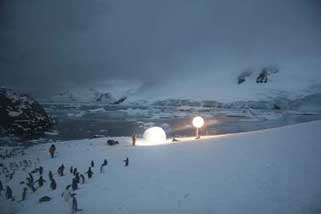
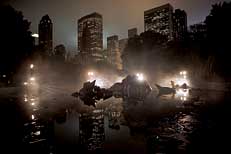
This year's best in show, regardless of medium (and by a large margin at that), was Pierre Huyghe's A Journey That Wasn't (2005), "a travelogue/ fairy tale/ performance of immense beauty and mystery," as it has been described by its Termite Art advocate, R. Emmet Sweeney. A Journey That Wasn't alternates super 16 and HD footage of Antarctica and Central Park's Wollman Rink, where Huyghe staged a performance of his voyage in October 2005, backed by a 42-piece orchestra. The expedition itself centers upon the attempted discovery of a rare albino penguin, which Huyghe's film captures in the closing minutes. I mention this lest any of its spectators missed the penguin's appearance, which I should also mention matters neither to one's assessment of the work's quality nor even to the viewer's experience of the work. The fact is that as a film intended for gallery rather than theatrical exhibition, The Journey That Wasn't is to be (and most certainly will be) viewed in segments that often commence after the film has begun and conclude before the film is over -- in other words as its spectators walk into and out of its exhibition space.

Corresponding to this variation in form, The Journey That Wasn't articulates its content through a frequent repetition of leitmotifs, rather than via a more conventional story arc. Specifically, it is the documentary facts of each, both the topographical details of the spaces and also the spectacle of human -- and animal -- presence. Resulting is a work that both emphasizes the Biennial's stated preoccupation with reflexivity, and more subtly, the texture and tactile cold of the environs. Whereas Huyghe captures the placid black surfaces, floating snow-packed isles and brutal cold of a liquid that barely surpasses 32º F, with a conscienciousness rivaling Flaherty or the recent landscape documentaries of James Benning (13 Lakes and Ten Skies, both 2004), an indeterminacy surrounds his mist-shrouded Central Park reproductions: is it a crisp autumn evening or is it more unseasonnal; and does the water have any discernable cooling effect of its own? In short, the artifical setting lacks the tactile precision of the natural locale. All of this is to say that The Journey That Wasn't utilizes its form to stimulate the sensorial memory of its spectator (in responding to the work's tactility) while asking he or she to consider their experience of viewing the film, which is simulated in the Central Park reproduction; the Whitney spectator, like the Wollman rink participant, views an aesthetic interpretation of an Antarctic expedition.
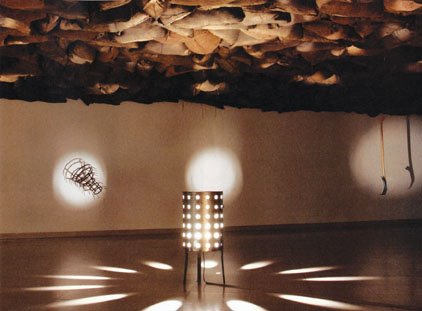
Apart from the moving image, another of the more compelling reconfigurations of form belonged to Urs Fisher, who attached burning candles to a pair of swinging pendulums, thereby charting its invisible path on the floor beneath. (Fisher's sculpture fills a space confined by cut-out walls that similarly annunciate the otherwise unseen.) Likewise, Elaine Sturtevant's reproduction of Marcel
Duchamp's epochal display of "found" objects translates a discrete space through a specific aesthetic idea -- that her feeling for these pieces constitutes as much of an artistic expression as did his -- which nevertheless succumbs to the same cynicism of the original, even if it avoids the joking quality of both Duchamp's instillation and most of the other work contained in Day for Night.
If there is an overarching weakness displayed in this year's biennial, it is that same pestering rash that has inflicted the Western art world since the end of the modernist age: irony. Everything has to have a punch-line. The artist is forever superior to his or her subject. Humility does not exist in postmodern art. Whatever this portends, western art has not been able to find its way since modernism first began to lose its momentum. If nothing else, the Whitney Biennial offers us a glimpse into contemporary art's most celebrated placeholders.
Either way, the inclusion of Francesco Vezzoli's Trailer for a Remake of Gore Vidal's Caligula (2005) speaks to the aesthetic paucity of the Biennial endeavor.

First there is the trailer's credited writer and its namesake, Gore Vidal: before his participation in such unremittingly trashy exercises as Myra Breckinridge (novel) and the aforementioned Caligula (screenplay), Vidal was responsible for some of the greatest dross ever to grace the silver screen -- he penned Suddenly, Last Summer and Ben-Hur in a single inglorious year (1959). Second, there is the fact that a trailer, an advertisement for a film -- albeit for a non-existent remake -- is somehow supposed to constitute noteworthy art. The best trailers either a) tell us what a film is about and/or b) convey the film's mood or a feeling for the film that will c) encourage the spectator to want to see the film. This is their function. A fictitious trailer will continue to do a) and/or b), producing irony when thoughts of c) are broached. Are we really being told that this experience is as important to us as are our traditional inquiries into who we are, where we come from and where we are going, or at least to questions concerning the ontological status of the art -- and no, a flaccid critique of "capitalism" or "media" or what have you does not an engagement of these questions make -- or is it that no one is willing to ask these questions any more? Whichever way you look at, Vezzoli and Vidal's inclusion in the Biennial is troubling.
Fortunately, not all the video art in Day for Night was nearly this inelegant and insubstantial.
This year's best in show, regardless of medium (and by a large margin at that), was Pierre Huyghe's A Journey That Wasn't (2005), "a travelogue/ fairy tale/ performance of immense beauty and mystery," as it has been described by its Termite Art advocate, R. Emmet Sweeney. A Journey That Wasn't alternates super 16 and HD footage of Antarctica and Central Park's Wollman Rink, where Huyghe staged a performance of his voyage in October 2005, backed by a 42-piece orchestra. The expedition itself centers upon the attempted discovery of a rare albino penguin, which Huyghe's film captures in the closing minutes. I mention this lest any of its spectators missed the penguin's appearance, which I should also mention matters neither to one's assessment of the work's quality nor even to the viewer's experience of the work. The fact is that as a film intended for gallery rather than theatrical exhibition, The Journey That Wasn't is to be (and most certainly will be) viewed in segments that often commence after the film has begun and conclude before the film is over -- in other words as its spectators walk into and out of its exhibition space.
Corresponding to this variation in form, The Journey That Wasn't articulates its content through a frequent repetition of leitmotifs, rather than via a more conventional story arc. Specifically, it is the documentary facts of each, both the topographical details of the spaces and also the spectacle of human -- and animal -- presence. Resulting is a work that both emphasizes the Biennial's stated preoccupation with reflexivity, and more subtly, the texture and tactile cold of the environs. Whereas Huyghe captures the placid black surfaces, floating snow-packed isles and brutal cold of a liquid that barely surpasses 32º F, with a conscienciousness rivaling Flaherty or the recent landscape documentaries of James Benning (13 Lakes and Ten Skies, both 2004), an indeterminacy surrounds his mist-shrouded Central Park reproductions: is it a crisp autumn evening or is it more unseasonnal; and does the water have any discernable cooling effect of its own? In short, the artifical setting lacks the tactile precision of the natural locale. All of this is to say that The Journey That Wasn't utilizes its form to stimulate the sensorial memory of its spectator (in responding to the work's tactility) while asking he or she to consider their experience of viewing the film, which is simulated in the Central Park reproduction; the Whitney spectator, like the Wollman rink participant, views an aesthetic interpretation of an Antarctic expedition.
Apart from the moving image, another of the more compelling reconfigurations of form belonged to Urs Fisher, who attached burning candles to a pair of swinging pendulums, thereby charting its invisible path on the floor beneath. (Fisher's sculpture fills a space confined by cut-out walls that similarly annunciate the otherwise unseen.) Likewise, Elaine Sturtevant's reproduction of Marcel
Duchamp's epochal display of "found" objects translates a discrete space through a specific aesthetic idea -- that her feeling for these pieces constitutes as much of an artistic expression as did his -- which nevertheless succumbs to the same cynicism of the original, even if it avoids the joking quality of both Duchamp's instillation and most of the other work contained in Day for Night.If there is an overarching weakness displayed in this year's biennial, it is that same pestering rash that has inflicted the Western art world since the end of the modernist age: irony. Everything has to have a punch-line. The artist is forever superior to his or her subject. Humility does not exist in postmodern art. Whatever this portends, western art has not been able to find its way since modernism first began to lose its momentum. If nothing else, the Whitney Biennial offers us a glimpse into contemporary art's most celebrated placeholders.
Wednesday, May 10, 2006
New Film: United 93
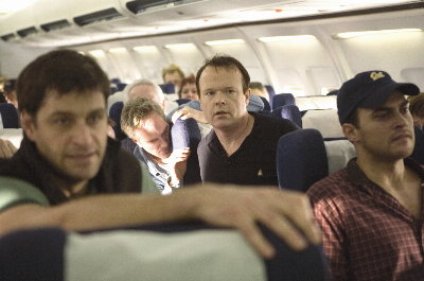
"Let's roll!" Well, actually, "Are you guys ready? Let's roll... come on, let's go!" Herein lies the difference between the film that many people were either dreading or hoping for, and the film that English-born director Paul Greengrass ultimately produced. United 93 is in this way a marvel of understatement, opting whenever possible to downplay the subject's more incendiary facets, while maintaining a plausible correspondence to that day's grave events. Consequently, United 93 more closely resembles a memorial than it does a political tract -- Greengrass commemorates their heroism to the measure that the flight's braver passengers acted beyond their mere survival instincts, in order to prevent their plane from becoming the weapon that 9/11's earlier flights had become. That this might stimulate in the film's audience (myself included) the hope that they might act like these valiant men, should they ever find themselves in a similar situation, does not connote anything resembling propaganda; rather, what is in evidence is an art that elevates the spectator with the awareness of the capacities of human nature. Uplift has always been a part of great art (not to say that Greengrass' film is exactly this). To demand its suppression for fear of its political consequences is to participate in a cause made dubious by its dependence upon withholding facts or encouraging that thoughts and emotions of a certain moment to be forgotten.Of course, the story of United 93 is by no means obscure to most American viewers. Then again, Greengrass attempts to reproduce the events of that day from an epistemological position that none of us shared. Simply put, United 93 puts us inside the plane and air traffic control centers as the events of 9/11 unfold in a facsimile of real-time. This is to say that Greengrass is interested in recreating the experiences of that day, not simply in telling a story, which he further conveys through his hand-held, interventionist camera work that places the spectator in a position inside the action. Greengrass' point in making United 93 is therefore quite clear: to give the viewer a sense of what it might have been like to participate more intimately in the incidences surrounding the hijacking of United flight 93.
What results is a narrative of great fascination that at once communicates the banality of that early Tuesday morning -- the flight 93 travelers on their cell phones holding their stiff coffees, the air traffic controllers nonchalantly preparing for an ordinary, problem-free day (after all the weather, the only x-factor, was perfect) -- as well as the extreme pressures that result once the situation has become clear. For the terrorists, with whom Greengrass begins his film, this exists from the outset; that the director has made this storytelling choice allows even these men to retain a modicum of humanity as they prepare for their inhumane violence. Again, this is a mark of realism, not of propaganda -- in spite of the murder that these men will commit, they must have experienced some nervousness, some doubt (not in their cause, perhaps, but in their ability to complete their mission) before they commenced with the hijacking. Greengrass shows that there is no need to exaggerate either the heroism of the passengers or the villainy of the terrorists; his narrative superbly honors the victims without succumbing to what might be an understandable tendency.
Once more, let us to return to one of the chief objections leveled against United 93: "why now?" After all, the Bush administration is finally being excoriated on the war and his administration's foreign policy in the way that many of his detractors feel is due. Why tempt fate with a film like United 93 if not to serve their interests? Again the response should be abundantly clear: even assuming that position, September, 11, 2001 was one of the most important days in our history, whose impact and memory provides us a key to understanding the world we live in today. And of course, those persons who indeed gave their lives that day -- to his credit, Greengrass allows them to first demonstrate a willingness to overcome their fears and do whatever necessary for the good of their country, before they seem to grasp for their survival in developing a contingent strategy for landing the plane -- deserve our continued remembrances and admiration. September 11th deserves not one but any number of films, given its centrality to American life in this new century, as well as for its verification of both humanity's capacity for evil and for bravery and heroism. Should this spate of movies ever arrive as one would expect it will, United 93 will undoubtedly remain one of their very best.
Tuesday, May 02, 2006
New Film: Water
Warning: the second and third paragraphs contain partial spoilers.
Deepa Mehta's Water (2005), a Canadian-Indian co-production that concludes the director's 'elemental trilogy,' is foremost an object of social protest against the continued practice of child marriage in India, and particularly, the Hindu prohibitions against remarriage placed on widows of any age. Mehta's film, situated during the reform-minded late 1930s, tells the story of Chuyia, a seven-year old widow who is sent off to spend the remainder of her days in a monastery that we later discover is financed by the prostitution of another of its inhabitants, the radiant Kalyani (Lisa Ray).
Like the much younger Chuyia, Kalyani never did meet her husband, but has been nonetheless conscribed to an existence best described as a sort of living death -- the only other options that these women have, we are told, would have been to burn themselves on their husbands' funeral pyres or to marry their brothers-in-law.
The rambunctious pre-pubescent quickly befriends the twenty-something Kalyani, as well as an ancient woman she calls "Auntie," but runs afoul of the shrill mistress Madhumati, whose only companion seems to be Gulabi, the transvestite "eunuch" and pimp who whores out Kalyani. When Madhumati learns of Kalyani's plan to marry the liberal-minded law graduate, Narayan (John Abraham), she chops off the younger woman's hair -- until now, she is the only one who has been allowed to grow her hair long, owning to certain economic imperatives -- and locks her in her room. After being freed by the religiously-conflicted Shakuntala (Seema Biswas), another of Chuyia's early antagonists who will later become one of little girl's chief advocates, Kalyani joins Narayan in preparation for their union. Kalyani's fellow widows celebrate by flinging vibrantly-colored powders (including an incandescent shade of fuchsia) on one another, as the tragedy of their existence seems to have been mitigated by the social reforms championed by progressive political paragon, Mahatma Ghandi.
Yet, the logic of Mehta's social critique does not allow for such a happy resolution. After Kalyani inquires as to whom Narayan's father is, she abruptly ends their engagement. Without providing further spoilers, suffice it to say that Chuyia will be subjected to the same ruinous experience that assured the former's tragic end. The point is that the restoration of the familial structure, long an axiom of the popular Indian cinema, is here denied its currency; such conservatism is disavowed by Mehta's progressive platform.
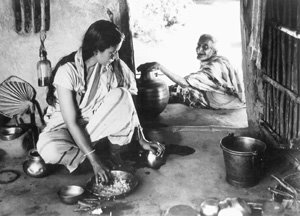
Rhetorically, Water belongs to a tradition whose origins can be traced back to Satyajit Ray's epochal Pather Panchali (1955), which itself challenged India's dominant popular mode by bringing neo-realist social description to a cinema that similarly excluded the use of diegetic song picturization and epic temporal structures. (For instance, Bimal Roy's Do Bigha Zamin [1953] likewise invested its content with a neorealist style, though it maintained Bollywood's musical and epic conventions.)
In the case of Water, however, Bollywood-styled music is still utilized, though not in the typical diegetic manner -- this is to stay that the characters don't themselves sing, though the narrative placement of the numbers and the choices of the singers' voices effectively dictate their emotions. As such, a perfunctory realism is maintained, while the conventions of Bollywood cinema are referenced (and revised).
Likewise present are a variety of Indian character types, which find rather direct correspondences in Ray's corpus. There is the Bengali archetype of the urbane, well-educated, liberal-minded son who returns to the countryside (cf. The World of Apu, 1959); his friend, the lazy descendent of aristocracy who embraces Western mores (cf. The Chess Player, 1977); the rascally, toothless old woman (Auntie) who befriends Chuyia (cf. Pather Panchali); and of course, there is the head-strong, if somewhat mischievous child protagonist, whose perspective guides the narrative -- all the way down to the camera's insistence eye-level framing (again cf. Pather Panchali, and particularly Apu's sister).
In fact, Mehta's connection to Ray's feature debut is made even more explicit by the opening compositions of a lily pad-covered marsh, which while imitating the master's indelible black-and-white photography of the corporeal world, nonetheless incorporate an extreme over-saturation of color that is all her own. Moreover, if Ray's exposition of natural beauty serves to underscore the director's ideas concerning human transience, his latter-day counterpart's co-option of this schema indicates nothing so much as an aesthetic preference and an awareness of its position within the history of Indian counter-cinema. Nevertheless, the visual grace of Water nearly matches the Ray: consider for instance the images depicting the couple beneath the giant hardwood on the banks of the river, with its powerful bleached white light pouring through the tree's tangled branches.
Indeed, Mehta's is a work unapologetically grounded in the concerns and the immediacy of this life. In this manner, the film's greatest provocation is its challenge to the wisdom of a religion that could countenance such a deplorable tradition. While, the evils of child marriage remain a distant -- and obvious -- transgression for any Western audience member, the film's inversion of the equation "God is truth" to read "Truth is god" could be counted as a rebuke to any theistic faith. In this way, the hyperbole of the melodrama -- make no mistake, Water is propaganda -- and its apparent distance from Western practices, becomes less safe than it would at once appear. Still, this is a film whose potency remains twined to one's feelings concerning the evils of child marriage and the Hindu religion's traditional prohibitions on remarriage. That Water is therfore the ultimate middle-brow art house spectacle -- one can feel bad about what is presented on-screen without ever being accused of complicity -- should not mitigate its very real power.
Deepa Mehta's Water (2005), a Canadian-Indian co-production that concludes the director's 'elemental trilogy,' is foremost an object of social protest against the continued practice of child marriage in India, and particularly, the Hindu prohibitions against remarriage placed on widows of any age. Mehta's film, situated during the reform-minded late 1930s, tells the story of Chuyia, a seven-year old widow who is sent off to spend the remainder of her days in a monastery that we later discover is financed by the prostitution of another of its inhabitants, the radiant Kalyani (Lisa Ray).
Like the much younger Chuyia, Kalyani never did meet her husband, but has been nonetheless conscribed to an existence best described as a sort of living death -- the only other options that these women have, we are told, would have been to burn themselves on their husbands' funeral pyres or to marry their brothers-in-law.The rambunctious pre-pubescent quickly befriends the twenty-something Kalyani, as well as an ancient woman she calls "Auntie," but runs afoul of the shrill mistress Madhumati, whose only companion seems to be Gulabi, the transvestite "eunuch" and pimp who whores out Kalyani. When Madhumati learns of Kalyani's plan to marry the liberal-minded law graduate, Narayan (John Abraham), she chops off the younger woman's hair -- until now, she is the only one who has been allowed to grow her hair long, owning to certain economic imperatives -- and locks her in her room. After being freed by the religiously-conflicted Shakuntala (Seema Biswas), another of Chuyia's early antagonists who will later become one of little girl's chief advocates, Kalyani joins Narayan in preparation for their union. Kalyani's fellow widows celebrate by flinging vibrantly-colored powders (including an incandescent shade of fuchsia) on one another, as the tragedy of their existence seems to have been mitigated by the social reforms championed by progressive political paragon, Mahatma Ghandi.
Yet, the logic of Mehta's social critique does not allow for such a happy resolution. After Kalyani inquires as to whom Narayan's father is, she abruptly ends their engagement. Without providing further spoilers, suffice it to say that Chuyia will be subjected to the same ruinous experience that assured the former's tragic end. The point is that the restoration of the familial structure, long an axiom of the popular Indian cinema, is here denied its currency; such conservatism is disavowed by Mehta's progressive platform.Rhetorically, Water belongs to a tradition whose origins can be traced back to Satyajit Ray's epochal Pather Panchali (1955), which itself challenged India's dominant popular mode by bringing neo-realist social description to a cinema that similarly excluded the use of diegetic song picturization and epic temporal structures. (For instance, Bimal Roy's Do Bigha Zamin [1953] likewise invested its content with a neorealist style, though it maintained Bollywood's musical and epic conventions.)
In the case of Water, however, Bollywood-styled music is still utilized, though not in the typical diegetic manner -- this is to stay that the characters don't themselves sing, though the narrative placement of the numbers and the choices of the singers' voices effectively dictate their emotions. As such, a perfunctory realism is maintained, while the conventions of Bollywood cinema are referenced (and revised).Likewise present are a variety of Indian character types, which find rather direct correspondences in Ray's corpus. There is the Bengali archetype of the urbane, well-educated, liberal-minded son who returns to the countryside (cf. The World of Apu, 1959); his friend, the lazy descendent of aristocracy who embraces Western mores (cf. The Chess Player, 1977); the rascally, toothless old woman (Auntie) who befriends Chuyia (cf. Pather Panchali); and of course, there is the head-strong, if somewhat mischievous child protagonist, whose perspective guides the narrative -- all the way down to the camera's insistence eye-level framing (again cf. Pather Panchali, and particularly Apu's sister).
In fact, Mehta's connection to Ray's feature debut is made even more explicit by the opening compositions of a lily pad-covered marsh, which while imitating the master's indelible black-and-white photography of the corporeal world, nonetheless incorporate an extreme over-saturation of color that is all her own. Moreover, if Ray's exposition of natural beauty serves to underscore the director's ideas concerning human transience, his latter-day counterpart's co-option of this schema indicates nothing so much as an aesthetic preference and an awareness of its position within the history of Indian counter-cinema. Nevertheless, the visual grace of Water nearly matches the Ray: consider for instance the images depicting the couple beneath the giant hardwood on the banks of the river, with its powerful bleached white light pouring through the tree's tangled branches. Indeed, Mehta's is a work unapologetically grounded in the concerns and the immediacy of this life. In this manner, the film's greatest provocation is its challenge to the wisdom of a religion that could countenance such a deplorable tradition. While, the evils of child marriage remain a distant -- and obvious -- transgression for any Western audience member, the film's inversion of the equation "God is truth" to read "Truth is god" could be counted as a rebuke to any theistic faith. In this way, the hyperbole of the melodrama -- make no mistake, Water is propaganda -- and its apparent distance from Western practices, becomes less safe than it would at once appear. Still, this is a film whose potency remains twined to one's feelings concerning the evils of child marriage and the Hindu religion's traditional prohibitions on remarriage. That Water is therfore the ultimate middle-brow art house spectacle -- one can feel bad about what is presented on-screen without ever being accused of complicity -- should not mitigate its very real power.
Monday, April 10, 2006
New Film: Magic Mirror & A Comedy of Power

Warning: the following contains spoilers in the fourth paragraph.
96 year-old Portuguese auteur Manoel de Oliveira -- that really says it all doesn't it -- is the world's oldest active filmmaker and is the only director to begin his career during the silent era. Oliveira has been particularly active since the mid-1970s, having made approximately one film per year in the period since. Yet, what is more remarkable than the director's age or even his late-career productivity is the consistent high quality of his work: no European filmmaker has made more great films in the past fifteen years than Oliveira (and were not such a large number of his films from the 1980s still unavailable, one could perhaps push that date back even further). For arguments sake, one could name Abraham's Valley (1993), The Convent (1995), Party (1996), Voyage to the Beginning of the World (1997), The Letter (1999), I'm Going Home (2001) and A Talking Picture (2003), and one would have one of the world's most autobiographical and formally adventurous cinemas without even naming such agreed upon masterpieces as No, or the Vainglory of Command (1990), Inquietude (1998) and The Uncertainty Principle (2002), which like the earlier films, remain unavailable to US audiences.

Oliveira's latest feature, Magic Mirror (Espelho Magico, 2005) -- if one doesn't count the picture he is currently shooting with Bulle Ogier and Michel Piccoli -- has likewise not yet secured US distribution, and may remain without a distributor into the immediate future. For one, Oliveira hardly rates as a household name, despite the brilliance of his body of work; and two, the Portuguese master remains one of the international art house scene's most challenging auteurs.
Magic Mirror continues many of the master's long-held formal and thematic preoccupations: namely, mortality, the relationship between film and theatre and the moral status of wealth. Similarly, Oliveira utilizes the gorgeous Leonor Silveira (a mere 60 years his younger) as a proxy for his person, just as he did with his supreme achievement of the past decade-and-a-half, Abraham's Valley. In this case, Silveira plays the devout Alfreda, whose childlessness compels her to fantasize about seeing the Virgin Mother, particularly after she is told that Mary was the product of a wealthy family: she too was born into enormous wealth (as was Oliveira himself), and hopes above all else to talk to the woman, presumably in hopes of unlocking the mysteries of both the Christ child's miraculous birth and also the Judean woman's relative fortune -- thereby settling the issue of the wealthy's difficult path to salvation that one finds in Christian doctrine.

Significantly, Alfreda never finds the answers she seeks, just as one might suspect Oliveira himself has not found sufficient answers to the questions of God's existence (The Convent and Party seem to treat this subject most directly; and in a similar fashion, one might see Ricardo Trepa's freed criminal and his prison companion as exemplars of a protest theodicy of sorts, particularly with the latter's instance that he is animated by hate) and second, to means by which he might reconcile his social position and the social imperatives of his art -- again Abraham's Valley is the finest treatment of this subject. Still, Oliveira does happen to save one unprecedented moment of genuine magic for the end: the narrative continues after Alfreda passes on, without the answers, compellingly giving us Oliveira's own conceptualization of life after his own death. Here, we see a newly-minted couple, a smiling young child and the continuation of the estate (that houses much of the drama) accompanied by the joyous lilt of the score. Life continues, unabated, in all its richness.
In this concluding passage, Oliveira offers what could have been a wonderful epithet to his career -- just as I'm Going Home could have been one of the most profound final films ever made -- were he not already at work on something new. Whether this film rates with the others listed above (it most likely does not, though it is by no means minor within the context of European art cinema) the fact that we still have Oliveira and that he is still as prolific as ever is itself cause for celebration.

Also without US distribution at present, is the latest from French New Wave auteur Claude Chabrol, A Comedy of Power (L'Ivresse du pouvoir). While Chabrol is more known in the broader culture and film world as a whole, the quality of his work is far less consistent than is Oliveira's. The French director's latest effort is middling to be sure, even if it begins with an absolutely brilliant opening sequence: in one unbroken take, Chabrol follows a corporate criminal from the heights of his suburban Paris office to the street where he is apprehended and charged with defrauding shareholders. From this bravura opening shot, Chabrol establishes a spatial logic that he maintains for much of the film -- namely that power relationships are established in terms of distance from the ground. The film's conspiring CEO's occupy the upper floors of glass and steel behemoths, while the film's crusading magistrate, Isabella Huppert, operates far closer to ground level. Of course, the point is to get the big-wigs out of their towers, just as it is for Huppert to herself ascend. Conflict, on the other hand, is the result of shared heights, such as Huppert and her cause-weary husband, as well as with the fellow female magistrate next to whom they (the conspiring Gaullist power-brokers -- very much Lang territory -- that is) place Huppert, in the hope that they will take each other down.
Together, these threads suggest a narrative critical of bourgeois greed and the will to destroy those with money -- an interesting critique by a director like Chabrol in a nation like France, certainly. However, Chabrol's narrative soon loses the focus of its first part, en route to one of the least satisfying endings of the director's recent career, which is doubly disappointing considering that the spatial logic is for time, the most rigorous of any of Chabrol's films since Le Boucher (1970). Yet even in this system, Chabrol doesn't complete the promise of what at first appears to be genuine mastery.
Sunday, April 09, 2006
New Film: The Sun
Aleksandr Sokurov's The Sun (Solntse, 2005) is the third chapter in a tetralogy, for which Moloch (1999) and Taurus (2001) were the first two parts. Like these, The Sun treats the subject of a 20th century dictator -- or "hero" -- who "suffers a personal tragedy" (Islands of Sokurov). In the case of The Sun, Sokurov depicts Emperor Hirohito in the final days of the War, while he is awaiting the fate to be handed down to him by the "occupying forces." Sokurov's episodic narrative includes a conference of the Emperor's cabinet, Hirohito's study of marine biology, two of his meetings with General MacArthur, a photo-op with the Allied forces, a sit-down with a biologist and a reunion with his family. While their temporal relationship to one another is imprecise (and unimportant) the basic arc of the narrative suggests one day with the dimly-lit, misty morning giving way to a sunny afternoon and then to the pale light of evening: these transmogrifications portend the drift from the nebulous opening moments with the Deity cocooned in his palace to the sun-diffused, white light and candle-lit distinction of his meetings with MacArthur where he agrees to renounce his divinity.
Yet, to even make this claim for The Sun is to participate in the sort of analysis that a work as impressionistic as Sokurov's would (almost) seem to resist. Almost, as Sokurov's hieratic shot-reverse structure -- frequent transgressions of the 180 degree rule -- discloses his interest in preserving the spatial disorientation that his eschewal of establishing shots effects. The idea is that we never really know the spaces of the Imperial Palace, as if the narrative were remembered, dictated from a point in the future; at the same time, The Sun offers an imprint of that evanescent moment existing immediately prior to Hirohito's end -- immediately before and after the dictator renounced his divinity (and suggestively, before his final fate). It is a refashioning of Mother and Son's subject, as it is of Russian Ark's interest in preserving a disappearing culture (and even of Dolce's articulation of Eastern visual aesthetics).

All of this is to say that The Sun coalesces a number of Sokurov's preoccupations -- it could even be described as a signature. Then again, the seriousness of much of Sokurov's work is absent in The Sun, in spite of its ostensible subject: there is the old servant who lusts after the Hershey bar, to say nothing of the dictator's peculiar gestures. Indeed, it is in these actions, strange and banal alike, that Sokurov conveys the humanity of his subject (much like as he does with Hitler in Moloch). Ultimately, this can be said to be the director's purpose, namely to tactilely lend presence (and humanity ) to the person of Hirohito, as when we see the Emperor sliding on his slippers, smelling his breath in his hands -- there exists an effervescent quality to this gesture which could be said to summarize his entire aesthetic: as with Whispering Pages he reproduces the impression of a place and time that is as fleeting as the enveloping mists that descend upon the island nation -- or when we see his mouth forming words which never pass through his lips.
This brings us to another key feature of Sokurov's inimitable style: namely, the sometime absence of naturalistic synchronicity between sound and image. But even more, it is the soundtrack's discordance, such as the scrambled radio transmissions or even the crickets' chirping, that offer an often menacing oral counterpoint to the narrative's quotidian incidents. In the end, of course, this is a film about a man meeting his fate, though it almost goes without saying that something of this dramatic register will not appear on screen.
Qualitatively, it could (and should) be argued that Sokurov is working on an entirely different plane than virtually anyone else in cinema today, and that The Sun rates as one of his most accomplished idiosyncrasies. It is the ultimate Sokurov film, far more so than his international art house breakthrough, Russian Ark, both for its instantiation of such a large number of his key themes and also for its attempted recreation of the profoundly transitory -- the life of a God in a disappearing world. In closing, I would also wish to praise Issei Ogata's brilliant recreation of this living deity, which no less than animates Sokurov's glorious work of art.
Yet, to even make this claim for The Sun is to participate in the sort of analysis that a work as impressionistic as Sokurov's would (almost) seem to resist. Almost, as Sokurov's hieratic shot-reverse structure -- frequent transgressions of the 180 degree rule -- discloses his interest in preserving the spatial disorientation that his eschewal of establishing shots effects. The idea is that we never really know the spaces of the Imperial Palace, as if the narrative were remembered, dictated from a point in the future; at the same time, The Sun offers an imprint of that evanescent moment existing immediately prior to Hirohito's end -- immediately before and after the dictator renounced his divinity (and suggestively, before his final fate). It is a refashioning of Mother and Son's subject, as it is of Russian Ark's interest in preserving a disappearing culture (and even of Dolce's articulation of Eastern visual aesthetics).

All of this is to say that The Sun coalesces a number of Sokurov's preoccupations -- it could even be described as a signature. Then again, the seriousness of much of Sokurov's work is absent in The Sun, in spite of its ostensible subject: there is the old servant who lusts after the Hershey bar, to say nothing of the dictator's peculiar gestures. Indeed, it is in these actions, strange and banal alike, that Sokurov conveys the humanity of his subject (much like as he does with Hitler in Moloch). Ultimately, this can be said to be the director's purpose, namely to tactilely lend presence (and humanity ) to the person of Hirohito, as when we see the Emperor sliding on his slippers, smelling his breath in his hands -- there exists an effervescent quality to this gesture which could be said to summarize his entire aesthetic: as with Whispering Pages he reproduces the impression of a place and time that is as fleeting as the enveloping mists that descend upon the island nation -- or when we see his mouth forming words which never pass through his lips.
This brings us to another key feature of Sokurov's inimitable style: namely, the sometime absence of naturalistic synchronicity between sound and image. But even more, it is the soundtrack's discordance, such as the scrambled radio transmissions or even the crickets' chirping, that offer an often menacing oral counterpoint to the narrative's quotidian incidents. In the end, of course, this is a film about a man meeting his fate, though it almost goes without saying that something of this dramatic register will not appear on screen.
Qualitatively, it could (and should) be argued that Sokurov is working on an entirely different plane than virtually anyone else in cinema today, and that The Sun rates as one of his most accomplished idiosyncrasies. It is the ultimate Sokurov film, far more so than his international art house breakthrough, Russian Ark, both for its instantiation of such a large number of his key themes and also for its attempted recreation of the profoundly transitory -- the life of a God in a disappearing world. In closing, I would also wish to praise Issei Ogata's brilliant recreation of this living deity, which no less than animates Sokurov's glorious work of art.
Thursday, April 06, 2006
New Music: Ringleader of the Tormentors
Two years ago, in a year flush with comebacks, none loomed larger than Morrissey's. While Prince and others may have sold more records overall -- though Mozzer's superlative You Are the Quarry did manage to debut at #11 in the US, the highest of his career -- it was Morrissey who was re-established as a cultural paragon. And not just for YATQ (abbreviations of this sort are code amongst his legions of fans) but for the influence that his solo career, and that of his former outfit, The Smiths, cast over a new generation of Brit pop and its North American equivalents. Virtually every new artist of the moment, from Franz Ferdinand to The Libertines to The Killers, not only acknowledged the Mozzer's influence, but were at pains to elevate him to the status of mentor and icon. 2004 was the year of Morrissey, with tomes like Saint Morrissey and the second edition (!) of Songs that Saved Your Life, to go along with the countless cover stories and magazine spreads that greeted the return of a man who was not so long ago the least fashionable person in alternative music -- so much so that the had gone seven years without a record contract, in spite of the fact that he still (I believe) holds the distinction of selling out Madison Square Garden faster than anyone else in its history, and in spite of the fact that in 2003, the world's biggest-selling music weekly, NME, named solo Moz and The Smiths the "most influential" artists in pop music history, controversially above even The Beatles. (If you've been following British music since their demise, this opinion may not sound quite as absurd as it may to those who haven't; depending on how highly one rates The Stone Roses, Radiohead, Oasis, The Strokes, Arctic Monkeys and even Andre 3000 and Interpol, one could make the case.)
All of this is to say that this past Tuesday's release of Ringleader of the Tormentors finds its creator at the peak of his vogue, with expectations to match such a lofty reputation. For those of us who found in his most recent success vindication (my self included) there comes with the obvious anticipation for the new album, a feeling of anxiety and even dread -- will it be ordinary enough to push Morrissey back to his Southpaw Grammar-Maladjusted-phase of reduced stature. You see, in Morrissey we start to glimpse what could have been, an alternative music history, a possible world where The Smiths were as big as The Beatles and where all other musical injustices have been righted. Yes, we see this in Morrissey, whose graceful transition into middle age (both physically, and more importantly, vocally) reminds one of no one so much as Frank Sinatra.

Like Nancy's dad, Mozzer's solo work can't exactly be said to challenge our sonic assumptions -- even his much-heralded YATQ sounded very old fashion, when compared to the other best records of its year. Yet to even make this observation is to miss the point when it comes to Moz; no, the point is that Morrissey has always challenged our assumptions about popular music when it comes to content, as always delivered with an unprecedented immediacy for popular music, whether it is in tandem with Johnny Marr's brilliant, and often quite unconventional song-writing for The Smiths, or with his less vanguard solo career. Morrissey is always Morrissey, a genre unto himself, a popular music of the utmost literary pedigree and one in which rock's fundamental presuppositions are questioned: the sex, drugs and rock-and-roll lifestyle has always been anathema to rock's best-known celibate straight-edger. For Morrissey, however, it's never been about morality, but rather about discontent -- his is the only truly punk corpus; Morrissey hates everything.
Well, while, this might be an exaggeration, Morrissey's aesthetic and his content are as always essential to an understanding of his latest instantiation of his own personal genre. Ringleader of the Tormentors finds the "Pope of Mope" on the heels of both unmitigated success and in a change of scenery: the Los Angeles transplant (remember: "we look to Los Angeles for the words that we use, London is dead") has relocated to the Eternal City, Rome. From the strong opening track, "I Will See You in Far Off Places," a change is evident, with its Oriental themes and instrumentation. Then again, as with YATQ's "America is Not the World," Morrissey opens with a confrontation of US foreign policy. Yet, whereas Mozzer concludes the earlier opener with the strangely touching repetition of the line "I love you" over and over (referring to his adopted homeland), here he seems to be addressing some anonymous one outside the US, perhaps Muslim, as he says "if your God bestows protection upon you... and if the USA doesn't bomb you... I believe I will see you."
Of course the "one" in ROTT is ambiguous and open to slippage, as is the addressee, interestingly (though not unprecedentedly -- his masterpiece "I Know it's Over" makes very good use of this): perhaps the most interesting instance of the latter being teh similarly exceptional "Dear God Please Help Me," track 2, where he sings "Then he motions to me... with his hand on my knee... dear God did this kind of thing happen to you?" At once imploring God and seemingly addressing a confident, Morrissey shows himself as always to be adept with double meanings -- though we must remember anything is possible with this forgiver of Jesus.
As far as his sexuality is concerned, the always elusive Morrissey – is he gay, straight, bi-sexual, a-sexual? -- leaves some pretty compelling clues on the excellent mid-tempo third track, "You Have Killed Me": "Pasolini is me..., Visconti is me..." Indeed, by name checking Italy's two most famous homosexual directors (with complications, importantly -- though the latter could be his producer as well) perhaps we can finally lay to rest the speculation; evidently, Morrissey himself has even admitted to recently breaking his long-held practice of celibacy, to say nothing of his rumored spottings at gay night-spots.

Musically, the following track, "The Youngest Was the Most Loved," with its refrain, "there is no such thing in life as normal," rates as a highlight and instantly establishes itself as Morrissey classic, particularly for its children's chorus repeating the above line, though it is by no means one of his lyrical masterpieces. In fact, ROTT gets off to a rather remarkable start musically, continuing into the proceeding, up-tempo, "In the Future When All is Well."
After the forgettable sound of "The Father Who Must Be Killed," a stilting mid-tempo number, Morrissey offers another essential track, "Life is a Pigsty," which displays Tony Visconti's lush productions at their richest. (In placing the track in the center of the album, Morrissey uses a strategy similar to the construction of his solo debut, Viva Hate [1988], where "Late Night, Maudlin Street" serves a smiliar function.) Of course, it is not simply this track's aural terrain, but the repeated lyric "even now, in my final hour of my life... I'm falling in love again," which establishes its importance to ROTT -- has he found someone, is he referring to Rome, etc.?
Then, demonstrating the intelligence of ROTT's track sequence, Morrissey tells us "his one true love is under ground": now, is he talking about The Smiths and his partnership with Marr or a friend or lover of the type that Mark Simpson, in Saint Morrissey, claimed prompted his masterpiece Vauxhall and I (1994)? Musically, this track, "I'll Never Be Anybody's Hero Now," another strong entry, operates in the "I Am Two Persons" mold.
In the subsequent four tracks, the highlight would seem to be #10, "To Me You Are a Work of Art," a torch-song with the Morrissey difference: you see, he would give you his heart, if he had one. More than any other song on the album -- with the exception of his first single, the uber-catchy "You Have Killed Me" -- it is easy to imagine Morrissey performing it live, which at this point is what it's all about. Not so much seeing Moz in the flesh, though there are few who are any better, but having Morrissey in the flesh, whatever he decides to do with it. Besides, we feel he has already given us his heart -- nobody has laid his thoughts and feelings so bare in their art as has Morrissey from "Hand in Glove" onward.
All of this is to say that this past Tuesday's release of Ringleader of the Tormentors finds its creator at the peak of his vogue, with expectations to match such a lofty reputation. For those of us who found in his most recent success vindication (my self included) there comes with the obvious anticipation for the new album, a feeling of anxiety and even dread -- will it be ordinary enough to push Morrissey back to his Southpaw Grammar-Maladjusted-phase of reduced stature. You see, in Morrissey we start to glimpse what could have been, an alternative music history, a possible world where The Smiths were as big as The Beatles and where all other musical injustices have been righted. Yes, we see this in Morrissey, whose graceful transition into middle age (both physically, and more importantly, vocally) reminds one of no one so much as Frank Sinatra.

Like Nancy's dad, Mozzer's solo work can't exactly be said to challenge our sonic assumptions -- even his much-heralded YATQ sounded very old fashion, when compared to the other best records of its year. Yet to even make this observation is to miss the point when it comes to Moz; no, the point is that Morrissey has always challenged our assumptions about popular music when it comes to content, as always delivered with an unprecedented immediacy for popular music, whether it is in tandem with Johnny Marr's brilliant, and often quite unconventional song-writing for The Smiths, or with his less vanguard solo career. Morrissey is always Morrissey, a genre unto himself, a popular music of the utmost literary pedigree and one in which rock's fundamental presuppositions are questioned: the sex, drugs and rock-and-roll lifestyle has always been anathema to rock's best-known celibate straight-edger. For Morrissey, however, it's never been about morality, but rather about discontent -- his is the only truly punk corpus; Morrissey hates everything.
Well, while, this might be an exaggeration, Morrissey's aesthetic and his content are as always essential to an understanding of his latest instantiation of his own personal genre. Ringleader of the Tormentors finds the "Pope of Mope" on the heels of both unmitigated success and in a change of scenery: the Los Angeles transplant (remember: "we look to Los Angeles for the words that we use, London is dead") has relocated to the Eternal City, Rome. From the strong opening track, "I Will See You in Far Off Places," a change is evident, with its Oriental themes and instrumentation. Then again, as with YATQ's "America is Not the World," Morrissey opens with a confrontation of US foreign policy. Yet, whereas Mozzer concludes the earlier opener with the strangely touching repetition of the line "I love you" over and over (referring to his adopted homeland), here he seems to be addressing some anonymous one outside the US, perhaps Muslim, as he says "if your God bestows protection upon you... and if the USA doesn't bomb you... I believe I will see you."
Of course the "one" in ROTT is ambiguous and open to slippage, as is the addressee, interestingly (though not unprecedentedly -- his masterpiece "I Know it's Over" makes very good use of this): perhaps the most interesting instance of the latter being teh similarly exceptional "Dear God Please Help Me," track 2, where he sings "Then he motions to me... with his hand on my knee... dear God did this kind of thing happen to you?" At once imploring God and seemingly addressing a confident, Morrissey shows himself as always to be adept with double meanings -- though we must remember anything is possible with this forgiver of Jesus.
As far as his sexuality is concerned, the always elusive Morrissey – is he gay, straight, bi-sexual, a-sexual? -- leaves some pretty compelling clues on the excellent mid-tempo third track, "You Have Killed Me": "Pasolini is me..., Visconti is me..." Indeed, by name checking Italy's two most famous homosexual directors (with complications, importantly -- though the latter could be his producer as well) perhaps we can finally lay to rest the speculation; evidently, Morrissey himself has even admitted to recently breaking his long-held practice of celibacy, to say nothing of his rumored spottings at gay night-spots.

Musically, the following track, "The Youngest Was the Most Loved," with its refrain, "there is no such thing in life as normal," rates as a highlight and instantly establishes itself as Morrissey classic, particularly for its children's chorus repeating the above line, though it is by no means one of his lyrical masterpieces. In fact, ROTT gets off to a rather remarkable start musically, continuing into the proceeding, up-tempo, "In the Future When All is Well."
After the forgettable sound of "The Father Who Must Be Killed," a stilting mid-tempo number, Morrissey offers another essential track, "Life is a Pigsty," which displays Tony Visconti's lush productions at their richest. (In placing the track in the center of the album, Morrissey uses a strategy similar to the construction of his solo debut, Viva Hate [1988], where "Late Night, Maudlin Street" serves a smiliar function.) Of course, it is not simply this track's aural terrain, but the repeated lyric "even now, in my final hour of my life... I'm falling in love again," which establishes its importance to ROTT -- has he found someone, is he referring to Rome, etc.?
Then, demonstrating the intelligence of ROTT's track sequence, Morrissey tells us "his one true love is under ground": now, is he talking about The Smiths and his partnership with Marr or a friend or lover of the type that Mark Simpson, in Saint Morrissey, claimed prompted his masterpiece Vauxhall and I (1994)? Musically, this track, "I'll Never Be Anybody's Hero Now," another strong entry, operates in the "I Am Two Persons" mold.
In the subsequent four tracks, the highlight would seem to be #10, "To Me You Are a Work of Art," a torch-song with the Morrissey difference: you see, he would give you his heart, if he had one. More than any other song on the album -- with the exception of his first single, the uber-catchy "You Have Killed Me" -- it is easy to imagine Morrissey performing it live, which at this point is what it's all about. Not so much seeing Moz in the flesh, though there are few who are any better, but having Morrissey in the flesh, whatever he decides to do with it. Besides, we feel he has already given us his heart -- nobody has laid his thoughts and feelings so bare in their art as has Morrissey from "Hand in Glove" onward.
Monday, March 27, 2006
New Film: Inside Man
Or, How I Learned to Stop Worrying and Love (no, not love; let's say like or even like a lot, if we must) Spike Lee.
It is interesting that Inside Man represents one of those archetypical instances of a director, seemingly under contract for a fairly straight exercise in genre, which might as well have been crafted for him or her in advance. Then again, it is precisely in these sorts of works that the merits of the auteur theory become clearest: it is, after all, a theory that defines the status of the director as an artist, not simply an advocation of autobiographical filmmaking. And there can be no denying Lee's imprint on Inside Man, in spite of the fact that it may well be one of the director's least personal pictures.
At the level of technique, Lee's stylistic elan is apparent from the opening shot: Clive Owen's bank robber addresses the camera, telling us his name, profession and location (a cell, though significantly, not a prison cell). The director proceeds to adopt Hitchcock's technique -- from Vertigo -- wherein a tracking shot is accompanined by a zoom. The effect (also used spectacularly by Scorsese in Goodfellas' diner scene) brings us closer to the character, even as the space behind the figure is reconstituted. It is, in other words, a signifier of a baroque style, as is for instance Lee's frontal tracking shot, in which Denzel Washington's fluid movement seems to suggest that he is standing on top a scooter or cart of some sort. These moments of excess, within the broader framework of generally terse direction, indicate the same flamboyant stylist who translated the American baroque of Welles and Scorsese to Brooklyn's Bed-Stuy neighborhood in his exceptional Do the Right Thing (1989).

Yet, it is that terseness, the film's economy, which truly recommends Inside Man. Much of this quality can be attributed to Russell Gewirtz's exceptional screenplay, though even in the film's dialogue Lee's voice is unmistakable -- particularly in the race-baiting that has been transformed from politically-militant axiom to politically-correct satire. Indeed, Lee's rhetoric seems to be in the process of softening, especially since his 2002 standout, 25th Hour, which encapsulates America's post-9/11 feeling that "we are all New Yorkers" better than any other film I know. Inside Man shares with that earlier pinnacle an ethnographic description of five boroughs life, as well as its referencing of incarcaration (though it stops short of making fear of anal rape a structuring motif, as is the case with 25th Hour, which itself might just portend the director's willingness to bait groups other than racial or ethnic in their orientation; here, Washington is allowed a single quip).
Returning for the moment to the narrative structure, Lee and Gerwitz encourage us to hope that Owen can get away with his crime -- a large portion of the heist genre's pleasures, after all, pertain to the intelligence and dexterity of the crimes committed; and from the opening monologue, Lee affirms his position within this tradition. It helps that Lee skillfully discloses and conceals many of the details of the caper, creating objects of suspense beyond the simple will they or won't they get away with it axiom. One of the best early examples of this is Lee's refusal to re-enter the space of the bank after being introduced to Washington's negotiator, for an extended duration. While we already know the anti-heroes, we are little more cued into what the protagonist is facing at this moment than he is himself. In this way, Lee shows himself to be a bravura manipulator of narrative information, as he will throughout the remainder of the film. I'm tempted to make a comparison to Bryan Singer's modern classic, The Usual Suspects (1995), though I would do so only with the caveat that Lee's twists don't entirely reach for that same epistemological vertigo.
Friday, March 10, 2006
New Film: Battle in Heaven & Old Joy
Carlos Reygadas' Battle in Heaven (Batalla en el cielo, 2005) opens and closes with a comely young light-skinned Mexican woman performing fellatio on an obese, unattractive, middle-aged mestizo gentleman, whom we later discover has been the girl's driver since childhood. That Reygadas would choose to begin his film with so graphic an image surely underscores his desire to incite. Then again, it quickly becomes evident that this selection does not serve as mere provocation alone, but rather provides a formal matrix through which the remainder of his film can be understood. Moreover, that he likewise concludes his film in this same fashion allows the director to crystallize the film's principle discourses, namely of cinematic representation, class conflict and religious belief. And all in a blow-job.
Following the shocking opener, Reygadas introduces us to his hero Marcos, whom we soon learn -- in an almost off-handed off-camera revelation -- has just been involved in the kidnapping of a baby who tragically died during the affair. This point, however, garners far less narrative time than the fellatio or than Reygadas' seemingly ethnographic interest in the Mexico City subway tunnels where Marcos' wife sells her wares.
However, it is not a third-world tourist impulse that animates Reygadas in so precisely detailing the latter, but it is rather social commentary, particularly when Marcos' subsequent experiences are compared to those of his female employer, Ana, as he drives the young woman home from the airport, through the tree-lined boulevards of her leafy suburb. Importantly, Reygadas lingers on both the public space of the metro system and the private space of the automobile to convey the sense in which the dead time for the country's working poor is characteristically chaotic, whereas comfort defines these moments for the rich.
In a telling moment of social incongruity, Ana asks Marcos a question and then quickly interrupts him once her boyfriend is free again to speak with her on her cell phone. Yet, if Ana does treat Marcos as an employee who is of less importance than even the most trivial incidents in her own life, she does seem to maintain a certain fondness for and trust in Marcos, whom she asks to take her to a brothel where evidently she works in secret. There, Marcos, refuses the pleasures of a young prostitute insisting that Ana forced him to come. Ana then interrogates Marcos about his feelings for her, but drops it when it becomes clear how he feels.
At this point, the opening salvo increasingly looks as if it may exist outside the time of the film narrative altogether, be it as a representation of his fantasy, or more compellingly, as a purveyor of formal and social meaning, at once illuminating Reygadas' post-Kiarostami tendency to constrict the visual field while creating an expansive aural space, even as his lowly mestizo character is pleasured by a woman of higher social standing whom we assume would never do something like this in real life. In other words, Reygadas uses his fellatio as a socially-leveling device. There is indeed something intriguing to this latter reading, even if Reygadas does have the pair engage in intercourse later in the film. Then again, this simulated sexual act is presented on screen in long take, whereas Reygadas masks this same activity between Marcos and his equally unattractive wife.
Speaking of this latter sex act, when it concludes, Reygadas moves his camera to disclose an image of Christ over the couple's bed, even as their heavy-breathing continues. This apparent visual joke, far from a throw away, in fact distills a key component of the director's vision: the idea of ecstasy (as in Bernini's St. Theresa). Following the pilgrimage that Marcos ultimately joins, seemingly in a desperate search for forgiveness, Reygadas closes his film with the second fellatio scene, which in this case shows Marcos grinning for the first time and hovering over Ana in a position of power. As such, Reygadas conflates the transcendence inherent in both religious devotion and sexual fulfillment, in a fashion that one could see as congruent with the noted trend in baroque figuration. Moreover, the pilgrimage itself follows a definitive conflation of sex and violence that seems to situate Reygadas in a tradition in Mexican filmmaking that also includes two of its most accomplished directors, Luis Buñuel and Arturo Ripstein.
However, it is not simply these themes that find their way into these concluding gestures -- both the violence and the sex act -- but it is moreover Reygadas' arguably radical view of a reconstituted Mexican society. The intimation may be that a violent overthrow of class structures is required, but in the universe of Battle in Heaven a little fellatio would seem to suffice.
Kelly Reichardt's Rotterdam prize-winner Old Joy, which will play at New York's Walter Reade theatre as part of their 'New Directors' series on March 21st (and which should manage some form of distribution thereafter, one would hope), begins with the image of a bird perched on a gutter followed by a series of shots of a man, covered in ants, meditating in the grass. In other words, its opening passage is a whisper to Reygadas' scream, even if similarities abound elsewhere. For one, both films share a documentarian concern for the non-fictional locations of their narratives.
In the case of Old Joy, this is (lower-middle class) Portland and its mountainous environs: roadsides and passing storm cloud formations seem to attract nearly as much attention as the strained interaction of the two 'old friend' leads, Mark (Daniel London) and Kurt (Palace Music frontman Will Oldham).
Backtracking for the moment, the spare narrative of Old Joy concerns Mark and Kurt's overnight camping trip, with a visit to a local hot springs to follow the next day. Throw in Mark's pregnant partner, an avowedly liberal radio talk show, and a diner visit in the morning and one has the totality of Old Joy's narrative. Nevertheless, Reichardt's narrative demands nothing further as she needs little more than a quick shoulder rub and an arm dropping into the hot spring water to say everything that we would ever need to know about the past, present and future of their friendship. Old Joy demonstrates an admirable economy, which along with its contemplative tone distinguishes it from the vast majority of "indie" cinema.
Then again it is not these qualities alone that recommend Reichart's film, even if she does mildly contaminate the film's understated poignancy with a final gesture consistent with the film's liberal humanist rhetoric. Old Joy importantly manifests a genuine nostalgia for Gen X's heyday -- the Slacker to Reality Bites years -- making it (along with the undeniably elegiac Before Sunset [2005]) as one of the first works to long for this not-so-long ago 'golden age.' However, what makes this film particularly significant on this front, given the liberal values espoused by Kurt and the left-wing, call-in talk show that Mark listens to, is the speed in which this impression has been reached by Generation X's left-of-center constituency (which importantly was always far smaller than their parents'). Evidently an era that made Eddie Vedder its mouthpiece wasn't entirely successful at changing the world after all? All kidding aside, Old Joy represents an important next step in 'Gen X' cinema.
Following the shocking opener, Reygadas introduces us to his hero Marcos, whom we soon learn -- in an almost off-handed off-camera revelation -- has just been involved in the kidnapping of a baby who tragically died during the affair. This point, however, garners far less narrative time than the fellatio or than Reygadas' seemingly ethnographic interest in the Mexico City subway tunnels where Marcos' wife sells her wares.
However, it is not a third-world tourist impulse that animates Reygadas in so precisely detailing the latter, but it is rather social commentary, particularly when Marcos' subsequent experiences are compared to those of his female employer, Ana, as he drives the young woman home from the airport, through the tree-lined boulevards of her leafy suburb. Importantly, Reygadas lingers on both the public space of the metro system and the private space of the automobile to convey the sense in which the dead time for the country's working poor is characteristically chaotic, whereas comfort defines these moments for the rich.In a telling moment of social incongruity, Ana asks Marcos a question and then quickly interrupts him once her boyfriend is free again to speak with her on her cell phone. Yet, if Ana does treat Marcos as an employee who is of less importance than even the most trivial incidents in her own life, she does seem to maintain a certain fondness for and trust in Marcos, whom she asks to take her to a brothel where evidently she works in secret. There, Marcos, refuses the pleasures of a young prostitute insisting that Ana forced him to come. Ana then interrogates Marcos about his feelings for her, but drops it when it becomes clear how he feels.
At this point, the opening salvo increasingly looks as if it may exist outside the time of the film narrative altogether, be it as a representation of his fantasy, or more compellingly, as a purveyor of formal and social meaning, at once illuminating Reygadas' post-Kiarostami tendency to constrict the visual field while creating an expansive aural space, even as his lowly mestizo character is pleasured by a woman of higher social standing whom we assume would never do something like this in real life. In other words, Reygadas uses his fellatio as a socially-leveling device. There is indeed something intriguing to this latter reading, even if Reygadas does have the pair engage in intercourse later in the film. Then again, this simulated sexual act is presented on screen in long take, whereas Reygadas masks this same activity between Marcos and his equally unattractive wife.
Speaking of this latter sex act, when it concludes, Reygadas moves his camera to disclose an image of Christ over the couple's bed, even as their heavy-breathing continues. This apparent visual joke, far from a throw away, in fact distills a key component of the director's vision: the idea of ecstasy (as in Bernini's St. Theresa). Following the pilgrimage that Marcos ultimately joins, seemingly in a desperate search for forgiveness, Reygadas closes his film with the second fellatio scene, which in this case shows Marcos grinning for the first time and hovering over Ana in a position of power. As such, Reygadas conflates the transcendence inherent in both religious devotion and sexual fulfillment, in a fashion that one could see as congruent with the noted trend in baroque figuration. Moreover, the pilgrimage itself follows a definitive conflation of sex and violence that seems to situate Reygadas in a tradition in Mexican filmmaking that also includes two of its most accomplished directors, Luis Buñuel and Arturo Ripstein.However, it is not simply these themes that find their way into these concluding gestures -- both the violence and the sex act -- but it is moreover Reygadas' arguably radical view of a reconstituted Mexican society. The intimation may be that a violent overthrow of class structures is required, but in the universe of Battle in Heaven a little fellatio would seem to suffice.
Kelly Reichardt's Rotterdam prize-winner Old Joy, which will play at New York's Walter Reade theatre as part of their 'New Directors' series on March 21st (and which should manage some form of distribution thereafter, one would hope), begins with the image of a bird perched on a gutter followed by a series of shots of a man, covered in ants, meditating in the grass. In other words, its opening passage is a whisper to Reygadas' scream, even if similarities abound elsewhere. For one, both films share a documentarian concern for the non-fictional locations of their narratives.

In the case of Old Joy, this is (lower-middle class) Portland and its mountainous environs: roadsides and passing storm cloud formations seem to attract nearly as much attention as the strained interaction of the two 'old friend' leads, Mark (Daniel London) and Kurt (Palace Music frontman Will Oldham).
Backtracking for the moment, the spare narrative of Old Joy concerns Mark and Kurt's overnight camping trip, with a visit to a local hot springs to follow the next day. Throw in Mark's pregnant partner, an avowedly liberal radio talk show, and a diner visit in the morning and one has the totality of Old Joy's narrative. Nevertheless, Reichardt's narrative demands nothing further as she needs little more than a quick shoulder rub and an arm dropping into the hot spring water to say everything that we would ever need to know about the past, present and future of their friendship. Old Joy demonstrates an admirable economy, which along with its contemplative tone distinguishes it from the vast majority of "indie" cinema.
Then again it is not these qualities alone that recommend Reichart's film, even if she does mildly contaminate the film's understated poignancy with a final gesture consistent with the film's liberal humanist rhetoric. Old Joy importantly manifests a genuine nostalgia for Gen X's heyday -- the Slacker to Reality Bites years -- making it (along with the undeniably elegiac Before Sunset [2005]) as one of the first works to long for this not-so-long ago 'golden age.' However, what makes this film particularly significant on this front, given the liberal values espoused by Kurt and the left-wing, call-in talk show that Mark listens to, is the speed in which this impression has been reached by Generation X's left-of-center constituency (which importantly was always far smaller than their parents'). Evidently an era that made Eddie Vedder its mouthpiece wasn't entirely successful at changing the world after all? All kidding aside, Old Joy represents an important next step in 'Gen X' cinema.
Sunday, February 26, 2006
Current Exhibitions: Goya's Last Works & Edvard Munch: The Modern Life of the Soul
Visually, Goya's paintings of this period (which, for this exhibition, include the wonderful "Self-Portrait with Dr. Arreita" [1820] on loan from the Minneapolis Institute of the Arts) eschew spatial depth in the same fashion as the Black Paintings, though few match the chromatic darkness of that marginally-earlier cycle. If there is a key to the portraits that Goya limned in southwestern France, it would seem to be (as my girlfriend Lisa Broad, a film scholar as it happens, observed) in his individual depictions of their mouths -- just as the key to Rembrandt's portraiture is in his handling of his subject's eyes. In both, it is possible for us to perceive an entire internal universe, though one might say in Goya's case it is more personality whereas with the Dutch master that universe is the soul.
Regardless, whenever one has the opportunity to see a large number of Goya's -- even in smaller shows such as the Frick's -- it is hard not to conclude that Goya was indeed the most purely talented painter to emerge between Vermeer (if not Velazquez and Rembrandt) and Cezanne. His was an art that looked to Velazquez in particular, but which imprinted his own internal tumult and social vision on an art that humanized often the most inhuman of subjects. As his friend Antonio Brugada once said of him, "[he] had never been able to imitate anyone," and by the time of this final phase, "he was too old to begin."
n contrast to Goya's unique idiom, the picture of Edvard Munch that emerges from the Museum of Modern Art's Edvard Munch: The Modern Life of the Soul is of a deft imitator who conveyed a singular vision only in the interstices of his lengthy career. A cursory survey of the MoMA's expansive showcase would seem to indicate that Norway's most famous painter borrowed extensively from Manet, Whistler, Seurat, Sargent, Klimt, Gauguin, Ensor and Van Gogh (in particular), among others. Yet, Munch was capable of distinguishing himself as a gifted depicter of fin-de-siecle unease, anguish and even despair, as with his Death in the Sick Rooms-cycle, and with such masterpieces as the aptly-titled "Despair" (1892), "Moonlight" (1893) and especially the singular "The Storm" (1893; from the MoMA's permanent collection) where a gale-wind messes with a bride, hands to face, and the formless figures of her bridal party who imitate her gesture. It is in pieces like these that Munch's perspective is clearest, finding its formal expression particularly in their pale quality of light, their insistence of hard, mannered gesture and the indistinct duplication of human features that mark these works. If, in the end, we see works like these -- and the exhibition's structuring absence, "The Scream" -- as exceptions rather than the rule for Munch, then the importance of a show like the MoMA's can be easily interpreted: in portraying Munch as the artist he actually was, not in the artist a few spare masterpieces would have led us to believe.
Thursday, January 26, 2006
Shigehiko Hasumi: An Appreciation
The first time I encountered Shigehiko Hasumi's writing was in a volume on Japanese master Mikio Naruse, which he co-edited for the Filmoteca Espanol, on the occasion of an exhaustive retrospective of the director's work at the San Sebastian film festival. The volume, half in Spanish, half in English became something of a sacred text to me, having just discovered Naruse's work through the writings of Philip Lopate. As much as I owe to the latter for the discovery, it was Hasumi's glorious prose however which helped me to appraise Naruse as one of the cinema's very best directors. Hasumi's approach in this writing might be best understood as disclosing a matrix for viewing the auteur's cinema that conformed to much larger questions of medium specificity. In Naruse's case, Hasumi traced a lineage of simplicity from Griffith through Ford and Godard: the first posited that cinema was comprised of a man, a woman and a gun; the second, a man, a woman and a horse; Godard, a man, a woman and a car; and finally with Naruse, cinema had reached its base of simplicity with a man and a woman, or more accurately, a man, a woman and light. It thus became Hasumi's task to illustrate those moments which reveal this essential state in cinema throughout Naruse's work. (For this reason he found particular value in 1940s curiosity, The Song Lantern).
My second encounter with Mr. Hasumi -- actually that's professor, and not only professor, but dean of Tokyo University; indeed, a number of his students have gone on to become great directors such as Kiyoshi Kurosawa -- was for a panel discussion on the art of Yasujiro Ozu for the director's centenary in 2003. At this event, which also featured Robin Wood, Tom Gunning and a number of other film studies big shots, Hasumi gave one of the most compelling and off-beat presentations as he examined Ozu's women through the gesture of tossing down articles of clothing (and particularly their husband's). In so doing, he revisited the opinion that his was a socially conservative cinema, while delving into a concern central to the medium's particularity: namely, the gesture.
Interestingly enough, Prof. Hasumi returns to the throwing gesture in his latest Rouge essay "John Ford, or The Eloquence of Gesture". Here, he supposes that the essence of that master can be found in that same gesture, while again enlivening his auteur study with a deeper theoretical inquiry into the essence of the art. This is the best film essay that I've read in a very long time; it is indeed the sort of prose and analysis that should serve as a model for all aspiring film scholars and critics -- I know it will for me. In simply reading it, I found my own avocation elevated to a level which it rarely attains.
My second encounter with Mr. Hasumi -- actually that's professor, and not only professor, but dean of Tokyo University; indeed, a number of his students have gone on to become great directors such as Kiyoshi Kurosawa -- was for a panel discussion on the art of Yasujiro Ozu for the director's centenary in 2003. At this event, which also featured Robin Wood, Tom Gunning and a number of other film studies big shots, Hasumi gave one of the most compelling and off-beat presentations as he examined Ozu's women through the gesture of tossing down articles of clothing (and particularly their husband's). In so doing, he revisited the opinion that his was a socially conservative cinema, while delving into a concern central to the medium's particularity: namely, the gesture.
Interestingly enough, Prof. Hasumi returns to the throwing gesture in his latest Rouge essay "John Ford, or The Eloquence of Gesture". Here, he supposes that the essence of that master can be found in that same gesture, while again enlivening his auteur study with a deeper theoretical inquiry into the essence of the art. This is the best film essay that I've read in a very long time; it is indeed the sort of prose and analysis that should serve as a model for all aspiring film scholars and critics -- I know it will for me. In simply reading it, I found my own avocation elevated to a level which it rarely attains.
Monday, January 23, 2006
New Film: Looking for Comedy in the Muslim World & Match Point
I am an Albert Brooks fan. A big Albert Brooks fan. To me, Modern Romance (1981), Lost in America (1985) and Defending Your Life (1991) each rate among the best American comedies of their era, with Real Life (1979) and Mother (1996) not far behind. The lone dud in his corpus is his 1999 Sharon Stone-vehicle The Muse, which even I will concede doesn't qualify as a good film, quote-endquote.
After seeing the trailer for Brooks's latest, Looking for Comedy in the Muslim World, and learning of Warner Brother's unceremonious dumping of the picture onto its independent label, I worried that Brooks perhaps had made something roughly equivalent to his earlier failure. I am pleased to report that Looking for Comedy... isn't the unmitigated disaster I had feared. Okay, so it isn't a great film either, but all things considered, Looking for Comedy... is a minor success for a director whom many would seem prepared to toss on the ash heap of film history. Sure, Looking for Comedy in the Muslim World is minor Brooks. But the mere fact that it is still an ambitious, intelligent comedy while holding that distinction confirms Brooks as a major American film artist, in spite of his small output. In other words, even minor Brooks can be quite good.
The premise of Looking for Comedy... is compelling enough: an American council, headed by Fred Dalton Thompson, has selected Albert Brooks to travel to India and Pakistan in order to learn what it is that makes Muslims laugh (as a first step in developing an understanding of that Byzantine culture). Okay, so he wasn't exactly their first choice, but they did eventually chose him -- and with the inducement of the "Medal of Freedom," for which Brooks is more than a little excited, he's sold. Plus, it's not exactly like Brooks has been working a lot lately.
In fact, Looking for Comedy... trades on this suggestion that Brooks is a has-been, who is now best-known for voicing Nemo, not for his brilliant directorial work. Having said that, Brooks's work in Looking for Comedy... remains nothing if not ambitious, as he challenges the new orthodoxy of our overtly-political present: is the US's problem that it does not better understand the Muslim world? Ostensibly, Brooks's answer seems to be that for better or worse, any cursory attempts at such an understanding cannot yield the intended results -- leading the film to its clever concluding punchline. Indeed, it is in this final bit of humor that Brooks's concerns coalesce as we are instructed on the political implications of his post 9-11 endeavors (speaking of both the film and the project depicted by the film).
Yet, it is often less the political issues that guide Brooks in Looking for Comedy... than it is the autobiographical elements of the persona that he has once again resurrected for the screen. That his project goes so horribly awry indicates not his self-pity but rather his self-deprecating humor, which it should be remembered largely separates Brooks from his East Coast counterpart, Woody Allen, and the latter's competing screen personality. Typically the punchline to many of his own jokes, here Brooks trots out his thirty year-old stage act to a confused New Delhi public, which hasn't nearly the familiarity with his smart takes on improv and ventriloquist routines that his jokes obviously demand. As a matter of fact, a companion of his later points this out to an affronted Brooks, who as always remains confident of his comedy's (and crowd's) intelligence.
Indeed, what we get yet again is an Albert Brooks unwilling to compromise his art -- he is offered an al Jeezera sitcom in which he would play the "Jew" in a Muslim apartment complex, to which he reiterates his refusal to do t.v. -- even if this means making a comedy which isn't always that funny. One might even say there is a certain avant-garde quality to Looking for Comedy... provided Brooks's willingness to describe himself on-screen as a has-been with comedy that is thirty years out-of-date. Then again, Brooks shows himself to be on the vanguard when it comes to addressing post-9/11 reality. In this, Looking for Comedy... hardly seems minor.
As I have mentioned, Brooks's natural filmmaking double has long been Woody Allen, whom I admire a good deal less, customarily. Consequently, I found myself rather skeptical when I heard all the praise surrounding Allen's latest, Match Point. Having ultimately succumbed to the hype, let me just say that this is indeed Allen's best in quite some time -- perhaps the last equivalent work is his 1992 Husbands and Wives, which of course shares a mutual interest in marital infidelity and Ingmar Bergman. Without elaborating in too much detail or giving away too much of the plot, suffice it to say that Allen successfully weaves his operative metaphor (the tennis ball that could go over the net or fall back on one's own side in equal measure) into the narrative in an organic and I would say surprising way. Sure, he is tempted by his characteristic heavy-handedness here -- but so was his primary source for the film, Bergman, almost to a film -- but ultimately this sporadic failing detracts very little from what is ultimately an expertly narrated crime drama. If last year's atrocious Melinda and Melinda made me want to forget Allen's existence entirely, Match Point is a reminder that he can be a very good director -- even when his dialogue is hopelessly dated and his lead, Scarlet Johansson, is a black hole when it comes to charisma. What is really on display here is exceptional story-telling structure coupled with a clean, classical technique. Given the converging elements of Allen's pacing and plotting, the other player's uniformly strong performances and Johansson's rotten one, Match Point truly made me hope for its male lead's happiness, whatever that might mean -- think of Hitchcock's Frenzy (1972). What I will not give it credit for is an avant-garde, cringe-producing performance equaling Brooks's intentionally bad comedy. With that said, Match Point marks one of those rare occasions when Allen has been unmistakably better than Brooks. I guess that goes to show what he can still do when he stays out of the film and away from comedy.
After seeing the trailer for Brooks's latest, Looking for Comedy in the Muslim World, and learning of Warner Brother's unceremonious dumping of the picture onto its independent label, I worried that Brooks perhaps had made something roughly equivalent to his earlier failure. I am pleased to report that Looking for Comedy... isn't the unmitigated disaster I had feared. Okay, so it isn't a great film either, but all things considered, Looking for Comedy... is a minor success for a director whom many would seem prepared to toss on the ash heap of film history. Sure, Looking for Comedy in the Muslim World is minor Brooks. But the mere fact that it is still an ambitious, intelligent comedy while holding that distinction confirms Brooks as a major American film artist, in spite of his small output. In other words, even minor Brooks can be quite good.
The premise of Looking for Comedy... is compelling enough: an American council, headed by Fred Dalton Thompson, has selected Albert Brooks to travel to India and Pakistan in order to learn what it is that makes Muslims laugh (as a first step in developing an understanding of that Byzantine culture). Okay, so he wasn't exactly their first choice, but they did eventually chose him -- and with the inducement of the "Medal of Freedom," for which Brooks is more than a little excited, he's sold. Plus, it's not exactly like Brooks has been working a lot lately.
In fact, Looking for Comedy... trades on this suggestion that Brooks is a has-been, who is now best-known for voicing Nemo, not for his brilliant directorial work. Having said that, Brooks's work in Looking for Comedy... remains nothing if not ambitious, as he challenges the new orthodoxy of our overtly-political present: is the US's problem that it does not better understand the Muslim world? Ostensibly, Brooks's answer seems to be that for better or worse, any cursory attempts at such an understanding cannot yield the intended results -- leading the film to its clever concluding punchline. Indeed, it is in this final bit of humor that Brooks's concerns coalesce as we are instructed on the political implications of his post 9-11 endeavors (speaking of both the film and the project depicted by the film).
Yet, it is often less the political issues that guide Brooks in Looking for Comedy... than it is the autobiographical elements of the persona that he has once again resurrected for the screen. That his project goes so horribly awry indicates not his self-pity but rather his self-deprecating humor, which it should be remembered largely separates Brooks from his East Coast counterpart, Woody Allen, and the latter's competing screen personality. Typically the punchline to many of his own jokes, here Brooks trots out his thirty year-old stage act to a confused New Delhi public, which hasn't nearly the familiarity with his smart takes on improv and ventriloquist routines that his jokes obviously demand. As a matter of fact, a companion of his later points this out to an affronted Brooks, who as always remains confident of his comedy's (and crowd's) intelligence.
Indeed, what we get yet again is an Albert Brooks unwilling to compromise his art -- he is offered an al Jeezera sitcom in which he would play the "Jew" in a Muslim apartment complex, to which he reiterates his refusal to do t.v. -- even if this means making a comedy which isn't always that funny. One might even say there is a certain avant-garde quality to Looking for Comedy... provided Brooks's willingness to describe himself on-screen as a has-been with comedy that is thirty years out-of-date. Then again, Brooks shows himself to be on the vanguard when it comes to addressing post-9/11 reality. In this, Looking for Comedy... hardly seems minor.
As I have mentioned, Brooks's natural filmmaking double has long been Woody Allen, whom I admire a good deal less, customarily. Consequently, I found myself rather skeptical when I heard all the praise surrounding Allen's latest, Match Point. Having ultimately succumbed to the hype, let me just say that this is indeed Allen's best in quite some time -- perhaps the last equivalent work is his 1992 Husbands and Wives, which of course shares a mutual interest in marital infidelity and Ingmar Bergman. Without elaborating in too much detail or giving away too much of the plot, suffice it to say that Allen successfully weaves his operative metaphor (the tennis ball that could go over the net or fall back on one's own side in equal measure) into the narrative in an organic and I would say surprising way. Sure, he is tempted by his characteristic heavy-handedness here -- but so was his primary source for the film, Bergman, almost to a film -- but ultimately this sporadic failing detracts very little from what is ultimately an expertly narrated crime drama. If last year's atrocious Melinda and Melinda made me want to forget Allen's existence entirely, Match Point is a reminder that he can be a very good director -- even when his dialogue is hopelessly dated and his lead, Scarlet Johansson, is a black hole when it comes to charisma. What is really on display here is exceptional story-telling structure coupled with a clean, classical technique. Given the converging elements of Allen's pacing and plotting, the other player's uniformly strong performances and Johansson's rotten one, Match Point truly made me hope for its male lead's happiness, whatever that might mean -- think of Hitchcock's Frenzy (1972). What I will not give it credit for is an avant-garde, cringe-producing performance equaling Brooks's intentionally bad comedy. With that said, Match Point marks one of those rare occasions when Allen has been unmistakably better than Brooks. I guess that goes to show what he can still do when he stays out of the film and away from comedy.
Friday, December 30, 2005
The Year in Film

As much as a number of my colleagues seem to be convinced that 2005 was a great year for film-going, I remain somewhat unimpressed by the quality of new work which I saw during the previous twelve months. To say this is not to imply that there was a dearth of films worthy of mention as one of the year's best: I was reasonably satisfied with the quality of all ten films I mentioned for my Senses of Cinema ten best list which I submitted a couple of weeks ago, even before I saw an eleventh which I feel definitely deserves mention (which I will in my 'top 11' to follow). However, it is my belief that there has been noticeably few all-time great films released in the past three or four years. Put another way, I would say of the half-dozen or so best films that have been made since the conclusion of the 90s, only one was made after 2001 (and that was 2002's Russian Ark). And concerning these masterpieces -- Yi Yi, Werckmeister Harmonies, The House of Mirth, In the Mood for Love, I'm Going Home, Mulholland Drive, Spirited Away, Russian Ark -- I'm not sure any (save the first) would rate with the half dozen or so best films of the previous decade, which were in a few cases were made by the same directors (Edward Yang, Bela Tarr, Wong Kar-wai, Manoel de Oliveira) who had made clearly superior films during the prior ten years.
All of this is to wonder whether we are beginning to find ourselves between generations of great filmmakers -- as we did, I would submit in the late 70s and early 80s before the Asian new wave which was ushered in by such talents as Yang, Hou Hsiao-hsien, Tian Zhunagzhuang, John Woo, Takeshi Kitano and Hayao Miyazaki. Perhaps my number one will prove to be the first great film by one of the next generation's greatest artists, Apichatpong Weerasethakul? Perhaps Lisandro Alonso and his Argentine cinema will become this decade's [early] Abbas Kiarostami and Iran? Perhaps Lucile Hadzihalilovic will experience a peak comparable to Jane Campion's in the early to mid 90s? Hopefully, 2005 will prove ultimately to be the beginning of something new, not the trough that seems from its final days.
Here they are, the eleven best films of 2005 (1-10 in order of preference, plus an 11th not in order):
Tropical Malady (Apichatpong Weerasethakul, 04)
2046 (Wong Kar-wai, 04)
The Sun (Aleksandr Sokurov)
A History of Violence (David Cronenberg)
Los Muertos (Lisandro Alonso, 04)
Innocence (Lucile Hadzihalilovic, 04)
Three Times (Hou Hsiao-hsien)
L'Enfant (Luc & Jean-Pierre Dardenne)
Kings and Queen (Arnaud Desplechin, 04)
13 Lakes (James Benning, 04)
And the eleventh that I saw after my initial submission of the list:
Caché (Michael Haneke)
(For more detailed analyses of the best of these, see my annual annotated 'ten best' lists with a 2005 version to follow sometime next year.)
Then again, it was less the above films that truly rewarded my love of film this year than it was the rarely-screened silent, classical & post-classical Japanese pictures I saw as part of "The Beauty of the Everyday: Japan's Shochiku Company at 110," "Early Autumn: Masterworks of Japanese Cinema from the National Film Center, Tokyo," "The IFC Center's Weekend Classics," and "Naruse: The Unknown Master." For this cinephile, 2005 was the year of classical Japanese film in New York. It is only fitting that the best of these celebrated its fiftieth anniversary this past year.Here are fifteen of the best:
Floating Clouds (Mikio Naruse, 55)
Humanity and Paper Balloons (Sadao Yamanaka, 37)
Boy (Nagisa Oshima, 69)
Wife! Be Like a Rose! (Naruse, 35)
Sound of the Mountain (Naruse, 54)
Mr. Thank You (Hiroshi Shimizu, 36)
Scattered Clouds (Naruse, 67)
Late Autumn (Yasujiro Ozu, 60)
The Whole Family Works (Naruse, 39)
Ornamental Hairpin (Shimizu, 41)
Flowing (Naruse, 56)
Every Night Dreams (Naruse, 33)
Women of the Night (Kenji Mizoguchi, 48)
Our Neighbor Miss Yae (Yasujiro Shimazu, 34)
Japanese Girls at the Harbor (Shimizu, 33)
Thursday, December 01, 2005
New Film: The Ice Harvest
So, yes, if you've confined yourself to Hollywood pictures this year, by choice or circumstance, you most likely have convinced yourself that there are no good movies out there... and largely, you're correct. However, as I have said, there are modest virtues to be witnessed in the John Cusack-Billy Bob Thorton headliner, The Ice Harvest, which opened nationwide last week to below average reviews and an indifferent public -- judging by the poor box office. What critics and audiences have missed in passing over the über-cruel comedy cum neo-noir is this year's most extravagant reinterpretation of genre, in this case the Christmas film, even if the Ramis-helmer may at times seem like Bad Santa (2003) redux or a Coen Brothers retread.
In the Groundhog Day director's favor, however, is what might be judged to be the fuller reversal of genre (even if it can't equal Bad Santa's wicked pleasures) and the more generous picture, as it avoids the condescension of the Coen's, however nihilistic Ramis' perspective may be. The point is that The Ice Harvest operates according to a spatial logic that catalogues those places that Christmas movies tend to elide -- bars, strip-clubs... okay, lots of strip-clubs, etc. -- and a set of details that seem to cut against the holiday's mythical grain, be it Oliver Platt's Christmas Eve binge-drinking and subsequent purging, Thorton's porn video and even the (freezing) rainstorm itself, which Ramis snidely and economically introduces during the opening credit sequence with a few drops falling on a nativity Christ child. These are people and places which exist -- on Christmas just as they do anytime else -- but typically have no place in your typical Christmas movie... and rightfully so, one could argue.
Nevertheless, Ramis' Bad Santa set-up (which is surely the epochal film in this sub-subgenre) gives way to a Fargo (1996) or A Simple Plan (1998) without the accents -- or more importantly, given that we are talking about Witchita and not Minneapolis, the snow. Consequently, Ramis reminds us of his postmodern street-cred by giving us another generic mash-up, just as he presaged Pulp Fiction a decade earlier with his experimental Groundhog Day-time structure. Still, it is less the director's adept generic/tonal shift than it is the cohesiveness of his heterocosm that marks The Ice Harvest as noteworthy new Hollywood cinema. The very fact that The Ice Harvest engages our sense of narrative expectation, let alone the rigor of its conceit, provides its anomaly in the wasteland that has been 2005.
Monday, September 26, 2005
New Film: L'Enfant (The Child)
Jean-Pierre and Luc Dardenne's Cannes Palme d'Or winner, L'Enfant (The Child), deserves perhaps the highest praise that can be bestowed upon a work of art -- that it is true. To make this claim is not to suggest that it speaks from a right perspective or that it possesses a style that commensurately depicts its setting; rather, to say that L'Enfant is true is to acknowledge the verisimilitude of its psychological description. From this its viewpoint is to be judged, not vice versa.
That viewpoint, a Jamesian Christianity (as in the works-driven epistle), extends the logic of the brothers' previous masterpiece, The Son (2002). If the earlier film manifested an artisanal purity in the singularity of its purpose, both narratively and formally, the latter is a far messier affair, consistent with the titular adult lead's indirect path to salvation. His is not an easy attainment of maturity founded upon self-actualization, but is instead a reaffirmation of The Son's earlier claim that man is to be judged by his actions. It is not enough for one to be contrite in their words; genuine behavior modification must follow. That this is so is not simply a matter of a divine calculus but is instead reflective of self-absorption's power to destroy the lives of others, whether it is the emotional destruction of Sofia after he sells their newborn child or Bruno's abandonment of his weakened adolescent protege after a robbery. This is the true meaning of 'love thy neighbor.'
Of course, the film's inclusion of the theft and the subsequent theme of redemption through imprisonment reference the brothers' most consistent source, Robert Bresson, and particularly Pickpocket (1959) -- just as their Rosetta (1999) refashioned Mouchette (1967). (So too there exaggerated use of sound and extreme reduction of depth of field.) In this way, they continue to be the master's most loyal followers, updating his inimitable cinema with their own Jamesian variation. Moreover, the film's absence of arc befits their own revision in L'Enfant: it is no longer the struggling saint but instead the sinner who is now the subject of their allegory -- a Child, helpless without the love of his Father.
That viewpoint, a Jamesian Christianity (as in the works-driven epistle), extends the logic of the brothers' previous masterpiece, The Son (2002). If the earlier film manifested an artisanal purity in the singularity of its purpose, both narratively and formally, the latter is a far messier affair, consistent with the titular adult lead's indirect path to salvation. His is not an easy attainment of maturity founded upon self-actualization, but is instead a reaffirmation of The Son's earlier claim that man is to be judged by his actions. It is not enough for one to be contrite in their words; genuine behavior modification must follow. That this is so is not simply a matter of a divine calculus but is instead reflective of self-absorption's power to destroy the lives of others, whether it is the emotional destruction of Sofia after he sells their newborn child or Bruno's abandonment of his weakened adolescent protege after a robbery. This is the true meaning of 'love thy neighbor.'
Of course, the film's inclusion of the theft and the subsequent theme of redemption through imprisonment reference the brothers' most consistent source, Robert Bresson, and particularly Pickpocket (1959) -- just as their Rosetta (1999) refashioned Mouchette (1967). (So too there exaggerated use of sound and extreme reduction of depth of field.) In this way, they continue to be the master's most loyal followers, updating his inimitable cinema with their own Jamesian variation. Moreover, the film's absence of arc befits their own revision in L'Enfant: it is no longer the struggling saint but instead the sinner who is now the subject of their allegory -- a Child, helpless without the love of his Father.
Saturday, September 24, 2005
New Film: The Weeping Meadow
There are anachronisms and then there are anachronisms. If in the past I have found it necessary to praise a director like Clint Eastwood for a technique more at home in 1962 than in its own age, I have done so with the feeling that for someone like him, form was only a means to an end. For Eastwood, style was (and is) never its own justification, but can be rather something to detract from the urgency of his narratives. To someone like Eastwood, modifications in form, rather than indicating some sort of aesthetic progress, possessed a danger in their potential to obscure his artistic intentions. At the same time, these same purposes were never themselves static, but instead experienced remolding in the image of their own particular moments. In short, while his technique stayed the same, his thought was evolving.
At first glance, Theo Angelopoulos might strike one as the same sort of figure. After all, The Weeping Meadow, whatever else it is, is a film from a different stylistic moment. Nonetheless, the ideas contained in The Weeping Meadow show the director's evolution from a Marxist historicism, focusing almost exclusively on Greek history (The Travelling Players, 1975), to a more existential consideration of Balkan realities (Ulysses' Gaze, 1995). Yet, there is one important difference between the aforementioned Eastwood and Angelopoulos: whereas invisibility of style is Eastwood's ultimate end, Angelopoulos has long foregrounded his own once dazzling technique.
The problem is, it no longer seems as though the Greek auteur is utilizing his form to ask questions. If The Travelling Players established a fatal continuity to the exigencies of Greek history, via a camera that moved from figure grouping to figure grouping, often bridging temporal discontinuities over the course of a single tracking shot, The Weeping Meadow's continued employment of this same style, minus its formally radical employment, fails to remain self-justified. If anything, The Weeping Meadow is a film that should have been made twenty-five plus years ago, considering its scant modifications of his own modernist form. (Sparing use of music psychologically is in fact the only reevaluation of Angelopoulos' Travelling Players' technique.) This is, in other words, a profoundly dated text. Of course,The Weeping Meadow has its moments of beauty -- which Angelopoulos, as always, never allow his spectators to forget -- but the ability to photograph a Greek landscape poetically loses some of its appeal as the film drags on toward the three hour mark. Its one thing to watch Angelopoulos reinvent the medium for four continuous hours in The Travelling Players; it's yet another thing to see him copying himself -- poorly -- for three.
So again, there are anachronisms and there are anachronisms. Unfortunately, a thirty-year late re-tread of late modernism is not exactly the most enticing variety. If anything, The Weeping Meadow reconfirms the necessity to understand films at the moment of their creation. If we can forgive a film like The Birth of a Nation (1915) for its aberrant politics (by today's standards) it is likewise important to understand the inadequacy of a film like The Weeping Meadow on the basis of its historical moment -- which unfortunately for the director ended long ago.
At first glance, Theo Angelopoulos might strike one as the same sort of figure. After all, The Weeping Meadow, whatever else it is, is a film from a different stylistic moment. Nonetheless, the ideas contained in The Weeping Meadow show the director's evolution from a Marxist historicism, focusing almost exclusively on Greek history (The Travelling Players, 1975), to a more existential consideration of Balkan realities (Ulysses' Gaze, 1995). Yet, there is one important difference between the aforementioned Eastwood and Angelopoulos: whereas invisibility of style is Eastwood's ultimate end, Angelopoulos has long foregrounded his own once dazzling technique.
The problem is, it no longer seems as though the Greek auteur is utilizing his form to ask questions. If The Travelling Players established a fatal continuity to the exigencies of Greek history, via a camera that moved from figure grouping to figure grouping, often bridging temporal discontinuities over the course of a single tracking shot, The Weeping Meadow's continued employment of this same style, minus its formally radical employment, fails to remain self-justified. If anything, The Weeping Meadow is a film that should have been made twenty-five plus years ago, considering its scant modifications of his own modernist form. (Sparing use of music psychologically is in fact the only reevaluation of Angelopoulos' Travelling Players' technique.) This is, in other words, a profoundly dated text. Of course,The Weeping Meadow has its moments of beauty -- which Angelopoulos, as always, never allow his spectators to forget -- but the ability to photograph a Greek landscape poetically loses some of its appeal as the film drags on toward the three hour mark. Its one thing to watch Angelopoulos reinvent the medium for four continuous hours in The Travelling Players; it's yet another thing to see him copying himself -- poorly -- for three.
So again, there are anachronisms and there are anachronisms. Unfortunately, a thirty-year late re-tread of late modernism is not exactly the most enticing variety. If anything, The Weeping Meadow reconfirms the necessity to understand films at the moment of their creation. If we can forgive a film like The Birth of a Nation (1915) for its aberrant politics (by today's standards) it is likewise important to understand the inadequacy of a film like The Weeping Meadow on the basis of its historical moment -- which unfortunately for the director ended long ago.
Friday, September 23, 2005
New Film: A History of Violence
*WARNING - THERE WILL BE SPOILERS FROM THE FIFTH PARAGRAPH ONWARD IN THIS ANALYSIS*David Cronenberg's A History of Violence is to date the best English-language film of 2005. That it should be so will come as no surprise to anyone who has paid attention to the director's work over the last decade. To a film, there is perhaps no corpus in the Anglo-Saxon cinema during this time which has continued to examine the mysterious depths of personality in the way that Cronenberg's has. For the countless scores of movies that seek to awe and entertain us -- and make no mistake, Cronenberg does both -- here is a body of work that foremost seeks to ask the most essential of questions, what is it to be human? Indeed, a film like A History of Violence makes us wonder why all films don't attempt something similar, given the ease with which the visceral and the thought-provoking commingle within the film.
But of course A History of Violence is a rarity for Hollywood. Then again, as much as we sometimes like to pretend otherwise, a film like Cronenberg's has always been a rarity in Hollywood. Why does Alfred Hitchcock -- Cronenberg's most obvious influence in A History of Violence -- continue to engender such a cultish following? Because he was unique, because he was better than most... and so too is Cronenberg.
Like Hitchcock, Cronenberg adapts the default form of Hollywood classicism to suit his own idiosyncratic narrative ends. 'Adapt' (rather than adopt) as his form, at times, evinces its own consubstantial logic quite apart from the basic codes of Hollywood storytelling. Perhaps the best example of Cronenberg's narratological flexibility occurs in the opening scene in which two outsider hoods "check out" of their motel. With the camera remaining outside their crummy roadside accommodations, Cronenberg introduces us to these characters by making a very important discursive point: they are cold-blooded killers. This point, indeed, is not made until Cronenberg cuts for the first time as the character who had remained outside the entire time enters the motel office. Inside we see, along with the indifferent henchman, that his protege has executed the two motel workers. That Cronenberg maintained the spatial and temporal continuity of the earlier shot confirms what has already been suggested: that he entered the space with the sole purpose of murdering the pair; that it was not accidental, that his execution did not involve a struggle or any sort of in-the-moment rationalization (had there been a cut, on the other hand, either would have been structurally possible). If this is not enough, the gentleman now in the room proceeds to kill a little girl who spots him looking through a cooler -- an on-screen variation of what had been already established through a singluar stylistic choice.
In the next shot we are introduced to the film's protagonists, Tom Stall (Viggo Mortensen), his beautiful wife (Maria Bello), his son and daughter. The screaming little girl is quickly reassured that there is no such thing as monsters as we are ominously introduced to this swath of small-town American perfection -- and their seemingly obvious future victimization. (Importantly, Cronenberg does not make fun of their ethos: visually he shows the natural beauty of the Midwest, while the couple's sexual life seems to indicate an uninhibited ideal.) However, before we get to this point, Cronenberg establishes the teenage son's victimhood -- to a high school bully -- giving us another character on whom we wish justice meted.Subsequently, the two out-of-towners force their way into Tom's diner at closing time. Once it becomes clear that they are there to rob the establishment -- which we know will mean certain death for our protagonists -- and once one of the characters moves to rape the female waitress, Tom acts almost instinctively, killing the pair of assailants with breathless dexterity. Suffice to say that he is regarded as a hero and that we feel no sympathy for the dead, even if we might regret their physical pain (which Cronenberg carefully includes).
However, as any one who has ever seen a Cronenberg film knows, what follows is anything but straight narrative. Following Tom's heroic action, a mangled Ed Harris and a pair of his cronies arrive in the diner. Mr. Harris's character insists on calling Tom, Joey, which, for the naturalistic grace of Mortensen's performance, we find as odd as Tom evidently does. Regardless, the former persists, and Tom seems to have been thrust in a very Hitchcockian 'wrong man' scenario. As we soon learn, Harris is a mobster with a beef against this Joey who was responsible for carving up his face with barbed wire. Again, for those acclimated to the Cronenberg universe (think Spider, 2002) one begins to wonder if Tom is indeed Joey without knowing it -- that he is some kind of "schizo" as his wife wonders. Our answer comes shortly for this man who is strangely adept at killing, but who is nonetheless saved by his son at the last possible moment. (It is therefore implied that the young man might just share his father's violent acumen.)
The point is, whether or not Tom/Joey is aware of his past, that this violence exists within him, which is precisely where Cronenberg's big questions commence. Does Tom bare responsibility for Joey's past actions if he is not aware of them? Which is Tom/Joey's true personality? Can he be both of these people at once, and if so what makes him the person he is (if it is not a single personality)? Who is he, in other words, and what is it that makes him human if not a unified self?Of course, there is another dimension in what would seem to be his suppressed former (perhaps true, though not necessarily) self: that there is violence living inside him. Indeed it is at this point that Cronenberg's film skips over any possible misreading as political allegory -- violence is a fact of life, or more precisely in the instance of this narrative, a former life. In fact, the history to which the title refers is that of Tom's self, a history which Cronenberg's narrative slight-of-hand shows to be in his everyman, and implicitly in all of us. That his physically timid son manifests the same violence (while finding a narrative causality in his genetics) reinforces the ubiquity of human violence. While it is true that Cronenberg is removing the too-perfect veneer of Middle America, it is of even greater importance that he is excoriating the illusory skin of human goodness. In this most perfectly ordered specimen there is untamed violence.
Subscribe to:
Posts (Atom)