Sunday, July 01, 2007

In Memory of Edward Yang (1947-2007)

Courtesy of GreenCine Daily, Taiwanese director Edward Yang passed away earlier today at age 59. Best known in the U.S. for his 2000 masterpiece, Yi Yi, which is this writer's choice for the best film made thus far this decade, Yang directed only seven features and an eighth segment for a portmanteau feature over his three decade career. Yang was born on November 6, 1947 in Shanghai. After moving to Taiwan shortly after the 1949 revolution on the mainland, Yang and his family (like fellow master filmmaker Hou Hsiao-hsien) moved to Taiwan. Yang would later spend time in the United States, where he studied electrical engineering and thereafter filmmaking at USC (where he dropped out), before returning to his adopted homeland.

Having returned to Taiwan, Yang, along with Hou, spearheaded the "Taiwanese New Wave," which yielded a number of the finest films made over the course of the past twenty-five years. After contributing to In Our Time (1982), Yang released the seminal That Day, On the Beach (1983) a year later. However, it was with the director's 1985 Taipei Story, starring Hou himself, that Yang was established as one of the greatest directors of the late twentieth century. In Taipei Story, one of the three or four best films of the 1980s, Yang asserted his place as the contemporary heir to the 1960s cinema of alienation, introducing a formal rigor (one might be tempted even to see his engineering training as a formative influence on his technical precision) that has elevated Yang among his international art cinema colleagues.

After 1986's The Terrorizer, a strong film by any measure, except for perhaps against the films that preceded and followed it in the Yang's oeuvre, the director's next film was A Brighter Summer Day, which was in the opinion of many (myself included) the director's best, and, not to sound like a broken record, one of the very best films of its or any decade. As it happens, I was fortunate enough to see A Brighter Summer Day during my undergraduate years - spring of 2001 - though it did take something of heroic effort to attend the film: it screened one night only in Chicago, which at the time was three-and-a-half hours away from home. Knowing that it might be my only chance to see the picture (having discovered it through Jonathan Rosenbaum) I drove the seven hours round-trip on a school night to see Yang's sublime masterpiece. Suffice it to say that it remains one of my most precious film-going experiences.

Following a pair of comedies in the mid-90's, A Confucian Confusion (1994) and Mahjong (1996), the director made the third supreme masterpiece of his career, Yi Yi. To summarize, quoting myself from an earlier post,
'Yi Yi contains more than virtually any other film ever made. What is meant by [this] is not excess, but rather the full scope of existence: comedy and tragedy, happiness and sadness, feeling and empathy, the physical and the metaphysical, art and life. Indeed, Yi Yi represents nothing more than it does a prayer, offered on the part of its maker for its many characters who continue to make the same mistakes in their lives, generation after generation. After all, the literal translation of the title is 'One One,' intimating precisely this sort of repetition, which is likewise picked up in the names of the younger generation's protagonists, Ting Ting and Yang Yang. The latter, a clear stand-in for the director, becomes a photographer in order that he might show people the half of life that they do not normally see: in this case, the backs of their heads. His engagement is thus art, as his older sister, who repeats the same romantic mistakes as her father, chooses to speak to her comatose grandmother, who thusly becomes a stand in for god. At one point she even breaks from her coma (her silence) to comfort the young girl, even if it remains unclear as to whether this represents a literal occurrence. Either way, Yang's is a film that intentionally confronts as much of life as possible, offering open conclusions to the eternal questions it raises.'
Surely few filmmakers have ever made films that approach Yang's in terms both of their formal richness and in their depth of insight. Though film lovers everywhere should mourn the fact that we will never get the chance to see a new masterpiece by Yang - though for many, myself included, the difficulty in securing some of the above titles will mean that the joys of his work are still to come - the corpus he has left is one one of greatest we have ever been blessed with. Edward Yang will be greatly missed.

Sunday, June 24, 2007

On Connoisseurship (& the Achievement of Valeska Grisebach's Longing)

In a recent exchange in the comments section of the excellent group blog Termite Art, my good friend and site co-founder Matthew Singer and I had an extended exchange on the relative merits of reviewing films like The Fantastic Four: The Rise of the Silver Surfer (2007). At the time neither of us had seen the film, though at least in my view it nonetheless could serve as emblematic of all supposedly "critic-proof" films whose audience is assured more by the popularity of its comic source, the film franchise to which it belongs and most importantly the advertising dollars spent to generate interest than to the response of the critics. Admittedly, my commentary suffered from a naivete that Mr. Singer rightly pointed out. In my advocacy of ignoring films like The Rise of the Silver Surfer - assuming that it is indeed not of interest - I suggested another film that I had yet to see, Valeska Grisebach's Longing (Sehnsucht, 2006), as more deserving of print publications' attention. For this, Matt again called me out, asking who was to be the "arbiter" of what is "interesting." In my opinion, both Matt (host of IFC News and Internet film critic - and for those who have not read him, Matt is a very talented critic in the Roger Ebert mold, in my opinion at least) and myself (film studies PhD and Internet film critic - though less talented I'm afraid) qualify, inasmuch as we share a formal training in the discipline, and possess a discernment that follows from it and also (and perhaps more importantly) from instinct.

In retrospect, I should have expected the reaction I received on Termite Art: what I was advocating - and indeed I have come to realize that this is the driving force for all my work in the field of cinema studies - was connoisseurship, which is as uncommon in the field of cinema studies today as it is in the discipline of art history, where the term has been used pejoratively since the 1970s. Connoisseurship is viewed with skepticism by both the defenders of popular and "low" culture on the one hand - primarily for its elitism - and ideologically-minded critics and scholars on the other (for whom the determination of a work's value based on aesthetic critique is itself ideologically loaded). When one does see advocacy in film criticism currently, it is for political engagement, not for the determining of the status of the work of art over and against those of other works. Either art is fundamentally about pleasure, and therefore quality is subjective, as is I believe true for the modern-day defenders of popular culture, or culture is principally a tool for both political progress and regimes of suppression, shifting a work's value from criterion of aesthetic quality to those of political expediency.

As a connoisseur I deny both. For me, art enriches, it can instruct and it can improve. It helps us to see, and even more, to think. This is not to say that any work needs to say something novel or complex. In fact, I tend to subscribe to the theory that many of the best works are themselves mirrors, that they show us ourselves and that we are not alone in what we think or what we feel. In other words, they show us the truth - which as we all know continues to be under assault from those who would deny that such thing exists.

Moreover, works that do this are rare indeed. While, the Internet, an all-region DVD player and a small amount of disposable income has basically put the corpus of an entire art within reach of the spectator, the ever-expanding number of choices that one faces militates against seeing something worth the viewer's time. This again is where I believe the connoisseur comes in: namely in directing the interested spectator to works that will have an effect of enrichment. Above I mentioned that I had yet to see Longing when I used it as a counter-example; I based its utility on the high regard it found last year among British critics (and the certainty that few readers would have heard of the film). Having since viewed Grisebach's work let me redouble my advocacy: Longing is exactly the sort of film that critics have the responsibility to lead their spectators to, so long as they believe film is an art and that art can elevate.

What is it one might ask that separates Longing from other works currently in the marketplace? (Usually Tativille commits itself to this precise task without the meta-commentary; in future I will continue to do exactly that.) To begin with, Longing secures an emotional complexity in its female performances that is rare indeed - in one particularly remarkable moment, upon discovering that her new lover does not remember that they slept together, we see one of Grisebach's heroines masking her fleeting joy behind an expression of jubilation. She has to show her new lover her satisfaction while hiding the sadness that his question has wrought. We see in this instance the intimations of what her life may have been, that perhaps such opportunities are not so common with her and when they do seem to occur, that they evaporate just as quickly. In other words, Grisebach gives us a mirror.

Then again, in her male lead, we have a cipher. We understand what he is thinking as much as his wife (the film's third principle) does, which is to say that his psychology is a source of mystery. As such Grisebach reverses the logic of most films that employ this epistemological pattern - wherein the woman is the greater source for mystery. Further it is truly his body, his face that is the more acutely fetishized: in another of the great moments in the cinema of the past year, Grisebach frames her male lead dancing to a Robbie Williams song in tight medium close-up, from his shoulders up. He closes his eyes and sways to the music, reminding us how young he is. Truly, he has become the object of the spectator's - and shortly as we see the waitress/his future lover's as well. In short, Longing, helps to see both the complexity of its very real characters and also the narrative systems it is responding to and revising.

We also see a world that is at once quite foreign - small-town, rural Germany - and still quite familiar to this viewer at least. Grisebach shows us a place/a community that most viewers of her film will never see in person. This I would submit is its own justification. At the same, and thus expanding the work's value further, her rendering of the landscape and particular the sensitivity she shows for light - particularly that light just after sunset - shows a nature that may be very familiar to viewers, even if it is rarely detailed on screen. Longing indeed evokes a feeling of place that is dependent on the spectator's awareness of this time of day at a particular time of year. The tactile feeling of place that accompanies this knowledge therefore becomes an end of Grisebach's work, open to those with a familiarity for such places, just as her characters introduce us to real, albeit complex emotions. To see ourselves and the world we live in we as spectators do need a certain degree of sensitivity.

In sum, Longing proposes to show us truths, emotional and natural, that it relies upon us to confirm through our experience. Then again, its situation - an instance of adultery and its consequences for a marriage - are unfamiliar to many a spectator. In this regard, Grisebach allows for the possibility of a moral truth, though suffice it to say that she ultimately leaves it open to the spectator to determine the film's conclusion. In the film's closing, semi-diegetic (as my viewing companion Lisa Broad so eloquently put it) scene, Grisebach makes us aware of her own agency - thus highlighting the film's construction - in the person of a tween, even as she establishes the film's open ending. As such, Longing asks us to decide for ourselves; it raises a scenario and invites its spectators to find a solution. It asks us to engage with the work of art, while delineating the roles of filmmaker and spectator. She makes it abundantly clear how her film is constructed, while preserving her narrative world.

This active role for the spectator is essential to the connoisseurship I have above highlighted as my methodology. When viewed as a source of pleasure foremost, passivity is the rule. When viewed through an ideological lens, the artist's manipulation, for better or for worse, becomes key. However, when art is considered for what it shows us, the spectator becomes cardinal. This I believe is a verification of the above system's merit: that compels its viewer to think, to remember and even to judge.

Wednesday, June 13, 2007

The Best in (Not Exactly) New Korean Cinema: Peppermint Candy (2000) & Christmas in August (1998)

With the feting of his latest film, Secret Sunshine, at this year's Cannes festival (in the best actress category) director Lee Chang-dong appears poised to break through to Western audiences - in that way that Korean art house directors do, on the festival circuit. In other words, Lee could soon be familiar to the same European and American spectators who know the names Im Kwon-taek and Hong Sang-soo, should that is Secret Sunshine receive the attention that some critics have been arguing it deserves. (Of course, there is another stratosphere of Korean art house success - namely Park Chan-wook's Oldboy [2003] and Bong Joon-ho's The Host [2006] - that does not apply here.)

With that perhaps overly optimistic scenario in mind, it would seem fit to turn our attention to the most widely acclaimed of the director's previous three features, 2000's Peppermint Candy, which remains in the opinion of many one of the pivotal works of the New Korean cinema. Peppermint Candy opens with a small, light colored dot in the upper half of the screen that continually increases in size. Soon, it becomes clear that said shape is the opening of a rail tunnel that we are about to exit in the film's inaugural phantom ride. After this single take opening, Lee includes a title, 'Outdoor Excursion Spring 1999,' before cutting to a middle-aged man lying motionless on the ground. The aforesaid prefatory image, as we will soon discover, becomes a visual motif for the picture, which Lee has structured as a series of scenes or sets of scenes that are arranged in reversal chronological order. Concurrent with this, it will also become evident that the transitional phantom rides are themselves spooled backwards, reinforcing the film's narrative-in-reverse organization.

In this opening passage, the whiskered, disheveled gentleman to whom we are initially introduced, Park Yong-ho (Sol Kyung-gu), rises from the ground and approaches a group of late thirty-somethings who are picnicking on the banks of a river. Park walks into the center of the group, bumping into the puzzled picnickers; however, these bewildered day-trippers soon recognize Park's identity, he was old friend of theirs, and one of the celebrants even says that he wanted to call Park, but no one knew his whereabouts. Following his uncomfortable reintroduction to the group, Park commences singing karaoke with a song featuring the lines "what can I do if you leave me behind" and "I loved you so much." At this point, with only the strangeness of the lead's gestures to guide us, we anticipate that these lines of dialogue might tell us something about his behavior, perhaps that he was long ago estranged (or even abandoned) by the group he now confronts.

After this opening salvo, Park continues with his inexplicable behavior, walking out into the nearby river, and a moment later, climbing onto the top of a rail bridge. After a train passes by on an adjoining track - much to the relief of his acquaintances - a second approaches on the bridge upon which he stands. Thrusting his arms open, Lee waits for the on-coming train, which obliterates the protagonist a moment later.

Immediately prior to this accident, Lee freezes on Park's gesture, relayed in a freeze frame, and then we have the film's second phantom ride image accompanied by a subsequent title reading 'The Camera. Three Days Earlier. Spring 1999.' In this sequence we are introduced to the protagonist's despair in the days before his suicide - he even holds the gun to his head, though as per the film's structure we know he does not pull the trigger. Likewise, through rare a moment where the dialogue is used for exposition, we are made aware that he has a wife that has left him, and in a scene intentionally robbed of its poignancy, we see the lead meet with a former love, from whom he receives a gift whose significance only becomes clear toward the film's conclusion.

As we continue to move backward, Park next introduces the spectator to his wife in the throws of an affair, and thereafter to someone whom Park knew when he used to be a police officer (by this point he has entered the private sector and become a successful businessman). In this passage he rhetorically asks the second male, while they stand side by side in a public restroom, whether "life is beautiful." While this question seems to possess an ironic quality given the scene that we have just witnessed, again Lee invests it with a deeper resonance as his narrative continues its backward trajectory.

Lee's narrative reaches a climax in the film's penultimate passage, 'Military Visit May 1980,' named for a visit from the protagonist's first love Sun-im (Moon So-ri). (Spoiler for the less detail conscious viewer: Sun-im is the woman we are introduced to, on her death bed, three days prior to Park's suicide.) During this scene, coinciding with the declaration of martial law on the Korean Peninsula, Park commits an act that it becomes clear shaped the totality of his future life, leading ultimately to the suicide that opens the film. Similarly, the declaration of martial law was a moment from which contemporary Korean history. In fact, as has been cofirmed by a Korean colleague of mine, all of the key moments in Lee's film correspond to quintessential junctures in the nation's history. The personal and political are consubstantial in Lee's picture. Peppermint Candy is a national history in the form of an individual-centered narrative.

In delaying his revelation of the aforementioned acts, Lee refuses the simple causal reading that would dominate the same narrative spooled in chronological order. Instead, Lee secures a new position for his spectator: as a voyeur privy only to the acts and the immediate clues disclosed in the scene; in Peppermint Candy we see as we always see the unfamiliar, from the outside, without the privilege of knowing the thoughts of another. At the same time, Lee's structure suggests, as the narrative slowly proceeds in reverse, that life was once better for Park, and as we are introduced to Sun-im to a greater and greater degree, that somehow the film's protagonist has lost his opportunity to be happy. Again, the film's reverse narrative does not allow the spectator to develop a false hope; whereas a more conventional narrative would always allow for a possible future happiness in that which has yet to occur, we know that things are going to end badly for Park. Lee rends with certainty and all lack of ambiguity the narrative of a life that was not as it could have been. The past truly cannot be remedied.

This same feeling of a life not consummated pervades Hur Jin-ho's much more conventional Christmas in August (1998), another of the New Korean cinema's key works. Like Peppermint Candy, Christmas in August centers ultimately on a love affair that is not meant to be, in its case due to the terminal disease afflicting the film's male protagonist, Jung-won (Han Suk-kyu). Jung-won operates a photo gallery, where he shortly meets a pretty young woman, Da-rim (Shim Eun-ha), who is at least a decade his junior. She begins to come by more and more often to chat with the perpetually smiling Jung-won, of whom at no point does she know that he is in the final days of his existence. For his part, the unmarried Jung-won - he does have a past love who comes by asking about his health and why he never married; he tells the woman he was waiting for her - suffers in silence, at night, and in a drunken confession to a male friend, discloses his numbered days, though his companion does not seem to believe him immediately.

As Hur's light-hearted, chaste romance progresses, we are at once aware that their nascent relationship cannot work out, even as the film's forward trajectory reserves the possibility for a (conventional) miracle, unlike Peppermint Candy where such a scenario is prevented by the film's reverse structure. Nevertheless, Christmas in August conveys a life that could have been, a possible happiness finally denied to its protagonists. Indeed, Hur crystallizes this theme in one of the film's final images: Jung-won looks at Dar-im in the distance; we see his out-of-focus hand - Hur uses a telephoto lens to compress the distance - touching the section of glass behind which the woman is visible. As such, the glass itself becomes a pressing reminder of the impossible gap that separates the pair - his illness - however close they have become.

Ultimately, if Hur's film lacks the immutability of Peppermint Candy's tragedy, it gains in pathos through our awareness of the circumstances of the romance, in comparison again to Da-rim who does not share our and Jung-won's knowledge of the situation. Indeed, this is a film where everything meaningful can be read in the protagonists' gestures, emotions, and especially in the male lead's withholding of the latter. Christmas in August's power comes from our knowledge of the suffering that Jung-won keeps hidden in his final few days of bliss, behind his grinning mask.

In this regard, Hur's film owes no small debt to the cinema of Japanese master Yasujiro Ozu, whose influence can at times be overstated with regard to contemporary Asian cinema. Here, there can be no mistaking the director's inspiration - though it could just as well have been Hou Hsiao-hsien's early work which that director has long claimed was not inspired by Ozu, though he would later make an homage (Cafe Lumiérè, 2003) to the director - which was always true of Kore-eda Hirokazu's After Life (1998). In fact, like that death-centered narrative, Hur utilizes frontal set-ups that coincide with snap-shots taken in Jung-won's studio. Likewise, Christmas in August compellingly overlaps with a second film from that same year, Olivier Assayas's Late August, Early September (itself a clear homage to Ozu in title if not in subject) in both theme and once more, even in title.

Of course, Peppermint Candy also has a significant correspondence of its own: Christopher Nolan's 2000 Memento. Nolan's film, which in the opinion of this writer Peppermint Candy bests in virtually every regard, including the wonderful lead performance that has been heretofore neglected, uses the structure to convey the protagonist's state of amnesia to the spectator, where again Peppermint Candy uses a similar structure to make one's fate irreversible. Peppermint Candy says something profound about time, namely that it cannot be countered, whereas Memento's time structure smacks of gimmickry, though executing in a highly entertaining and innovative manner.

With the curious overlap between Christmas in August, Peppermint Candy and the aforementioned better-known Western (and Japanese) art house films, the development of the New Korean cinema as a shadow to the established canon begins to emerge. While again the films of Im, Hong, Park and Bong have begun to remedy the neglect of a national cinema whose vitality has long preceded its visibility, it is high time that some of the very best works in this tradition become better known to the Western cineaste. Hopefully Secret Sunshine can accomplish this for Lee. For Hur, wide-spread appreciation may not be as immediate, though any viewer with a DVD player (the region 3 Edko Video DVD for this film will pay in region 1 players) will have the opportunity to see what we have been missing in the neglect of the New Korean cinema - a work of boundless warmth and humanity, the very antidote to the high-key, extreme Korean cinema best known to film-lovers outside Korea. At the very least, Christmas in August and Peppermint Candy confirm the substantial breadth of the New Korean cinema.

Friday, June 01, 2007

The Best in Romantic Comedy: Knocked Up (2007) & Antoine and Antoinette (1947)

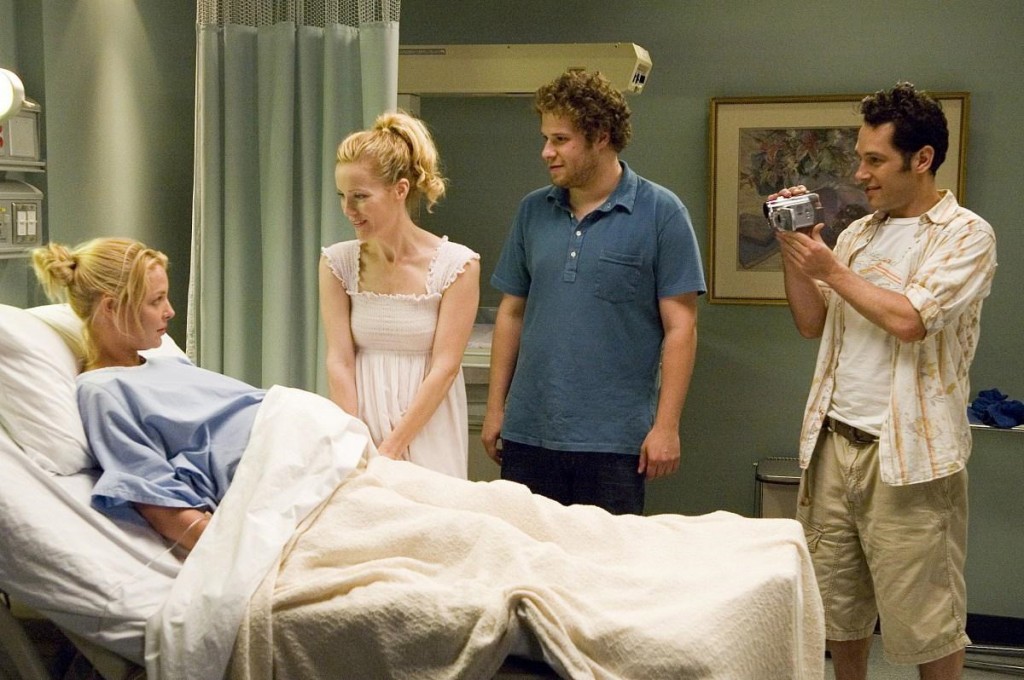
Writer-director Judd Apatow's Knocked Up opened Friday to near universal acclaim and the prospect of sizable box office. While I was a big fan of Apatow's largely under-appreciated television work (Freaks and Geeks and Undeclared), I was also a detractor of his previous feature, The 40-Year Old Virgin (2005), which was another well-reviewed box office hit that nonetheless struck me as one-note. With Knocked Up, Apatow exceeds these previous efforts in every respect, creating easily one of the funniest comic features in the past few years. In other words, Knocked Up fulfills the substantial promise of Freaks and Geeks and Undeclared.

As many of my readers are familiar undoubtedly with the premise of Knocked Up, I'll be very brief: Seth Rogan's Ben Stone, an apt name for the out-of-work (except for his development of a porn website) pot-loving illegal alien from Canada - a bogeyman to put the southern border's worst to shame - knocks up beautiful E! on-screen personality Alison Scott (Katherine Heigel) after a night of dancing (Ben may indeed throw the dice too many times, but that's all he's got) and one too many cocktails. Ben has his charms, to be sure, but the idea that she and he would end up together, regardless of the shots consumed, strains credulity.

After learning she's become pregnant following the pair's unprotected one-night stand - Ben just assumes she uses a "dam" or something, which he knows is disgusting - Alison reveals her pregnancy to her mother (Joanna Kerns) who says they'll get rid of it. She even reminds her of a relative who had a "real" baby after terminating a similar pregnancy. By contrast, Ben's father (auteur icon Harold Ramis) refuses to look at the pregnancy as a tragedy, reminding Ben that he's "the best thing that ever happened" to him, which Ben claims depresses him. In fact, Knocked Up may be the most pro-life mainstream Hollywood film in quite awhile - as Ben furtively tells the infant the story of its conception late in the film, he tells the child that failing to use a condom was the best decision he ever made.

This is not to say that Knocked Up is exactly safe for conservatives: beyond the fact of the one-night stand, Apatow's picture largely trades in sexual explicit jokes and stoner humor, with Ben's friends being more or less stereotypes of this latter sort - say That 70's Show with the cast of Freaks and Geeks (a skeevy Jason Segel may be the cringe-inspiring highlight, though its nice to see Martin Starr getting work, sporting a beard that is another of the film's running jokes). Still the film's profanity is no more the point ultimately than is its default pro-life stance. In the end, Knocked Up serves to reassure its twenty-something audiences (as also its protagonists from that same generation) showing them that there is nothing to fear from growing older and starting a family, however unconventional its construction. This is a film that gives its listless male viewers a gentle push toward responsibility (and its career-focused young female spectators the reassurance that having a child isn't life-ending - in fact, it helps Alison's career in Knocked Up), which both Ben and Alison accept at separate junctures of the pregnancy/film. Apatow's vision is unexpectedly generous - and in a way old-fashioned - coming on the heels of The 40 Year-Old Virgin.

Of course, Apatow's style remains televisual in Knocked Up: nearly every scene is constructed on the basis of a shot/reverse-shot editing structure, with the dialogue delivered in excessively shallow compositions of the scenes' actors. Inebriation, both during the original one-night stand and in a subsequent trip to Vegas produce two of the only deviations from this system. Indeed, Knocked Up is basically a film of one-liners, with Rogan and Alison's brother-in-law Pete (Paul Rudd in one of the film's most charismatic performances; his on-screen wife Debbie, Leslie Mann, is another stand-out) delivering many of the film's best lines. Be forewarned, nonetheless, that Apatow's humor combines graphic locker room banter with keen pop culture references; in other words, if you don't know Wild Things or Matisyahu, Apatow's humor might not be to your taste.

More universal in its light humor, and far more remarkable in its filmmaking technique, Jacques Becker's Antoine and Antoinette (1947) first came to attention for its Cannes prize victory sixty years ago, and as such deserves to be celebrated in a year where that same festival recently handed out its sixtieth anniversary prize. Instead, Jean-Pierre Melville's recent smash success (Army of Shadows, 1969) has assured that he will again represent film past during the summer retrospective season - this time with Le Doulos (1962). All Antoine and Antoinette has going for it is an infinite reserve of charm and boundless warmth, of a degree that has been rarely (if ever) achieved on screen. Obviously these are no competition for fashionable cynicism.

Antoine (Roger Pigaut) and Antoinette (Claire Mafféi) are a poor, early twenty-something married couple. He's a typographer and she works in a large department store where she's in charge of the passport photos machine. The exceedingly attractive Antoinette is constantly receiving propositions from the store's patrons and especially from a wealthy, middle age store owner M. Roland (Noël Roquevert). He continually attempts to lure her with the promise of riches her husband does not have the means to provide - in fact, it seems as though he has succeeded in doing this with another of his female employees. Nevertheless, Becker leaves us no doubt that the couple is very much in love, whatever their material wealth.

Fates change, however, with the discovery of a winning lottery ticket in one of Antoinette's volumes. The pair plot out what they'll do with their jackpot winnings of more than 800,000 francs - a new dress for her, a couple of new suits for him, a motorcycle with a sidecar (far better than his bicycle with the wrecked tire). Going to bed, the ticket is placed in a secure position as Antoine bides his time until he can collect their life-changing winnings. He is finally going to be able to give his beautiful young bride the life she deserves.

Suffice it to say that Antoine and Antoinette complicates their collection of winnings, though the plot machinations are not those we initially expect. In so doing, Becker reveals the core of pathos that defines his narrative: Antoine is not the sort of man (without revealing too much of the Le Million-inspired plot, we are led to believe he'll never be the sort of man) who can give his wife wealth. How then can she be happy with him, when her beauty assures that countless men could and would do exactly that? This again is the essence of Becker's film; Antoine and Antoinette discloses an essential young male anxiety.

At the same time, in the object noted above, Antoine and Antoinette also offers a fantastic solution to the basic problem highlighted. So too is Knocked Up a projection of male fantasy: a listless, twenty-something impregnates a beautiful E! news anchor - much to Apatow's credit the protagonist does not know this before hand - with whom he would have no chance in any known universe. Okay, getting a girl 'knocked up' is shall we say not exactly a male fantasy, but being with a girl like Katherine Heigel most certainly is, unemployed Canadian pothead or not. Simultaneously, Apatow offers a glimpse of twenty-something anxiety commensurate with the new century: here, of getting older, of taking a job, and most importantly, of starting a family. Again, Knocked Up reassures us that things will work out. This is his generosity.

Becker's finds his in the form of film magic Antoine and Antoinette employs: here, the intervention occurs in the improbable discovery of the ticket. Antoine and Antoinette does not deny the currency of the anxiety, even when Becker gives us every sense that Antoinette will stay with Antoine regardless. We just really want everything to work out for both of them, and for there to be no reason for Antoinette in particular to regret being with Antoine. Actually, the same hope that they'll work it out permeates Knocked Up, though Alison does have a good deal more cause to choose not to be with Ben; in this respect, Apatow and Ben must work some magic of their own - cleaning his character up, getting him a job, namely in securing the lead some theretofore absent responsibility.

Of course, the magic of Antoine and Antoinette, to return to the earlier film, is not confined to the film's plot, but instead infuses the picture's immediate post-war settings (shot in longer duration takes that showcase the Parisian locations, both public and domestic) and the director's whimsical technique, which feature devices such as the iris underscoring the film's debt to early cinema and particularly to René Clair. Then again, Antoine and Antoinette provides one of the most definitive anticipations of the nouvelle vague that would transform international art cinema a dozen years later. This is filmmaking at its freest - the director's subsequent Rendez-vous de juillet (1949) provides an even more explicit link to the free-forms of jazz that Antoine and Antoinette seems to mimic on occasion. Antoine and Antoinette remains one of the nearly forgotten treasures of the international cinema, so deserving of remembrance in this its sixtieth anniversary.

In the end, like Knocked Up, Becker's film is about joy: whereas the former locates it in children, commemorated over the film's heart-warming closing credits, Antoine and Antoinette finds this same quality writ in its protagonists' situations - once again, of being young and in love. The precariousness of joy is to be defended at all costs, be it in the rearing of children or in the magical intervention of film itself.

Tuesday, May 29, 2007

Pirates of the Caribbean: At World's End & The Recent History of the Sequel

Gore Verbinski's Pirates of the Caribbean: At World's End, the third installment in the director's 'tent-pole' franchise, opened on approximately 11,500 screens in more than 4,300 theatres en route to box office receipts totaling $139 million domestically and $251 million in 102 foreign territories. Both numbers place Verbinski's latest second to Sam Raimi's third installment in his tent-pole Spider Man franchise - released less than a month ago. Add to these the third Shrek film, released between the two, and we have witnessed a fifty percent increase in the number of $100 million openings in the previous month.

We are in other words in the midst of a discernible historical moment in which sequels - and particularly those comprising so-called tent-pole franchises - are dominating the business, but in a rather unique fashion: by opening to unparalleled numbers before dropping off precipitously thereafter; these films are making a good portion of their budgets back right away. The model may be relatively new, even if the sequel is far from it.

At the same time, all eras are not so inclined toward the sequel. For example, of the 16 films made between 1992 and 1998 that rank among the all-time top 100 box office champions, only one, The Lost World: Jurassic Park (1997) is a sequel. This was the period of the prestige blockbuster, i.e. Titanic (1997), Forrest Gump (1994) and Saving Private Ryan (1998), making it a throwback of sorts to the biggest grossers of the early 1970s, that is to The Godfather (1972), The Sting (1973) and The Exorcist (1973), all of which contended for Academy awards before generating sequels - with only The Godfather, Part II (1974) equalling the original in prestige and ambition (and none besting the original at the box office). That is, Coppola's second is the only of these that does not appear to be exploiting the success of the original, but building on it.

By contrast, six of the ten highest grossing films thus far this decade have been sequels, with two more the first installments in future franchises: Spider Man (2002) and Harry Potter and the Sorcerer's Stone (2001). Few of these have been mistaken for pictures of quality, for better or for worse. For a comparable period, one might look back to the 1980s with the second and third Star Wars pictures, the Indiana Jones franchise, and the sequels to such highly successful pictures as Ghostbusters (1984) and Back to the Future (1985) led at the box office. Few of these films can claim a high level of ambition, though most of their sources are similarly outside the picture-of-quality prototype.

So that leaves Pirates of the Caribbean: At World's End squarely within the latest instantiation of a sequel-driven box office, made to open in 4,000 theatres and quickly drift the viewers' thoughts with the next spectacle opening on an even greater number of screens. Verbinski's sensibility seems to correspond nicely to this system, delivering films that are essentially a series of spectacles or attractions, often lacking a clear sense of how the episodes follow one another. It just one set-piece, one boffo special effect after the next. Hence, not only are we in a moment when opening weekend numbers seem to portend events even more than in times past, but we have a filmmaking style to match: heavy on the events, light on artistic ambition. That is, we have filmmaking for the sake of producing spectacle, not for telling a story, or more importantly in my mind, saying something about the world in which we live. It is not art for art's sake, but art for spectacle's sake - and there is a difference (see the electric color palette of Michael Mann's Miami Vice for a recent example of the former).

Don't get me wrong, I'm not advocating the return to the prestige picture either: honestly give me the latest Pirates of the Caribbean over Forrest Gump any day. History tells us rather that the pendulum will swing back, sooner rather than later. In the meantime, if you want to see quality, don't think you're going to find it in the blockbuster, and don't bemoan a time when The Godfather or even Titanic was its year's highest grossing film. Most years that distinction belongs to Ben-Hur's or the Independence Day's of the world. If you want to see the best films in the world, attend a film festival, or better yet, buy an all-region DVD player and a $5 region 6 copy of Jia Zhangke's 2006 Still Life on-line. Just don't expect to find it in Pirates of the Caribbean or even Forrest Gump.

So back again to Pirates of the Caribbean: At World's End, which I found overly-long, often times boring though not without its sporadic pleasures: not the least of which is the alternative swashbuckling seven-seas that Verbinski and company have created - Verbinski and co.'s Singapore, their glacier-filled polar locales and a beautiful, nocturnal starry sky. Also, I enjoyed the filmmakers' Once Upon a Time in the West [1968] reference - the musical riff - during the show down where Jack is traded to the other side. And, is the presence of 'the green ray' from Jules Verne or Eric Rohmer? Either way, its a nice touch, though the difference between Verbinski's and Rohmer's green rays speak volumes.

Then again, was it really necessary to inject supernaturalism into the story in the first place (this goes back to the first film and especially Dead Man's Chest)? I suppose so given its spectacular purpose, even if pirates being pirates is interesting enough in this spectator's view. For what its worth, I still prefer the Disney World ride to any of the three films.

And I have one more departing suggestion for Disney: why not a prequel? After all, this is Verbinski's Return of the Jedi, isn't it? We have our Princess Lea (Keira Knightley's Elizabeth Swann does find herself temporarily in the role of sex slave before being coronated - as a king as it happens); our Ewok village (Shipwreck Cove); et al. Wouldn't it be nice to see Jack Sparrow doing his worse for a change, earning his reputation for more than some petty double-crossings here and there? Though I'm joking, it does seem to be the next logical step, especially if Johnny Depp (wisely in my opinion) walks away; besides which, a similar experiment did initiate it would seem the current sequel-obsessed epoch: when George Lucas inflicted Star Wars Episode 1 upon the world. And to think Return of the Jedi was my favorite movie when I was five.

Saturday, May 26, 2007

New Film: Still Life & The Boss of It All

Jia Zhangke's Still Life opens with a pair of extended duration, lateral camera movements that showcase the passengers of a river ferry en route to the Three Gorges's city of Fengjie. The last of the riders is Han Sanming (the name of both the actor and the male protagonist), who has arrived in search of his ex-wife and estranged daughter, neither of whom he has seen in sixteen years. After being extorted first by a group of small-time con artist, and then a young man who offers to take him to his wife's former address - which like much of Fengjie is now underwater - Han has a tense run-in with his ex's family. After discovering that she is working elsewhere, Han spends much of the remaining film, shuttling across the region, helping to the level structures chosen for demolition for 40 0r 50 yuan a day with his fellow laborers.

In fact, as Jia emphasizes, the water level was set to rise on the first of May, 2006, displacing an even greater number of Fengjie residents. Throughout the film, we see reminders of this fact in both the markings painted onto the sides of condemned buildings (noting how high future water levels) and also in the collapsing structure themselves, which the aforementioned laborers continuously level with their sledgehammers. Parenthetically, it remains worth noting that Jia made a second film on the same site last year, the non-fictional Dong, that details the same process of destruction.

After transitioning to the film's second part, utlizing a digitally-enhanced, unidentified flying object to bridge the split, Jia turns to Hong Shen's (Tao Zhao) search for her missing husband who disappeared two years earlier. Unlike Han, she and her husband seem to be more affluent, thereby figuring China's nouveau upper class, buffered by the nation's 'capitalism with Chinese characteristics.' Indeed, Hong attends a gathering on a balcony overlooking the region, where upon the flat-owners request, a bridge is illuminated, providing one of the year's most indelible visuals. As one of the party-goers puts it, "Chairman Mao dreamt it," but this gentleman "made it happen."

Indeed, Still Life highlights the substitution that has recently occurred in the country: China's latter-day, fugitive brand of capitalism has replaced the earlier cult of personality. Whereas the former transformed the once-idyllic landscape, submerging the ancient valley communities and displacing more than one million of its residents - perhaps more than any of the director's previous work Still Life highlights the human cost of communism - the scavengers of the new order prey on persons like Han, doing anything and everything to get ahead. Jia is dubious toward both, lamenting each's role in facilitating the cultural amnesia of the present. In one of the film's many concrete symbols, Han holds a bank note with Three Gorges in front of the landscape. Commerce has replaced art in the new China.

In fact, the history of Chinense visual aesthetics is cardinal to Still Life: that is, Jia repeatedly echoes Chinese landscape painting in his multi-plane compositions of Fengjie and its environs - especially in the film's opening shot that simulates the lateral expanses of scroll painting. In Jia's deep space compositions, registered in DV with that medium's seemingly infinite depth-of-field (the director's chosen format since his 2002 Unknown Pleasures), the filmmaker emphasizes the transformation 20th century landscape under Maoist communism - finding form in the high-rise tenements that surround the water; the demolition of these structures by the low-paid unskilled laborers, to make way for the flood waters; and the river itself, concealing centuries of Chinese history.

As with his previous masterpieces Platform (2000) and The World (2004), Still Life ultimately figures cultural erasure - the disappearance of a uniquely Chinese civilization - finding expression in the film's focal bodies of water; its collapsing Communist-era housing complexes; a series of once popular products from China's past, each of which Jia details via on camera titles; standards passionately sung by a child and replicated in ring tones; and finally, the two couples searching for their disappeared loves. Of these figures, it is likewise worth noting that they often occupy the foreground, in front of the sledge-hammeer swinging workers, and the waters beyond - each therefore conveying the film's principle theme on a series of receding planes. Hence, the director has not only discovered the perfect site for his subject, but has produced compositions to amplify these concerns. In other words, Still Life may be the director's finest film to date, reaffirming Jia's status as the greatest director of China's 'Sixth Generation,' and one of the few mainland directors who has produced works equal to those of its Republic of China counterparts, Hou Hsiao-hsien, Edward Yang and Tsai Ming-liang.

In comparison to the exacting control Jia maintains over his mise-en-scène, Danish auteur Lars von Trier's The Boss of It All literally leaves it to chance: von Trier utilizes a new technique he calls Automavision, which "entails choosing the best possible fixed camera position and then allowing a computer to choose when to tilt, pan or zoom." In The Boss of It All, von Trier's randomly-generated compositions (after the initial set-ups) frequently crop the picture's actors. The film's takes are uniformly very short, with "jumps" occurring even on lines of dialogue. In sum, von Trier's style operates independently of his content, stressing the artificality of its implementation and even the absurdity of reading form in content. However it is von Trier's emphasis on the former - on artificiality - that is continually highlighted by his aesthetic (or one might say his anti-aesthetic). To this end, von Trier himself appears reflected in the glass of office structure in the film's first shot and in a subsequent set of voice-overs where he refers to his manipulation of narrative information.

Likewise, the above self-reflexivity is figured in The Boss of It All's subject: of an actor (Jens Albinus) employed to pretend he is the eponymous "Boss of it All," which the film's actual boss Ravn (Peter Gantzler) uses as a diversion so that he can treat his employees poorly. For their part, from the barometer-obsessed, rage-filled country bumpkin Gorm to the sexually forth-right, if financially imprudent Lise, Ravn's employees are as quick-witted as their new supervisior - which is to say that they have been duped by their deceptively pathetic boss in his quest to sell to an Icelandic gentleman who still harbors a chip on his shoulder over 400 hundred years of Danish rule.

As much of The Boss of It All's success depends on the last-minute plot twists, I will avoid saying anything else about von Trier's latest, except to say that its humor often hits the mark - though it is a more conventional office comedy than the recent BBC and NBC depictions of the subject; if anything, the comedy compares to the automatically-generated plots of situation comedies (thank you to my viewing companion Lisa for the insight) such as Extra's meta "When the Whistle Blows" - The Office's evil twin. Perhaps this is one of the reasons von Trier so insistently reveals the device, beyond the director's sometimes knee-jerk rejections against conventional structures (like his own). Regardless, The Boss of It All is easily my favorite von Trier film since Breaking the Waves (1996) - though I will admit I am hardly an advocate of the director's work. For what its worth, Dancer in the Dark (2000) and Dogville (2003) remain two of my least favorite films of the decade, the former for its audience-directed hostility and the latter for its support of the slaughter of U.S. innocents. Then again, I guess von Trier is interesting enough to have gotten me to see his latest film, in spite of these earlier atrocities - whether that speaks well of von Trier or poorly of me is not clear.

The Boss of It All is currently screening at the IFC Center in Greenwich Village and is destined eventually for the television network of the same name. Still Life, which was recently screened as part of the Tribeca Film Festival, is also available on remarkably inexpensive English subtitled Region 3 and Region 6 DVDs.

Sunday, April 22, 2007

New Film: Syndromes and a Century

The critical consensus surrounding Thai auteur Apichatpong Weerasethakul's Syndromes and a Century is that the film is mystifying, if not entirely incomprehensible -- though still quite good, whatever that might mean. While I would have concurred with the above after its initial local screening last fall at the New York Film Festival, a second viewing at the IFC Film Center this past weekend, yielded a work of far greater lucidity (at least for this reviewer), while maintaining the same evasive allure.

Syndromes and a Century opens in a country hospital with a young soldier applying for a position with a pretty female doctor. Throughout most of her nonsensical questions -- as in if he prefers squares, circles or triangles... it's the second, and clear ones at that -- the camera remains fixed on the gentleman. This choice sets up part two (of a two part narrative) where the camera fixes on the young woman as she interviews a better-dressed male in an urban hospital . (For the record, Apichatpong has suggested that part one somehow commemorates his mother while part two, his father, both of whom were doctors.)

Similarly, Apichatpong's decision to utilize long, static takes similarly establishes the aesthetic that will prevail in the first part, even as it reflects the languid lifestyle that predominates in its country locations. In contrast, Apichatpong moves his camera more often in the second, urban section (though it is a slow, crepuscular panning that does not denote the quote-end quote frantic pace of city life). Likewise, these urban locales tend to be confined to an antiseptic, colorless hospital whose windows are almost always shut (and therefore, that emits few sounds from the outside world) whereas greens and the saffron of the monk's robes constitute the more colorful palette of the earlier section. Moreover, part one, again in comparison to the second half and the sounds of the humming fans that ventilate the building, is entirely composed of the ambient sounds of the countryside -- that is, of the birds singing, the insects humming, etc. -- which pass in through the open windows on the continual summer winds.

In this pristine back country, Apichatpong emphasizes the act of storytelling that has long been a hallmark of his directorial work -- with his "exquisite corpse" Mysterious Objects at Noon (2000) remaining the most obvious instantiation of this interest. Here, we have one tale following another, procuring a narrative that largely proceeds according to a set of digressions that again seems to cohere with the rural pace of life. In one exceptionally revealing example, within a second story that ultimately leads nowhere in particular, an older woman weaves a tale of a solar eclipse that produces this image subsequently. Comparatively, part two, after a Buddhist monk discusses a dream in which he is terrorized by livestock (as he had in the first section, though again from a different camera angle) is exorcised of storytelling, as if it is not only the walden-like natural world that is lost in Apichatpong's urban present/future.

Of course, the second half also lacks the religious presence of the first part, save again for the repetition of the earlier scene. Here, there are Buddha statues to the active monks and their summer festival in part one, where we see a dentist singing songs about teeth. However, this latter detail, far from being an amusing aside, confers an element of the cultural specificity that is conveyed as the purview of the rural episode: Thailand as a land of smiles, which to my understanding has long been a tourist symbol for the nation. Importantly, this same dentist also operates on a monk in both parts, which construe the varying meaning of the two halves -- in the first, he tells the youngish monk about his musical career and inquires about whether he'll receive credit for his good deed (thus showing his respect for the faith) whereas the second iteration is purely silent; in the urban environment the personal is lost -- Apichatpong features statues of individuals to compliment those of the similarly absent Buddhist faith -- as are the emblems of Thai cultural specificity.

However, the urban segment is not purely negation -- though it is this -- but is further a disquieting portrait of an (ecologically perhaps) ruinous present replete with the amputees that populate the white-walled hospital. Moreover, the film's second part concludes with a slow camera movement across a section of micro-fibre tubing that sucks in the smoke which is mysteriously present in the windowless basement (where the ill do their exercises to the airy space where this same action is conducted in the first part).
At this moment, to be sure, Apichatpong's narrative coheres as a pretty clear comparison of the urban and rural, past and present. However, the director then moves outside of the sealed hospital to a set of grassy landscapes that combine the natural and the architectural in the film's short coda. In this regard, it seems as if Apichatpong might be suggesting a tentative solution, though the continued lack of cultural specificity, apart from the pop song-group dance number that closes the film, assures that the director remains ambivalent toward this conventional (new urbanist) proposal. In this way, Syndromes and a Century preserves a degree of ambiguity against which the film's comparative structure largely militates.

Monday, April 09, 2007

New Film: The Wind that Shakes the Barley & Triad Election

The surprise generated by The Wind that Shakes the Barley's Cannes victory last year was not limited to the jury's oversight of the presumed winner, Pedro Almodóvar's Volver, but rather extended to its apparent incongruity with the interior orientation and sumptuous aesthetic of jury chair Wong Kar-wai. With Ken Loach's latest finally reaching the States during the past month, the above proposition has become no less quixotic as The Wind that Shakes the Barley appears to be, by quite a large margin, the most conventional official selection from last year's fest. Of course, the symbolic value behind awarding Loach, beyond what it says about those films thought to be front-runners such as Almodóvar's, is self-evidently political, and in keeping with the tenor of Cannes over the past few years, anti-American. And while it isn't much of a stretch to assume that Loach's film is an implicit condemnation of the U.S.'s prosecution of the latest Iraqi war and more broadly, its War on Terror -- particularly when one considers the references Loach and screenwriter Paul Laverty make to an illegal occupying army, as well as the extremely viscerally scenes of torture the director includes -- the fact is that The Wind that Shakes the Barley sustains a large degree of ambiguity when it comes to which tactics are best adopted by those opposing the British presence.

After the slaughter of an innocent near the beginning of the film, and the subsequent beating of train officials by British officers, Loach's narrative follows a small band of Republicans as they strike back against the far-better equipped British military. At the center of The Wind that Shakes the Barley --and of the militia itself -- are brothers, Damien (Cillian Murphy) and Teddy (Padraic Delaney); the latter is in fact the victim of torture in the aforementioned scene. However, once Britain forwards a truce, Damien and Teddy split ways with the former favoring continued guerrilla violence until Ireland is completely free of the British, whereas Teddy supports a maintenance of the hard-earned peace. While Teddy certainly possesses a moral authority earned by his heroic withstanding of extreme physical torture, Damien's clear socialist sympathies -- even leading the blue-eyed Damien to speak out in protest during the parish priest's homily -- mark the character as an extension of Loach's own oft-articulated leftist politics. As such, one might say that Loach tips his hand in favor of Damien's radicalism, though it is Damien and not Teddy who ultimately meets the greater tragedy -- though Teddy is by no means immune from the tragic either (given especially that he is Damien's brother). Hence, there seems to exist a futility to Damien's radicalism within this context, though it is likewise clear Loach does not endorse the alternative.

Joining The Wind that Shakes the Barley on New York screens later this month -- April 25th to be exact -- Johnnie To's Triad Election (a.k.a. Election 2) also shares with Loach's film a screening at last year's Cannes festival (vehimantly protested by the Chinese government) and as that parenthetical should indicate, political aspirations. In To's case, the enemy is Beijing, which is, as his narrative will make clear, the biggest syndicate of them all. Triad Election, as its sequel-obscuring U.S. title indicates, treats Hong Kong's underworld election with an unwilling, thirty-something tycoon Jimmy (Louis Koo) as the presumptive favorite. To be sure, Jimmy makes it quite clear that he has no interest in becoming the "biggest gangster" inasmuch as he is only interested in "making money." However, if one wants to be a businessman in Hong Kong -- and more pointedly as To suggests, China -- one needs be a gangster. In fact, while said balloting prompts extensive violent machinations as we are compelled to expect from the triad genre, it finally becomes clear that real threat to independent Hong Kong businessmen are not the triads at all, but Beijing. Indeed, China intervenes subsequent to the elections, demanding that centuries of tradition be discarded (for a result that will allow them to control the underworld of the former British colony).

Ultimately, the Triads are powerless against the Chinese, producing a message that may be far less sexy -- and less likely to secure hardware on the French Riviera -- than anti-Americanism, but one that remains a great deal more courageous. In fact To joins Tian Zhuangzhuang (and the latter's 1993 The Blue Kite) as a fearless critic of Beijing, thus reinvigorating a moribund national cinema. Moreover, while perhaps lacking the directorial pyrotechnics of his 2004 Breaking News, for example, Triad Election nevertheless features a great deal more visual inspiration than does The Wind that Shakes the Barley: for instance, in the director's staging of triad conferences in a pitch-black setting, thus removing everything but the visually essential from these meetings, there seems to exist a move toward abstraction in Triad Election that is on par with his genre-reversing The Mission (1999) -- and which matches his thematic revisions of genre. In other words, while Triad Election is every bit as indebted to a tradition of popular filmmaking -- albeit to the Hong Kong action film rather than the Anglo period biopic -- To shows an ambition in Triad Election which is largely absent in Loach's sympathetic portrait of the I.R.A. If only Wong was as brave heading a jury as he is making films (not that I still wouldn't have preferred Climates or heavy-favorite Volver).

Wednesday, March 28, 2007

The Wellspring Collection: Russian Ark (2002, Russia/Germany, 96 minutes)

The fact that Russian Ark is comprised of a single, 90-plus minute take might give one the wrong impression: that the picture is primarily a technical tour-de-force. Of course, the details of its production only add to this misconception. To begin with, Russian Ark was filmed entirely within the Hermitage of St. Petersburg, which because of its international cultural status required that director Aleksandr Sokurov and his crew complete the shoot in a single day (on the 23rd of December, 2001). After four years of development, filming commenced with over 1,000 actors, three orchestras and countless technicians. Sokurov entrusted the operation of a lone high-definition video camera to steadycam operator Tilman Büttner (Run Lola Run, 1998), whose task was to realize the director’s vision of three hundred years of Russian history in a single mobile take. Following three false starts, each of which were aborted around the ten minute mark, Russian Ark wrapped after a successful fourth attempt, thereby making history as the world’s first one-take feature, and achieving the director’s purpose of making a film “in one breath.”

Aleksandr Sokurov was born during the summer of 1951 in the former Soviet village of Podorvikha (located within the Irkutsk district).[i] As a young adult, Sokurov enrolled in Gorky University where he later earned a degree in history. In 1975, Sokurov switched courses, entering the Producer's Department at the All-Union Cinematography Institute (VGIK, Moscow). There, he soon came into conflict with the school’s administration, forcing the future director to finish a year early after his student works in cinematography were condemned for their formalism and their “anti-Soviet views.” (In hindsight, both accusations were undoubtedly accurate.) Nevertheless, the director’s first feature, The Lonely Voice of Man (1978-87), which was not accepted for graduation, received numerous prizes and the support of legendary Soviet director Andrei Tarkovsky, who helped Sokurov find work at the Lenfilm studio in 1980. To be sure, Tarkovsky has remained Sokurov’s primary influence ever since, providing the latter with a template for poetic and one might say spiritual filmmaking. These qualities are apparent in a series of masterworks that include Days of Eclipse (1988), The Second Circle (1990) and Sokurov’s signature Mother and Son (1997), all of which have won numerous international prizes for the Russian auteur.

In fact, Tarkovsky’s impact extends even to Russian Ark, where Sokurov’s aesthetic echoes the older director’s increasing use of longer takes late in his career (many of which run to six minutes or longer, including The Sacrifice’s [1986] extraordinary penultimate sequence-shot). However, it is outside of a Russian context that one sees the clearest precursors for Sokurov’s one-take strategy. Both Miklós Jancsó’s The Red and the White (1967, Hungary) and Theo Angelopoulos’ The Traveling Players (1975, Greece), for example, mobilize long takes and crowd movements to effect temporal passage within the boundaries of a single shot. Similarly in Japan, Kenji Mizoguchi’s 1953 masterpiece Ugetsu inaugurated the technique of introducing subjective variation within the space and time of a camera movement, via the director’s presentation of an encounter between the film’s male protagonist and his late wife. Nevertheless, while each of these antecedents attained an unprecedented level complexity in terms of their staging, the limits imposed by Sokurov’s subject created a number of unique impediments, any of which could have ended the production of Russian Ark permanently: a light burning out at an inopportune time, an actor flubbing his or her lines, or the camera lens steaming up as action moved from the courtyard back into the museum. Anticipating the last of these, Sokurov conducted experiments in a freezer and lacking the conclusive evidence he needed, lit a candle in a church, where he prayed for the success of his shoot.[ii]

Viewing Russian Ark in light of the challenges posed by the production, a certain tension – or even drama – is created by the film’s unspooling. Then again, to scrutinize Russian Ark in these terms would be to miss the point of Sokurov’s adoption of a one-take format (and to deviate from the way in which most spectators attend to the film). Indeed, one of the more remarkable qualities of Russian Ark is the ease with which the viewer forgets that they are watching a single-take picture. By the time the film concludes, it is less the technical bravura that is in evidence, than the melancholic mood that permeates the nobility’s final exit from the Winter Palace. An overwhelming emotional heft accompanies the film’s denouement, confirming Russian Ark’s elegiac status, which in its case pertains to the passing of high Russian and European civilization. As the ever-present off-screen narrator (voiced by Sokurov himself) says to his on-screen companion, Sergei Dreiden as the historical Marquis de Custine, “Farewell, Europe.” Thus, Russian Ark eulogizes not only the pre-Revolution Russian history that is instantiated by Sokurov’s cast of thousands which fill the grand hallways and ballrooms of the Hermitage, but also the beauty and majesty of this waning civilization: it is for the Canova at which the Stranger shouts “Mama” and for Rembrandt’s late masterwork "The Prodigal Son" upon which Sokurov and Büttner’s camera lingers and for Catherine the Great’s priceless china that is used during the dinner service; and it is for the costuming produced by the crew’s sixty-five designers, the music performed by Russian Ark’s three orchestras, and for the ephemeral qualities of the ball sequence depicted at the picture’s end – that is, for the dances, the gesturing, etc.

Therefore, it becomes clear that Russian Ark’s title is descriptive of its purpose: namely, to preserve a culture that continues to disappear. Sokurov’s use of the term ‘ark’ to describe this process is far from accidental: as the shot’s digitally-enhanced conclusion makes clear, the museum itself (or perhaps more accurately, the film) is this ark and is “destined to sail forever.” (Sokurov even adds rolling waves to the landlocked wintry exterior.) In this way, Russian Ark demonstrates both its currency among contemporary European cinema and also its integral position to the director’s oeuvre. With respect to the former, Russian Ark’s focus on a crumbling civilization situates the film in a fin-de-siècle tradition that also includes Michael Haneke’s The Seventh Continent (1989), Manoel de Oliveira’s Abraham’s Valley (1993), Raoul Ruiz’s Time Regained (1999; Ruiz likewise utilizes the technique of combining tracking shots with zooms to reshape spatial dimensions in his own narrative of time travel). As far as the director’s own corpus is concerned, contrary to the opinion of many critics, Russian Ark is very much of a piece with many of the director’s previous works: Russian Ark seems to complete a cycle of films – most of which feature the word ‘elegy’ in their titles – that similarly eulogize. Indeed, as with the director’s previous Elegy of a Voyage (2001), Russian Ark tours a museum’s galleries, though unlike that former film or indeed any of the other works that likewise comprise said cycle, Russian Ark greatly exceeds Sokurov’s previous efforts in terms of the scope of its production. As such, Russian Ark might just be the endpoint of the director’s aesthetic, and perhaps even its culmination.[iii]

At the same time, Russian Ark’s form remains a function of its content, not simply the latest manifestation of a personal style. Again, Russian Ark depicts three hundred years of the nation’s history – that is, of the transformation in the Hermitage’s use – beginning with Peter the Great (the city’s founder) and ending in the present among the gallery goers, though the narrative follows no similar trajectory. Throughout, the Marquis and the off-camera narrator snake through various historical moments, at times interacting with the palace’s population, and in other instances remaining invisible to the instruments of history. Through their tour a unitary fractal of time and space – a single shot – is maintained, even as the mise-en-scène cedes from one historical moment to the next. In fact, it is Sokurov’s careful delineation of on- and off-camera space that allows so many disparate times to coexist within the museum walls. Not only are new moments in the museum’s history broached when our guides cross through the palace’s thresholds from one room to the next, but indeed the space outside the frame is constantly remaking itself according to its next historical stage, just as Sokurov transforms the disclosed museum that exists before our eyes. Sokurov and Büttner transform on-camera space by pairing their forward tracking camera with zooms that effectively flatten or stretch the space in view, thereby producing a visual analogy for the historical transformations that shape the narrative. At the same time, Sokurov’s insistent use of a single take reaffirms the spatial unity of the museum. That is, if the contents of the space are being transformed over the course of Sokurov’s narrative, its basic scaffolding remains secure. Sokurov’s ‘ark’ therefore is a vessel of time – or multiple times – preserving again far more than the material objects on view in the Hermitage. Russian Ark enshrines the past, utilizing the specificity of an unbroken sequence of moving images to unite the broad scope of the palace’s history. Thus, Russian Ark creates a new form of montage that depends not on the juxtaposition of discrete spatial-temporal fragments in sequence, but on the moment-to-moment transformation of the mise-en-scène and on the arrangement of multiple time values in a single space. We may say, consequently, that the shot no longer denotes a united space and time but the potential for multiple times – the history of a space.

Directed by Aleksandr Sokurov Director of Photography, Steadycam Operator Tilman Büttner Produced by Andrey Deryabin, Jens Meurer, Karsten Stöter Screenplay by Anatoly Nikiforov, Aleksandr Sokurov Design Visual Concept and Principal Image Aleksandr Sokurov Music Performed by Mariinsky Theatre Orchestra Conducted by Valery Gergiev Original Score Sergey Yevtushnko Presentation of Hermitage Bridge Studio, Egoli Tossell Film AG

Cast Sergei Dreiden…. The Stranger - The Marquis de Custine, Maria Kuznetsova…. Catherine the Great, Leonid Mozgovoy…. The Spy, Mikhail Piotrovsky…. Himself (The Hermitage Director), David Giorgobiani…. Orbeli, Aleksandr Chaban…. Boris Piotrovsky, Tamara Kurenkova…. Herself (The Blind Woman)…. Maksim Sergeyev…. Peter the Great, Vladimir Baranov…. Nicholas II, Anna Aleksakhina…. Alexandra Fyodorovna, Wife of Nicholas II, Aleksandr Razbash…. Military Official

Notes:
[i] The biographical details included in this paragraph were taken from Aleksandr Sokurov’s official site, Island of Sokurov, which is overall an extraordinary resource on the director’s life and his body of work.
[ii] This last anecdote is included in Knut Elstermann’s fine documentary on the film’s making, In One Breath: Alexander Sokurov's Russian Ark (2003), which Wellspring featured on its DVD release of the film from that same year.
[iii] In terms of the critical response to Russian Ark, few if any of the director’s films have been as widely praised in the U.S.: it is, for instance, the only of the director’s films to have been reviewed by Roger Ebert, who gave the picture four stars (out of four) for his Chicago Sun-Times column. Likewise, art house-minded critics Jonathan Rosenbaum (Chicago Reader) and J. Hoberman (The Village Voice) both named the film as one of the year’s “ten best” in 2002. In addition, Russian Art is also the director’s only box office success, grossing a respectable $2,326,979 during its U.S. theatrical run, including an impressive $29,022 opening tally on two screens in December of 2002 (courtesy of Box Office Mojo). To date, Russian Ark has earned more than $6.5 million worldwide, of which forty-five percent has been earned in the United States, making it the seventy-ninth highest grossing foreign language film in this country’s history. These numbers are all the more impressive when one considers that Father and Son (2004), Sokurov’s most recent film to earn an American theatrical release – also courtesy of Wellspring – has yet to earn $40,000. On the contrary, the director’s highly-acclaimed biography of Japanese Emperor Hirohito, The Sun (2005) – Cahiers du Cinema’s number one film of the year – remains undistributed. Surely, The Sun’s inability to secure U.S. distribution emphasizes the void left by Wellspring’s disappearance from the American theatrical landscape.

Friday, March 23, 2007

New Film: Offside

Warning: the following post contains spoilers beginning in the second paragraph.

Jafar Panahi's Offside, the Iranian director's fifth feature, and the fifth to be banned in his home country, arrives in New York approximately twelve hours in advance of his President Ahmadinejad's scheduled arrival. This accident makes Offside perhaps the most timely New York premiere this spring, as the film extends Panahi's on-going account of social injustices -- particularly those against women -- in modern-day Iran. (That is, as we await the UN-sanctioned demagoguery of a world leader who has repeated voiced his desire to eliminate Israel and to eradicate the Jewish people from the face of the earth.)

In Panahi's latest, we glimpse the everyday injustices of Ahmadinejad's theocracy, where women are prevented from attending live sporting events, including Iran's final 2005 World Cup qualifier against Bahrain. Following a title that informs the spectator of this detail, as well as a second caption which claims that much of the film was shot at the stadium during said event, Panahi introduces us to an angry, albeit concerned father who is heading to the event to locate his daughter (before his sons can find her, whom he says would kill her). Subsequently, we are introduced to a female in disguise on a nearby bus, who we assume is the very girl noted above. As it will later turn out, she is not, though Panahi's film commences with following her attempts to enter the stadium. Therefore, it might be said that there is a certain interchangeability between the girls owing to their shared condition.

This young woman is immediately discovered, however, and is subsequently penned in with a group of her fellow male impersonators, just outside the stadium walls. As such, Panahi invents a formal analogue in the small visible cell positioned against the polyphonic off-screen stadium: that is, these young women, prevented from experiencing the public sphere on an equal basis with men, occupy a marginal space in relation to the larger, connoted off-camera space. Moreover, Panahi's utilization of tightly-framed mobile long takes further reinforces this dialectical relationship between theoretically separate on and off-camera spaces.

Of course, Panahi's use of long takes also succeeds in producing a facsimile of real time that has been the director's clearest stylistic device from his debut feature The White Balloon (1995). Here, the time of Offside is basically consubstantial with that of the game, concluding soon after the result is announced with the soldiers and the women celebrating in the nocturnal streets. (The game begins in late afternoon with Panahi charting the evening's transition to dusk.) In fact, within this coda, Pahani offers a glimpse of hope that is not unwarranted otherwise, provided his characterizations of the soldiers who guard the girls. While unwilling to break the law themselves, the soldiers seem to possess at least a flicker of sympathy. Hence, it might be said -- particularly when one considers the rebellion of the young women additionally -- that there is a reformative impulse in the people, even if the state remains irredeemably arcane.

In short, Offside continues Panahi's interrogation of Iranian social realities, culminating in another major work to stand beside his earlier highlights The White Balloon, The Circle (2000) and Crimson Gold (2003). However, unlike the first and third features listed above, Panahi's mentor Abbas Kiarostami did not pen the screenplay, which may account for an uncharacteristically underlined moment of psychological causality late in the film. Apart from this revelation, however, Offside remains a strong inheritor to the master's tradition, and once again confirms Panahi's status as Iran's greatest active filmmaker not named Kiarostami.

Monday, March 19, 2007

New Exhibitions: Tacita Dean / Spanish Painting / Gordon Matta-Clark


"All arts are founded on man's presence; only in photography do we enjoy his absence."
-Andre Bazin

Tacita Dean's Kodak (2006) joins James Benning's Ten Skies (2004) and Danièle Huillet and Jean-Marie Straub's These Encounters of Theirs (2006) as one of the finest new films to screen in New York thus far this year. Add to these works of the experimental (primarily non-narrative) cinema Film Comments Selects highlight Colossal Youth (Pedro Costa, 2006) and the structuralist-influenced April opening Syndromes and a Century (Apichatpong Weerasethakul, 2006), and one begins to wonder whether narrative cinema isn't beginning to fall further behind its avant-garde and poetic counterparts qualitatively. After such a lackluster year for Hollywood, such a claim does not seem as far-stretched as it might otherwise. Even the mid-majors have shown this turn with Michel Gondry's The Science of Sleep (2006). Of course, none of those films listed at the outset, in addition to Costa's, have or ever will receive anything approaching commercial distribution.

Fortunately, the Guggenheim New York is currently screening two of Tacita Dean's 16mm works, including the 40-plus minute Kodak, as part of its supplementary exhibition, The Hugo Boss Prize 2006: Tacita Dean. Kodak features footage of one of the eponymous film company's factories shot after Dean learned that this manufacturer of her 16mm medium was slated to close. Utilizing that same format, Kodak makes an argument for her medium's specificity and superiority over digital technologies in its registration of sensuous tones (particularly yellows, royal blues, turquoise/sea-greens and pink-tinted purples) in exceedingly low light. Dean's spare lighting often adorns empty corridors, which draw attention to film's post-human character -- that is as an indexical medium. This quality is similarly evident in Kodak's emphasis on the translucent material, which likewise underscores the medium's fragility. Indeed, this is the ultimate meaning that inheres within Kodak: namely, of a medium that is ceasing to exist, both in its lack of production and in the instability of the format itself. This eulogistic sense is suggested further in the concluding images of factory waste on the wet mill floor.

While the Tacita Dean exhibit occupies only a single room within the museum, the remaining non-permanent galleries are devoted to the epic Spanish Painting from El Greco to Picasso: Time, Truth, and History. As I may still write on the exhibition elsewhere, my comments will remain of necessity cursory. Suffice it to say of the enormous showcase, then, that while Spanish Painting does not break new ground, it does have the virtue of clarifying the unity of the Spanish visual tradition, and particularly the titular Picasso's self-conscious revisionism vis-a-vis his national context. In the end, if Picasso's art demonstrates the greatest dexterity, Goya's emerges as perhaps the most influential, Velázquez's the ultimate achievement in his nation's plastic tradition and El Greco's and Miro's the most respectively singular. It is worth noting that the exhibition is arranged by theme with many of the newer works (especially Picasso's) hanging beside those pieces that served as inspiration, either directly or indirectly.

For someone who is better versed in El Greco, Goya and Picasso, the opportunity to see such a large number of Velázquez's again -- many of which are on loan from the Prado -- serves to reinforce his preeminent stature, at least in this author's opinion: that is, as one of the oil medium's greatest practitioners, perhaps even the equal of Rembrandt himself. To be terse, Velázquez appears in Spanish Painting to be his art's greatest humanist: in the superlative "Don Sebastián de Morra" (ca. 1643-4) for example, the painter's representation of the little person secures the full weight of his subject's sadness, deriving as it does from his physical limitations -- both his height and his meaty hands. (A second similarly socially-themed highlight is Goya's "The Young Woman (The Letter)," after 1812, which limns the aristocratic subject concretely, while her servant and the workers behind her are all represented without this same clarity.) That is, Velázquez -- and Goya -- emphasize the social, whereas Rembandt's focus is the spiritual. To put it differently, Velázquez's subjects lack the souls that are the focus of his Dutch counterpart's art. Again, for Velázquez, it is their position within a social system and the impact that this has on their psychology -- to say nothing of his preoccupation with their garment's textures (Velázquez's painting, at its most assured, approaches a second sense, that of the creation of touch) and the medium itself, which all combine to forge the essence of his art.

Fifteen blocks to the south, The Whitney Museum of American Art is currently exhibiting the "anarchitecture" of Gordon Matta-Clark. Again, to be brief, Matta-Clark, son of Surrealist painter Roberto Matta, is perhaps best known for his incisions cut into abandoned or condemned structures, such as a pair of late 17th century homes (in "Conical Intersect") situated beside Paris's Centre Pompidou, or his 1974 "Splitting" where he does exactly that to a one-family home. In summary, Matta-Clark's art aids his spectator in securing a new perspective in viewing familiar locations, while offering substantive social and psychological ramifications: to the former, they assist us in understanding how people live together in cities, while the latter indicates both a formalization of Matta-Clark's broken home, and even more compellingly, his twin brother's suicide.

In terms of his media, since his art is by its definition ephemeral -- buildings immediately prior to their demolishing -- Matta-Clark portrayed his sites in both photographs and films. In so doing, Matta-Clark offers an analogy between his activity ("to clarify our personal awareness of place") and the process of representing the three-dimensional in two dimensions (namely, of finding a method to explode the spatial barriers inherent on said format). Thus, there is a rigor to match the artist's ambition, marking Matta-Clark as an exceedingly significant post-war American artist.

Thursday, March 15, 2007

New Film: Zodiac & The Lives of Others

David Fincher's Zodiac shoulders what might have been an insurmountable obstacle to its success as a thriller -- the fact that the true crime case upon which the film is based remains unsolved. Nevertheless, the director's latest serial killer picture secures a tension, though it is less connected to the police's investigation -- as of course its outcome is common knowledge -- than it is to amateur Robert Graysmith's (Jake Gyllenhaal as the author of the film's original non-fiction source) subsequent intervention. As Graysmith states when his wife (Chloë Sevigny) questions his motivation, he wants know to look into the eyes of the killer and to know that he is guilty. By this point, this is all that we as spectators want as well (or at least to know the murder's identity, obviously). And much to the credit of Fincher and his screenwriter James Vanderbilt, we become as convinced of a particular suspect's guilt as does Graysmith. Indeed, Fincher and Vanderbilt's control of circumstantial evidence ultimately points to the aforesaid suspect, even as we are compelled to at least wonder about the various other leads that Graysmith pursues.

To defer suspense until the film's second part -- that is, to transfer it onto the question of the killer's identity -- we are led to share in our degree of knowledge with the San Francisco P.D. (and especially its lead investigators Mark Ruffalo and Anthony Edwards) and the city's newspaper staff (where Gyllenhaal and Robert Downey Jr.'s Paul Avery work; the latter is another contribution to Downey Jr.'s drug-fueled persona -- cf. A Scanner Darkly, 2006) to which the Zodiac killer sends his encrypted missives. It is only after the investigation effectively concludes that Fincher and Vanderbilt begin to reveal the missteps of inter-departmental communication that assured the investigation's failure. As such, Zodiac offers a cogent account of this unsolved case and its likely perpetrator, and also a viable reason for its remaining unresolved.

Ultimately, Zodiac is less a sordid true crime case than it is a portrait of how these notorious murders remained unsolved. In other words, Zodiac is not Se7en (1995) -- not to imply that the earlier film has any basis in reality -- though it does share some of its tropes: perhaps the clearest example is the sparely lit, squirrel-infested trailer of one of the picture's suspects. Otherwise, many of Fincher's voluminous spaces feature visible overhead florescent lighting. Together, it again becomes clear, as it was in Se7en that the particularity of Fincher's style can be located in his modulations of (moody) lighting. Spatially, Fincher composes many of his shots horizontally across his wide screen.

Less obvious for any specific visual tropes, with the possible exception of occasionally distracting instances of rack focus, Florian Henckel von Donnersmarck's The Lives of Others (Das Leben der Anderen) offers another example of dubious recent history, albeit in fictionalized form. The recently Oscar-feted The Lives of Others -- the German picture was an upset winner in the 'best foreign language picture' category -- gives an account of one Stasi officer's (Michael Haneke axiom Ulrich Mühe) increasing disaffection with the GDR's practice of surveillance, though not on principle but rather by virtue of its abuses.

After one of East Germany's only loyal artists is placed under full surveillance as per a leading official's romantic interest in his actress lover, Stasi officer Wiesler begins his sabotage of the process, allowing the disenchanted writer and his compatriots to produce an anti-GDR tract that emphasizes the high incidence of suicide in the former state. Thus, Henckel von Donnersmarck limns a portrait of the GDR that both articulates the ubiquity of the state's crimes and also suggests the goodness and the courage of some of its citizenry. While of course both are undeniable, the filmmakers' emphasis upon the good Stasi provides a certain cover to those who may have been complicit; like De Gaulle's France in the postwar period, The Lives of Others indicates a move toward a revisionist, heroic history.

If it could be argued therefore that The Lives of Others presents a somewhat suspect glimpse at Germany's recent past, Henckel von Donnersmarck's direction of suspense leaves little to be desired. For example, the German director's staging of the climactic scene with all emphasis transferred onto a single feature of the architecture is worthy of and influenced by the 'Master of Suspense.' Then again, Henckel von Donnersmarck's assured direction of such sequences is accompanied by inclusions of passages that reiterate what the action has already made clear -- as with the overly distended conclusion. (The Lives of Others is nothing if not middle-brow.) Even so, the film's heart-warming final revelation, however overblown, achieves an undeniable emotional resonance.