Thursday, August 16, 2007

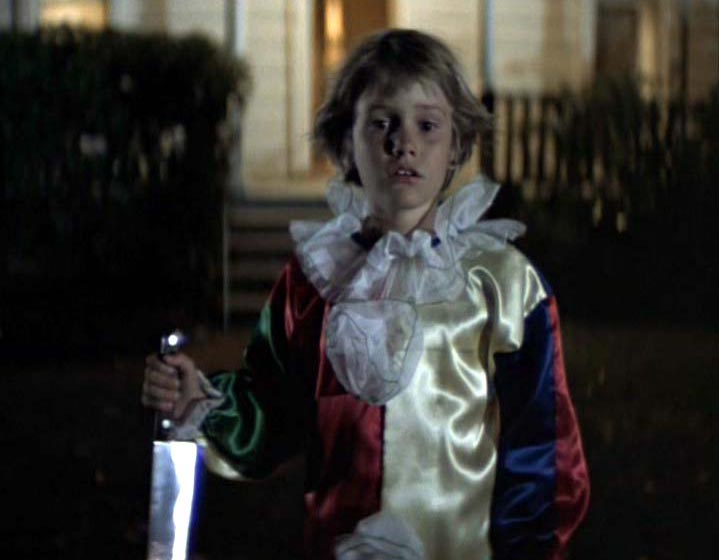
Facing the Bogeyman: John Carpenter's Halloween (1978)

Warning: the following post contains spoilers.

Every film critic/reviewer/scholar has his or her blind spots: chief among mine has long been horror films (from the time I dutifully avoided the slasher film bogeyman during my teenage years). Even now I have to be convinced beforehand of a horror pic's high quality - as I was recently with the highly arresting though ultimately compromised The Descent (2005, Neil Marshall); also, the inherently cinematic cave setting helped in its case - prior to spending my time in the presence of excessive carnage. Chalk it up to a puritanical adolescence, which I still believe served me well, viewing gaps aside.

Noticing John Carpenter's Halloween (1978) on IFC's late night schedule recently, and with my DVR ready to alter the time-space continuum so that I might watch it at my own convenience, I found the opportunity to improve, however incrementally, my familiarity with the genre. Suffice it to say that I was overwhelmed by Carpenter's horror standard, which in my estimation is every inch the equal of such other period generic classics as Don Siegel's Dirty Harry (1971) and William Friedkin's The Exorcist (1973) - with an ideology to match the content of these earlier films. Puritans of a different sort beware!

Halloween opens in the small town of Haddonfield, Illinois on Halloween night, 1963. Utilizing a wide angle lens, the camera tracks slowly toward a home in which we see a teenage couple making out before they steal away upstairs. The shot continues, passing around the side of the home and through the rear pantry. We already realize we are in the midst of a single-take point-of-view shot before we see a hand reach for a knife to the side of the camera. With the shot continuing, we wait as a teenage boy slinks out the front door. With the young man gone, we recommence with our movement up the front staircase. For a second time we see a hand, a child's hand, reach in front of the camera and grab an object - in this case a mask which shortly will transform the camera's visual field. Mask on, we enter the room of a beautiful naked teenager who scolds "Michael" as she stares at the camera. Seconds later he plunges the knife into her soft flesh as we continue to share his perspective. Leaving the room he heads down the same staircase and out the front the door where a man and a woman address him in the same way as they stand curbside. Carpenter's camera then reverses for the first time, showing a costumed little boy holding the bloody knife.

The film then jumps ahead to 1978 (its year of release) where we see a Doctor (Donald Pleasence) and his nurse en route to a parole hearing for the child killer, the one and only Michael Myers. Arriving at the asylum that holds the twenty-something (Tony Moran) - Dr. Loomis insists that he is beyond recuperation - we see a group of patients in white coats mulling around in pitch black near the side of the road. Momentarily, a visually-obscured Myers succeeds in stealing their car, which he will drive back to Haddonfield just in time for Halloween night, 1978.

With Myers back in the small Illinois town, Carpenter's often mobile camera, coupled with the menacing, if simple electronic score that the director himself likewise composed, provides the spectator with the unmistakable feeling that the film's on-screen subjects are constantly being watched. While cinema as an art form commonly trades on the impression that the viewer is watching life captured unawares - with a camera whose presence in space is typically effaced; that is, the players in the on-camera drama could never see the camera as in some theoretical sense it is presumed not to actually exist within the space of the narrative - here, our watching of the on-camera actors parallels that of the killer's. As such, Myers often crosses in front of the threshold of the camera, filling one of its corners with his back, or looming deep in the distance behind the actors. In this way, Carpenter succeeds in investing the majority of his picture with this voyeuristic quality. It is not simply that we could be sharing the killer's point-of-view but rather their unawareness that they are being watched, which therefore places them in danger.

Specifically, it is three teenager girls who are targeted by the maniacal murderer: Nancy Kyes's Annie, P. J. Soles's Lynda and most famously, Jamie Lee Curtis's Laurie, in her career-defining debut. Both Annie and Lynda endeavor to fool around with their boyfriends over the course of the evening. Annie is delayed when she spills food on her clothing, forcing her to strip on screen, before tossing her outfit into the washer. Lynda, however, succeeds, participating in a passionate bit of love-making on-camera with her young lover. On the other hand, Curtis's Laurie is stuck watching the children, and even when Annie does land her a date for the upcoming homecoming dance, the former protests vociferously after Annie tells Laurie's date of the latter's attraction for him. She seems to be in no rush to join her friends in their sexual activity.

It is significant, then, that only Laurie survives in Halloween: in fact, like Annie and Lynda, Myers's older sister is similarly sexually active, appearing like the others on-screen - and therefore before Myers - topless. Whether it is simply fate, for which Laurie provides a definition during class, even as Myers lurks outside the window, or it is her unwillingness to participate in the same behavior as the others, the fact remains that she is the only young woman who is saved from Myers. Importantly, she is also the lone young actress who does not appear topless on screen, even as he seems to stalk her with the greatest degree of vehemence. She does not receive the punishment of the young women who do display themselves unknowingly for Myers and knowingly for the audience. In this way, Halloween's sexual politics are definitively post-sexual revolution. Sex is punished.

This is not to argue that we don't share a certain complicity with Myers: obviously, the on-screen display of these young women is intended for the viewer; and again, we often share in the killer's visual point-of-view. (While Halloween references Carpenter's master Howard Hawks and particularly Thing from Another World [1951, dir. by Christian Nyby and produced by Hawks] it is Alfred Hitchcock and specifically Frenzy [1972] that appears to be the more direct point-of reference.)

Speaking of which, it is precisely the director's handling of this formal element - namely, point-of-view editing - that distinguishes Halloween as a work of unalloyed artistic importance. Beyond the astonishing opening sequence-shot, Carpenter routinely uses a shot/reverse-shot structure to facilitate the suspense that imbues the work. In particular, on countless occasions we see Myers somewhere in the background, lurking in the shadows quite literally; Carpenter then cuts to the person, most often Laurie or the young boy she babysits, looking on in terror. Upon the second cut, in shot after shot, Myers disappears.

Halloween closes like it begins - with exceptional bravura - though in the case of the ending it is sound rather than sight through which Carpenter's secures his tour-de-force. Here, after being pumped full of numerous rounds by Dr. Loomis, Myers's corpse disappears after a second reverse. Following this final implementation of Halloween's key stylistic motif, Carpenter shows us a series of empty, shadow-filled and dimly-lit interiors and exteriors accompanied by the sound of Myers heavy breathing behind his mask. In this one stroke, Carpenter tells us his bogeyman could be anywhere, while of course setting the stage for Halloween II.

For further reading, including whether or not to bother with any of the sequels, see Matt Singer's earlier Termite Art appreciation. Based on his recommendation, I think I'll stop my exploration of the Halloween films with the first.

Sunday, August 12, 2007

New Film: Colossal Youth

Pedro Costa's Colossal Youth (Juventude Em Marcha, 2006) recently concluded its ten-day Manhattan run as the season's most improbable über-small scale art house sensation. In some distant recess of the cinematic universe, Colossal Youth may just be the film of the year - that is as the latest and in many senses the most extreme instantiation of a European filmic minimalism that seeks to reinvent the language of the medium wholesale.

Colossal Youth opens with an extreme long framing of a Portuguese slum as furniture is tossed from a second floor window. In the next shot we see an aged immigrant woman, standing on a staircase with knife in hand, as she discusses swimming in Cape Verde as a younger woman. Like the prior take, Costa's camera doesn't move; in fact, with very few exceptions - a tilt here, and pan there - the director's camera never moves. It is only later that we will piece together that the woman presumably stabbed Ventura (played by an actor credited only as Ventura) who as the film proceeds will serve as our guide to the narrative.

As Colossal Youth unspools, Ventura moves between his former slum home, the new government flats built to house the former location's residents and even the makeshift housing that protected Ventura and a mate upon their 1972 arrival in Lisbon. In each of these places, save for the last, Ventura visits one or more persons that he refers to as his children, even when their physical appearance - to say nothing of the stories they narrate involving their biological parents - militate against the old man's claims (with the exception of the blind Bete). Regardless, Ventura's mobility provides Costa's minimal narrative with its structure: as a series of conversations and interactions between the lead and his under-class children.

This is to say, in the most conventional of senses, that nothing happens in Colossal Youth. In those instances that there is drama - when for example Ventura is stabbed (the opening image is an inversion of sorts as its long shot composition and presentation of action will be absent thereafter) or when Vanda's (Vanda Duarte, In Vanda's Room) sister dies - Costa's on-screen narrative, the image has excluded these incidents. Colossal Youth, in other words, is a narrative of interstitial fragments; we see a very small segment of the story Costa tells. In other words, Costa limits his narrative.

In a word, limitation is the operative principle behind Colossal Youth: whether it is the film's eschewal of action or more conspicuously, Costa's remarkably constricted framing. Throughout Colossal Youth, in fact, Costa reduces his frame to an excessively shallow space with one or two figures almost ubiquitously before a wall, a window or in a doorway. Maintaining this extraordinarily restricted framing, light enters the frame obliquely, detailing the edges of the shadow-engulfed figures. It is not only that Costa shows us an extremely small space but that even this fragment is often dominated by shadows: again, this is a cinema of infinite limitation.

Perhaps more than any other moment in Colossal Youth, this theme is highlighted in Ventura's inspection of his new flat. Here, Costa includes a door that continually swings shut, dictating that even in this potentially volumetric space Ventura will be restricted. He can never escape his social status, which along with everything else in Costa's film is worked out in spatial terms. Ultimately, the film's formal limitations match the social status of the film's heroic group: this swath of Lisbon's poorest class is removed to isolated corners of the slums and later to public housing once the former is raised.

Off-camera sound also proliferates, calling attention to the limitation placed on the mise-en-scène: the space utilized in the film, like the disclosure of narrative information, is severely limited, even as it continually refers to that which is not presented on screen. Costa is creating an art out of the scantest of means, thus confirming cinema's infinitesimal position within the broader cosmos. In this way, Colossal Youth is very much a film about the relationship between art and life, which is likewise established in the gap between the film's non-professional, Costa regular performers and the roles they play. When Ventura repeats the words of a letter time and again, we are reminded of this distinction.

In the end, Colossal Youth is above all a work of exceptional rigor, producing a form to match its content, whether it is the limitations noted above or in an experience of time to confer the banal subject.

Wednesday, August 08, 2007

New Film: Summer '04

Warning: the following piece includes partial spoilers in the fourth and fifth paragraphs.

Stefan Krohmer's Summer '04, from a screenplay by Daniel Nocke, is the third critically-acclaimed German art film to open in New York during the past six months - which at a glance at least would seem to be a record for the post-Fassbinder (d. 1982) era. Whether this is actually the case, the appearance of Summer '04, Florian Henckel von Donnersmarck's The Lives of Others and the finest of the three, Valeska Grisebach's Longing, in such short succession, constitutes a positive direction for this long underwhelming national cinema. Importantly, each was one of the first two features by a director under the age of forty: perhaps this new generation will bring us a cinema worth caring about once more.

Summer '04 treats the summer holiday of an exceedingly open-minded German couple, André and Miriam (Martina Gedeck, The Lives of Others), their fifteen year-old son Nils and his twelve year-old girlfriend Livia (Svea Lohde). The fact that their son and his Lolita-like girlfriend may be sexually active does not seem to concern the enlightened pair - that is, until Livia becomes involved with a handsome, athletic thirty-something Bill (Robert Seeliger) whom she meets while sailing with Nils.

The rather sexy Miriam in particular objects to the coupling, after Livia leaves a message that she is going to stay over at Bill's. While her partner André seems indifferent to Livia's choice, Miriam repeatedly claims that she would not want someone to allow her son to do the same without her consent; consequently she drives to the gentleman's home late in the evening to retrieve Livia. Arriving, she discovers that the young woman has left after a row with her much older companion. For his part, Bill attempts to assuage Miriam with his insistence that he has not acted inappropriately; her leaving was the result of her own immaturity.

Ultimately Livia does return, though only after Krohmer suggests that Miriam's life might be endangered in the mysterious Bill's under-lit attic. In the end, neither Miriam nor Livia is in any physical danger. Nor does it seem initially that Bill has any designs on Livia sexually - in answering Miriam's initial inquiry, he claims that he appreciates the young girl for her conversational ability (compared to the Americans with whom he had been recently spending time; significantly, Miriam quickly rejoins that she spent a year in America and met many interesting people).

Rather it is Miriam who seduces Bill, even if he seems apprehensive at first - that is, until we see the pair in a strikingly explicit sexual encounter. Suffice it to say that Krohmer and Nocke have more than their share of narrative reversals remaining in Summer '04, not the least of which is a letter dated to August of that year where Livia's true intentions are revealed. In short, Summer '04 is a work of exceptional psychological intrigue that reaches a climax (localized on one of the character's faces) during the dramatic reading of the letter in the film's final scene. As such, Krohmer's work deserves the comparisons it has generated to Roman Polanski, or as my viewing companion noted, to Claude Chabrol.

However, it is Summer '04's other speculated point-of-reference, Krohmer's almost namesake Eric Rohmer, who truly looms largest over the work: from the economy of infidelity to the rural holiday settings captured with a medium focal-length lens and natural light, from the opening credits to the specific dating of the letter to the title itself, Rohmer (i.e. Pauline at the Beach, A Tale of Springtime and A Summer's Tale) is the clear point of departure. Then again, it is worth noting that Rohmer is more an inspiration than a template for Krohmer: the dramatic pyrotechnics, underplayed as they are, nonetheless distance the German from his French influence and the latter's famed emphasis on dead time.

Still, Rohmer's impact remains unmistakable. Nowhere is this more obvious than in those moments when Krohmer films particular times of day, such as the late afternoon sun in which we see Livia and Nils arriving at a gas station, the more diffuse light that illuminates an outdoor dinner mid-evening, or most elegantly, the early twilight as Miriam drives to rescue Livia from Bill (in the scene noted above). Here, Krohmer's camera, in typically Rohmerian fashion, lingers first on the passing countryside, before showing Miriam in the cab of her auto. Come to think of it, Longing similarly highlighted this highly evocative time of night to great effect. Certainly we could do worse than to hope that an upturn in the German cinema might prominently feature an increased sensitivity to nature - and indeed, the inspiration of Rohmer more fully - that both works manifest.

Saturday, August 04, 2007

New Film: Opera Jawa (co-written with Lisa K. Broad)

Indonesian filmmaker Garin Nugroho's requiem, Opera Jawa, commissioned for 2006's New Crowned Hope Festival - a celebration of Mozart’s 250th birthday - equates more with the composer's art than have the two previous entries screened in New York (Apichatpong Weerasethakul's Syndromes and a Century and Tsai Ming-liang's I Don't Want to Sleep Alone). After all, Nugroho's virtually all-singing Javanese musical adheres to the basic structure of Mozartian opera, replete with that mode's mythic universe (Così fan tutte and The Magic Flute, for example) and its conventional artifice. At the same time, Opera Jawa remains deeply immersed in the traditional arts of Indonesia - dance, theatre, music, the visual arts - producing a work that is on the surface one of the most singularly exotic in the recent cinema.

Opera Jawa adopts a tale from the Hindu Ramayana, wherein the marriage of a poor potter and his beautiful wife Siti (Artika Sari Devi) is challenged by a wealthy, handsome paramour. Nugroho inscribes the fears and anxieties of the constituent narrative doubly, through both an operatic narrative, articulated lyrically, and in the gestures of the picture's folkloric dance. With respect to the latter, the conventions of Javanese dance may not be immediately apparent to many Western spectators - that is, we may not know exactly what the gestures signify - though the fact of their signification and their relationship to the meta-narrative are both clear enough.

Ultimately, Opera Jawa emphasizes the degree to which the film's mythic themes and the recourse to poetic representation (that is to forms whose codes convey something beyond themselves, without always being directly mimetic) are each universal, while the particularity of its representational structure remains decisively local. Opera Jawa is to the new Asian cinema what The Color of Pomegranates (1968, Sergei Paradjanov) was to the European art cinema of the 1960s - it is a filmmaking that invents its own idiom, which nonetheless remains deeply imprecated with its regional tradition. Along with Apichatpong's cinema, Opera Jawa may provide evidence that Asian art cinema has entered a post-modern (not postmodern) folk-art phase.

Opera Jawa also compares to Jacques Rivette's corpus in both its examination of multiple narrative levels and its interrogation of the relationship between film and theatre. Moreover, like Rivette's cinema again, Nugroho does not always immediately distinguish between dream and waking. In fact, the two seem to bleed into one another; Opera Jawa underlines film art's fundamentally surrealist character. At the same time, Opera Jawa's elisions between the two clarify rather than confuse: this is a film that, on its many levels, examines the same series of themes. It is the film's subjects that provide the connective tissue between its somewhat disparate narrative systems.

However, Opera Jawa remains much more than the above rationalizations may suggest: Nugroho's film combines excesses of both beauty and poetry, whether it is visual, lyrical or gestural. These surpluses have created many of the best moments in the cinema of the past couple of years, as for instance when Siti's lover hides beneath her skirt; when she visits his candle-adorned, waterside bed; when she travels down the red cloth laid by he and his mother; when Siti crouches, covered in clay, on her husband's potter's wheel; and finally, when the couple meet under a saffron, beach-front tent. In a word, Opera Jawa is one of the year's most memorable films.

Update: Also, check out R. Emmet Sweeney's excellent, very enthusiastic Opera Jawa review at Termite Art.

Tuesday, July 31, 2007

In Memory of Michelangelo Antonioni (1912-2007)

Italian film director Michelangelo Antonioni, who passed away at his home yesterday at the age of 94, was once the most fashionable of European directors: notoriously, the director's 1960 masterpiece L'Avventura, the ultimate succès de scandale, was greeted with catcalls at its Cannes premiere, before being awarded a Special Jury Prize that stipulated its invention of a new film language. Two years later, L'Avventura finished number two in the second ever Sight and Sound poll of the "ten best films of all-time," placing behind only Citizen Kane (1941).

Antonioni directed his first feature, the very good Chronicle of a Love Affair (1950), at the tail end of neorealismo's salad days, procuring an aesthetic that featured empty compositions and circling long takes - that is, an aesthetic that immediately enunciated its distance from Rossellini (to whom he nonetheless owed more than a passing debt - Antonioni-ennui, evident in his very best works of the next decade, was the direct descendant of Rossellini's Europa '51 [1952] and especially Voyage in Italy [1953]) and De Sica. Following such an auspicious debut, Antonioni made two of the better woman's pictures of the decade, A Lady Without Camelias (1953) and the underrated Le Amiche (1955). In 1957, Antonioni shifted gears somewhat with his Il Grido, which more than any of his previous works anticipated his great films of the early 1960s.

In 1960, Antonioni made the first of four consecutive films with muse Monica Vitti, L'Avventura, which has come to exemplify a certain strain European modernist filmmaking, distinguished by its use of long shot/long takes, empty frames and the overarching subject of modern alienation. It is one of the singularly defining films of its era. A year later, Antonioni made La Notte (1961), a fine effort that all-the-same may be the director's weakest of the period. However, the next year, Antonioni would direct his finest film, L'Eclisse (1962), which along with Rossellini's Paisan (1946) rates as the most profoundly Italian work that this writer knows - that is, L'Eclisse (aka The Eclipse) highlights the act of living with and among works of art in a manner that I would argue is both unique to an experience of the director's homeland and also rare in works of this national cinema. Likewise, L'Eclisse charts the relationship of sex and money as few films have, to say nothing of the film's concluding montage that further defines the new language evident in L'Avventura. L'Eclisse is a work of extraordinary formal rigor and invention.

In 1964, Antonioni made his first color feature, the exceptional The Red Desert, with a now red-headed Vitti. Two years later, Antonioni again defined the zeitgeist with his English language world-conquering Blow-up (1966), which may at once be the director's most overrated film and nevertheless a very fine work indeed. Antonioni, however, would not be so lauded for his next production, Zabriskie Point, which remains perhaps the one film maudit in his body of work, though in again capturing the spirit of its era, the late 1960s counterculture in its case, it is in many respects just as successful as Blow-up. The director's next fiction feature, 1975's The Passenger, starring Jack Nicholson, experienced a major reversal in its reputation following its theatrical re-release a couple of years ago - that is, it is now one of the director's acknowledged classics. This essential entry into Antonioni's corpus features one of the director's most inspired moments: the penultimate tracking shot that departs from the living protagonist, tracks through window bars, circles the courtyard and then returns to the same gentleman shot dead in his bed. A new language indeed.

While Antonioni would not attain such a height again in his later corpus, Identification of a Woman (1982) remains an interesting late instantiation of the master's personal universe, and Beyond the Clouds (1995) is a surprisingly buoyant and successful experiment co-directed by Wim Wenders. The director's most recent effort, a segment for the omnibus Eros (2004), has been unfairly vilified given its coherence to the director's preceding body of the work. Even to the end Antonioni was very much his own artist.

For me, Antonioni was one of the most important figures in my own growth as a cineaste. I first encountered the director as a name in the appendix of Roger Ebert's Great Movies volume, where the magical name L'Avventura (once again) was once considered the second best movie of all time. I tracked it down soon after in a suburban Minneapolis video store and would find myself completely mystified after a first viewing. After a second screening, not long after, I would be convinced that it was one of the very greatest films of all-time, a position from which I haven't strayed - that far - in the eight or nine years since.

In fact, I would publicly screen L'Avventura during my junior undergraduate year at Hillsdale College, where it was received better than almost anything else I showed that year. (I remember getting three times the number of spectators for my video tape screening than did the University of Michigan for their 35mm showing, where I was also in attendance. At that time Antonioni was nowhere near as fashionable as he is now; funny how quickly these things change.) For some reason, as difficult as it was, Antonioni still spoke to twenty year-olds at the end of last century as it had to viewers forty years before. For me, Antonioni will always be indispensable to a certain, exceedingly formative time in my life. And less subjectively, he remains one of the very best Italian directors of that cinema's finest moment.

Thursday, July 26, 2007

Uncovering the Author: Michael Curtiz's Angels with Dirty Faces (1938)

"Perhaps more than any other director, Curtiz reflected the strengths and weaknesses of the studio system in Hollywood... The director's one enduring masterpiece is, of course, Casablanca, the happiest of happy accidents, and the most decisive exception to the auteur theory."

-Andrew Sarris, The American Cinema: Directors and Directions 1929-1968


As with so many of his entries in The American Cinema, Andrew Sarris' account of Michael Curtiz's oeuvre has become the received wisdom among his auteurist followers, myself included. For Sarris, the Vasari of the classical Hollywood cinema, the "Lightly Likable" Curtiz - the author's classification for "talented but uneven directors with the saving grace of unpretentiousness" - was among "the most amiable of Warner's technicians faithfully [serving] the studio's contract players." A quick survey of his best-known, mid-career works would seem to reflect Sarris' assessment: whether it is his work with Errol Flynn in The Adventures of Robin Hood (1938, co-directed by William Keighley); with Humphrey Bogart and Ingrid Bergman in Casablanca (1942); or with Joan Crawford in her Academy Award-winning Mildred Pierce (1945) performance, in each we seem to see the director's personality superseded by that of his stars. (One might add Yankee Doodle Dandy [1942] as decisive evidence to this end, as Sarris has, though I cannot corroborate the point having never seen this acknowledged "classic," in spite of my increasing fondness for its star, Mr. James Cagney.)

Angels with Dirty Faces (1938), starring Cagney, Pat O' Brien and Bogart, is another film in this tradition, coupling Curtiz's own celebrated direction of actors with one of the studio's "steady output of crime dramas and gangster films with James Cagney," around which the "Warner's style in the 1930s... coalesced" (Thomas Schatz, The Oxford History of World Cinema, 227). In other words, Angels with Dirty Faces is the Warner's studio picture par excellence, even if it represents a late entry into the gangster film cycle that reached its peak in the early 1930s (as for instance in William A. Wellman's superlative Cagney vehicle Public Enemy [1931] or Howard Hawks' superior, Caddo Company-produced Scarface [1932], which rates as one of the decade's finest films in any genre).

So what then is there to say about Angels with Dirty Faces apart from its easy assignment among Warner's products of the time? Is its significance, assuming perhaps wrongly that there is one, its ordinariness, or more charitably its representative facility? Curtiz's film commences with a crane shot, opening on a newspaper headline that places the film's start in 1920, before it begins to move across a crowded tenement, which IMDb identifies as Hell's Kitchen (though it might have just as easily been the Lower East Side, given its similarity to the urban landscapes of George Bellows). In this circling, opening camera movement, the set itself is very much the point, as is the narrative world that it is seeking to represent. Curtiz's world is familiar, perhaps as recognizable as his Casablanca, though it is every bit as teeming with artifice as does his better-known, subsequent pic.

After a single cut, we are introduced to a pair of rather unkempt young men who harass a group of girls as they cross below their fire escape platform. Suffice it to say that the former pair will grow into Cagney and O' Brien, the first of whom becomes a gangster after moving into and out of a series of reform homes throughout his adolescence, and the latter later emerges as a Catholic priest, who reunites with his childhood chum after fifteen years (making Angels with Dirty Faces roughly contemporary by the end of the film).

While various other plot machinations introduce Bogart as Cagney's underworld attorney, George Bancroft as Cagney and Bogart's co-conspirator and Ann Sheridan as Cagney's love interest - not surprisingly she was one of the aforementioned victims of harassment - the core of Curtiz's narrative remains centered around Cagney and O' Brien, and particularly their struggle for the souls of "The Dead End Kids," not that is that Cagney actively endeavours to corrupt the young men; in fact, he uses his influence with the young would-be hoods to get them into O' Brien's gym for one of his buddy priest's basketball games. Ensuing is an extraordinarily long sequence in which we see the young men slowly - and admittedly, unevenly - purged of their violence during a very rough game of round ball, of which mobster Cagney ultimately officiates. Unlike in the NBA of our own time, however, Cagney fairly records their offenses, leading the young men to plead for a re-match.

In truth, Cagney's own road to redemption is itself every bit as uneven, though it is worth noting that his detour through the underworld commences after Bogart and Bancroft's unsuccessful assassination attempt on the film's first lead. In the end, (partial spoiler coming, though if it is at all a surprise, you are probably not terribly familiar with Hollywood filmmaking of the period) Cagney is redeemed, though it takes a final act immediately prior to his execution to secure this redemption. As such, Curtiz externalizes his lead's salvation, removing it from the realm of the spiritual and translating it into a recognizably cinematic form: that of action. Likewise, Angels with Dirty Faces reaffirms its social message at this same juncture, which is itself cardinal to Curtiz's narrative where his priest initiates a reform movement on his own. Ultimately, Cagney is compelled to act for the betterment of society, rather than persisting in his own self-interest, which we might say is the same moral of Casablanca. However, unlike the later film, Cagney's good work is quickly followed by the execution that is dictated by his crimes.

Even so, it is perhaps less in the director's clearly discernible message than in the visual style that Angels with Dirty Faces shares with Casablanca, where Curtiz's imprint is most evident (importantly, the two pictures share neither the same screenwriters nor the same directors of photography; Curtiz, Bogart and composer Max Steiner are the most conspicuous constants). In the earlier, as in the later film, Curtiz again combines exotic (at least for the middle class, American viewer), detailed sets with sparer backdrops that alternately highlight the film's studio genesis. Of course, the occurrence of the latter is not an intrusion of Brechtian theatrics but rather proof that sometimes the set's the point of the mise-en-scène and sometimes its not.

A more intentioned element of the director's technique is the film's mobile camera work, which follows Cagney and company through art director Robert M. Haas' pregnant slums, dank hideouts and glittering night spots. Curtiz and cinematographer Sal Polito's compositions achieve a dynamism both through this mobility and also in their selection of striking angles, and in particular, overheads, as when we see Cagney spying (from an upper floor) on the police who have infiltrated his place of residence. In this regard it is possible to see the immediate, Germanic visual tradition that Gregg Toland perfected in the subsequent years - most spectacularly of course in Orson Welles' Citizen Kane (1941) - though without the benefits of the famed lenser's deep focus photography. Distinctly, Curtiz and Polito combine sharply focused middle grounds with either fore or backgrounds that do not share its resolution (a telling instance occurs where we see one of the 'Dead End Kids' playing pool with an out-of-focus solid closest to the camera). Significantly, this same pre-Toland cinematography dominates in Casablanca as well, which, for whatever its contemporary political resonance, looks very much like a product of the previous decade. As with the latter film, likewise, Curtiz and Polito show a predilection for filming spaces filled with smoke or gas, as for instance in the conventional climactic shootout, which seems to prefigure Casablanca's indelible final image.

Still, these are dynamic works, not only for Curtiz's mobile camera and selection of baroque angles, but particularly for his editing technique that pushes forward his brisk narratives. Uniquely striking are Curtiz and editor Owen Marks' montage sequences covering extended durations, as with a series of documents that comprise Cagney's adolescent and adult criminal record early in the film or the the Dead End Kids' spectatorship of his trial during the film's culminating act. In sequences likes these, Curtiz and Marks utilize a series of stylized wipes introducing an additional level of dynamism to Angels with Dirty Faces. In fact, it is Curtiz's faculty for storytelling, and more accurately, for creating works of entertainment that may be the most conspicuous sign of his artistry: if The Adventures of Robin Hood, Angels with Dirty Faces, Casablanca and Mildred Pierce share anything, it is that they are foremost first-class entertainments. And as it is today, to be entertaining is no minor accomplishment, just as being 'Lightly Likable' is no small success.

Perhaps then Sarris' framework is not quite as foreign to Curtiz's aesthetic as it may at first appear. Regardless, auteurism, it is important to remember, is first a system of classification. As a theory, it exists because it allows us to conceptualize, catalog, and finally choose between and among larger bodies of works. An exception here and there doesn't doom the theory - which is fundamentally pragmatic - especially that is when it is no exception at all. In other words, Sarris may have spoken too soon.

Thursday, July 19, 2007

Scandinavians in Minnesota: Sweet Land & A Mirror of Nature: Nordic Landscape Painting

Ali Selim's Sweet Land, adapted by Selim and Will Weaver from the latter's short story "A Gravestone Made of Wheat," distinguished itself as a word-of-mouth favorite, running for a remarkable 37 consecutive weeks on 300 screens, though the independently-financed film brought in a mere $1.7 million during its exceptional run. Never mind its popular and even critical success - which extended to two Independent Spirit Awards, including best actress for Elizabeth Reaser - Sweet Land may well be one of the worst high-profile independent productions of the past few years. Whether publicly taking this position means that I have forfeited my Minnesotan birthright (as the descendant of Swedish and Norwegian immigrants) remains to be seen.

Sweet Land opens with a framing device (situated in the present) that challenges the decision of a middle-aged man to sell his grandparent's family farm - upon the death of his grandmother - which is located on the tall grass prairies of western Minnesota. From here, we flash back to the 1960s for a second framing segment, wherein the same grandchild mourns the death of his Norwegian grandfather along with his aged grandmother and family friend Frandsen. Having thus described the passing of each, we finally arrive in the immediate aftermath of World War I. Here, a pair of beautiful German mail-order brides (including the aforementioned Reaser as Inge, who is destined to become the family matriarch) reach their Upper Midwest destination. Presently, we are also introduced fleetingly to a forward-thinking socialist promoting universal suffrage, and to the pervasive anti-German sentiment that otherwise defines the prairie community.

This intolerance is greatest, according to the convention that Selim reflexively adopts, in the community Lutheran church, even though Frandsen (Alan Cumming) cheekily mentions that Martin Luther was a German. (For whatever reason, I was reminded of a line in the British Office where David Brent defends pal Finchy's alleged misogyny: "how can I hate women, when my mother is a woman?" Salim and Weaver's screenplay showcases the same intellect throughout as does Brent's best bloke.) However, when faced with the loss of Frandsen's family farm through its foreclosure by the local bank - one thing we are repeatedly reminded of is Selim and Weaver's axiom that "banks and farming don't mix"; whether or not it is possible that the pair know so little about the economics of farming remains to be seen, though their complete lack of understanding of a how a farm is operated (according to my hobby-farmer father and Swede Jay) is manifest elsewhere and indeed suggests that they don't know the first thing about either - the intolerant Lutherans band together to save the aforesaid farm, following the lead of patriarch Olaf (Tim Guinee). Thus, through this social action, the rural Christians are redeemed, as is Inge in their view - that is, as she works for the benefit of the collective.

Ultimately, Sweet Land rates as the most openly socialist American indie in quite some time (along with Half Nelson perhaps) beyond its status as avowedly anti-Christian, so long that is as it doesn't serve the film's social agenda. Indeed, it is compelling to read Sweet Land as a modern American variation on Aleksandr Dovzehnko's sublime tractor epic Earth (1930). However, rather than securing a transcendence through its depictions of the landscape - that in the case of Earth challenge its socialist program - Salim establishes the film's generational component through its adoption of a pair of framing flashbacks. In other words, whereas Dovzhenko adopts a visual poetics worthy of Mizoguchi, Salim favors a Spielbergian manipulation of sentiment that has made Sweet Land more the heir to Saving Private Ryan (1998) than to the best examples of the Soviet cinema. In the tradition of Spielberg, Sweet Land is filmmaking with the heaviest of hands.

Though ostensibly serving rhetorical programs of their own, the works on display in the Minneapolis Institute of Arts' A Mirror of Nature: Nordic Landscape Painting 1840-1910 lack the insufferable didacticism of Salim's film. Offering instead the beauty and majesty of nature as source for national pride - hence the exhibition's title - A Mirror of Nature showcases a tradition of landscape painting that is mostly unknown outside of its native Scandinavia. Perhaps the best comparison I can make for my film literate readers is that Scandinavian landscape painting compares to South Korean cinema: while it is influenced by a number of its surrounding national traditions that are well known to the West, the rich tradition of Scandinavian landscape painting, like Korean cinema, remains the purview largely of its national audience and the occasional expert. In each case, a wider audience is well deserved.

Among those works that best exemplify the eponymous aims of the exhibition are a series of works that collectively amount to what might be best described as a tradition of the Norwegian sublime, following closely in the manner of Caspar David Friedrich. Customarily, these works represent a figure or set figures immersed with an enormous, awe-inducing nature. While this effect possesses religious connotations in Friedrich - let alone in progenitors of the American sublime such as in the work Frederick Church - again the exhibition curators have emphasized its nationalistic meaning in works by Norwegians Johan Christian Dahl, Thomas Fearnley and Peder Balke (pictured above). That this characteristic would appear particularly prominent in works by Norwegian artists follows from that nation's tenuous existence during the period (in a union with Sweden under the control of the latter rival state; Norway did not attain full independence until 1905).

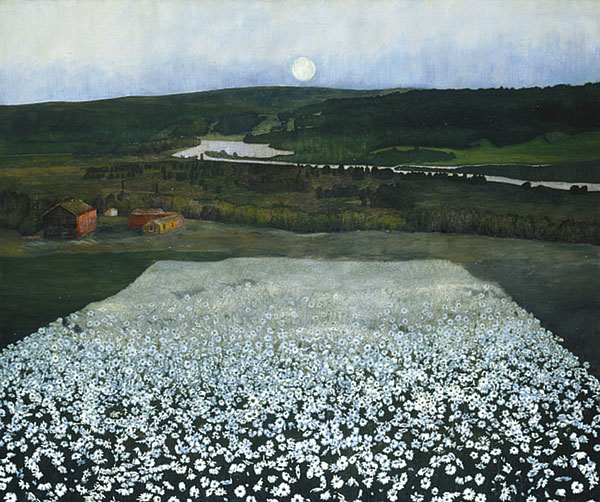
If there is a nation that stands out among the five represented (Denmark, Finland, Iceland, Norway and Sweden) it is Norway, not only for its indigenous tradition of the sublime, but also for a set of later works that emphasize a Parisian influence, be it the works of the Scandinavia's best-known painter Edvard Munch, or Harald Sohlberg's art nouveau Flower Meadow in the North (1905, pictured above).

Apart from the Norwegians, perhaps the most interesting national body of work on display is that of the Finnish, and particularly the work Akseli Gallen-Kallela. While Mirror of Nature's Finnish painters otherwise highlight a singular tradition of primitivist folk art, Gallen-Kallela's art may be among the most sophisticated in the exhibition. For instance, in Lake Keitele (1905, pictured above), the painter combines the placid, mirror-like surfaces of the lake with large washes of gray that emphasize the formal properties of the medium. In a second composition, Waterfall of Mantykoski (1892-4), Gallen-Kallela superimposes five vertical bars over the image of a waterfall, thus figuring the harp whose sonority compares to that of the cascade.

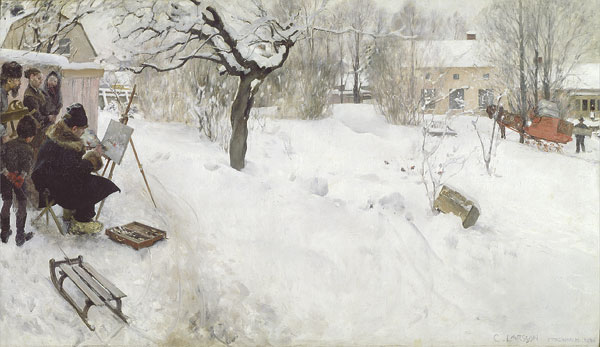
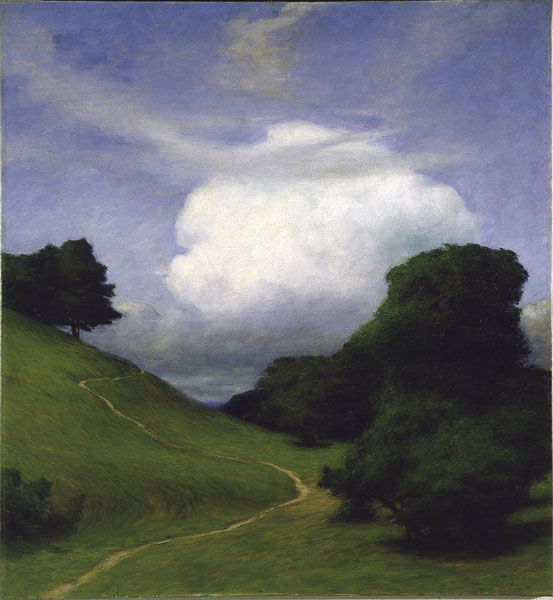
Other than the corpuses of Gallen-Kallela and certain of his countrymen, perhaps the most peculiar included in A Mirror of Nature is that of Sweden's Prince Eugen, which is noteworthly less for any representational ticks, than it is for the uncomplicated accomplishment of its royal creator. As the exhibition label states, "The Cloud [1896, pictured above] may at first sight seem to symbolize an ideal summer's day, but its mood is in fact more complex, marked by an undefined tension and a sense of a presence beyond what we are able to see." Along with Carl Larsson (his Open-Air Painter, 1886, is pictured at the beginning of this review), Price Eugen is the finest Swedish painter included in the exhibition and one of a number of revelations awaiting its Minneapolis patrons.

A Mirror of Nature: Nordic Landscape Painting 1840-1910 runs now through September 2 at the Minneapolis Institute of Arts. Following its lone North American venue, A Mirror of Nature will continue its tour of Scandinavia's capital cities. Sweet Land received its DVD release earlier this month.

Wednesday, July 11, 2007

New Film: Lady Chatterley

Pascale Ferran's Lady Chatterley may well have established a new standard in screen Romanticism, and at least indicates the currency of anti-Enlightenment thinking in our own time, as "John Thomas and Lady Jane" did within D. H. Lawrence's. Indeed, Ferran's film suggests the re-occurrence of this system of thinking not only in the aftermath of the First World War - in which Lady Chatterley's narrative is situated - but also in the 1960s (whose floral and free-love iconography are present) and implicitly again, in our own war-defined present. Perhaps the question becomes whether we have experienced any substantive change since the Second World War, Hiroshima and the Holocaust - at least within the Paris-New York axis - though that may be too much to hang on Ferran.

Rather, in spite of a certain historicity that is most evident in the above symbolic forms and even further in a passage adopting the style of home movies (where the medium's more recent specificity is highlighted - otherwise, with the help a minimal amount of imagination, Lady Chatterley's style almost seems commensurate with its historical situation), Lady Chatterley remains a relatively pure instantiation of the much earlier ethos. Throughout, Ferran emphasizes the narrative's rural setting, figuring both her heroine within the natural landscapes, in the vicinity of the gamekeeper's - her lover's - cabin, and commonly, elements of the environment itself isolated in close-up. Moreover, when finally the eponymous Lady Chatterley (César winning best actress Marina Hands) and the aforementioned Parkin (Jean-Louis Coulloc'h) finally do couple, Ferran manages to impute an incongruity to the garments they wear, in the face of the uncultivated nature. Of course, the pair will soon lose their apparel altogether, culminating in an ism-defining nude chase through an overgrown wood.

In short, Ferran's narrative imitates the conventional return to an animal nature from a constrictive civilization that was de rigueur within Romanticism. Exemplifying the scientific rationalism against Lady Chatterley is positioned, beyond the context of the recently-concluded Great War, is Lady Chatterley's husband Clifford (Hippolyte Girardot), who is not only wheelchair bound but further impotent as a consequence of the combat. In a particularly telling sequence, Clifford, in a new, motor-powered chair, attempts to climb a grassy hill with the assistance of neither his wife nor of the close-by gamekeeper. Unable to make it up the incline, he is assisted by the pair. In this way, not only his sexual inadequacy figured, but, following closely on the heels of a conversation with his wife when the latter advocates socialism, the powerless of the ruling class without the gamekeepers' and more directly, the soot-footed miners who occasionally appear in Ferran's narrative. To put it another way, Lady Chatterley showcases the congruence of left-wing politics and the Romanticism that defines the narrative. Undoubtedly, the critical enthusiasm for Ferran's film, both in France and most recently in New York, is a by-product of this seductive, politically-correct convergence - and again perhaps further confirmation of Romanticism's contemporary salience.

Still, speaking of the narrative, Lady Chatterley is most clearly a work of erotic cinema, though an instantiation with implications for the politics of the personal. During the first act of coitus, Ferran tightly frames her female heroine in close-up, registering her largely intractable expression throughout the act. In this way, Ferran maintains a system of identification that largely sutures Lady Chatterley's perspective by combining frontal framing and inserts of her visual point-of-view, or, as in an opening conversation recounting the horrors of World War I, her mindset via auditory means. At the same time, Ferran does not limit the viewer to the lead's psychology, but figures that of Parkin and those who share the Lady's estate.

Nonetheless, Lady Chatterley is dominated by long shot/long takes, lit by sensitively rendered natural light, which positions Ferran's film as the inheritor to a naturalist tradition in post-nouvelle vague French color cinematography that is perhaps best exemplified by the cinema of Claude Sautet (Nelly & Monsieur Arnaud, 1995) and André Téchiné (Wild Reeds, 1994). Perhaps the film's general suitability to its period follows from that era's proximity to the late 19th century visual tradition that Ferran's camera simulates. Similarly, Lady Chatterley shares in the slower pacing that is characteristic of many films in that tradition - often for the better - though in its case the value of this is perhaps a little less certain with a 168 minute running time that feels not a minute shorter.

Monday, July 09, 2007

New Animation: Ratatouille (co-written with Lisa K. Broad)

Writer-director Brad Bird's Ratatouille opens with a talking head from food critic Anton Ego, in which the Peter O'Toole-voiced pundit disputes legendary TV food personality Gusteau's (Brad Garrett) claim that everyone can cook. Enter the film's protagonist rat Remy (Patton Oswalt), an admirer of human beings - contrary to his father's wisdom - and their ability to not only survive but also to "experience and create," as well as the possessor of a very un-rodent like refined palette. With the latter acumen and the company of the hovering, transparent ghost of the late Gusteau, Remy endeavors to prove his maestro's point, first in his furtive visits to widow's farm house, and subsequently in the kitchen of Gusteau's eponymous Parisian eatery. (Each offers a similarly disgusting visual of a space besieged by the Remy and his kin.)

Once in the kitchen of Gusteau's, the suddenly silent rodent forges a puppetmaster-marionette relationship with gangly new hire Linguini (voiced by Lou Romano), himself completely helpless in the kitchen. Here, Remy fulfills the role of manipulator, thus securing an allegorical meanining in their relationship that is as pertinent to animated cinema than it is to its conventional photography-based format. Similarly, the licensing of Gusteau's image for microwavable burritos and bagel bites figures Bird's own creative product over and above the mass-produced items (animated and otherwise) from which Ratatouille is distingusihed.

Of course, the fact that Ratatouille lacks a human hand in its actualization potentially problematizes its anti-assembly line ethos. To this point, Bird's insistence that anyone can create - which is subsequently highlighted in a second speech by Ego where he notes that he saw something completely new in the kitchen - is itself a defense of the creative work accomplished in its this piece of computer-based animation. In Ratatouille we have a creator who is not human, but who has nonetheless created a work of a superlative aesthetic character that is simultaneously (and against expectations perhaps) warm. The true measure of computer-based animation is not simply its graphic successes, but moreover its status as a truly human art.

If therefore it seems as though Bird has made a bold claim for his own creation, fortunately for the director his filmmaking talents are more than equal to the task described in the film's rhetoric. Indeed, the director of the fine The Iron Giant (1999) and the extraordinary The Incredibles (2004), to date the finest work of American animation thus far this decade (in the opinion of Anderson), has again succeeded in creating a work of admirable visual narration. As with the latter in particular, Bird again adopts a facsimile of his protagonists' point-of-view, viscerally following his minute, fleet-footed hero as he races in and out of the tight spaces for which Bird's medium seems particularly well-suited. However, it is less his action direction capabilities (as advanced as they may be) then his attention to the details of his subjects: to the rats wet hair - this is the film where Pixar has finally overcome its textural limitations, achieving an unforeseen lightness; to the plating of an updated variation on the film's epnoymous dish that truly underscore Bird's artistry. Surely, Ratatouille is a work of total art. It is the rare piece of animation that is not intended primarily to sell toys.

Then again, Ratatouille is equally a work of premiere entertainment. In fact, when Ego receives the aforementioned plate, an old favorite transporting him back to the time of his childhood and memories of his mother, Ego drops his notebook and simply savors the dish before him. If Bird is addressing critics directly, he suggests that ultimate justification of Ratatouille like the eponymous plate on the dish, is enjoyment. The first rule is that the food tastes good, and that popular cinema be entertaining. With this baseline necessity, the aesthetic elaborations of each may be made.

As with the director's ode to human excellence The Incredibles, there may be no American filmmaker today as devoted to human greatness as is Bird. The irony, of course, is that Bird remains likewise the leading artist in the cinema's least human incarnation.

Sunday, July 01, 2007

In Memory of Edward Yang (1947-2007)

Courtesy of GreenCine Daily, Taiwanese director Edward Yang passed away earlier today at age 59. Best known in the U.S. for his 2000 masterpiece, Yi Yi, which is this writer's choice for the best film made thus far this decade, Yang directed only seven features and an eighth segment for a portmanteau feature over his three decade career. Yang was born on November 6, 1947 in Shanghai. After moving to Taiwan shortly after the 1949 revolution on the mainland, Yang and his family (like fellow master filmmaker Hou Hsiao-hsien) moved to Taiwan. Yang would later spend time in the United States, where he studied electrical engineering and thereafter filmmaking at USC (where he dropped out), before returning to his adopted homeland.

Having returned to Taiwan, Yang, along with Hou, spearheaded the "Taiwanese New Wave," which yielded a number of the finest films made over the course of the past twenty-five years. After contributing to In Our Time (1982), Yang released the seminal That Day, On the Beach (1983) a year later. However, it was with the director's 1985 Taipei Story, starring Hou himself, that Yang was established as one of the greatest directors of the late twentieth century. In Taipei Story, one of the three or four best films of the 1980s, Yang asserted his place as the contemporary heir to the 1960s cinema of alienation, introducing a formal rigor (one might be tempted even to see his engineering training as a formative influence on his technical precision) that has elevated Yang among his international art cinema colleagues.

After 1986's The Terrorizer, a strong film by any measure, except for perhaps against the films that preceded and followed it in the Yang's oeuvre, the director's next film was A Brighter Summer Day, which was in the opinion of many (myself included) the director's best, and, not to sound like a broken record, one of the very best films of its or any decade. As it happens, I was fortunate enough to see A Brighter Summer Day during my undergraduate years - spring of 2001 - though it did take something of heroic effort to attend the film: it screened one night only in Chicago, which at the time was three-and-a-half hours away from home. Knowing that it might be my only chance to see the picture (having discovered it through Jonathan Rosenbaum) I drove the seven hours round-trip on a school night to see Yang's sublime masterpiece. Suffice it to say that it remains one of my most precious film-going experiences.

Following a pair of comedies in the mid-90's, A Confucian Confusion (1994) and Mahjong (1996), the director made the third supreme masterpiece of his career, Yi Yi. To summarize, quoting myself from an earlier post,
'Yi Yi contains more than virtually any other film ever made. What is meant by [this] is not excess, but rather the full scope of existence: comedy and tragedy, happiness and sadness, feeling and empathy, the physical and the metaphysical, art and life. Indeed, Yi Yi represents nothing more than it does a prayer, offered on the part of its maker for its many characters who continue to make the same mistakes in their lives, generation after generation. After all, the literal translation of the title is 'One One,' intimating precisely this sort of repetition, which is likewise picked up in the names of the younger generation's protagonists, Ting Ting and Yang Yang. The latter, a clear stand-in for the director, becomes a photographer in order that he might show people the half of life that they do not normally see: in this case, the backs of their heads. His engagement is thus art, as his older sister, who repeats the same romantic mistakes as her father, chooses to speak to her comatose grandmother, who thusly becomes a stand in for god. At one point she even breaks from her coma (her silence) to comfort the young girl, even if it remains unclear as to whether this represents a literal occurrence. Either way, Yang's is a film that intentionally confronts as much of life as possible, offering open conclusions to the eternal questions it raises.'
Surely few filmmakers have ever made films that approach Yang's in terms both of their formal richness and in their depth of insight. Though film lovers everywhere should mourn the fact that we will never get the chance to see a new masterpiece by Yang - though for many, myself included, the difficulty in securing some of the above titles will mean that the joys of his work are still to come - the corpus he has left is one one of greatest we have ever been blessed with. Edward Yang will be greatly missed.

Sunday, June 24, 2007

On Connoisseurship (& the Achievement of Valeska Grisebach's Longing)

In a recent exchange in the comments section of the excellent group blog Termite Art, my good friend and site co-founder Matthew Singer and I had an extended exchange on the relative merits of reviewing films like The Fantastic Four: The Rise of the Silver Surfer (2007). At the time neither of us had seen the film, though at least in my view it nonetheless could serve as emblematic of all supposedly "critic-proof" films whose audience is assured more by the popularity of its comic source, the film franchise to which it belongs and most importantly the advertising dollars spent to generate interest than to the response of the critics. Admittedly, my commentary suffered from a naivete that Mr. Singer rightly pointed out. In my advocacy of ignoring films like The Rise of the Silver Surfer - assuming that it is indeed not of interest - I suggested another film that I had yet to see, Valeska Grisebach's Longing (Sehnsucht, 2006), as more deserving of print publications' attention. For this, Matt again called me out, asking who was to be the "arbiter" of what is "interesting." In my opinion, both Matt (host of IFC News and Internet film critic - and for those who have not read him, Matt is a very talented critic in the Roger Ebert mold, in my opinion at least) and myself (film studies PhD and Internet film critic - though less talented I'm afraid) qualify, inasmuch as we share a formal training in the discipline, and possess a discernment that follows from it and also (and perhaps more importantly) from instinct.

In retrospect, I should have expected the reaction I received on Termite Art: what I was advocating - and indeed I have come to realize that this is the driving force for all my work in the field of cinema studies - was connoisseurship, which is as uncommon in the field of cinema studies today as it is in the discipline of art history, where the term has been used pejoratively since the 1970s. Connoisseurship is viewed with skepticism by both the defenders of popular and "low" culture on the one hand - primarily for its elitism - and ideologically-minded critics and scholars on the other (for whom the determination of a work's value based on aesthetic critique is itself ideologically loaded). When one does see advocacy in film criticism currently, it is for political engagement, not for the determining of the status of the work of art over and against those of other works. Either art is fundamentally about pleasure, and therefore quality is subjective, as is I believe true for the modern-day defenders of popular culture, or culture is principally a tool for both political progress and regimes of suppression, shifting a work's value from criterion of aesthetic quality to those of political expediency.

As a connoisseur I deny both. For me, art enriches, it can instruct and it can improve. It helps us to see, and even more, to think. This is not to say that any work needs to say something novel or complex. In fact, I tend to subscribe to the theory that many of the best works are themselves mirrors, that they show us ourselves and that we are not alone in what we think or what we feel. In other words, they show us the truth - which as we all know continues to be under assault from those who would deny that such thing exists.

Moreover, works that do this are rare indeed. While, the Internet, an all-region DVD player and a small amount of disposable income has basically put the corpus of an entire art within reach of the spectator, the ever-expanding number of choices that one faces militates against seeing something worth the viewer's time. This again is where I believe the connoisseur comes in: namely in directing the interested spectator to works that will have an effect of enrichment. Above I mentioned that I had yet to see Longing when I used it as a counter-example; I based its utility on the high regard it found last year among British critics (and the certainty that few readers would have heard of the film). Having since viewed Grisebach's work let me redouble my advocacy: Longing is exactly the sort of film that critics have the responsibility to lead their spectators to, so long as they believe film is an art and that art can elevate.

What is it one might ask that separates Longing from other works currently in the marketplace? (Usually Tativille commits itself to this precise task without the meta-commentary; in future I will continue to do exactly that.) To begin with, Longing secures an emotional complexity in its female performances that is rare indeed - in one particularly remarkable moment, upon discovering that her new lover does not remember that they slept together, we see one of Grisebach's heroines masking her fleeting joy behind an expression of jubilation. She has to show her new lover her satisfaction while hiding the sadness that his question has wrought. We see in this instance the intimations of what her life may have been, that perhaps such opportunities are not so common with her and when they do seem to occur, that they evaporate just as quickly. In other words, Grisebach gives us a mirror.

Then again, in her male lead, we have a cipher. We understand what he is thinking as much as his wife (the film's third principle) does, which is to say that his psychology is a source of mystery. As such Grisebach reverses the logic of most films that employ this epistemological pattern - wherein the woman is the greater source for mystery. Further it is truly his body, his face that is the more acutely fetishized: in another of the great moments in the cinema of the past year, Grisebach frames her male lead dancing to a Robbie Williams song in tight medium close-up, from his shoulders up. He closes his eyes and sways to the music, reminding us how young he is. Truly, he has become the object of the spectator's - and shortly as we see the waitress/his future lover's as well. In short, Longing, helps to see both the complexity of its very real characters and also the narrative systems it is responding to and revising.

We also see a world that is at once quite foreign - small-town, rural Germany - and still quite familiar to this viewer at least. Grisebach shows us a place/a community that most viewers of her film will never see in person. This I would submit is its own justification. At the same, and thus expanding the work's value further, her rendering of the landscape and particular the sensitivity she shows for light - particularly that light just after sunset - shows a nature that may be very familiar to viewers, even if it is rarely detailed on screen. Longing indeed evokes a feeling of place that is dependent on the spectator's awareness of this time of day at a particular time of year. The tactile feeling of place that accompanies this knowledge therefore becomes an end of Grisebach's work, open to those with a familiarity for such places, just as her characters introduce us to real, albeit complex emotions. To see ourselves and the world we live in we as spectators do need a certain degree of sensitivity.

In sum, Longing proposes to show us truths, emotional and natural, that it relies upon us to confirm through our experience. Then again, its situation - an instance of adultery and its consequences for a marriage - are unfamiliar to many a spectator. In this regard, Grisebach allows for the possibility of a moral truth, though suffice it to say that she ultimately leaves it open to the spectator to determine the film's conclusion. In the film's closing, semi-diegetic (as my viewing companion Lisa Broad so eloquently put it) scene, Grisebach makes us aware of her own agency - thus highlighting the film's construction - in the person of a tween, even as she establishes the film's open ending. As such, Longing asks us to decide for ourselves; it raises a scenario and invites its spectators to find a solution. It asks us to engage with the work of art, while delineating the roles of filmmaker and spectator. She makes it abundantly clear how her film is constructed, while preserving her narrative world.

This active role for the spectator is essential to the connoisseurship I have above highlighted as my methodology. When viewed as a source of pleasure foremost, passivity is the rule. When viewed through an ideological lens, the artist's manipulation, for better or for worse, becomes key. However, when art is considered for what it shows us, the spectator becomes cardinal. This I believe is a verification of the above system's merit: that compels its viewer to think, to remember and even to judge.

Wednesday, June 13, 2007

The Best in (Not Exactly) New Korean Cinema: Peppermint Candy (2000) & Christmas in August (1998)

With the feting of his latest film, Secret Sunshine, at this year's Cannes festival (in the best actress category) director Lee Chang-dong appears poised to break through to Western audiences - in that way that Korean art house directors do, on the festival circuit. In other words, Lee could soon be familiar to the same European and American spectators who know the names Im Kwon-taek and Hong Sang-soo, should that is Secret Sunshine receive the attention that some critics have been arguing it deserves. (Of course, there is another stratosphere of Korean art house success - namely Park Chan-wook's Oldboy [2003] and Bong Joon-ho's The Host [2006] - that does not apply here.)

With that perhaps overly optimistic scenario in mind, it would seem fit to turn our attention to the most widely acclaimed of the director's previous three features, 2000's Peppermint Candy, which remains in the opinion of many one of the pivotal works of the New Korean cinema. Peppermint Candy opens with a small, light colored dot in the upper half of the screen that continually increases in size. Soon, it becomes clear that said shape is the opening of a rail tunnel that we are about to exit in the film's inaugural phantom ride. After this single take opening, Lee includes a title, 'Outdoor Excursion Spring 1999,' before cutting to a middle-aged man lying motionless on the ground. The aforesaid prefatory image, as we will soon discover, becomes a visual motif for the picture, which Lee has structured as a series of scenes or sets of scenes that are arranged in reversal chronological order. Concurrent with this, it will also become evident that the transitional phantom rides are themselves spooled backwards, reinforcing the film's narrative-in-reverse organization.

In this opening passage, the whiskered, disheveled gentleman to whom we are initially introduced, Park Yong-ho (Sol Kyung-gu), rises from the ground and approaches a group of late thirty-somethings who are picnicking on the banks of a river. Park walks into the center of the group, bumping into the puzzled picnickers; however, these bewildered day-trippers soon recognize Park's identity, he was old friend of theirs, and one of the celebrants even says that he wanted to call Park, but no one knew his whereabouts. Following his uncomfortable reintroduction to the group, Park commences singing karaoke with a song featuring the lines "what can I do if you leave me behind" and "I loved you so much." At this point, with only the strangeness of the lead's gestures to guide us, we anticipate that these lines of dialogue might tell us something about his behavior, perhaps that he was long ago estranged (or even abandoned) by the group he now confronts.

After this opening salvo, Park continues with his inexplicable behavior, walking out into the nearby river, and a moment later, climbing onto the top of a rail bridge. After a train passes by on an adjoining track - much to the relief of his acquaintances - a second approaches on the bridge upon which he stands. Thrusting his arms open, Lee waits for the on-coming train, which obliterates the protagonist a moment later.

Immediately prior to this accident, Lee freezes on Park's gesture, relayed in a freeze frame, and then we have the film's second phantom ride image accompanied by a subsequent title reading 'The Camera. Three Days Earlier. Spring 1999.' In this sequence we are introduced to the protagonist's despair in the days before his suicide - he even holds the gun to his head, though as per the film's structure we know he does not pull the trigger. Likewise, through rare a moment where the dialogue is used for exposition, we are made aware that he has a wife that has left him, and in a scene intentionally robbed of its poignancy, we see the lead meet with a former love, from whom he receives a gift whose significance only becomes clear toward the film's conclusion.

As we continue to move backward, Park next introduces the spectator to his wife in the throws of an affair, and thereafter to someone whom Park knew when he used to be a police officer (by this point he has entered the private sector and become a successful businessman). In this passage he rhetorically asks the second male, while they stand side by side in a public restroom, whether "life is beautiful." While this question seems to possess an ironic quality given the scene that we have just witnessed, again Lee invests it with a deeper resonance as his narrative continues its backward trajectory.

Lee's narrative reaches a climax in the film's penultimate passage, 'Military Visit May 1980,' named for a visit from the protagonist's first love Sun-im (Moon So-ri). (Spoiler for the less detail conscious viewer: Sun-im is the woman we are introduced to, on her death bed, three days prior to Park's suicide.) During this scene, coinciding with the declaration of martial law on the Korean Peninsula, Park commits an act that it becomes clear shaped the totality of his future life, leading ultimately to the suicide that opens the film. Similarly, the declaration of martial law was a moment from which contemporary Korean history. In fact, as has been cofirmed by a Korean colleague of mine, all of the key moments in Lee's film correspond to quintessential junctures in the nation's history. The personal and political are consubstantial in Lee's picture. Peppermint Candy is a national history in the form of an individual-centered narrative.

In delaying his revelation of the aforementioned acts, Lee refuses the simple causal reading that would dominate the same narrative spooled in chronological order. Instead, Lee secures a new position for his spectator: as a voyeur privy only to the acts and the immediate clues disclosed in the scene; in Peppermint Candy we see as we always see the unfamiliar, from the outside, without the privilege of knowing the thoughts of another. At the same time, Lee's structure suggests, as the narrative slowly proceeds in reverse, that life was once better for Park, and as we are introduced to Sun-im to a greater and greater degree, that somehow the film's protagonist has lost his opportunity to be happy. Again, the film's reverse narrative does not allow the spectator to develop a false hope; whereas a more conventional narrative would always allow for a possible future happiness in that which has yet to occur, we know that things are going to end badly for Park. Lee rends with certainty and all lack of ambiguity the narrative of a life that was not as it could have been. The past truly cannot be remedied.

This same feeling of a life not consummated pervades Hur Jin-ho's much more conventional Christmas in August (1998), another of the New Korean cinema's key works. Like Peppermint Candy, Christmas in August centers ultimately on a love affair that is not meant to be, in its case due to the terminal disease afflicting the film's male protagonist, Jung-won (Han Suk-kyu). Jung-won operates a photo gallery, where he shortly meets a pretty young woman, Da-rim (Shim Eun-ha), who is at least a decade his junior. She begins to come by more and more often to chat with the perpetually smiling Jung-won, of whom at no point does she know that he is in the final days of his existence. For his part, the unmarried Jung-won - he does have a past love who comes by asking about his health and why he never married; he tells the woman he was waiting for her - suffers in silence, at night, and in a drunken confession to a male friend, discloses his numbered days, though his companion does not seem to believe him immediately.

As Hur's light-hearted, chaste romance progresses, we are at once aware that their nascent relationship cannot work out, even as the film's forward trajectory reserves the possibility for a (conventional) miracle, unlike Peppermint Candy where such a scenario is prevented by the film's reverse structure. Nevertheless, Christmas in August conveys a life that could have been, a possible happiness finally denied to its protagonists. Indeed, Hur crystallizes this theme in one of the film's final images: Jung-won looks at Dar-im in the distance; we see his out-of-focus hand - Hur uses a telephoto lens to compress the distance - touching the section of glass behind which the woman is visible. As such, the glass itself becomes a pressing reminder of the impossible gap that separates the pair - his illness - however close they have become.

Ultimately, if Hur's film lacks the immutability of Peppermint Candy's tragedy, it gains in pathos through our awareness of the circumstances of the romance, in comparison again to Da-rim who does not share our and Jung-won's knowledge of the situation. Indeed, this is a film where everything meaningful can be read in the protagonists' gestures, emotions, and especially in the male lead's withholding of the latter. Christmas in August's power comes from our knowledge of the suffering that Jung-won keeps hidden in his final few days of bliss, behind his grinning mask.

In this regard, Hur's film owes no small debt to the cinema of Japanese master Yasujiro Ozu, whose influence can at times be overstated with regard to contemporary Asian cinema. Here, there can be no mistaking the director's inspiration - though it could just as well have been Hou Hsiao-hsien's early work which that director has long claimed was not inspired by Ozu, though he would later make an homage (Cafe Lumiérè, 2003) to the director - which was always true of Kore-eda Hirokazu's After Life (1998). In fact, like that death-centered narrative, Hur utilizes frontal set-ups that coincide with snap-shots taken in Jung-won's studio. Likewise, Christmas in August compellingly overlaps with a second film from that same year, Olivier Assayas's Late August, Early September (itself a clear homage to Ozu in title if not in subject) in both theme and once more, even in title.

Of course, Peppermint Candy also has a significant correspondence of its own: Christopher Nolan's 2000 Memento. Nolan's film, which in the opinion of this writer Peppermint Candy bests in virtually every regard, including the wonderful lead performance that has been heretofore neglected, uses the structure to convey the protagonist's state of amnesia to the spectator, where again Peppermint Candy uses a similar structure to make one's fate irreversible. Peppermint Candy says something profound about time, namely that it cannot be countered, whereas Memento's time structure smacks of gimmickry, though executing in a highly entertaining and innovative manner.

With the curious overlap between Christmas in August, Peppermint Candy and the aforementioned better-known Western (and Japanese) art house films, the development of the New Korean cinema as a shadow to the established canon begins to emerge. While again the films of Im, Hong, Park and Bong have begun to remedy the neglect of a national cinema whose vitality has long preceded its visibility, it is high time that some of the very best works in this tradition become better known to the Western cineaste. Hopefully Secret Sunshine can accomplish this for Lee. For Hur, wide-spread appreciation may not be as immediate, though any viewer with a DVD player (the region 3 Edko Video DVD for this film will pay in region 1 players) will have the opportunity to see what we have been missing in the neglect of the New Korean cinema - a work of boundless warmth and humanity, the very antidote to the high-key, extreme Korean cinema best known to film-lovers outside Korea. At the very least, Christmas in August and Peppermint Candy confirm the substantial breadth of the New Korean cinema.

Friday, June 01, 2007

The Best in Romantic Comedy: Knocked Up (2007) & Antoine and Antoinette (1947)

Writer-director Judd Apatow's Knocked Up opened Friday to near universal acclaim and the prospect of sizable box office. While I was a big fan of Apatow's largely under-appreciated television work (Freaks and Geeks and Undeclared), I was also a detractor of his previous feature, The 40-Year Old Virgin (2005), which was another well-reviewed box office hit that nonetheless struck me as one-note. With Knocked Up, Apatow exceeds these previous efforts in every respect, creating easily one of the funniest comic features in the past few years. In other words, Knocked Up fulfills the substantial promise of Freaks and Geeks and Undeclared.

As many of my readers are familiar undoubtedly with the premise of Knocked Up, I'll be very brief: Seth Rogan's Ben Stone, an apt name for the out-of-work (except for his development of a porn website) pot-loving illegal alien from Canada - a bogeyman to put the southern border's worst to shame - knocks up beautiful E! on-screen personality Alison Scott (Katherine Heigel) after a night of dancing (Ben may indeed throw the dice too many times, but that's all he's got) and one too many cocktails. Ben has his charms, to be sure, but the idea that she and he would end up together, regardless of the shots consumed, strains credulity.

After learning she's become pregnant following the pair's unprotected one-night stand - Ben just assumes she uses a "dam" or something, which he knows is disgusting - Alison reveals her pregnancy to her mother (Joanna Kerns) who says they'll get rid of it. She even reminds her of a relative who had a "real" baby after terminating a similar pregnancy. By contrast, Ben's father (auteur icon Harold Ramis) refuses to look at the pregnancy as a tragedy, reminding Ben that he's "the best thing that ever happened" to him, which Ben claims depresses him. In fact, Knocked Up may be the most pro-life mainstream Hollywood film in quite awhile - as Ben furtively tells the infant the story of its conception late in the film, he tells the child that failing to use a condom was the best decision he ever made.

This is not to say that Knocked Up is exactly safe for conservatives: beyond the fact of the one-night stand, Apatow's picture largely trades in sexual explicit jokes and stoner humor, with Ben's friends being more or less stereotypes of this latter sort - say That 70's Show with the cast of Freaks and Geeks (a skeevy Jason Segel may be the cringe-inspiring highlight, though its nice to see Martin Starr getting work, sporting a beard that is another of the film's running jokes). Still the film's profanity is no more the point ultimately than is its default pro-life stance. In the end, Knocked Up serves to reassure its twenty-something audiences (as also its protagonists from that same generation) showing them that there is nothing to fear from growing older and starting a family, however unconventional its construction. This is a film that gives its listless male viewers a gentle push toward responsibility (and its career-focused young female spectators the reassurance that having a child isn't life-ending - in fact, it helps Alison's career in Knocked Up), which both Ben and Alison accept at separate junctures of the pregnancy/film. Apatow's vision is unexpectedly generous - and in a way old-fashioned - coming on the heels of The 40 Year-Old Virgin.

Of course, Apatow's style remains televisual in Knocked Up: nearly every scene is constructed on the basis of a shot/reverse-shot editing structure, with the dialogue delivered in excessively shallow compositions of the scenes' actors. Inebriation, both during the original one-night stand and in a subsequent trip to Vegas produce two of the only deviations from this system. Indeed, Knocked Up is basically a film of one-liners, with Rogan and Alison's brother-in-law Pete (Paul Rudd in one of the film's most charismatic performances; his on-screen wife Debbie, Leslie Mann, is another stand-out) delivering many of the film's best lines. Be forewarned, nonetheless, that Apatow's humor combines graphic locker room banter with keen pop culture references; in other words, if you don't know Wild Things or Matisyahu, Apatow's humor might not be to your taste.

More universal in its light humor, and far more remarkable in its filmmaking technique, Jacques Becker's Antoine and Antoinette (1947) first came to attention for its Cannes prize victory sixty years ago, and as such deserves to be celebrated in a year where that same festival recently handed out its sixtieth anniversary prize. Instead, Jean-Pierre Melville's recent smash success (Army of Shadows, 1969) has assured that he will again represent film past during the summer retrospective season - this time with Le Doulos (1962). All Antoine and Antoinette has going for it is an infinite reserve of charm and boundless warmth, of a degree that has been rarely (if ever) achieved on screen. Obviously these are no competition for fashionable cynicism.

Antoine (Roger Pigaut) and Antoinette (Claire Mafféi) are a poor, early twenty-something married couple. He's a typographer and she works in a large department store where she's in charge of the passport photos machine. The exceedingly attractive Antoinette is constantly receiving propositions from the store's patrons and especially from a wealthy, middle age store owner M. Roland (Noël Roquevert). He continually attempts to lure her with the promise of riches her husband does not have the means to provide - in fact, it seems as though he has succeeded in doing this with another of his female employees. Nevertheless, Becker leaves us no doubt that the couple is very much in love, whatever their material wealth.

Fates change, however, with the discovery of a winning lottery ticket in one of Antoinette's volumes. The pair plot out what they'll do with their jackpot winnings of more than 800,000 francs - a new dress for her, a couple of new suits for him, a motorcycle with a sidecar (far better than his bicycle with the wrecked tire). Going to bed, the ticket is placed in a secure position as Antoine bides his time until he can collect their life-changing winnings. He is finally going to be able to give his beautiful young bride the life she deserves.

Suffice it to say that Antoine and Antoinette complicates their collection of winnings, though the plot machinations are not those we initially expect. In so doing, Becker reveals the core of pathos that defines his narrative: Antoine is not the sort of man (without revealing too much of the Le Million-inspired plot, we are led to believe he'll never be the sort of man) who can give his wife wealth. How then can she be happy with him, when her beauty assures that countless men could and would do exactly that? This again is the essence of Becker's film; Antoine and Antoinette discloses an essential young male anxiety.

At the same time, in the object noted above, Antoine and Antoinette also offers a fantastic solution to the basic problem highlighted. So too is Knocked Up a projection of male fantasy: a listless, twenty-something impregnates a beautiful E! news anchor - much to Apatow's credit the protagonist does not know this before hand - with whom he would have no chance in any known universe. Okay, getting a girl 'knocked up' is shall we say not exactly a male fantasy, but being with a girl like Katherine Heigel most certainly is, unemployed Canadian pothead or not. Simultaneously, Apatow offers a glimpse of twenty-something anxiety commensurate with the new century: here, of getting older, of taking a job, and most importantly, of starting a family. Again, Knocked Up reassures us that things will work out. This is his generosity.

Becker's finds his in the form of film magic Antoine and Antoinette employs: here, the intervention occurs in the improbable discovery of the ticket. Antoine and Antoinette does not deny the currency of the anxiety, even when Becker gives us every sense that Antoinette will stay with Antoine regardless. We just really want everything to work out for both of them, and for there to be no reason for Antoinette in particular to regret being with Antoine. Actually, the same hope that they'll work it out permeates Knocked Up, though Alison does have a good deal more cause to choose not to be with Ben; in this respect, Apatow and Ben must work some magic of their own - cleaning his character up, getting him a job, namely in securing the lead some theretofore absent responsibility.

Of course, the magic of Antoine and Antoinette, to return to the earlier film, is not confined to the film's plot, but instead infuses the picture's immediate post-war settings (shot in longer duration takes that showcase the Parisian locations, both public and domestic) and the director's whimsical technique, which feature devices such as the iris underscoring the film's debt to early cinema and particularly to René Clair. Then again, Antoine and Antoinette provides one of the most definitive anticipations of the nouvelle vague that would transform international art cinema a dozen years later. This is filmmaking at its freest - the director's subsequent Rendez-vous de juillet (1949) provides an even more explicit link to the free-forms of jazz that Antoine and Antoinette seems to mimic on occasion. Antoine and Antoinette remains one of the nearly forgotten treasures of the international cinema, so deserving of remembrance in this its sixtieth anniversary.

In the end, like Knocked Up, Becker's film is about joy: whereas the former locates it in children, commemorated over the film's heart-warming closing credits, Antoine and Antoinette finds this same quality writ in its protagonists' situations - once again, of being young and in love. The precariousness of joy is to be defended at all costs, be it in the rearing of children or in the magical intervention of film itself.