Wednesday, August 20, 2008

New Film: A Girl Cut in Two / La Fille coupée en deux (2007)

Though it is not without its peaks,* the cinema of nouvelle vague maestro Claude Chabrol retains a certain minor quality across its fifty years, forever favoring the divertissment of acerbically-pictured bourgeois duplicities as something other than thematic view-point. This something other might profitability be called a genre, were it not so wholly identified with Chabrol himself, in much the same way that Hitchcock's thrillers strike us as Hitchcock's first, rather than as ordinary or even extraordinary instances of a larger category. Chabrol has similarly crafted an artistic identity that is consubstantial with an immediately recognizable signature form, as if to prove the veracity of the auteur theory that he once helped author. Indeed, the formal application of what is essentially an organizing principle - namely that the films of a single director might be profitably read with and against each other - serves as the engine of the enduring "New Wave" movement, whether its Rohmer's tales/comedies/seasons, Rivette's allegories for narrative creation and mise-en-scène, or Godard's self-reflexive dissections of film form. Chabrol, almost more than a Rohmer - or even a Mondrian - works in the slightest of variations.

A Girl Cut in Two (La Fille coupée en deux) adheres to this same principle of small difference, figuring a Marquis de Sade beneath the cultivated exterior of provincial author Charles St.-Denis (François Berléand). Though surrounded by developed sensuality, whether in the graceful form of his saintly wife Dona (Valeria Cavalli) or the darker expertise of the startling Capucine (Mathilda May), St.-Denis nevertheless seeks the company of blond, weather-girl bombshell, Gabrielle (Ludivine Sagnier). Sagnier's twenty-something is introduced by the first of a series of hard-cuts that finds the on-camera personality standing before a blank green screen. St.-Denis presence in the studio, and subsequently in a nightclub, alongside Benoît Magimel's Paul Gaudens - a stranger to both Gabrielle and the film's spectators, but not to St.-Denis - provide two near introductions before a formal meeting at a book signing the next day. Suffice it to say that St.-Denis propositions the much younger Gabrielle - and that she soon reciprocates.

In following St.-Denis to "Paradis," his urban work sanctuary featuring a presumably much-used double bed covered by black and faded jewel tone-stripped sheets, Gabrielle implicitly rebuffs the advances of the more age-appropriate (and obscenely wealthy) Paul, who is himself the perfect Hitchcockian dandy, a marginally heterosexual heir to the eponymous Lodger (1926) and to Strangers on a Train's Bruno (1951).^ Like St.-Denis, with whom he shares a mutual, albeit mostly undefined enmity, Paul is captivated by the lithe young beauty, whose attraction for the spectator - or at least for the heterosexual male viewer - seems as much conditioned by Chabrol's narrative structure and camera work as it is by Sagnier's actual physique. Certainly Sagnier provides a striking presence in her white-cinched overcoat and in a corsetted red top - shot before a flat, single-toned red backdrop. Yet, early on at least, Sagnier seems to be on screen too rarely, turning her back to the viewer or cut away from by Chabrol when it is her beauty precisely that organizes the narrative. Chabrol keeps us desiring this woman's presence, until another hard cut, following an unspecified, off-camera act undertaken by St.-Denis and Gabrielle in an upscale brothel, inspires the female lead to solemnly ask to be taken back to his flat.

This conspicuous on-screen absence serves as one of the director's principle narrative strategies in the relatively opaque A Girl Cut in Two, where the details of what is left off-camera remain immured from speculation. For all of the film's sadistic implications, Chabrol's mise-en-scène retains an exterior chastity,+ only hinting at the degradations that befall the willing Gabrielle during her sentimental education - the image of Sagnier on hands and knees in black negligee (and with peacock feathers attached to her rear), which may well be seared into the spectator's consciousness by the film's ultra-sexy poster, is perhaps the most obvious exception. Chabrol in other words balances the puritanical and that decadent that his surrogate St.-Denis proposes as the two possible states for the current French character. As the Chabrolian sub-genre dictates, the one is located behind the other.

*At the top, one must include Les Cousins (1959), Les Bonnes femmes (1960), An Unfaithful Wife (his masterpiece; 1969), Le Boucher (1970), Violette (1978), and La Ceremonie (1995). A second level of contenders might further contain Le Beau Serge (1958), Les Biches (1968), Wedding in Blood (1973), Story of Women (1988), Merci pour le chocolat (2000) and Flower of Evil (2003).

^ Richard Allen has a fine consideration of this character motif in Hitchcock's Romantic Irony (Columbia University Press, 2007)

+ Chabrol's handsomely lit and lensed visual style (by frequent Chabrol collaborator, cinematographer Eduardo Serra), notable as so much French cinema for its pale blue tones, is commonly articulated through the distinctively classical technique of shot/reverse-shot editing. Among the best examples of the cutting is Gabrielle's meeting with her television station supervisor in the latter's office. For the film's filtered look see Paul's mother at home late in the picture's runtime.

This piece is dedicated to the memory and inspiration of the late Manny Farber (1917-2008).

Friday, August 08, 2008

From Catastrophe: Jean Renoir's The Southerner (1945)

There are moments in the history of the arts when apparent cataclysm yields sterling results. One such instance is the break-up of the greatest band of the 1980s, The Smiths, after just four LP's. Sprouting from what seemed to be a cultural calamity, Morrissey's solo career may not stand up to The Smith's corpus song-for-song and album-for-album - not even The Beatles arguably can match The Smiths in either category - but there can be no denying the richness and even variety of his post-Smith's output. His is a career without which the best in latter-day indie rock would seem unthinkable.

Likewise, director Jean Renoir's exit from France following the critical and commercial disaster of his ultimate master work The Rules of the Game (1939), marks another such node in the history of artistic expression. No filmmaker can claim the sustained level of achievement that Renoir attained during the 1930s in his native France, where with one masterpiece after another the son of the Impressionist both defined an entire industry, as well as a film movement ("poetic realism") while exceeding his time - save for the even more tragic two-feature career of Jean Vigo - effortlessly. "The French Renoir" was the greatest of all French directors, proving the celluloid heir to that nation's venerable naturalist and (again) Impressionist traditions.

Hollywood, on the other hand, and particularly its studio settings, certainly must have seemed ill-suited to facilitate the director's characteristic realism. Yet The Southerner (1945) emerges as a full flowering of the director's mature - location-bound - idiom, in its case transposed onto the flat cotton fields of the American south. The Southerner further marks the middle point between Renoir's 1939 The Rules of the Game and his late period masterpiece The River (1951), both chronologically and thematically.

Borrowing from the earlier film, Renoir infuses his American film with a like carnality, fixing chiefly on its male protagonist Sam Tucker (Zachary Scott). Sam maintains an active conjugal life with his wife Nona (Betty Field), is forthrightly desired by a pretty young neighbor girl (Noreen Nash) and is twice pursued over his single pal - who in serving as the narrator in the film's picture book opening fulfills the role of the plump Renoir surrogate ala Octave. (He similarly offers comic relief in a pair of unexpected outbreaks of violence that reinforces the link.) Sam's mother, moreover, is displayed in the apparent aftermath of a tryst with her aged fiance, lying beside the gentleman in the partial shelter of the cotton crops. Looking forward, The Southerner's physicality anticipates Renoir's under-appreciated ode to sensuality, Picnic on the Grass (1959).

In fact, The Southerner repeatedly looks ahead, though often to the less distant The River. In embryonic form, The Southerner anticipates that later film's cyclical understanding of human history and its organization of life into seasons, depicted in a calendar illustrated by its Americanist drawings (cf. John James Audubon); the snake motif is referenced but not developed; and lastly, it refers to and even suggests the possibility of dead children - a theme again that overlaps with The River.

The aforesaid child, Sam and Nona's son, is endangered by their villainous neighbor Devers's (J. Carrol Naish) initial refusal to share water and later his insistence that he not be given milk (for his "spring sickness"). We are told that in both cases, these supplies can be easily spared the child, which basic human sympathy would dictate. In this regard, and in the ever-present suggestion that Sam and his family might have their lease revoked by a potentially malevolent landlord, Renoir's American cinema reintroduces the communitarianism of his leftist French film practice - though as (almost) always, the director's politics are worn lightly.

Renoir's humanism, however, is equally clear in his portrayal of the highly sympathetic proletariat Tucker's, whether it is the perpetually hard-working Sam or his strong-willed wife. She is in fact the one member of the family who seems to be able to reign in the often unreasonable Granny (Beulah Bondi) - she complains when one of her two blankets is used to make a coat for her granddaughter; in certain respects, Bondi's character seems to anticipate Pather Panchali's (1955) similarly curmudgeonly matriarch. Actually, that Bondi has been cast in the part sheds some light on Renoir's famous assertion that Leo McCarey knew the true nature of people better than anyone else in the American cinema: surely it was Make Way for Tomorrow (1937) that inspired the quotation?

Still it is less these characterizations than The Southerner's visual interest which truly assure its high level of accomplishment: the horizontal cotton fields often picturesquely framed by the Tucker's dilapidated farm house; and the dark storm clouds gathering above Granny's head; the enormous catfish pulled from the muddy river; and the conclusion with the film's protagonists wading out into the overflowing artery; the opossum hanging in the tree; and Nona collapsing onto the dirt field, her arms burrowing beneath the dry surface. In this last moment in particular, The Southerner's physicality is translated into gesture, producing a film of almost ineffable carnality.

And of course, metaphor adheres in the film's landscape, whether it is the slow leak in the farm house's roof or in the downpour that signals catastrophe for the Tucker's. Yet, it is the untransportable nature of the director's visuals, be it Michel Simon's flotation in Boudu Saved from Drowning (1932) or Betty Field's collapse into the dirt that mark Renoir's cinema at its very finest. From The Rules of the Game's failure would come one of the lesser-seen treasures of America's war-era cinema - as well as one of its greatest, and most tactile, single moments.

Monday, August 04, 2008

New Blog: Ten Best Films

Dearest Tativille readers,

To provide greater access to Tativille's most popular feature - the film lists - I have created a second site exclusively devoted to these: "Ten Best Films." In the meantime, Tativille will continue to feature my original film and art analyses, including a newly published extended essay on Rossellini's thematic emphasis on hagiography. Enjoy the new site!

Update: And for a little context as to what you may be looking at with all those lists, see David Bordwell's spot on new post, detailing the differences between cinephiles and cinemaniacs, and apropos of "Ten Best Films," the games we cinephiles play.

Rossellini & Sainthood: A Tativille Essay

Introduction
What can be seen on earth indicates neither the total absence, nor the
Manifest presence of divinity, but the essence of a hidden God.
-Blaise Pascal, Les Pensées, c. 1650s

In the fall of 2003, the Museum of Modern Art programmed a series of films under the heading The Hidden God: Film and Faith. Spanning much of the history of international art and popular cinema, from Leo McCarey’s Love Affair in 1939 to Steven Spielberg’s A.I. – Artificial Intelligence in 2001, from Au hasard Balthazar (Robert Bresson, 1966) in France to Yaaba and Tilai (Idrissa Ouedraogo, 1989 and 1990) in Burkina Faso, all the works had in common an emphasis upon the invisible presence or the explicit, directed absence of the divine. In other words, they are films that largely maintain the material nature of the cinema – that is, they do not figure immateriality through special effects, animation, etc, – whatever their stances may be on the existence of a reality beyond the physical world.

Consequently, it should surprise no one that among those filmmakers featured in the program (and in a subsequent volume of essays on the film) Roberto Rossellini leads all directors with four features: Stromboli (1950), The Flowers of St. Francis (1950), Europa ’51 (1952) and Voyage in Italy (1954). Of these, what is immediately striking about each, with the exception of The Flowers of St. Francis, is that they are collaborations between Rossellini and his then-lover Ingrid Bergman, that they feature present-day settings, and including St. Francis now, that they were made in succession. Indeed, it is almost as if we can see an attitude and emphasis in these works that was specific to a single moment in the director’s career. That is, during his Bergman cycle, Rossellini exemplifies a strain in postwar European modernism, where in a religious context the formal limits of the material medium is used to figure the limits of epistemology and materialist conceptions of the universe. Divine presence equates

to the un-representable in its cinema, as it does in other art forms. [1]

Of course, this moment is far from exhaustive when it comes to religious subject matter in Rossellini’s work. To begin with, there is the director’s sympathetic portrayal of clergymen in his epochal Rome, Open City (1945) and Paisan (1946), his fable of a simple woman who believes she is going to give birth to Jesus Christ in The Miracle (1948), his biography of French theologian Blaise Pascal (1971) and most striking of all, his ‘life of Christ’ narrative, The Messiah (1976). In the last of these in particular, God is no longer hidden, but is made flesh in the person of Christ, which in fact is the very economy that serves as the basis for religious representation in Western art. At the same time, Rossellini retains a purely material mise-en-scène in The Messiah, refusing to represent the miraculous on screen (this includes even the resurrection which is implied by Christ’s absence in the tomb and a cutaway to the clouds above). In other words, Rossellini’s The Messiah attempts to realize the physical experience of Christ’s life on earth, retaining the realist aesthetic for which he is remembered. Like The Flowers of St. Francis, The Messiah reproduces a facsimile of what this world must have looked like, thereby eschewing a tendency to remake the past in the image of the present. [2]

So if realism is an irreducible quality of Rossellini’s figuration of metaphysical content, what are those factors that distinguish the works from each other? On what basis, in other words, might we erect a taxonomy of religious expression in the director’s corpus? Recalling both their refusal to embellish – that is to depict the immaterial materially – and also the situation of many narratives in the present tense, an emphasis on the life of the believer in the modern world becomes an obvious stage for the films. In particular, Rossellini’s religious work seems divisible into two primary categories: films that treat the life of the saint, and those that represent the experience of the sinner. Among others, a definitive example of the latter is the director’s Stromboli, which “reduced to its simplest terms… turns out to be, with a new accent but with age-old significance, the struggle between Creator and creature.” Here, however, all is not hopeless; grace intervenes: “God, her antagonist, will reveal himself to her only at the end, triumphing over both chorus and protagonist and leading her to the summit of despair, and after focusing her to invoke the light of Grace to come free from her inhuman solitude.”

However, it is the first category – the life of the saint – that will be examined in greater detail over the course of the subsequent pages. In giving shape and substance to this delineation, three films will be treated in greater depth: Rome, Open City, The Flowers of St. Francis and Europa ’51. While two of the three were made consecutively, there seems to exist enough variation in these films to adequately rend the theme of sainthood in Rossellini’s corpus – the first is a “dramatised documentary” narrating the recent past, the second a biography of a canonized evangelist (and his followers) who lived in the twelfth and thirteenth centuries, and the third a fictionalized depiction of a woman whose saintly actions alienate her from the modern, rationalized world in which she lives. Together, in the view of this author, these films illuminate an essential dimension of Rossellini’s artistic practice: namely his examination and contemplation of the Christian life. As these films reveal, it is not only a context but a purpose for his work, and is therefore elemental to any understanding of Rossellini as a director – as elemental that is as his realist aesthetic or his engagement with contemporary social realities. It is fitting therefore to begin where the director’s verisimilitudinous style and his political viewpoint are most clearly in evidence: in Rome, Open City.

Rome, Open City

More than any other of Rossellini’s films, the circumstances of Rome, Open City’s making directly impact its iconological content. Accordingly its extensive documentation becomes not only fortuitous but indeed essential to an understanding of the picture’s meaning. David Forgacs’ account in his recent B. F. I. tome on the film is instructive in this regard:

Allied (British and US) troops had entered the city on 4 June 1944 and the film had begun to take shape that summer. The script was written between September and December 1944. The film went into production in January 1945, when the Germans still occupied the north of Italy and as Soviet troops were advancing west across Poland. It was post-produced in the summer of 1945 (all the sound was post-synchronised) and its first public screening was in Rome on 24 September, five months after Italy was liberated and just three weeks after the Japanese capitulation in the Pacific.

So, Rome, Open City was conceived and produced during the dueling occupations of the Nazis and the Allies, at a moment when the outcome of the war had not yet been decided. As such, the subject was “still ‘scorching’” for Italian spectators, though the war had concluded by the time of its premiere. At the same time the characters depicted by Rossellini and his screenwriters, represent a semi-fictionalized recent past. For example, the original model for Don Pietro Pellegrini (Aldo Fabrizi’s character) was Don Pietro Pappagallo, who was arrested and executed in “one of the most notorious events in the preoccupation” in 1944, while Don Giuseppe (Peppino) Morosini became a second model. The second was likewise executed by the S.S. on Easter Monday, leading to “commemorations… and accounts of his death… immediately after Rome was liberated.” “The episode of Pina’s death,” moreover, “was based originally on that of Maria Teresa Gullace, a pregnant woman of thirty-seven with five children who was shot dead in Viale Giulio Cesare on 2 March 1944.” (Concerning the Communist character, Forgacs argues that he is a “composite of different people and events,” while the historicity of Romoletto’s gang is uncertain.)

Thus to summarize, Rossellini and his collaborators rendered a series of characters who either directly evoked recent axioms of the modern resistance mythology, or would suggest types of figures who fought on their side. Either way, it seems clear that there is an act of commemoration in Rossellini’s schema, even if its effect was a call to action, or at least a redoubling of resolve. A contemporary equivalent might be Paul Greengrass’s docudrama United 93 (2006), which foremost attempts to memorialize the courage of the men and women who participated in the downing of the plane – though of course it meant that they sacrifice their lives to save those of others. Indeed, one might imagine the impact intended to be something like ‘I hope I could have or would act similarly were I ever to be in a comparable situation.’ Likewise, one might say for Rome, Open City that its political raison d’être is both a desire to commemorate those who had acted so courageously and selflessly during the resistance, and similarly to induce consonant behavior should circumstances merit it once more (in addition to the straight-forward autobiographical role that it shares with all of Rossellini’s immediate postwar work).

For the purposes of this piece, however, it is less the theme of engagement than it is its commemorative function which is of interest. Surely, this is among the key functions of hagiography – that is to honor those who have lived admirably, and as such, to provide a model for right living. In this way, not only are the commemorative and engagé themes intertwined, and indeed contingently related, but the film’s temporal situation becomes clear likewise. That is, as a film that reproduces recent events in an attempt to shape the future. To be sure, its confusion with documentary form, instantiated by the term “docudrama,” demands precisely such a connection to temporality, given that it suggests a situation of the narrative in a historical place and time – by necessity, any documentary (or docudrama) viewing supposes the presentation of a historical moment. Now while it is obvious that all films depict a time now lost, there are manifold examples of work that propose a situation in the present of the spectator’s viewing – in Rossellini’s work, his Bergman cycle – and even in the case of science fiction, a future not yet achieved. By virtue of its facsimile of documentary and its evocation of recognizable historical persons, Rome, Open City is a work of the past, however recent.

All of this is to say that Rome, Open City is not only a call for action, but also an act of memorializing (a time, a place, its people). In this respect, Rossellini’s film depicts not only the heroic acts of a clergyman, and a leader of the women’s resistance who is herself religious, but also a Communist party member and even the children of Rome. In other words, Rossellini’s rendering of these heroic figures is both universal in that encompasses left and right, secular and religious, and also abstract, in that there remains some ambiguity as to the historical identities of those who are honored. The common thread is their action – it is their engagement that makes these men and women modern saints.

At the same time, the ultimate martyrdom of Don Pietro retains a privileged status according to its position near the conclusion of the narrative, and also for the psychological detail with which the director has invested this sequence. If Pina is gunned down suddenly in the street, Don Pietro is given ample time to weigh his actions and their consequences; he knows that he is going to die if he fails to name names. Yet, it is not only that he is going to die, but that he will experience the torture that he can hear the Communist submitted to in the other room. Still Don Pietro doesn’t talk. He dies well, which he remarks is “not difficult… The difficult thing is to live well.”

All of this is to argue for a slightly modified model of focalization that pertains to the director’s rendering of sainthood: while it is true that the film discloses the thoughts, feelings and anxieties of Don Pietro, and that we can empathize with these, we are likewise watching someone who (given the film’s autobiographical genesis) actually experienced something like this. In other words, there is a slippage between the historical circumstances for the film – with which Italians of the time would be intimately aware – and its fictionalization that becomes inscribed in the film’s focalizing system.

Importantly, the reapplication of this commemorative mode and its implications for spectatorship occurs in the director’s Paisan as well. Specifically, it is in the first, fourth and six sections of the six-episode film, depicting events in Sicily, Florence and the Po Valley respectively, where partisans are martyred for the resistance cause. While Rossellini does not evoke particularly instances of martyrdom, each of these deaths serves to provide a generic example of sacrifice that occurred time and again during the war. It is as if in Paisan Rossellini is no longer saying ‘remember what such and such did’ but rather ‘remember your many countrymen who gave their lives for the cause during the war.’ Indeed, it is almost as if Paisan operates as a war memorial, dedicated to all those who lost their lives during the war. And of course, it is a memorial targeted not only at Italian spectators, but at American ones as well.

The Flowers of St. Francis

Theoretically less ambiguous as an example of filmic hagiography is the director’s 1950 masterwork The Flowers of St. Francis, whose Italian title, Francesco, giullare di Dio translates as “Francis, God’s Jester.” However, in its case, the director has made clear that his purpose is not the representation of a saint’s life per se, but rather to show the impact of “the Franciscan message… and spirit” on its followers. In fact, The Flowers of St. Francis depicts both scenes from the life of the titular St. Francis (Brother Nazario Gerardi) and also dramatizations of the friar’s experience with Franciscan monastic life. (The friars similarly are played by uncredited members of the Nocere Inferiore monastery.) Specifically, the film opens with the friars beginning their mission amidst a torrential storm, and ends with the men playing a game to decide where each will disperse to, after locals offer alms to the impoverished friars. In between these book-end sequences, their lives are depicted in a series of vignettes that collectively suggest a certain randomness, at least with respect to their occurrence in time – which is to say that Flower’s narrative is not necessarily sequential.

As to the episodes themselves, each is introduced with an intertitle (and an organ interlude; music otherwise is used rarely in The Flowers). Included among these are ‘How Brother Ginepro returned naked to St. Mary’s of the Angels, where the brothers had finished building their hut,’ ‘How Giovanni, known as “the simpleton” asked to follow Francis and began imitating him in word and gesture’ and ‘How Francis, praying one night in the woods, met the leper.’ It is worth noting, for instance, that the last depicts an event noted by a number of the saint’s biographers. To take one example, in the four volume Butler’s Lives of the Saints, Francis’s hagiographer details the scene as follows: “Riding one day in the plain of Assisi he met a leper, whose sores were so loathsome that at the sight of them he was struck with horror. But he dismounted, and as the leper stretched out his hand to receive an alms, Francis, whilst he bestowed it, kissed the man.” Indeed, in this account there emerge slight differences, such as its occurrence in the day rather than at night (as it is in the film). Still, Rossellini’s presentation of the events, less a few minor details, retains the spirit if not the authenticity of the historical account. And in a sequence such as the saint’s encounter with the leper, The Flowers of St. Francis operates as hagiography.

Then again the historical authenticity of The Flowers of St. Francis has little bearing on the film as a work of art. Certainly, it is less important for an understanding of The Flowers than it was for Rome, Open City. Indeed, in the later film, the details of Francis’s life are less essential than are the decisions the authors have chosen to represent, and to be sure the form that has been adopted for the film. Regarding the latter, the key significance of the episodic narrative is its facility in generating a temporal model that can be regarded as uniquely Christian: that is, time does not simply pass in The Flowers of St. Francis, but is instead suspended through the episodes that eschew specific relations to a time in Francis’s life. Surely, there is a beginning – “So Francis, to vanquish the world, made himself contemptible and humble. He became a child in order to be worthy of the kingdom of heaven.” – and there is an end, “How Francis left St. Mary of the Angels with the Friars and preached throughout the world.”

Yet, it is the mode of existence that defines the interim which establishes this distinctly Christian temporal mode. Indeed, it is this concept of a “kingdom of heaven” that influences Rossellini’s rethinking of temporality – where ‘the life of the world to come’ is established in this life. Existence with the friars, possession-less and without desire for worldly gain, prefigures the after life, which is to be understood in terms of an eternal communion with the divine, divorced from individual property or gain. In that life, as in the corporeal existence of the friars, everything is directed toward a worship of the Godhead. They efface themselves in committing themselves completely to the directed worship of the divine through acting in His behalf. Consequently, the following Christian axiom is fulfilled in their choice of vocation: “For whoever wishes to save his life shall lose it, but whoever loses his life for my sake, he is the one who will save it.” In other words, the friars gain eternal life, but importantly this life begins not after death but in their daily existences. As such, the sting and significance of death is reduced to the degree that life will continue unabated for these brothers once they pass over to the other side – though it will no longer be ‘through a glass dimly’ that they understand.

This then is the relationship of Christian thought to The Flowers of St. Francis’ temporal structure: namely, in figuring eternal life by mitigating time’s passage and as such the death that such transience automatically inscribes. Of course, Rossellini did not invent the episodic structure nor are all episodic films ‘Christian.’ Rather it is that in this case, through the manipulation of standard form, a particular idea or worldview has found its articulation in the picture’s structure.

Consequently, one might ask from whence has Rossellini’s structure come? While certainly there are manifold examples of episodic narrative structure from the silent era on – Intolerance (1916) is a defining example; and in the director’s own career, Paisan (which will be discussed again in the following paragraph) – additional precursors to The Flowers of St. Francis emerge in literature and especially in icon painting. Though the director expressly warns against interpreting his film according to the former, there are instances of hagiographic content, as has been noted above. In terms of the latter, the episodic structure suggests a basic congruence. To take just one example, a thirteenth century Saint Catherine with Scenes from Her Life is sufficiently descriptive. Here a central image of the saint is surrounded by scenes that dramatize her life with no particularly emphasis placed on their arrangement. At the same time, the effect of flanking scenes is proto-cinematic as it narrates the saint’s life, adding propositional content to the figure at the center of the panel – that is, Saint Catherine who experienced such-and-such forms of tortures, etc. It is her story, told in an episodic format, just as The Flowers conforms to a similar structure. To be sure, it is possible to imagine a portrayal of the same subject matter in a painting that would share Saint Catherine with Scene’s from Her Life’s form: with a portrait of St. Francis and his “flowers” in the center, abutted by the scenes from their lives.

Of course, The Flowers of St. Francis is by no means the best known of the director’s episodic pictures. This distinction goes to his Paisan, which at the same time, submits to a different structure than The Flowers inasmuch as the characters vary from scene to scene. At the same time, the theme of time’s suspension remains integral to at least one of the six segments, the fifth. Here, in the Franciscan, Apennine monastery section, repeated reference is made to the present’s unity with the past: “this time of the evening 500 years ago,” and “the footsteps of monks for 500 years.” Indeed, Rossellini is suggesting a life that remains unchanged, and is therefore very much out of time (which positions the episode in direct contrast to the other very timely segments of Paisan). These men too are seeking to conform themselves to the will of God and to begin eternity in this life, though in contrast to St. Francis, the film’s multi-episode structure interrogates this decision to be apart from rather than in the world. Besides which, charity is the central focus of St. Francis’s gospel in the film that bares his name. The friars are anything but outside the world.
Europa ‘51

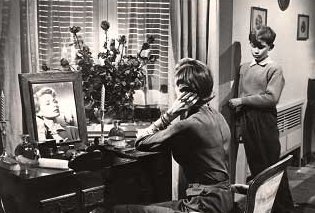
‘Being in the world’ certainly characterizes the final film to be discussed as well, Europa ’51 (released in 1952). In this work, Ingrid Bergman’s Irene Girard commits herself to a life of service after her young son passes away soon after he throws himself down a set of stairs intentionally. Initially, she twines herself to Marxist Andrea Casatti (Ettore Giannini) who practices a social gospel of his own in his charity for the poor. However, Irene soon becomes disillusioned with the “hate” that animates Andrea’s class rhetoric, arguing that her search is for a “different path, a spiritual path… something eternal.” Truly, it seems as though she tries to “love her neighbor,” though in the end she admits that something else animates her: “the love for others is born out of the hate I have for my self, of all that I have and have ever had… it’s nothing more.” Nonetheless, whatever her motives, a chorus of admires can be heard at the film’s end pleading that “she’s a saint,” even as she is being locked up in an asylum permanently.

Thus, Europa ’51 functions as the most explicitly hagiographic of Rossellini films, though it is that of a saint in our time. As Martin Scorsese puts it in his short essay on the film, “every aspect of Rossellini’s artistry is at the service of questioning modern sainthood.” Indeed, it is for this reason that she is condemned to an asylum: namely, that there is no place for simplistic religious faith in rationalist postwar Europe. When someone does attempt to live their life expressly for the betterment of others, “bound to nothing,” and therefore “bound to everyone,” there is no conclusion to be drawn other than that such a person must be mad. (It is both a rejection of capitalism and also Marxism, making it therefore untenable to the power-brokers of her world, and in micro, to those running the institution.) Yet, in her madness, “Irene has truly become, or made herself, God’s instrument.”

As such, we are reminded of what was said of St. Francis in the film’s opening intertitle: that ‘the world laughed at him and called him mad.’ Certainly, Europa ’51 can be seen as an extension of that work, rendering sainthood within the strictures of modern secular society: as Rossellini has said, “the idea came to me while I was filming The Flowers. I asked myself: if Francis, or someone like him, came back to earth today, how would he be treated? He could only be treated as a madman.” Surely, Bergman’s institutionalization makes this theme explicit – and the reality again that there is no place for a saint in this world. Thus, Europa ’51 accentuates the incongruity that emerges between the world and the life of the Christian. Indeed, it is in this respect that Rossellini’s rhetoric seems to have changed since the ecumenicalism of Rome, Open City and Paisan. If brotherhood was the defining position of both, emphasizing the political project of nation-building in the immediate postwar period, Europa ’51 figures a disillusion with this project that is every bit as powerful as Vittorio De Sica’s in Miracle in Milan (1951). In the case of Rossellini’s film, the possibility of cooperation between left and right that was so powerfully represented in Rome, Open City has reached its breaking point in the inconsistency between class (struggle) politics and the Christian faith. And if Europa ’51 is any indication, it is the Christian faith that Rossellini confirms – though certainly it is a faith that expresses itself in the same good works undertaken by Andrea.

Europa ’51 likewise distinguishes itself in Rossellini’s corpus as the present-day Bergman collaboration that depicts the life of a saint rather than that of the sinner (present-day as their Joan at the Stake [1954] is one of the director’s earlier efforts at historical biography – along with the aforementioned St. Francis). In their earlier pairing, Stromboli, as well as their subsequent Voyage in Italy and Fear (1954), human weakness and particularly adultery emerges as the principle subject. Moreover, grace intervenes to save the heroine and the marriage respectively in Stromboli and Voyage in Italy respectively, while Fear concludes with another of the director’s suicides (cf. Germany, Year Zero [1948] and Europa ’51). Fear, like the other two suicide pictures, is a work of despair arising from the director’s biography: whereas the first two reflect his son Romano’s premature death in 1946, the final film – and indeed the theme of adultery – surely coincides with the marital problems that he and Ingrid were having up until their split in 1957. Likewise Fear is a film about a consuming guilt that ultimately overcomes the heroine; she is her own judge and is unable to redeem herself, ultimately prompting her suicide.

Of course no similar degree of guilt can be ascribed to either of the children in Germany Year Zero and Europa ’51 respectively. Moreover, the first is a noticeable deviation from the taxonomy offered for the director’s early corpus, from Rome, Open City to Fear. Then again, that it so clearly documents a specific time and place, which bares on the psychology and fate of the young protagonist, to say nothing of the noted autobiographical resonance, certainly establishes it as major Rossellini – and perhaps an exemplar of another taxonomic category with religious implications, the work of desperation (Europa ’51 and Fear being other examples, while its opposite, the film of hope would include such films as Rome Open City, Stromboli, and Voyage in Italy; and again, Paisan straddles both categories, as it does with the sinner-saint distinction.)

Conclusion
If, as some maintain, it is possible to trace a spiritual itinerary throughout my films, I would say that Germany Year Zero is the world that has reached the limits of despair because of its loss of faith, whereas Stromboli is the rediscovery of faith. After which, it was natural to look for the most accomplished form of the Christian ideal: I found it in St. Francis.
-Roberto Rossellini, The Message of The Flowers of St. Francis

As the above account of Europa ’51 should make clear, the director’s “spiritual itinerary” does not end with The Flowers, but extends in the director’s next film, charting the new territory of contemporary sainthood. Moreover, if one is to posit the film of the ‘sinner’ as its dialectical opposite, the narrative likewise continues through his final collaborations with Bergman. Indeed, this proposed division of the director’s religious work seems to be confirmed by his own mid-career itinerary, as he identifies Germany Year Zero as a film with religious implications – namely, where despair is total, and faith is identifiable in its complete absence. As such it becomes increasing clear that to speak of a religious trajectory in the director’s work is to consider films beyond those with expressly religious subject matter – hence his mention of Germany Year Zero, and the closing descriptions of Fear.

Ultimately, the above attempt to create a taxonomy for this subject has no justification beyond its facility in clarifying certain themes and tendencies in the director’s work. That Rossellini fluctuated between the two categories shows a persistent interest in the themes, especially during the period in question (1945-1954). Then again, as the brief mention of The Messiah – and Blaise Pascal – indicates, Rossellini did not abandon an interest in religion later in his career. It did, however, take a different form: cultural history. In each, history is demystified, assuming the form of the quotidian – Christ, for example, does his carpentry work while preaching to his followers. As such, the one aspect of the director’s work that remains present even in these latter deviations from the earlier taxonomy is the director’s realism. In each, Rossellini attempts to reproduce reality through a reproduction of surface verisimilitude. Indeed, in all of his works, Rossellini never fails to show the world as it is or was. God is irreducibly present, but divine form is forever hidden from sight.
-->
[1] For an equivalent in the plastic arts, Spanish sculptor Jorge Oteiza (1908-2003) is particularly revealing. In his minimalist facture, Oteiza draws attention to the possibility of the divine through the focus that his pieces place on space - rather than matter, which is itself equal to the material world. Lest this equivalency is less than clear, Oteiza gives many of his pieces expressly religious titles.


[2] This quality is most striking in The Messiah’s depiction of the ‘Last Supper’ and the ‘Crucifixion.’ With regard to the former, in contrast with better known Renaissance examples, Rossellini represents his figures seated on the ground, whereas Giotto’s and Leonardo da Vinci’s frescos showcase Christ and his disciples seated around a banquet table in an Italian-style structure. In terms of the latter, Rossellini depicts the three crosses hoisted above a rocky hillside that is almost entirely de-populated otherwise. In this way, Rossellini departs from traditional iconography (instantiated in Mantegna’s “Calvary,” c.1457-60) which typically features the mourning Virgin and Roman centurions – casting lots for his garments – beneath the crosses.
 
-->
For a full list of citations, please consult the author.

Tuesday, July 22, 2008

Thursday, July 10, 2008

New Film: WALL·E

The latest from Pixar, the most consistently rewarding of the present-day Hollywood studios, WALL·E both manifests its production company's greatest strengths, namely a striking process-oriented, formal intelligence and a clearly proscribed point-of-view, while presenting a line of argumentation that is by any measure inconsistent. WALL·E is nothing short of an artistic indulgence, in the Reformation-era Roman Catholic sense, made to atone for the sins that it will commit by virtue of its hyphenate co-producer Disney's marketing strategies. Like the codified latter-day practice of giving to off-set one's carbon footprint, a twenty-first century indulgence to be sure, WALL·E's anti-consumerist screed is a rhetorical propitiation for the prominence of its action figures on Wal-Mart endcaps everywhere. Whither an Environmentalist reformation? Who will be its Martin Luther to the Environmental movement's private jet-papist Al Gore?

Writer-director Andrew Stanton's (Finding Nemo, 2003) WALL·E opens eight hundred years into a dystopian future, wherein the earth has been depopulated save for a super-resilient insect and the squat, eponymous robot (pictured above), whose programmed function is to compact and stack - in skyscraper form - the planet's (read: America's) seemingly bottom-less sea of waste. After an introduction to the robot's gleaner's instinct and his lonely bachelor love of Hello, Dolly!, we are introduced to the Apple™-inspired EVE, Pixar's latest sexy new toy - even if she lacks the threat of replacement embodied by Toy Story's Buzz Lightyear (co-scripted by Stanton). EVE, as we will shortly learn, has been dispatched to search for organic life on the once green planet, which she finds among her new robotic suitor's collected treasures. With her discovery, EVE is summoned back to the mother ship, that is, to an enormous space vessel, the Axiom, that has preserved human life beyond our atmosphere for the previous five and seven-hundred years.

Prior to EVE's return, with WALL·E predictably stowing away, the bulk of Stanton's picture occurs without dialogue - as many critics have rightly noted, this is indeed an exceptionally experimental narrative device for an animated work. The exceptions occur on the level of WALL·E's attempts at anthropomorphic utterances - the iconic instance (at least for those who have seen the film's trailer) is his incorrectly accented "Wall-e" - EVE's (still limited) later model speech and most conspicuously, a televised spot from retail powerhouse "Buy and Large," with an on-screen Fred Willard narrating.

The fact that
WALL·E presents actual human beings within the frame of its computer-animated narrative is of no minor significance. This is a film that is making a greater claim for its plausibility than any of its Pixar fore-bearers. WALL·E does not represent a parallel world where for instance monsters generate a city's power by scaring its children (Monsters, Inc., Pete Docter, 2oo1) or where a family of superheroes are forced under cover (The Incredibles, Brad Bird, 2004); rather WALL·E is this world, hundreds of years from now, when our massive Bush-era consumption has left the earth uninhabitable. The form of Stanton's picture is in other words less parable than it is cautionary tale; rats (Ratatouille, Bird, 2007) will never become great chefs but our consumer habits might just imperil the planet's future, the filmmakers' argue. This linking between commerce and environmental degradation, it is worth noting further, makes explicit the prevailing anti-capitalist bias inherent within the modern Environmentalist movement.

Outside the earth's atmosphere, amid the black expanse and violet solar systems that combine to create WALL·E's most visually striking spaces, the aforesaid vessel houses the fattened, static remnants of human civilization, now confined to floating, mobile chairs with their ubiquitous television screens that forever shield their eyes from the rest of the ship, let alone from the cosmos beyond. (When their flat screens malfunction, two separate passengers express surprise that the shuttle contains a pool, which naturally figures prominently in the Axiom's floor plan.) The human figures themselves remain plastic and relatively lifeless when contrasted with the inorganic robotic figures that this inorganic medium successfully anthropomorphizes.

Of course, their reliance upon televisual images marks yet another of WALL·E's prominent inconsistencies. As if it were necessary to remind Stanton and company, WALL·E is after all a work of visual culture, which as it happens has blinded the film's obese human subjects from each other and the world around them, to say nothing of softening their minds to the point that the Captain is required to ask what farming is, and later to explain it to his fellow travelers. It is likewise a children's film in the Disney-Pixar stable, meaning that its introduction into the world of consumption will be followed naturally by scores and scores of cute new toys, which let us be reminded, is precisely what got us into the place we are when WALL·E commences. WALL·E is in other words both disease and cure; an extraordinary moneymaker for its filmmakers' that deigns to critique the very activity that it participates in. If the system allows for it, why not act as both prophet and parasite?

In the end, WALL·E's proscriptions emerge as more measured than many of its diagnoses. The very notion of moderation is by no means controversial, nor is that of stewardship, though its conceit of a fragile biosphere - in contrast to the resiliency of its automated protagonists - remains open to debate. Less modest, however, are the film's closing credits that trace the history of Western art from the Egyptians through Van Gogh, while figuring the renewal that the film's conclusion stipulates. Here, still another Pixar artist has made a claim for his medium's role among the arts, though unlike Bird's Ratatouille which claims that a non-human can create an art worth savoring, Stanton seems to imply that his is the next step in the storied tradition into which he has inserted his robotic figures. Presumably this is great art - an art for the ages - because of its (presumably, again) unassailable politics. WALL·E is nothing if not ambitious.

In many respects this is what is most commendable about both WALL·E and latter-day Pixar filmmaking more broadly. From Toy Story to The Incredibles and Ratatouille to WALL·E, Pixar has introduced a set of auteurist filmmakers within the form of computer animation, and each with their own distinctive point-of-view. John Lasseter's (Toy Story and Cars, 2006) is a cinema of nostalgia, Bird's of a Randian advocacy of excellence and now Stanton's an anti-capitalist, orthodox Environmentalist animated film practice. (Stanton's has naturally connected with the left-leaning critical apparatus in excess of any of his esteemed antecedents.) Moreover, WALL·E manages the texture of subjective film art, or at least of an empathetic filmmaking, with its shy, nerdy protagonist, frequently fixing his viewfinders like slipping spectacles. Whatever one's feeling might be about WALL·E's politics or about the inconsistencies that threaten its rhetorical heft, Stanton does manage to continue his inhuman format's remarkable, sustained propensity to create in the first-person. Stanton is, in other words, one more distinctive voice in Pixar's polyphonic factory.

Sunday, July 06, 2008

7th New York Asian Film Festival: Fine, Totally Fine & Sukiyaki Western Django

Arriving on the final weekend of the 7th New York Asian Film Festival, first-time writer-director (and former janitor) Yosuke Fujita's Fine, Totally Fine (Zenzen daijobu) rates as one of the latest installment's unqualified highlights, and one of the funniest pictures to screen inside or out of the fest midway into 2008. Whereas Hitoshi Matsumoto's previously-screened Dainipponjin found its comedy in its satirization of the classical monster genre, video game aesthetics and reality television - as well as its study of the nation's evolving values - the grist of Fine, Totally Fine's humor is its finely sketched characterizations.

As the focal point of the film's love quadrangle, Kimura Yoshino's Akari is less noteworthy for her allure per se, than for her epic clumsiness, manifesting itself in a pair of remarkably unsuccessful attempts at opening a box of tissues, an equally unaccomplished attempt at sliding a porno mag into an undersized wrapper - along with its catastrophic consequences - and finally, her performance of a routine gesture that ranks as one of the most cringe-worthy inserts in the medium's history.

The first of her three suitors is Hisanobu (Okada Yoshinori), a hospital administrator who hires Akari as a janitor and manages a second older woman who repeatedly claims that he is the only person in the world who is actually nice to her. He really is that nice, which leads him to a rather uncomfortable evening in the latter's flat. Here she assures him that she won't "rape" him; the older lady assures Hisanobu that she has "graduated" from that. Indeed, Hisanobu often plays the straight-man, be it in his encounters with his employees or those with his fellow twenty-nine year-old pal, Teruo (Yoshiyoshi Arakawa).

Teruo, an overgrown adolescent whose dream is to revolutionize the haunted house industry, and whose greatest pleasure seems to be frightening young children, matches Akari punchline for punchline. Teruo's comedy is less purely physical, however, than it is the sum of his expressive responses (frequently to his elaborately-plotted shocks), his bizarre actions - at a business meeting he opts for a spoonful of sugar to a cup of tea or coffee - or more generally, his slow up-take. If anyone could be said to "carry" Fine, Totally Fine, its Arakawa. Of course, Fine, Totally Fine quite liberally shares its humor with its supporting players as well, as for instance Teruo's father whose peak occurs with an improbable, unexpected musical performance during a television broadcast (spoiler: its a love song about rice).

If it were to be said that Fine, Totally Fine was only as strong as its jokes, then Fujita's debut would be a very strong work indeed. However, the film's genuine sweetness and warmth, always worn quite lightly, be it in a gesture of kindness from a little girl (when a moment of discomfort seems imminent) or in the final exchange between Hisanobu and Akari emphasizes the work's depth, and moreover the maturity of a work framing its protagonists movement toward a belated adulthood - all within a Farrelly-esque milieu that matches the Brothers' hard-won affection for its under-dog heroes.

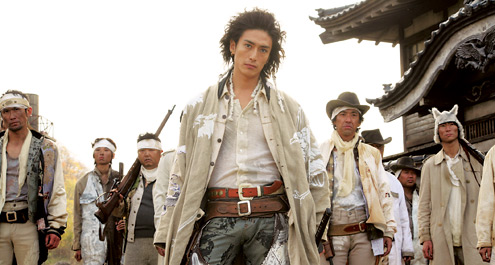
By comparison, Takashi Miike's Sukiyaki Western Django (2007) exemplifies nothing so much as it does a filmmaking that is unwilling to be anything other than sophomoric. Sure there's an intelligence here - Miike's translation of the genre finds an equivalent in the film's phonetic English dialogue, for example - but never is there a sense of stake or depth in Miike's work, to contrast it with Fujita's picture or even the best of Sukiyaki Western Django's most buzz-worthy supporting player Quentin Tarantino (i.e. Pulp Fiction, Jackie Brown and Kill Bill, Volume 2). Rather, Miike's soul-less cinema is all about its punchlines - never as funny as Fine, Totally Fine, though they do have a formal side in the director's tightly-framed reveals - targeted toward a public who want nothing more in the world (evidentally, if the Japan Society crowd is any indication) than a bad-ass grandma with an enormous dragon tattoo on her back. This is a film for Miike's audience, for his post-modernist public - a club that most certainly does not include this writer as a member. Yet even for today's small "n" nihilists, Sukiyaki Western Django may not exactly rate as major Miike, if its relatively lazy action set-pieces are any indication.

Friday, June 27, 2008

7th New York Asian Film Festival: Sparrow (co-written with Lisa K. Broad)

Johnnie To's Sparrow (Man jeuk, 2008) is the second of the director's most recent pictures to screen at this year's New York Asian Film Festival - following his supernatural, semi-comic crime thriller Mad Detective (2007) - and though it largely breaks from the director's preferred action idiom, To's very latest is both superior to the fest's other entry and likewise rates as one of the 7th installment's most immediately satisfying works. With Sparrow, To has purportedly created a work with no other intention than to make precisely the film he wanted, which it would seem was a French film from the nouvelle vague era. Not exactly a "New Wave" film, however, as Sparrow's most conspicuous references include Robert Bresson's Pickpocket (1959) and Jacques Demy's The Umbrellas of Cherbourg (1964) rather than say the films of Truffaut or Godard. In sum, To's latest is a film made in the broader spirit of the era, cobbling together a series of allusions connected by their mutual period and national context, and most importantly, by the director's unmistakable affections.

Sparrow opens with the eponymous animal fluttering into the spartan Hong Kong flat of the perpetually grinning Kei (Simon Yam). As such, To immediately commences with his sequence of references by alluding to Jean-Pierre Melville's Le Samuraï (1967), whose 1970 Le Cercle rouge, importantly, the Hong Kong director plans to remake for a 2009 release. Kei, as we will discover in the following scene, is a pickpocket, prompting the aforesaid Bresson paean: specifically, To alludes to the balletic, train-bound theft that earlier marked the French director's perfecting of (action) film editing. Yet, both of the opening sequences are imprinted with a lightness that is at once incommensurate with its Melville and Bresson sources and also perfectly at home in the To film; the song-and-dance sequence of Demy feels eminent throughout - no doubt thanks to the Michel Legrand-style score which Termite Artist R. Emmet Sweeney noted following the screening.

While there are other obvious allusions worth noting, from a pair of set pieces utilizing ballons - think the recently re-fabricated The Red Balloon - to the Umbrellas of Cherbourg denouement, Sparrows remains more than the sum of its references. For one, this is a film of unsurpassed tactility, registering in the bird's light feet on Lam's hand, the razor blades that the jovial pickpockets hide on their tongues, the spikes driven into Kei's hand or the female lead's (Kelly Lin) smooth touch of another's hand. Like the heightened abilities of Bresson's Dostoevsky-inflected lead, To's players manifest a similarly magnified sensitivity, which the director routinely emphasizes in his precise mise-en-scène. While Sparrow may largely lack the action set pieces of say an Exiled (2006), To's filmmaking is exceedingly skilled as always, mixing the director's commonly mobile takes with a profusion of disparate angles (many of which favor an overhead position).

Speaking of set pieces, it makes a good deal of sense that To would favor relatively discrete blocks of narrative given the picture's two year gestation period - not that To's more rapidly-completed works possess a markedly different character. Consequently, it is also at this level that those things which most recommend the superb Sparrow become evident: as for instance the film's commendable light comedy, which can be witnessed in a pair of fine elevator-based set-ups. In other words, while Sparrow may be more than the sum of its references, it very much remains (in the best sense) a sum of its parts.

In the above respect, Sparrow does accord within To's traditional practice. On the level of theme, likewise, we can further see its explanatory value, particularly in his latest's emphasis on game-play (a key theme in many of the director's films, including his sterling 1998 A Hero Never Dies). Here, To's concluding shootout is replaced with what amounts to a contest of skill, centering on the protagonists' profession, with the film's beautiful female lead as the ultimate prize. In this extraordinary passage, the libidinal and violent are replaced by the game, which retroactively confirm the significance of this theme across the director's corpus. His is a cinema of prowess, where his players (within the director's equally achieved mise-en-scène) are forever called upon to show their level of skill, be it in his generically-prompted shootouts or in Sparrow's substitute 'game.'

Though singular on the level of narrative, Sparrow nevertheless emerges as central to To's craft as a whole; the film's differences reinforce the film's essential similarities to the director's body of work.

Sparrow screens at the IFC Film Center in lower Manhattan on Wednesday, July 2nd at 9:40 PM.

Update: See the aforementioned Sweeney's analysis here. As always, Rob's post is exceedingly well-written and insightful; note especially his underlining of Hong Kong's centrality to Sparrow (a point we forgot to mention). If there is a theme to the 7th NYAFF thus far, it would seem to be its selections' love affairs with the continent's highly photogenic cities.

Tuesday, June 24, 2008

7th New York Asian Film Festival: Dainipponjin (by, Lisa K. Broad)

The charming Superhero mockumentary Dainipponjin (Hitoshi Matsumoto, 2007) opens with a wistful ode to ode to the compact umbrella, which despite its diminutive size, is able to grow large and shield its owner in an hour of need. Dai-Sato, played by writer-director Matsumoto, has a particular fondness for expanding objects because they remind him of himself; in his role as superhero Dainipponjin (a.k.a. Big Japan Man) he too must grow to several times his size to protect Japan from monstrous “baddies.” Throughout the film mild-mannered Dai-Sato is shadowed by an unseen cameraman/interviewer who attempts to get a sense of Dai-Sato’s life as a 6th generation Dainipponjin. It quickly becomes apparent that the superhero’s life isn’t all it’s cracked up to be. Dai-Sato lives in a rundown shack whose gate is defaced by graffiti and heckling notes. As the filmmaker follows Dai-Sato inside, his camera lingers on the overgrown lawn and rundown child’s swing set that hint at Dai-Sato’s troubled domestic life. Dai-Sato longs for the days of his grandfather’s reign when baddies were plentiful and Superheroes were idolized by children and respected by adults. When we finally witness Dai-Sato’s transformation into Dainipponjin, it is preceded by a shabby religious ceremony in an outbuilding of a local power plant. The presence in the background of a sheepish looking employee wearing a windbreaker illustrates with comic precision how much the lot of the superhero has declined since golden era. Later, in a very funny sequence we meet Dai-Sato’s senile grandfather who escapes from his nursing home, transforms into diaper clad giant, and wreaks havoc in an attempt to reclaim his youth.

In terms of its tone and subject-matter Dainipponjin is very much of its moment. It shares The Incredibles’ (Brad Bird, 2004) interest in the everyday logistics of super-heroism, while also partaking in a gentler version of the cringe comedy made popular by television shows like The Office and Curb Your Enthusiasm. Unlike the often unlikable protagonists portrayed by Ricky Gervais and Larry David, Matsumoto is a thoroughly cuddly sort who is devoted to his housecat and proudly takes his young daughter to visit the bunny rabbits at the petting zoo. Stylistically, Dainipponjin is intensely heterogeneous. The handheld interview segments which consist mostly of static long-takes and following shots derive much of their droll humor from the juxtaposition of foreground and background action. The sequences where Dai-Sato transforms into Dainjipponjin parody the rapid montage style and pulsing techno music of contemporary action films, while the monster fights are rendered in the idiom of video games (before each battle a dossier flashes onscreen to highlight each Baddie’s powers and weaknesses). A giddy coda section featuring the American “Super Justice” Family makes whimsical use of antiquated models, reveling in the current nostalgia for pre-CGI effects evinced by Michel Gondry’s similarly funny and poignant Be Kind Rewind (2008).

Dainipponjin screens at the Japan Society in Midtown Manhattan, Friday, July 4 at 2:30 PM.

Sunday, June 22, 2008

7th New York Asian Film Festival: Sad Vacation

Writer-director Shinji Aoyama's Sad Vacation (2007), one of nine New York Asian Film Festival entries originating from upstart Japanese production-distribution outfit Stylejam, completes a loose trilogy that also includes the filmmaker's 1996 Helpless and his 2000 Eureka, which for many cinephiles, this writer included, continues to rank as the finest Japanese film of the current decade. On the basis of the latter achievement alone - the only of Aoyama's films I've had the privilege to see - Sad Vacation easily ranks as one of the most hotly anticipated of this year's NYAFF selections, at least for those spectators who incline more towards the art house than the grindhouse.

Sad Vacation early on seems to meet precisely these very high expectations. Following an opening pre-credit passage that re-introduces Helpless's protagonist, Tadanobu Asano's Kenji, into Aoyama's narrative universe, we see Asano/Kenji floating down a lazy river like Michel Simon in Jean Renoir's Boudu Saved from Drowning (1932) - or better yet André Bazin's description of Simon floating in the Marne, "yellow" and "glaucous" with its "tepid" August warmth. Aoyama has resurrected this image in the precise colors that the film theorist once used. Hence, Aoyama has shown himself to be an attentive student of his former University of Tokyo professor Shigehiko Hasumi; the spectacle of the everyday comes vividly into focus in this early passage, as does the director's unmistakable sensitivity for texture.

The film's essential looseness continues throughout much of the film's first two-thirds, in spite of the dramatic pyrotechnics that mark Aoyama's equally conspicuous melodrama. These two tendencies combine in the picture's Kyūshū garage, into which Kenji moves after spotting its proprietress, his long-lost - absentee - mother (Eri Ishida). Kenji, still with an enormous amount of animus toward his mother and perhaps intent on exacting some measure of revenge for her past neglect, brings with him Yuri (another Helpless holdover) and the Chinese boy Achun whom he had saved in the picture's opening sequence - in other words, he brings his surrogate family to the second collection of drifters who have congregated at the Mamiya's place (among these is Eureka's young heroine Kozue, Aoi Miyazaki), themselves forming such a grouping. In this way, Sad Vacation reapplies one of the key thematic constructs of the director's 2000 masterpiece: the reconstituted familial unit.

Moreover, since many are also heroes of the earlier two works, they also live with the same traumas they did in the earlier pictures. Indeed, this reusing of prior characters marks the film's most formally compelling feature. (The flash-forwards that pepper the narrative - the other most noteworthy device in Sad Vacation, which the NYAFF's program notes compare to The Limey - though distinct, do not appear to possess a similarly organic narrative function.) Specifically, Aoyama's narrative strategy constructs a diegetic world that emerges as far more than the sum of the film's plot elements. Like the spiritual undercurrent, a key subtext of Eureka similarly, which is expressed in a sign that we return to on multiple occasions - "We are not alone" - the film's story world extends far beyond the visible. As with The Darjeeling Limited, this is a film with a clearly articulated author (perhaps the explanation for the flash-forwards?) and with many narratives threads that might have been pursued alternatively.

But it is that favorite contemporary Japanese theme of the dysfunctional family (spanning back to at least Yoshimitsu Morita's fine 1983 The Family Game) that Aoyama pursues. While Aoyama's vision remains lucid throughout the picture's final third, with both his explicit condemnation of Japanese mothers and fathers and his humanistic affirmation that we must concern ourselves with the living - though Kenji's mother's heartless statement of this view is less credible - the film's plot becomes ever more labyrinthine in Aoyama's attempts to weave in its rhyming antecedents. Consequently, it becomes increasingly evident that Sad Vacation fails to stand on its own as a feature, requiring an awareness instead of not only Eureka but also Helpless - less to understand the film's transparent point-of-view than to juggle its ever-multiplying character count. What had been a languid float through the water and then a digressive congregation of the damned finally becomes a test of character recongition that detracts from Sad Vacation's greatest strengths.

And then there is the Sad Vacation itself, narratively repeating the theme of the eponymous Johnny Thunders song that scores the opening credits. With said "vacation" we have one last melodramatic turn, which collectively constitute a piling on that cancels Sad Vacation's earlier promise.

Sad Vacation screens at the Japan Society in Midtown Manhattan, Sunday, July 6 at 1:15 PM.

Saturday, June 21, 2008

7th New York Asian Film Festival: Adrift in Tokyo / Tenten

As one of the twenty-six feature-length Japanese pictures screening at this year's New York Asian Film Festival - among the forty-three films total - writer-director Satoshi Miki's Adrift in Tokyo (Tenten, 2007) may not rate particularly high on many Asian cineastes lists of must see's - considering especially the presence of such higher-profile auteurs as Takeshi Miike (Sukiyaki Western Django), Shinji Aoyama (Sad Vacation), Hur Jin-ho (Happiness) and Johnnie To (Mad Detective and Sparrow), to say nothing of its ever popular slate of Manga adaptations, J-horror and hardcore action. Yet, it somehow might be too much to expect that any of the other forty-two will match Miki's fifth feature, a comedy of extraordinary narrative simplicity and organic interdependence that finally provides a physic alternative scenario for the film's two - presently - family-less leads.

Among the film's many sterling comic set-pieces, Adrift in Tokyo opens with creditor Fukuhara's (Tomokazu Miura) arrival at slacker law student Takemura's (Joe Odagiri), where the former shoves his sock in the latter's mouth - before complaining that it has become damp upon sliding it back on - and where the latter is left with the same three-stripe Aquafresh on his rump that he proudly noted purchasing in the film's introductory voice-over. Miki registers this opening sequence in wide-angle, long shots that maintain longer-than-average durations. Here his hand-held camera is affixed to a tripod, which importantly will be eliminated for much of the film's remaining run time.

As Adrift in Tokyo proceeds, Miki's camera is indeed mobilized alongside the film's narrative. Speaking of the latter, Fukuhara offers Takemura the opportunity to pay his debt by accompanying him on a walk around the city (with its end to be stipulated subsequently by Fukuhara). With Fukuhara assuring Takemura that his intentions are neither criminal nor untoward - though there is a narrative justification that Fukuhara will soon supply - they commence their "wanderings" around Tokyo, a city that Fukuhara notes is "perfect for taking walks" becuase of its "varied scenery." In fact, it is precisely the film's setting that soon emerges as one of the film's primary subjects, be it an autumnal sidewalk or a nocturnal, neon-saturated thoroughfare. Miki succeeds continually in locating the picturesque in the world's largest metropolis. Adrift in Tokyo thusly reminds us of the paramount importance of place in this most setting-dominated of artistic forms. Of course, the signifance of the background and the film's many cityscape inserts are not inescapably readable as the film's point, and as such can procure a sense of loss in their own belatedly focused reception. Upon Adrift in Tokyo's conclusion, in other words, I felt the need to almost immediately see it again.

However, it is just as often the city's indescript corners of Tokyo that attract the filmmaker's attention. In one instance, Fukuhara and Takemura encounter a small, stand-alone watch retailer; Fukuhara proceeds to ask the proprietor how such a business can survive to which the latter responds by showcasing his martial arts prowess. In precisely such an instance, Miki effectively highlights his concern to document an evanescing city and also his supreme comic talents. This is a film that is equally parts poignant and comic.

With respect to the film's comedy, a number of the finer moments are supplied by Mrs. Fukuhara's three co-workers, who themselves constitute the picture's primary sub-plot. We are introduced to the trio with one asking the others to smell his horrifically-scented coif - evidently, we are told, it has the mossy and earthy smell of a "cliff." Or, there is their diverting turn as film extras for aged actor whose sighting is said to bring good luck.

In many respects, as funny as Adrift in Tokyo is, it is the film's poignancy that stands out. To be sure, the pair's walk - for reasons that have been elided in this review - is quite likely the final journey through Tokyo for one of the two. This finality is reflected in the picture's autumnal setting and extended into the types of places (like the watch shop) that the pair encounters. It becomes, moreover, an opportunity for Takemura to be sutured into a family for the first time in his life - in one fine instance, Fukuhara even pretends to be his father and one of the older gentleman's female acquaintances, his mother - and for Fukuhara to take his walk, a favorite pastime of he and his wife's, with a stand-in for his long dead son. In this respect, Adrift in Tokyo repeats a seemingly common recent Japanese refrain of the broken family remade by unrelated surrogates.

Adrift in Tokyo
ultimately enacts an alternate past for one of the two leads, and substitutes for a future that the second might not get. In the form of comic divertissement, Miki has created a total work of art.

Adrift in Tokyo screens at the Japan Society in Midtown Manhattan, Thursday, July 3 at 4:20 PM.

Monday, June 16, 2008

7th New York Asian Film Festival: Mad Detective

Warning: the following post contains partial spoilers.

Johnnie To and Wai Ka-Fai's Mad Detective (2007, Hong Kong), from a screenplay by Wai and Au Kin Yee, represents To and Wai's first directorial collaboration since 2001's superlative Fulltime Killer, with which it shares a heightened sense of its own status as cinematic form - beyond To's ever-present generic awareness. Here this increased emphasis is procured both visually, in the conspicuous lens flaring that pairs with To's ubiquitous low-key lighting, and narratively (no doubt owing, at least partially to co-writer, co-director Wai's contribution) in the re-introduction of the figure of the double - or in the case of Mad Detective, septuple.

Mad Detective orbits around Lau Ching Wan's soon-to-be ex-detective Bun, whom we first see investigating a crime by being kicked down a flight of stairs while voluntarily inside a suitcase; he then offers an ear that he has chopped off to honor a retiring officer. Suffice it to say that Bun is the eponymous detective. Following a subsequently-introduced officer's 18-month disappearance, Lau is invited to assist for his investigatory brilliance. Yet it is less his analytic abilities, as we soon see, than his facility to see through to a person's true personality that accounts for his unique skills as a detective. To and Wai handle this plot element by fluidly replacing the film's characters with separate performers to represent their inner-selves, or in the case of the missing cop's partner, his seven selves (including a sweaty, overweight replacement and a sexy, female superego). Consequently the lightly surreal effect of the pair's strategy at times simulates the perceptual experience of Bun and his seamless transitions between reality and fantasy - an alternation supported well by the assertive nature of the cinematic image.

Mad Detective culminates, fittingly, in a Lady from Shanghai-inflected house of mirrors where the picture's multiple doubles (and septuples) replace figural reflections. With each in search of his missing gun - a generic staple, to be sure - To and Wai's generic revision racks into focus. At this juncture, the filmmakers have crystallized their reframing of internal character conflict by contrasting it with its generic predecessors: the bodies are reflected by other figures with the shattered glass on the ground beneath. While ultimately Mad Detective may not mark the height of To's commercial cinema powers, To and Wai's film nonetheless reinforces the pair's collaborative identity, while offering more than serviceable revisionist filmmaking.

Mad Detective screens Sunday, June 22 at 7:20 PM at the IFC Center in New York. It is also available on a Mei Ah region 3 DVD with English subtitles.