Thursday, April 21, 2011

Foolish Wives by Sergius Karamzin: Manners, Manipulation and Modernism in von Stroheim’s Monte Carlo

           For much of the scholarship surrounding Erich von Stroheim’s filmmaking, biography has taken precedence over the works themselves.  That researchers would emphasize the director’s life story is by no means surprising, given both the extraordinary trajectory of his career and also the fact that none of von Stroheim’s films survive in their intended form.[1]  Indeed, few filmmakers of the silent era could claim an entrance as auspicious as von Stroheim’s: biographer and scholar Richard Koszarski has argued that “until the coming of Orson Welles, Blind Husbands [1919] was the most impressive and significant debut film in Hollywood history.”[2]  Then again, von Stroheim would be out at Universal within three years, after being fired during the production of Merry-Go-Round (1923).[3]  The director’s termination closely followed his completion of Foolish Wives (1922), which the studio billed as “the first real million-dollar picture.”[4]  Subsequent to Merry-Go-Round, the director commenced shooting of Greed (1924) at Goldwyn, which like Foolish Wives survives only in badly-mangled versions – though its reputation coupled with the film’s remaining elements were enough to secure seventh place in Sight and Sound’s 1952 Critics’ Poll, and fourth place ten years later.[5]  Following Greed, the director would make four additional films at four separate studios, before beginning his second career as an actor-for-hire.  In this final phase of his professional life, von Stroheim experienced some success, teaming with Jean Renoir, one of his most esteemed followers, in La Grande illusion (1937), before creating another of his best-remembered characters, Max von Mayerling, in Billy Wilder’s Sunset Boulevard (1950).[6] 
         Testifying to the seductive nature of the von Stroheim’s biography, it would seem natural if not necessary to qualify the above acting successes with the claim that von Stroheim remained “unhappy” in the final decades of his life, as Geoffrey Nowell-Smith does in his Oxford History of World Cinema capsule.[7]  Certainly this impulse confirms the power of the narrative represented in von Stroheim’s life: namely of a victim, or better yet, of an isolated genius destroyed by the studio system.  Of course, von Stroheim not only courted this interest in his personal biography, but in fact manufactured an interest in his life that would extend beyond the screen: as the well-documented story goes, von Stroheim was no ‘von’ at all, but an Austrian Jew who immigrated to the United States in his earlier twenties.  Yet, in the countless interviews that the actor-director conducted until his death in 1957, von Stroheim never wavered from his insistence that he was of noble lineage, as he similarly embellished his Austrian military career and even his Jewish ethnicity.[8]  Surely, von Stroheim manufactured a public persona in much the same fashion that he created his fictions.  Any study of von Stroheim the artist, therefore, should require an attention to this additional creation – that is, to Erich von Stroheim.
            Still, as compelling a figure as von Stroheim is, what commends his study, ultimately, is less the details of his biography than it is the art he produced (even in the fragmentary form in which the work has been preserved).  Among these films – or “skeleton(s)” of films[9] – few more forcefully demand artistic reassessment than does Foolish Wives, a film whose controversy von Stroheim was never able to escape.  While the narrative surrounding Foolish Wives focuses upon von Stroheim’s well-documented extravagances, the product on the screen “astounded” Jean Renoir, who admitted to seeing it “at least ten times.”[10]  Fellow émigré director Ernst Lubitsch made reference to the film in the both the setting of his 1930 musical Monte Carlo, and also in a small detail wherein one of the gamblers rubs a hunchback for good luck.  Furthermore, one may cite the press that accompanied the film, which though mixed overall, featured more than its share of accolades: the Evening Telegram called it “the most extravagant of all American films, and also one of the most absorbing”;[11] Mae Tinee of the Chicago Daily Tribune remarked on the “tapestried perfection of the whole”;[12] and Fredrick James Smith of the Los Angeles Times claimed that “we have never observed more brilliant direction.”[13]  
            However, Mr. Smith later added that “we have never noted such a lavish instance of a director losing perspective and grip upon his story,”[14] while a reviewer for the New York Times noted that Foolish Wives “could have been made with much less architecture without losing its essential dramatic quality.”[15]  A second reviewer writing in the Los Angeles Times likewise argued that “there is a great deal to find fault with in the matter of continuity, drama and theme.”[16]  Thus, the most common criticisms leveled against von Stroheim begin to crystallize: specifically, that the director failed to attended to the dramatic qualities of the photoplay, while succumbing to every imaginable extravagance in the production of his film.
Certainly, none of these criticisms warrant our neglect of Foolish Wives as an aesthetic object today – particularly if we refuse to define film as essentially theatrical or even as filmed theatre (a preconception belied in many of the reviews listed above).  While some of the concerns of earlier reviewers remain evident – for instance, the opinion that the film’s editing and continuity are inadequate – it is important to qualify these observations.  In the case of the film’s cutting, it is essential to note the fact that von Stroheim’s picture was reduced from a “perfect” thirty reels to the “scrappy ten-reel print” of its general release, which indeed mitigates reviewers’ criticisms of the director’s inadequacy in this regard.[17]  As a matter of fact, that it was in this mangled form that both Renoir (in 1924) and Lubitsch saw Foolish Wives should further refuse any claim that our materials deny a proper appreciation of von Stroheim’s film as an art object.  Actually, our Foolish Wives is more complete – since its reconstruction by the American Film Institute in 1979 – than were any of the versions screened since its reduction to ten reels, immediately after its premiere in 1922.[18]  In short, we are better equipped to assess von Stroheim’s art presently than we have been at any point since its initial, troubled release.
Consequently, what follows is precisely this, a consideration of Foolish Wives as an aesthetic object, which was the product of a single artistic will.  This final caveat is especially necessary as few films of its time can equal the importance placed on the identity of its creator.  As the aforementioned New York Times reviewer put it, “more than is the case with most other photoplays attributed to an individual, this production is the work of Mr. von Stroheim, for he not only wrote and directed it, but is by far the most conspicuous figure in the cast.”[19]  Yet, it is not simply that von Stroheim occupied the aforesaid positions, but that the narrative itself refers to his role as the film’s creator, and more precisely to von Stroheim’s agency as a manipulator of the narrative.  Indeed, this theme of manipulation will be emphasized in the following essay, particularly as it confirms the work’s highly-advanced reflexivity.  At the same time, Foolish Wives is very much a film of its context, which would seem the natural point of departure.  It is only after these circumstances are detailed that the film’s exceptional qualities will be considered.

European Manners in the Aftermath World War I
            Foolish Wives opens on a close-up of a roulette wheel, followed closely by the title, ‘Monte Carlo, Europe’s playground – irresponsible and gay as ever when the Armistice was signed.’  Thus, von Stroheim immediately establishes not only the luxury of the resort, but the film’s setting in the aftermath of the First World War.  Indeed, while this context is common in Foolish Wives, it is a theme that is often removed to the background of von Stroheim’s film.  For instance, in the picture’s first establishing shots of the resort community, von Stroheim includes two men being pushed past each other in wheelchairs.  Thereafter, we see a veteran passing on his crutches and a truck filled with soldiers, which likewise features a wounded serviceman.  In a later scene located in the City’s poorest quarter, von Stroheim films a young girl also on crutches and a young boy wearing a combat helmet, though again they form little more than the background for a visit by Karamzin.
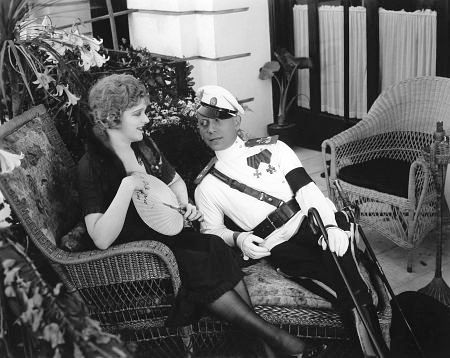
Of course, it is the film’s emphasis on luxury that is the more ubiquitous stage for the film.  Following the above-noted imagery and title, for example, von Stroheim’s narrative shifts locations to Villa Amorosa, the seaside residence of three supposed members of the Russian aristocracy, Her Highness Olga Petchnikoff (Maude George), Princess Vera Petchnikoff (Mae Busch) and Their Cousin, Count Wladislaw Sergius Karamzin (von Stroheim).  We are introduced to the “cousins’” opulent lifestyle during a breakfast that features Karamzin drinking his “eye-opener” of ox-blood and eating his caviar “cereal.”  Prior to their meal, we first see von Stroheim’s Karamzin firing at targets, which is an activity he repeats subsequently in one of the grand seaside casinos.  In this latter instance, Karamzin and his fellow aristocrats hunt for sport, firing at doves as they are released from metal cages.  Importantly, this is a motif that Renoir will later reprise in the justifiably famous hunting scene that serves as a centerpiece to the director’s masterpiece, La Règle du jeu (1939).  As in that film, this gesture of human brutality is a condemnation of war, though rather than prefiguring the direction of European society, von Stroheim’s film directly references the experiences of Europe’s recent past. 
Further, the hunting scene reveals not only the brutality of the society, but its misplaced values as well.  For example, Mrs. Hughes (Miss Dupont as the twenty-one year-old wife of an American diplomat) looks on Karamzin’s success in this activity with favor, while regarding her husband’s unwillingness to participate as a deficiency in his manners: “This [ignorance] is revealed during the pigeon shooting scene, when, in closeup, she smilingly admires Karamzin for the senseless killing of several birds but looks down on her husband, who does not participate as he disapproves of this decadent pastime.  Her contempt of her husband is expressed by a high-angle point-of-view shot.”[20]  As Nora Henry puts in it conjunction with the above quotation, she is “ignorant of true values.”[21]
This displacement of moral standards is further articulated during the scene following Karamzin’s arrival in Monte Carlo.  Upon his entrance, the highly-decorated Karamzin dutifully salutes his fellow soldiers, albeit distractedly, before ignoring another veteran as his thoughts turn toward Mrs. Hughes.  Once with the diplomat’s wife, another lone veteran populates the background quietly; the gentleman comes into view when he refuses to pick up Mrs. Hughes’ book.  At this point, Mrs. Hughes takes his refusal to help as boorishness, as compared with Karamzin’s continental manners.  However, when Mrs. Hughes later learns that he is an armless veteran, she apologizes to the gentleman, tenderly placing his jacket over his shoulders.  Thus, von Stroheim undercuts the virtue of manners, suggesting not only their superficiality in the present setting, but the complicity of Europe’s aristocracy in the destruction of the Great War.  This wounded soldier represents the truth of the prior conflict, against which Karamzin’s participation – as a “Capt. 3rd Hussars Imperial Russian Army” – is revealed to be counterfeit.  That is, Karamzin either served in an honorific position that did not present the dangers faced by the wounded veterans, or like von Stroheim himself, Karamzin falsified his military experience.   

Out Griffith-ing Griffith
Before continuing on to the film’s various other themes, it may be worth considering first the director’s primary artistic context – that is, as a student of D. W. Griffith’s.  To begin with, von Stroheim participated in the shoot of The Birth of a Nation (1915), making his film debut as an extra (“the man falling off the roof”).[22]  He followed this debut with parts in Intolerance (1916) and Hearts of the World (1918), where he also served as an uncredited technical advisor.  While certainly this limited collaboration does not entail influence, von Stroheim’s films from the beginning manifested a technique similar to the master’s, with their reliance on analytical editing – including an emphasis upon close-up views. 
However, even in this perfunctory style, Griffith’s impact is not clear.  For a more definitive example of the director’s influence, one might consider the following passage: von Stroheim pairs a scene emphasizing the difficulty experienced by Mr. Hughes as he removes his gloves with Karamzin’s flawless European mores.  Hence, von Stroheim utilizes a technique that is similar to D.W. Griffith’s intellectual editing in A Corner in Wheat (1909): while Griffith makes an argument by intercutting sequences featuring a gilded aristocracy with those of starving peasants, von Stroheim compares the manners of Karamzin with the clumsiness of Mr. Hughes’ gestures.  Thus, the director further establishes Mrs. Hughes’ psychology, even if the narrative’s progression does not represent the woman’s perspective per se.  Instead, von Stroheim produces the basis for his protagonist’s attitudes in his comparative editing strategy.
 Actually, Griffith’s influence is evident often within von Stroheim’s filmmaking: an Evening World critic even claimed that von Stroheim “out Griffiths Griffith.”[23]  In this regard, the sequence following Mr. Hughes’ visit to the Russians’ private casino is instructive: Karamzin sneaks Mrs. Hughes a note that pleads with the married woman to meet with him privately; Mrs. Hughes excuses herself with a headache; she calls on the Count; her husband then takes leave of Her Highness Olga and Princess Vera; in the meantime, Maruschka the maid, who earlier had been asked to prepare for a female visitor, sets the manor of fire; this forces both Karamzin and Mrs. Hughes to jump from a soaring tower; and so forth.  Thus, von Stroheim carefully establishes a series of concurrent spaces – that is, he utilizes Griffithian parallel editing – which produces the tension of these sequences, particularly for instance when Mr. Hughes’ drive home coincides with his wife’s call to Karamzin.  In other words, Foolish Wives mimics the structure of any number of the director’s films, including The Drive for Life and The Lonely Villa (both 1909), where drama is produced from the uncertain moment of a traveler’s arrival: will he find his wife absent, will he find them together, or will something else occur?  Certainly, von Stroheim’s handling of this passage demonstrates a profound debt to the earlier master.
           
“A Veritable Mephisto of Evil”
            Tellingly, when faced with a chance to reveal true courage during the arson scene noted above, von Stroheim’s Karamzin jumps in advance of Mrs. Hughes.  On the ground, Karamzin claims that he jumped first to show Mrs. Hughes “how,” which understandably is met with derision.  Indeed, this detail underscores another of Foolish Wives’ more remarkable qualities: namely, von Stroheim’s thoroughly unredeemable characterization of Karamzin.[24]  Surely, the military interloping detailed above is far from his most grave offense.  For this, one must turn to his deceit and abuse of a series of women, including his ‘cousins,’ Her Highness Olga and the Princess Vera; Mrs. Hughes; Maruschka, the maid whom he agrees to marry, and whose life savings he plunders – before she attempts to kill Karamzin and his woman friend; and perhaps worst of all, the half-witted Marietta, whom it is suggested he rapes in one of the film’s final scenes.  In earlier incarnations of the film, in fact, von Stroheim was even more brutal.  For instance, in the film’s original form, Karamzin impregnated Maruschka, who gave birth prematurely before jumping to her death.[25]  Of course, von Stroheim’s themes ran afoul of period censors and incurred the condemnation of more morally-sensitive critics.[26] 
In a sense, these criticisms are not without justification, given the film’s identification structure, which it could be argued invites spectator to share in Karamzin’s vices.  In his first extended encounter with Mrs. Hughes, for example, von Stroheim’s camera lingers along with Karamzin’s gaze on Mrs. Hughes’ uncovered calves.  Thus, when Mrs. Hughes covers her ankles after a reverse to Karamzin’s gaze, she is hiding her legs not only from Karamzin but from the spectator similarly.  Likewise, the viewer shares in Karamzin’s voyeurism as both stare at Mrs. Hughes’ naked back through a hand-held mirror.  Then again, it is not simply the attractive Mrs. Hughes who von Stroheim shoots in this fashion, but the dim Marietta as well: von Stroheim films Karamzin’s first look at the slow young woman in a tilt running from her toes to her face.  Consequently, von Stroheim cuts to Karamzin licking his lips in response.  Moreover, throughout this sequence, Karamzin puffs on a long (decidedly phallic – and indeed erect) cigarette that reappears in the film’s many seduction scenes.  As such, von Stroheim invites his spectator to share in the debauched thought process of his licentious protagonist.

“Free, White, and Twenty-One”
As far as Mrs. Hughes is concerned, it is worth stating that she is by no means innocent when it comes to Karamzin’s advances.  In the aforementioned passage, where Karamzin first encounters Mrs. Hughes reclining with her book, the latter lies with her legs uncovered.  Far from being a passive recipient of Karamzin’s leering eyes, Mrs. Hughes actively courts the Count’s attention: “Sitting in good view of her, [Karamzin] sees that she is hardly interested in her book but rather is slightly bored and obviously ready to flirt; she looks around inconspicuously and pulls up her skirt to show her legs.”[27]  Thus, the process of looking featured in this sequence becomes two-sided – Karamzin (and the spectator) looks, while Mrs. Hughes knowingly receives, and perhaps even encourages this gaze.  Moreover, this act of looking and being looked at will be reversed shortly when the lady watches Karamzin converse with a mutual friend, who seems delighted to chat with the Russian.  She becomes the active agent, the spectator in this sequence, with von Stroheim no less aware of the fact that he is being looked at. 
Furthermore, this sense of active (or independent) agency extends to Mrs. Hughes’ relationship with her husband.  When she is challenged by Mr. Hughes on the matter of her “friendship” with Karamzin, the lady responds that she is in fact “free, white, and twenty-one.”  Certainly, when one considers this proclamation in light of contemporary marital patterns, it becomes clear that her threat carries genuine force.  As Charles Musser points out in his essay on “The Comedy of Remarriage,” the number of divorces per year doubled from 83,045 in 1910 to 167,105 in 1920.[28]  In the period of 1914 to 1918, the average number was 111,340, while in the three years that followed, the per annum rate jumped to 155,070 – another forty percent increase.[29]  Therefore, as Musser argues, it becomes possible to speak of a “quantitative crisis” in the number of couples being divorced in the late 1910s.[30]
In this environment, the comedy of remarriage was born in films like Cecil B. DeMille’s Old Wives for New (1918), Don’t Change Your Husband (1919) and Why Change Your Wife? (1920).[31]  While none of von Stroheim’s films properly conform to this genre, the theme of the “blind husband” – obviously, the title of the director’s first film and a phrase repeated in Don’t Change Your Husband – occurs throughout his early work.  That is, like in DeMille’s comedies, von Stroheim’s dramas emphasize the impermanence of the marital union: in Foolish Wives for instance, Karamzin argues that “yes – husbands are stupid; with them a woman won is a woman secure.”  As such, von Stroheim’s films share many of the anxieties of these early comedies of remarriage, though significantly, they refuse to repeat the breakups featured in DeMille’s comic cinema.  In von Stroheim’s cinema, marriage is tested but ultimately remains in tact.  Indeed, in films like Blind Husbands and Foolish Wives it is the seducer who is judged: in both cases – each of which conclude in the character’s death during its film’s climax – the seducer character is played by von Stroheim.

Epistemology in Foolish Wives
While it is true that von Stroheim’s protagonist does not escape his comeuppance at the conclusion of Foolish Wives, it remains true otherwise that Karamzin is granted superior knowledge throughout the film.  Importantly, von Stroheim refuses to allow his spectator to take comfort in his Karamzin’s mistakes.  Instead, we share the character’s epistemological range, which itself exceeds that of the film’s supporting characters.  In this way, von Stroheim flatters his spectator by providing his viewer with more information than those being manipulated in his picture.  As a point of comparison, one could compare von Stroheim with his student Lubitsch, even if in the case of the latter, no individual character shares Karamzin’s nearly omniscient point-of-view.  In the case of Lubitsch’s The Shop Around the Corner (1940), for example, the two co-worker protagonists (played by James Stewart and Margaret Sullivan respectively) engage in a pen-pal relationship without knowing that it is with one another.  However, Lubitsch provides the viewer this information before either Stewart or Sullivan is aware of the other’s identity.  This manipulation of the spectator and protagonists’ epistemological ranges lends the situation its gravity: on the one hand, we see that they would and should be together, while on the other we witness the petty arguments that could derail their corresponding chances at happiness. Thus as in Foolish Wives, the spectator knows more than the films’ more sympathetic characters, thereby establishing the narrative’s dramatic gravity. 
Then again, unlike in Lubitsch’s work, the viewer occupies the same position as the picture’s least sympathetic figure.  For example, when Karamzin scams Maruschka out of her life savings, we see the Count wet his finger, which he proceeds to drip on the table as if being brought to tears.  Significantly, we do not see the falling water from Maruschka’s point-of-view, which therefore assures that we do not misconstrue the dripping water as his tears.  Instead, von Stroheim makes it clear that we are watching Karamzin manipulate the maid.  Likewise, during Count Karamzin and Mrs. Hughes’ trip to the country, von Stroheim establishes a similar gap between the viewer and von Stroheim’s knowledge on the one hand and Miss Dupont’s on the other.  Here, von Stroheim makes Karamzin’s fabrication of the situation unambiguous from the outset: “The Count knew the country so well, he was soon able to get himself – ‘hopelessly lost!’”  Shortly we see the pair in the midst of a squall, fumbling to find their way – though we also see the Russians’ dog freely traveling through a space that the animal seems to know quite well.  Indeed, Karamzin ties a note to the dog, which it dutifully returns to Olga, even as the couple is forced to stay in a squalid cabin.  (In other words, the dog reinforces the contrivance of the situation.)  Moreover, we soon learn that Karamzin is no stranger to this latter locale; it would seem that the Count frequently gets himself “hopelessly lost” in the vicinity of this cabin.  However, fate intervenes with the arrival of a monk and his Saint Bernard, thereby thwarting Karamzin’s designs.  Nevertheless, von Stroheim uses our knowledge of his nefarious plotting to create the comedy and/or drama of this incident, even if he is stopped in the end.
A similar utilization of this strategy occurs in a subsequent exchange between von Stroheim and Mr. Hughes, where Karamzin informs the cuckold husband of his devious intentions.  That is, when Mr. Hughes asks Karamzin about a letter that the Count is authoring, Stroheim’s character tells him that he is “writing a love letter” to Mrs. Hughes.  Mr. Hughes laughs at this suggesting, reassured with respect to Karamzin’s motives – because, of course, no one could be so audacious as to write a love letter to another man’s wife, and then tell him about it.  Yet, this is exactly what Karamzin does, as von Stroheim makes clear to his spectator.  To be sure, the director again constructs an encounter around our knowledge of his character’s willful misbehavior; we are not allowed to be deceived by Karamzin, whatever we may think of his conduct.  Indeed, we are spectators to Karamzin’s taunting of those in an inferior position of knowledge. 

 “Foolish Wives by Erich von Stroheim”
            Of course, the ultimate purpose for von Stroheim’s provocation is to secure the trust of Mr. Hughes.  With her husband out of the way, even if only temporarily, Karamzin is free to finesse a large sum of money from Mrs. Hughes.  To do so, Karamzin must convince her of his situation’s immediacy, which he succeeds in doing through the guile of his performance.  Indeed, Karamzin’s success as a con man is dependent on the quality of his acting throughout, which effectively draws the spectator’s dimension to the act of performance in Foolish Wives.  In other words, we might say that von Stroheim’s film is about acting to the extent that this characteristic is repeatedly foregrounded.  That is, von Stroheim’s narrative operates on the basis of the spectator’s awareness that the Russians’ are successfully (or not so successfully) deceiving Monte Carlo’s elite.  In short, performance drives Foolish Wives’ narrative.  As Richard Koszarski puts it, Karamzin’s acting actually directs the story: “Karamzin can be considered the ‘director’ of this story, setting in motion little scenarios involving the cousins, Maruschka and Mrs. Hughes, always with himself at the center.  He continually moves the action of the picture by his own outrageous playacting.”[32]  Thus, Karamzin’s facility in shaping the narrative reflects the agency of the character’s interpreter, von Stroheim, who is of course the film’s true manipulator.
Nevertheless, Foolish Wives’ reflexivity is more clear elsewhere.  Returning to the first meeting of Karamzin and Mrs. Hughes, the latter is reading a book entitled “Foolish Wives by Erich von Stroheim,” with the following passage highlighted:
To the average American, written or unwritten codes or honor and etiquette and are unessential, as, in his tiresome chase after the dollar, he has no time to cultivate that, for which the European mainly lives.  In his battle of wits fought for commercial superiority the fatigued body forgets sometimes to react even to the most primitive and fundamental laws of politeness.
As such, the director focuses his own participation in the film’s manipulation, emphasizing his agency in shaping the attitudes of the female protagonist.  Importantly, the book does not read “Foolish Wives by Sergius Karamzin,” which would maintain the diegetic integrity of the picture, but again lists von Stroheim as author.  Thus, it is this extra-textual agent who shapes attitudes, and as result, Karamzin can only respond in approval – pointing to the passage, Karamzin replies, “very good.”  In other words, it is not Karamzin alone who manipulates the narrative, but von Stroheim in his respective roles as both the Count and also as the film’s maker.  To be certain, the very theme of manipulation serves to define the director’s craft as it entails a similar shaping of events: both von Stroheim and his character Karamzin manipulate events to achieve their intentions.  As a consequence, Foolish Wives reveals its scaffolding as a work of cinema that relies on both direction (von Stroheim and Karamzin) and performance to shape and guide the narrative.   
In other cases, however, von Stroheim’s reflexivity simply refers to the film as film – or to its filmic sources.  For example, when we first see von Stroheim as Karamzin, he is taking target practice at his seaside villa.  Von Stroheim cuts from a long to a frontal close-up of his character, where he is firing toward the camera.  Thus, von Stroheim explicitly references Edwin S. Porter’s The Great Train Robbery (1903), though importantly the director subsequently undercuts the reference: von Stroheim’s Karamzin appears to look around the camera, as if it is blocking his view of the target.  As such, von Stroheim calls attention to the presence of his camera, thereby reaffirming the film’s self-consciousness in this separate aspect.  Likewise, the existence of the book calls attention to the film’s own fictional construction apart from any narrative agency.  That is, Foolish Wives undercuts the realism that is otherwise so pervasive throughout the film.

A $12,000 Realist “Whim”
            Before parsing the implications of the above paradox, it would seem necessary to discuss, even if only briefly, the film’s realism.  In this respect, the film’s opening sequence would seem instructive, particularly for the details of its actualization.  For these sequences, the director and his crew traveled three hundred miles from Universal City (the location of the reconstructed Monte Carlo) up the California coast to Del Monte, at considerable expense to the studio and in order to shoot the sequence as a series of interiors and exteriors.[33]  As a result, von Stroheim succeeds in replicating not only the vistas of the Riviera, but indeed its physical atmosphere as well.  From the initial scenes in the Villa, wind ruffles the curtains of the mansion, passing through its enormous marble columns and mingling with the burning incense.  When the narrative transitions to Monte Carlo, the wind continues to blow, rustling the feathers of a military officials’ helmet, disturbing the flags that decorate the city, and sweeping across the surface of the pond during the squall that strands Karamzin and Mrs. Hughes.  While none of these details signify anything in particular, collectively they indicate the director’s interest in reproducing the verisimilitude of the events to the smallest detail. 
            This interest is perhaps most spectacularly represented in a detail Koszarski mentions during his account of the production.  Quoting the pressbook, the author notes that von Stroheim “demanded the glass so that his cameras could catch the reflection of the massive Hotel de France, and the famous gambling Casino.”[34]  The publication continues: “This directorial whim for absolute realism cost Universal $12,000.”[35]  Similarly, the director’s penchant for total verisimilitude extended to the reflections captured by his monocle, including the pattern of nocturnal light and shadow produced by the shudders of Marietta’s bedroom.  In other words, von Stroheim an interest in detail that far exceeded the exigencies of narrative, on the basis of which so many reviewers of the time criticized the director.

Conclusion
            Indeed, it is this emphasis on minutiae that has long been the director’s aesthetic legacy, for better or for worse.  Von Stroheim’s construction of a realist mise-en-scène through the accumulation of details, has been that single element of style that has most impacted future directors.  As Renoir puts it, citing the effect of seeing Foolish Wives ‘at least ten times,’ “I began to look around me and was amazed to find quantities of subjects both intrinsically French and perfectly adaptable to the screen.  I began to realize that the movement of a scrubwoman, of a vegetable vendor, of a girl combing her hair before a mirror frequently had superb plastic value.”[36]  In short, von Stroheim’s strove for the “utmost honesty” in his aesthetic.[37]
             Hence, the relationship between the director’s obsessive attention to detail and Foolish Wives’ extraordinary reflexivity begins to appear less paradoxical.  That is, each attempts to reveal truth, be it in the reproduction of the world exactly as it appears, or in the disclosure of the art’s scaffolding.  In other words, von Stroheim attempts not only to show us a world that looks just like ours, but also how he has created this world.  It is in this respect that Foolish Wives surpasses its own age: that is, in terms of the film’s continued references to its author and the act of authorship that his contribution connotes, von Stroheim’s picture resembles no era so much as it does the nouvelle vague.  (None of this is to suggest that reflexivity is otherwise absent in the period’s filmmaker.  Rather, it is Foolish Wives’ obsessive interest in its own authorship that recalls other eras.)  For instance, when one compares Foolish Wives to the films of Jacques Rivette (such as Celine and Julie Go Boating [1974] or The Story of Marie and Julien [2003] for example), it becomes clear that both share an emphasis on the process of fiction – of how films are made – expressed through a fundamentally classical structure.  Similarly, von Stroheim’s self-consciousness echoes that of Jean-Luc Godard’s cinema, where cinematic form is continually interrogated.  In other words, von Stroheim, like Rivette or Godard, reflects cinema’s modern phase, instantiated by the self-consciousness that reversed classical illusionism in the middle part of the century.  That is, if modernism in painting materialized when painters began to signify their work’s own painted-ness around the turn of the century, cinema’s mirror stage represents a similar turn in the history of the art form – which owing to the medium’s late development, occurred some fifty years after Pablo Picasso’s “Les Demoiselles d’Avignon” (1907).  Thus, von Stroheim’s significance as a filmmaker begins to far excel the details of his biography or even those of his mise-en-scène.  Through a close analysis of Foolish Wives, another picture of Erich von Stroheim starts to emerge: that is, a portrait of the director as the cinema’s first modernist.


[1] That is, when they survive at all: both The Devil’s Passkey (1920) and Walking Down Broadway (1933) remain lost, though the latter was reproduced as a series of eighty stills by von Stroheim biographer Richard Koszarski and William K. Everson in “Stroheim’s Last ‘Lost’ Film: The Making and Remaking of Walking Down Broadway,” Film Comment, May-June 1975, pp. 6-19.
[2] Richard Koszarski, Von: The Life & Films of Erich von Stroheim (New York: Limelight Editions, 2001), p. 41.
[3] Los Angeles Times (1886-Current File); Oct. 8, 1922; ProQuest Historical Newspapers Los Angeles Times (1881-1985), p. 16.
[4] This phrase appears in an advertisement for the film preceding its January 1922 release.  New York Times (1857-Current File); Jan. 16, 1922; ProQuest Historical Newspapers New York Times (1851-2003), p. 16.
[5] The Sight & Sound Top Ten Poll: 1952: http://www.bfi.org.uk/sightandsound/topten/history/1952.html and The Sight & Sound Top Ten Poll: 1962: http://www.bfi.org.uk/sightandsound/topten/history/1962.html.
[6] Von Stroheim earned a ‘best supporting actor’ Oscar nomination for his semi-autobiographical portrayal of this has-been director cum chauffeur, though it is important to remember that “the Hollywood establishment absolutely hated Sunset Boulevard and refused to support it in the voting” (Koszarski 334).
[7] Geoffrey Nowell-Smith, “Erich von Stroheim” in The Oxford History of World Cinema, ed. Nowell-Smith (New York: Oxford University Press, 1997), p. 54.
[8] Koszarski notes that von Stroheim went as far as to fudge his military records when applying for military reserve duty in 1930 (Koszarski p. 7).  Similarly, von Stroheim made no mention of his Jewish ethnicity when he began calling on third wife Valerie Germonprez: “Von Stroheim was always a practicing Catholic when Valerie knew him; it was decades later before she learned any different” (p. 33).
[9] Apropos of Foolish Wives, von Stroheim stated that version shown at New York’s Central Theater was “only the skeleton of my dead child.”  Quoted in Thomas Quinn Curtiss, Von Stroheim (New York: Farrar, Straus and Giroux, 1971), p. 131.
[10] Jean Renoir quoted in André Bazin, Jean Renoir, ed. François Truffaut (New York: Da Capo Press, 1992), p. 152.
[11] New York Times, Jan. 13, 1922, p. 21.
[12] Mae Tinee, Chicago Daily Tribune (1872-1963); Oct. 8, 1922; ProQuest Historical Newspapers Chicago Tribune (1849-1985), p. G1.
[13] Fredrick James Smith, Los Angeles Times, Jan. 15, 1922, p. III27.
[14] Ibid.
[15] “The Screen,” New York Times, Jan. 12, 1922, p. 15.
[16] Edwin Schallert, Los Angeles Times, Feb. 16, 1922, p. III4.
[17] Koszarski, p. 94.
[18] Arthur Lennig gives a detailed account of the restoration that he supervised in Stroheim (Lexington, Kentucky: The University Press, 2000), p. 142-5.
[19] New York Times, Jan. 12, 1922, p. 15.
[20] Nora Henry, Ethics and Social Criticism in the Hollywood Films of Erich von Stroheim, Ernst Lubitsch, and Billy Wilder (Westport, Connecticut: Praeger Publishers, 2001), p. 31.
[21] Ibid.
[22] Koszarski, p. 17.
[23] New York Times, Jan. 13, 1922.
[24] Edwin Schallert in the Los Angeles Times called Karamzin “a veritable Mephisto of evil” and entirely “bogus inside and out” (p. III4).
[25] Lennig, p. 137.
[26] Lennig quotes von Stroheim thusly: “Since that first showing of Foolish Wives I have seemed to walk thru vast crowds of people, their white American faces turned toward me in stern reproof.  My ears have rung their united cry: ‘it is not fit for the children!  Children!  Children!’… [I had] not one thought for the children, any more than [did] Hugo, or Voltaire, or Shakespeare, or any writer of intelligence and sincerity.”   Lennig then adds that “Most of the male critics disapproved the film on moral grounds (p. 147).
[27] Henry, p. 30.
[28] Charles Musser, “The Comedy of Remarriage” in Classical Hollywood Comedy, Kristine Brunovska Karnick and Henry Jenkins, eds. (New York: Routledge, 1995), p. 287.
[29] Ibid.
[30] Ibid.
[31] Ibid.
[32] Koszarski, p. 99-100.
[33] The “Villa Amorosa” alone cost $25,000.  In total, the director spent more than $400,000 on Foolish Wives’ sets.  Ibid., p. 86-87.
[34] Ibid., p. 87.
[35] Ibid.
[36] Renoir, p. 152.
[37] Koszarski, p. 139.

Sunday, March 20, 2011

New Film: The Turin Horse & Of Gods and Men (Co-written by Michael J. Anderson & Lisa K. Broad)

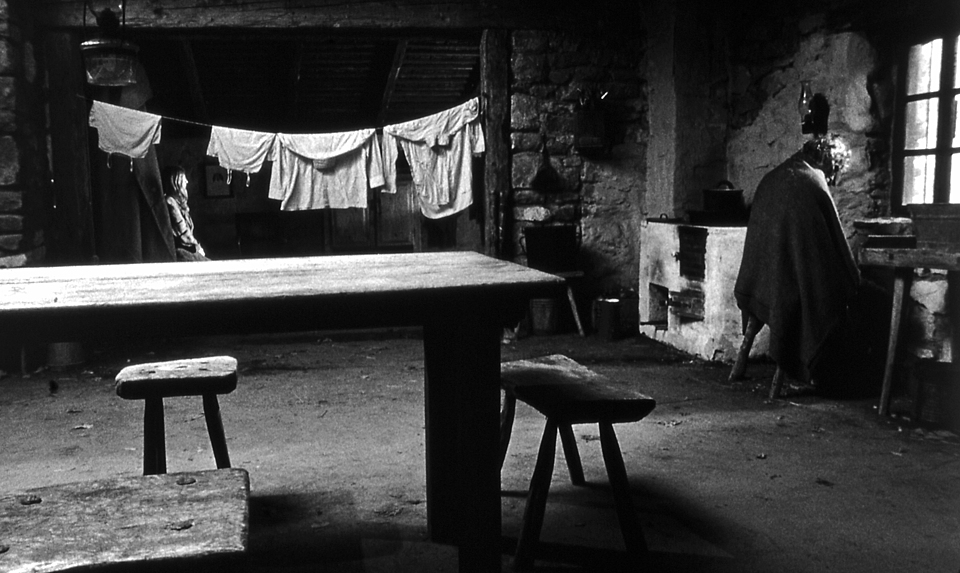
Premiering at the 61st Berlin International Film Festival, where it was honored with the second prize, Jury Grand Prix Silver Bear, Béla Tarr's The Turin Horse (A torinói ló, 2011) advances the aesthetic program of the director's supreme masterpiece Sátántangó (1994), presenting gestures that maintain the same phenomenological plenitude as those depicted in the earlier work, and repeat with maximal regularity and minimal variation over the course of the 2011 film's 146-minute duration. Within The Turin Horse's six-day time-span, Tarr and co-director Ágnes Hranitzky bring to terrible life the bleak daily rituals of his father and daughter protagonists, confined to a single sparely lit and even more modestly appointed room on a perpetually wind-swept Hungarian plain. Each day Ohlsdorfer (János Derzsi) and his daughter (Erika Bók) wake in near darkness, with the latter dressing her physically impaired father before she is forced - in her daily trips to the close-by family well - to face the unceasingly harsh conditions outside their home. As she opens their front door on the second day, the gale's deafening howl smacks the spectator no less than the cold wind and the accompanying wall of dust hits the young female lead as she crosses through the threshold. Back inside, she prepares meal after meal of boiled potatoes - never more or less than two - with her father scraping the skin off the scorching objects using his remaining working hand.

Indeed, it is in Bók's preparation of their day-one meal that Tarr's peculiar registration of gesture manifests itself mostly clearly. Here, Bók does not simply drop the potatoes in the murky water of the stove-top pot before taking them out moments later, following a temporally abridging cut. (The film's lone food item references both Van Gogh's "Potato Eaters" [1885], as the film's directory of photography has confirmed in an interview, and also Chantal Akerman's Modernist masterpiece of Sisyphusian ritual, Jeanne Dielman, 1975.) Rather, Tarr stays with Bók as she sits beside the stove, staring out their lone window as she - along with the film's viewer - waits for the food to cook. In this regard, Tarr not only portrays the elements of the family's daily ritual, but more importantly, the director further records the (approximate) duration of their enactments; Tarr presents his viewer with facsimiles of the felt experience of his gestures. The Turin Horse's presentation of ritual is in this sense fundamentally phenomenological in nature.                

By comparison, Xavier Beauvois's Of Gods and Men (Des hommes et des dieux, 2010), itself a first runner-up last year at the 63rd annual Cannes Film Festival, opts for a far more conventional presentation of the daily repeated acts of its heroic monks. In Of Gods and Men, much more a work of the humanist art film middle certainly, but one of notable accomplishment nonetheless, the monastic episodes appear in comparatively abbreviated, summary form, verging closer to items on a list - bottling preserves, hoeing a garden, etc. - than to the distended, if comparatively phenomenologically precise articulations of ritual contained in The Turin Horse's modernist art cinema. Frequently bathed in a cool blue-green light that provides the principle visual marker of the naturalistic French idiom from which Of Gods and Men descends, Beauvois and cinematographer Caroline Champetier shoot his ritual-generated, commonly wordless episodes (in this sense the Cannes prize-winner is very much like The Turin Horse; neither however is silent, given the recourse to song in Beauvois's film and the consistently prominent score and sounds of howling wind in Tarr's) in a series of largely static set-ups, with camera movement primarily initiated by and following figural movement. Consummately a work of craft with takes that are longish by commercial standards, Of Gods and Men nevertheless does not match the durational excesses inscribed through Tarr's lengthy set-ups.

***
Tarr and cinematographer Fred Kelemen utilize an astonishingly small number of takes - a mere thirty over the course of The Turin Horse's 146-minute duration - with an average shot-length approaching five minutes. Exemplary of their heavily choreographed strategies is the pivotal, six-and-a-half minute take in which Bernhard (Mihály Kormos) visits with news from the village. The sequence-shot opens with the sound of Bernhard pounding on the door. Entering, he asks Ohlsdorfer for "palinka," with the latter commanding his daughter to fill a bottle for their visitor. Crossing the under-lit space - the filmmakers rely exclusively on natural and on-camera, diegetic light sources - Bók replenishes a bottle in the lower foreground while the men converse at a table situated within a second, background plane. As Bernhard's monologue continues, Bók crosses back to the table, with Kelemen's mobile Steadicam keeping the bottle in the center of the frame. Once at the table, Kormos's Bernhard occupies much of the composition as he continues to speculate.

With Mihály Vig's score increasingly audible, its crescendoing figures marking the passage as a dramatic climax, Tarr and Kelemen zoom slowly into the speaker, where they will remain until he concludes with his diatribe. At this juncture, the backward zooming camera accommodates his listener Ohlsdorfer's response as well as Kormos's departure through the doorway, now present in the rear of the frame. Consequently, Tarr and Kelemen's camera moves with Bók once again as she proceeds to the window, where she will watch as Bernhard disappears into the barren landscape, amid the sharp sounds of the swelling wind outside and its thematically inspired double on Vig's musical accompaniment. (The ubiquity of one or the other or both confirms the condition of chaos that the film inscribes from the outset.) Tarr and Kelemen accordingly have complexly choreographed this verbal torrent in a single, mobile take, reliant on zooms and moving camera work to procure both close-ups and multi-planar longs over the course of its more than six-and-a-half minute running time. The sequence-shot, representative of the filmmakers' strategies throughout, is signature Tarr.

***
Likewise defining is the content of Bernhard's four-plus minute speech - a verbal outpouring that, it should be noted, breaks substantially with the film's comparative lack of verbosity. Reinforcing the cardinality of Friedrich Nietzsche to The Turin Horse's philosophical point-of-view (the film opens with an anecdote about the philosopher and the eponymous horse) and thus to the director's worldview, Tarr and fellow screenwriter László Krasznahorkai provide one of the richest, if less than succinct articulations of the director's personal outlook, reproduced below in its entirety:
Because everything's in ruins. Everything's been degraded, but I could say that they've ruined and degraded everything. Because this is not some kind of cataclysm, coming about with so-called, innocent human aide.  On the contrary... It's about man's own judgement, his own judgement over his own self, which of course God has a hand in, or dare I say: takes part in. And whatever he takes part in is the most ghastly creation that you can imagine. Because, you see, the world has been debased. So it doesn't matter what I say because everything has been debased that they've acquired, and since they've acquired everything in a sneaky, underhand fight, they've debased everything. Because whatever they touch - and they touch everything - they've debased. This is the way it was until the final victory. Until the triumphant end. Acquire, debase. Debase, acquire. Or I can put it differently if you like: to touch, debase and thereby acquire, or touch, acquire and thereby debase. It's been going on like this for centuries. On, on and on. This and only this, sometimes gently, sometimes brutally, but it has been going on and on. Yet only in one way, like a rat attacks an ambush. Because for this perfect victory it was also essential that the other side... That is, everything that's excellent, great in some way and noble should not engage in any kind of fight. There shouldn't be any kind of struggle, just the sudden disappearance of one side, meaning the disappearance of the excellent, the great, the noble. So that by now these winning winners who attack from the ambush rule the earth, and there isn't a single tiny nook where one can hide something from them, because everything they can lay their hands on is theirs. Even things we think they can't reach - but they do reach - are also theirs. Because the sky is already theirs and all our dreams. Theirs is the moment, nature, infinite silence. Even immorality is theirs, you understand? Everything, everything is lost forever! And those many noble, great and excellent just stood there, if I can put it that way. They stopped at this point, and had to understand, and had to accept that there is neither god nor gods. And the excellent, the great and the noble had to understand and accept this right from the beginning. But of course they were quite incapable of understanding it. They believed it and accepted it but they didn't understand it. They just stood there, bewildered but not resigned, until something - that spark from the brain - finally enlightened them. And all at once they realized that there is neither god nor gods. All at once they saw that there is neither good nor bad. Then they saw and understood that if this was so, then they themselves do not exist either! You see, I reckon this may have been the moment when we can say that they were extinguished, they burnt out. Extinguished and burnt out like the fire left to smolder in the meadow. One was the constant loser, the other was the constant winner. Defeat, victory, defeat, victory and one day - here in the neighborhood - I had to realize and I did realize, that I was mistaken, I was truly mistaken when I thought that there has never been and could never be any kind of change here on earth. Because, believe me, I know now that this change has indeed taken place."
Bernhard's argument has affinities, therefore, with a number of philosophical methodologies: namely, deductive/inductive reasoning, hypothetical stipulation and conceptual analysis. It also employs a use of incantatory repetition that recalls the texture of modernist poetry. The combined effect of these strategies is a sense of irreversible totality ('everything has been debased that they've acquired, and since they've acquired everything in a sneaky, underhand fight, they've debased everything') that radiates out from a central source, like ripples in a pond. Unlike traditional cinematic images - which tend to gravitate toward the particular - this kind of philosophical reasoning, which deals only with the universal and the abstract will not accommodate individuals, exceptions, or contingencies. By combining airtight - even airless - logic, with an aesthetic of extreme repetition and abstraction, Tarr seeks to banish specificity from his cinematic world, creating a kind of paradox: a photographic rendering of the horror of the absolute. Tarr continually speaks of everything; the fate described is inescapable.

Of course, the unnamed event has occurred even before The Turin Horse begins ('the change has indeed taken place') with the opening prologue displaying its symptoms both in the horse's described immobility - the anecdote is spoken over a black screen - and in Nietzsche's horrified response. The chaos to which The Turin Horse attests reveals itself only after the fact, through series of plagues - the off-screen horrors in the village, the drying up of the well - brought on by visible (the gypsies) and invisible agents alike; by the time it is encountered, that is by the time it takes a concrete form, its consequences are already irreversible. In this sense, The Turin Horse is a film about everything that is antithetical to a medium that is by its nature particular: constructed on abstract ideas that are articulated in an at best convoluted form - Ohlsdorfer is in some sense right to describe Bernhard's ideas as "rubbish" - Tarr's film continuously references an invisible turning.

This chaos, both described and foretold by Bernhard, is brought to the homestead by the traveling band of gypsies who pronounce ownership over Ohlsdorfer's water. The morning after they are run off by the ax-wielding lead, Bók discovers that their well has in fact run dry.  With no other plausible explanation, The Turin Horse compels its spectator to impute this tragic result (this effect) to the ominous appearance of the itinerant group, who appear as the harbinger of a destiny already set in motion. The perpetually waiting leads - they take turns staring out their lone window onto a wind-swept hillside - finally become aware of the pestilence deep into the film's two-and-a-half hour duration. The chaos that is already ubiquitous has at this moment become local. When next they attempt to leave their suddenly water-less farm, some unknown off-camera incident propels them to return as quickly as they have left. The condition reported by Bernhard is inescapable.

***
Of Gods and Men likewise centers heavily on the act of waiting, though in its case the enemy has a name: Islamic extremist terrorists. Beauvois's film opens in an ecumenical ideal where the French monks live in harmony with their poor Muslim neighbors. Michael Lonsdale's Luc serves as a physician who would appear just as comfortable in John Ford's eminent piece of confessional resistance, 7 Women (1966). The Trappists attend local ceremonies where they show maximal respect for their Islamic brothers and sisters, who in turn demonstrate admirable friendship and warmth toward their Christian counterparts. Lambert Wilson's Christian is well versed in the Koran, quoting it to Farid Larbi's comparatively enlightened extremist-killer Ali Fayattia as they are besieged on Christmas Day. As with Bruno Dumont's Hadewijch (2009), Of Gods and Men inscribes a new French reality wherein adherents of the Islamic faith outnumber those who of the Catholic confession. Their shared humanist commitment provides the de facto creed of the film's French public.      

However, with local military intervention leading to Ali Fayattia's death, Christian and his fellow monks become victims of terrorist reprisal, taken from their compound as they enjoy their Last Supper to a tape recording of Tchaikovsky's "Swan Lake." Ultimately, they are led onto a misty, snow-covered hillside - here the fog is lyrical embellishment, whereas in The Turin Horse it functions as a metaphysical principle, as a metonymy for the film's hermeneutic resistance - where they are martyred for a faith that ultimately reveals itself in their refusal to leave their Islamic brothers and sisters in their greatest time of need. Beauvois's film in this regard provides a comparatively easy humanist politics, where the film's tragedy is brought on by the actions of military and para-military organizations. On the ground, there is abundant understanding and compassion; again, when terrorist Ali Fayattia comes face to face with the monks on the Christian feast, he reveals himself to be a man of religious tolerance. As a result, Of Gods and Men emerges as a profoundly pacifistic work, where the film's real-life image of apocalypse could be reversed with a broader application of the film's values. 

The Turin Horse once more takes a very different perspective, wherein the film's apocalypse is both already upon us and irreversible. While The Turin Horse refuses to name its cataclysm - lending the film an added power and increasing its resonance - a number of suspects nonetheless readily come to mind, from ecological disasters to modern capitalist society to hordes of modern-day barbarians (Islamic extremists) destroying the European Union's 'New Rome.' Foremost among these objects of the film's apocalypse is a post-sacred European civilization, whose implications Nietzsche understood more than a century before Tarr teased them out on screen in his Fin de siècle period piece. In one of the film's final set-pieces, Ohlsdorfer and his daughter prove incapable of keeping a lantern lit, thus providing a negative counter to Tarr's master Andrei Tarkovsky's Nostalghia (1983) dénouement. Where faith remains an option for the deceased Soviet director, in Tarr's world, as in Nietzsche's, 'there is no god nor gods.' When they understood this, and further when they realized that there was no 'good nor bad,' 'they were extinguished, they burnt out.'

Lisa and I would like to thank R. Emmet Sweeney for his material support to this piece. Cinema Guild will release The Turin Horse on a limited basis beginning in early 2012.

Monday, March 14, 2011

Senses of Cinema 58 +

Long-time readers of this site, or at least those who have been around since last September, will be familiar by now with my approximately semi-annual statement of contrition for not posting more regularly on Tativille.  As always, the exigencies of my professional contact with the medium - that is, as an academic film scholar specializing in the work of Howard Hawks - have curtailed my opportunities and inclination to spend more time fulfilling the role of on-line critic hobbyist.  When last I did plea for your forgiveness, the New York Film Festival was looming in the immediate future, providing both the impetus and the subjects to increase my on-line pace.  Though there is nothing so concentrated on the current horizon, the spring season for art cinema releases will offer this writer some opportunity to right my latest wrong.  (Had I not done so last fall, now would be the time to extol the virtues of 2010's best films, Apichatpong Weerasethakul's Uncle Boonmee Who Can Recall His Past Lives and Abbas Kiarostami's Certified Copy; both are currently engaged in their North American theatrical runs.)

In the meantime, allow me to draw your attention to the latest issue of Senses of Cinema, where I have two new pieces, and where Mrs. Tativille, Lisa K. Broad, has a third.  Included in the current issue's "Featured Articles" section is my 6,500 word treatment of Ernst Lubitsch's silent comedies, "Transatlantic Auteur: Ernst Lubitsch's Self-reflexive Comedies of Misunderstanding".  To borrow Senses of Cinema's description, Transatlantic Auteur is "a detailed analysis of the both the stylistic and thematic continuities, and the fault lines, between the German and Hollywood periods of Lubitsch’s work."  Over in the "Cinémathèque Annotations on Film" section, I have a second, much shorter essay on a single, masterful work of screen comedy: "The Awful Truth and the Smallest Injustice in Film History".  In the same section, Lisa provides a very fine analysis of Alain Resnais's undervalued "La Guerre est finie".  Please do check out all three of our pieces, and as always, thank you for your continued readership - particularly in this productively leaner time.

Saturday, February 26, 2011

Recasting Harry Callahan: Focalization, Epistemology and Discourse in Dirty Harry (1971), Zodiac (2007) and Sudden Impact (1983)

This piece was originally delivered in an abridged version at the 2010 Society for Cognitive Studies of the Moving Image conference in Roanoke, Virginia, under the title "Recasting Harry Callahan: Focalization, Epistemology and Discourse in Dirty Harry, Sudden Impact and Zodiac."  Please be advised that this essay contains multiple spoilers.   

Produced in the aftermath of two landmark rulings of the United States Supreme Court under chief justice Earl Warren, 1964’s Escobedo vs. the State of Illinois where in essence the court decided that the sixth amendment right to legal counsel applied not only to post-indictment questioning but to pre-indictment interrogations, and 1966’s Miranda vs. the State of Arizona, which held that statements procured through interrogation were valid only so long as it could be demonstrated that the suspect had willingly waved his or her fifth amendment right not to incriminate his or herself, Don Siegel’s Dirty Harry (1971) fuses the concern raised in the dissents to both rulings that the impediments that each placed on criminal investigations would lead to greater rates of acquittal, with a fictionalization of one the United States’ most notorious series of unsolved murders, those of the so-called “Zodiac” killer.

Siegel’s film opens with the killer’s point of view, aided by a high-powered scope as he follows his bathing, soon-to-be victim. With the film’s incipient killing complete, Siegel then introduces us to detective Harry Callahan, played here as in the film’s four sequels by Clint Eastwood. Callahan rapidly establishes his investigative acumen, as he locates the source of the assassination that the introductory passage carefully mapped for its viewer. Callahan determines the shooter’s position almost immediately, which leads to his discovery of both evidence in the form of a shell-casing, and also the killer’s letter. In short, the viewer is made to feel confident from the outset that Callahan will be able to locate the still unnamed assassin. This crime will not remain unsolved, unlike its real-life model.

With the aforesaid letter signed by the Zodiac’s astrological equivalent “Scorpio,” Siegel makes explicit his San Francisco-based film’s connection to the recent Bay Area murders. Siegel, however, unlike as in the real-life, unsolved ‘Zodiac’ murders does not keep his killer’s identity hidden for long, but rather shows Scorpio’s face on-screen twenty minutes into the film’s 102-minute duration, with the police department’s want ad response to his demands in his possession and conspicuously circled in order to make his identity clear. Hence, Dirty Harry will not be about discovering the killer’s identity, but rather will focus on his apprehension by the San Francisco P.D., and of course, by 'Dirty Harry' specifically.

As the sequence in which Scorpio is identified proceeds, Siegel adopts a strategy of parallel editing, with the film alternating between Scorpio on another rooftop, following the film's cold open, preparing for a second assassination, and the police department attempting to locate the shooter by helicopter. Thus, Dirty Harry diverges from said set-piece, where the film adheres solely to Scorpio’s point-of-view (which of course follows from the fact that murder is unexpected). In the subsequent passage, with the police department now cognizant of Scorpio and his written threat, the question becomes whether the police will be able to spot and stop Scorpio before he claims another victim. As such, Siegel’s film signals the influence of D. W. Griffith, whose cross-cutting strategies in The Drive for Life (1909), The Lonely Villa (1909) and most prominently and notoriously The Birth of a Nation (1915), provide a pattern of saving victims from bodily harm and from crimes that are in the process of being perpetrated. As in these Griffith films, the victim is saved; Siegel extends this pattern to a second rooftop assassination attempt, with Harry and his partner on the lookout for Scorpio whom they suspect may be planning to kill a Catholic priest as per his written threat. Again, Scorpio’s crime is thwarted, though once again he escapes from the rooftop. Thereafter, Scorpio abducts the teenage Ann Marie Deacon. This successful crime, as is the case with a second murder that Scorpio commits immediately after his first thwarted assassination, significantly does not appear on screen.

Callahan, however, receives a tip as to the suspect’s whereabouts, prompting the officer and a police associate to set off in search of Scorpio - with Deacon's life presumably hanging in the balance. In this way, the narrative enacts a very Griffithian ‘last minute rescue’ scenario, which we as spectators understand will not wait for Callahan to secure a search warrant from the district attorney; time is indeed his most pressing obstacle. With Callahan thus scaling a locked fence, Siegel cuts to Scorpio as he watches his police adversary arriving. Consequently, Siegel not only diminishes our hope that Callahan will be able to capture Scorpio, but indeed we become worried for the officer’s safety as it is Scorpio who possesses knowledge of both of their locations. With Callahan arriving in Scorpio’s empty living quarters, however, Siegel utilizes off-camera sound to indicate that the latter is fleeing. With this, Callahan sets off in pursuit of the suspect, with our desire for the murderer’s apprehension and Ann Marie Deacon’s safe return, restored. Callahan thus chases Scorpio through a shadowy football stadium, eventually tracking him onto the turf, at which point he signals to his associate to flood the field with light.

Frozen in the spotlighting, the visibly limping Scorpio raises his hands over his heads. Harry, however, rather than continuing to chase the serial killer, who notably beat the officer severely during a prior, pre-arranged ransom-drop, exacts a bit of extra-legal revenge by discharging his firearm at the immobile Scorpio. Of course, we as viewers can find a degree of satisfaction in this personal act and understood fully that if Harry wanted to kill Scorpio, he certainly would have done so. Still, Callahan’s shot, and his subsequent coercive, on-field interrogation where he extracts Ann Marie Deacon’s location – she is dead as the viewer will see subsequently – lead to Scorpio’s release on the grounds dictated by the two Warren court rulings. While at this juncture we can certainly go along with Callahan’s assertions that Ann Marie Deacon’s rights supersede those of Scorpio’s, and that he was right to search for the abducted girl even if this meant acting beyond the law – we can agree with his sentiment that the law is "crazy" – his personal score-settling is less easy to excuse, even if we as viewers can find pleasure and even justice in his actions. Dirty Harry does introduce at least a degree of ambiguity.

From Callahan’s employment as a bagman in his first attempt to rescue the missing Deacon, Scorpio manipulates the San Francisco P.D. Harry is offered the same job after the latter hijacks a school bus, a detail that Siegel and his screenwriters take from the real-life Zodiac case, though in reality the Zodiac’s threat proved hollow. In this second instance, Harry declines the request of City Hall, asking when they are going to stop messing around with the killer. The mayor objects that he has given his word and that Scorpio will not be “molested.” Thereafter, Harry proceeds to the drop-off spot, leading to a concluding showdown that visually echoes the Western showdowns that he instantiated in the works of Sergio Leone. With the police department failing in not only protecting its citizenry, but in pursuing justice for the Scorpio’s victims, Callahan faces off with Scorpio as the latter holds a boy hostage. Again demonstrating his extraordinary aptitude with his Magnum revolver, Harry shoots Scorpio allowing the boy to escape. As he looms over Scorpio, Harry waits for his adversary to draw first in order to justify his shooting. Seeing how comprehensively he has manipulated the police force, we too want him to make this mistake, to test Harry, and for Callahan to achieve both justice for the dead and to take Scorpio off the streets permanently. We get the ending we desire, after which Harry tosses his badge in the adjacent pond upon finishing the job. With this concluding gesture, he shows his contempt for a criminal justice system that has become ineffective in achieving its primary purposes: to secure justice and keep its citizenry safe.

David Fincher’s true crime adaptation of Robert Graysmith’s treatment of the ‘Zodiac’ killings, simply entitled Zodiac (2007), declines to arrive at both the same vigilante solution as Siegel's film and also its cynical conclusion. Rather, Fincher’s film focuses on the legally undecided question of the serial killer’s identity, mooring itself to the San Francisco P.D.’s investigation of the Bay Area killings, and to cartoonist and author Graysmith’s extra-curricular investigation of the cold case. In Fincher’s hands, the ‘Zodiac’ killings speak less than they do for Siegel to a criminal’s ability to manipulate the media, politicians and law enforcement and to the impediments placed on officers to secure evidence and ultimately achieve justice following Escobedo and Miranda. Justice, in fact, proves a secondary concern at best for Fincher, who instead is more interested in deciphering the mystery of the Zodiac’s identity, and in the epistemological question of whether it is possible to know the Zodiac by sight, whether by looking into his eyes he reveals himself to be a serial killer. Zodiac is about knowing the killer’s identity; it is not about saving the public from a monster, attaining justice for those whom he has victimized or critiquing a criminal justice that has made both more difficult, which is to say those concerns that were most current during the Zodiac’s activity in the late 1960s and early 1970s – the time of Dirty Harry’s release.

In facilitating the film’s primary epistemological questions, Fincher assiduously masks the killer’s identity during three sets of murders, as well as a fourth abduction and possible attempted murder. In three of the four, the Zodiac strikes at night with Fincher and director of photography Harris Savades’s low-key cinematography concealing the killer’s identity in the enveloping shadows of their set-ups. In the fourth, the killer’s one daylight homicide, the Zodiac himself conceals his identity, wearing a suit of his own design. In each instance, the Zodiac left witnesses, whether it was the two men and the younger mother that he failed to kill, or the two young boys and two police officers who saw the Zodiac fleeing from the taxi cab killing. From their testimony, Fincher reconstructs probable scenarios for each of the murders. In this sense, all of the violent crimes perpetrated or attempted on screen are focalized through the evidence provided by the witnesses, with shots depicting the victim’s point-of-views included in the set ups. Indeed, it is for this reason that a fourth, Christmas 1968 double homicide is excluded: it is one crime that, though incontrovertibly the Zodiac’s, no witnesses were left. Even so, Fincher does conceal at least one piece of evidence, the 1991 identification of primary suspect Arthur Leigh Allen by the surviving victim of the July 4th, 1969 homicide. In this instance, Fincher does not stick solely to what we know – or think we know – about the crimes, but instead preserves the film’s primary dramatic question: who is the Zodiac? Fincher delays his film’s answer.

In so doing, Dirty Harry’s early, driving concern of capturing the Bay Area serial killer is deferred in Zodiac, inasmuch as his identity not only remains un-established, but as he remains (unlike Scorpio) unrecognizable, even to the film’s viewers. The viewer is not placed in a privileged position here, where we are able to root for the police to discover what we already know – and thus to capture the killer on the loose, which thanks to Dirty Harry’s regulation of information becomes our primary desire as viewers. Rather, until at least the film’s introduction of a substantial amount of circumstantial evidence that implicates Arthur Leigh Allen, we wait for the killer’s identity to be confirmed. Indeed, we know only as much as the Zodiac case’s investigating officers Dave Toschi, the real-life inspiration for Harry Callahan, as well as for Steve McQueen’s 'Bullit,' and his partner, William Armstrong, know. Zodiac restricts its narrative to the known evidence of the case. And even after Fincher establishes the likelihood of Allen’s guilt - though there is not enough hard evidence for an indictment - a second suspect, Rick Marshall, is introduced into the narrative. While Marshall does not remain the focus of narrative interest for long, his inclusion, so late in the narrative, emphasizes the continued unsolved nature of the Zodiac murders.

By this point, the film’s narrative has shifted from its focus on the Police Department’s investigation, to that of cartoonist Robert Graysmith, who first comes into contact with the case while working at the San Francisco Chronicle. As with Toschi years earlier, Graysmith ultimately concludes that Allen is the likely killer, thanks in part to additional pieces of circumstantial evidence that he has since uncovered, independent of the police investigation. With a reasonable degree of certainty that Allen is the Zodiac, Graysmith pursues his own desire for resolution, where he first discusses his theory with Toschi, and then tracks down Allen, into whose eyes he stares. As he has stated earlier in the film: “I need to know who he is. I need to stand there, look him in the eye.”

In Zodiac, criticisms of Dirty Harry and the police work in Siegel’s original are reserved for the 1971 picture’s real-life inspiration, Dave Toschi, who again cautions Graysmith with an “easy Dirty Harry” after his insistence that he cannot “prove” the cartoonist’s theory. In an earlier meeting again with Graysmith, and this time outside a departmental screening of the Siegel film, Toschi responds to another officer’s jab that “that Harry Callahan did a hell of a job with your case” with “no need for due process, right?” spoken almost beneath his breath. That the screening and Toschi’s response come immediately after the news that the District Attorney lacks the evidence to prosecute Allen only reinforces Toschi’s portrayal as an anti-Dirty Harry. In Fincher’s rehabilitation of the real-life officer, Toschi objects first to the suspect’s denial of rights, to which we will remember Callahan responds that he’s “all broken up,” and then to Graysmith’s claim that one can know the truth without proof, meaning without legally admissible, non-circumstantial evidence, which again led to Harry’s response that the “law’s crazy.” For Toschi, the law is paramount, as accordingly are legal rights; as such, Fincher’s film insists on the equal protection that the constitution gives to all citizens, even to those accused of crimes. Whereas for Callahan, it is natural rights, namely that of life, which is of foremost importance, and which supervene when the criminal justice system fails to adequately preserve the aforesaid right. He seeks a primordial form of justice that restores equality between the killer and the killed, though again only after he is prompted by Scorpio’s draw.

With justice reserved for the legal system in Zodiac, the narrative’s lack of non-circumstantial evidence dictates that justice does not receive serious consideration in Fincher’s film. By comparison, justice is emphasized in the director’s previous serial-killer classic Se7en (1995), albeit in the degraded form of a mass murderer’s impetus for choosing his seven victims. That is, Kevin Spacey selects his victims on the basis of their transgressions of the seven deadly sins, thereby assuming a divine authority in enacting his crimes. While there is in other words a perversity in Spacey’s enactment of justice certainly, Se7en does not emphasize the necessity that he be brought to justice, in part perhaps due to guilt of all but one of his victims. When he does break his pattern and kill Brad Pitt’s wife, the latter becomes the executioner, thus completing what Spacey insists is “masterpiece.” While it is not this precisely for Spacey’s killing of the innocent Paltrow and her unborn child, the film’s interest resides in these killings being brought to their completion, in the Seven Deadly Sins each receiving their homicidal translation. Extra-legal justice is nothing more than the killer’s alibi and Brad Pitt’s ultimate transgression - his wrath.  (Zodiac, it is worth noting in conclusion, provides a sort of revision of Se7en, as its real-crime, serial killer subject procures a form that in its very looseness separates itself from the tight, pre-determined construction of Se7en and its deadly sins.)

Dirty Harry’s third sequel and the first and only directed by Clint Eastwood, Sudden Impact (1983), manifests a similar ethos of self-revisionism. In this instance, as in the first ‘Dirty Harry’ sequel, Ted Post’s Magnum Force (1973), Callahan is not the agent of vigilante justice, but rather his or her pursuer. In Sudden Impact, Sondra Locke plays the film’s vigilante, whose identity Eastwood delays until after the film’s second homicide, which like the first, results in a man shot in his groin and head in the front seat of his automobile. Eastwood shows both killings on camera, with Callahan arriving on the scene of the second.

Immediately after the second homicide, Eastwood discloses Locke’s identity as Jennifer Spencer, a modern artist whose work corresponds closely to a number of nineteenth and twentieth-century models including those of the German Expressionists, the mid-century Abstract Expressionists, and in one very distinctive instance pictured here, to Edvard Munch’s The Scream. The last of these comes after a series of similarly enacted homicides that by this point in the narrative signals her growing awareness not only of the anguish which her gallery show “Dark Visions” depicted previously, but of the darkness inside her. Spencer, the artist, is nothing if not self-aware, which stands in distinct contrast to Eastwood’s Callahan.

Between the first and the second of Spencer’s homicides, we see ‘Dirty Harry’ threaten a group of recently acquitted criminals after they taunt him on an elevator, stop a robbery by shooting and killing all but one of the assailants in the presence of a coffee shop’s innocents, and lastly accuse a mafia don in the presence of his just married daughter. The first and third of these correspondingly prompt to retaliatory acts that culminate in Harry jumping from a full automobile as it careens off the end of a peer and shooting three mob hit-men who stalk Harry across a dimly lit boardwalk. By the time Harry is reassigned to a case in rural San Paulo, Harry’s body-count is approaching double digits - to Jennifer’s two. He is, it goes without saying, far less self-aware than the murderess, with whom he is conflated throughout the remainder of the film.

To take just one example of this comparison, Eastwood presents Spencer stabbing a mirror in her home following another of her homicides. This in fact is the second consecutive mirror she destroys as she fires her handgun at the first immediately after the crime. In both instances, Eastwood suggest that Spencer cannot abide this clear, unblemished view of herself; she is, to push the metaphor, broken, which we see not only in these mirrors but in the paintings, one of which is reflected in the second of the two reflective surfaces. Callahan, on the other hand, has no such self-awareness as he tracks the killer whose identity he will only later realize; while his actions bring about more deaths than do hers, and while those people he kills are no more deserving than Spencer’s victims (as we come to learn), he seems to lack her internal struggle.

Indeed, we have by this point discovered the source of Spencer’s anguish and her impetus to kill. Jennifer and her near comatose sister were raped by a group of San Paulo townies during a party held in the recent past. At this point it is worth mentioning that Sudden Impact’s transposition to small-town America provides the film with one of its significant points of revision of the vigilante formula – not only Dirty Harry, but Michael Winner's 1973 Charles Bronson-vehicle Death Wish are paradigmatic examples of the vigilante’s response to urban social decay – as it does in its selection of a female as the agent of justice. Here we have the crime itself, followed by her final confrontation with Eastwood following a shootout that leaves that last of her attackers dead.

Thus, unlike the crimes in Dirty Harry and Zodiac which we experience as they unfold, here the precipitating crime comes in the victims past, and is filtered through her subjectivity. Then again, there is never any sense that she is misremembering, which the reactions of those she kills reinforces; it becomes clear by the film’s end that her account of events is accurate. Thus, Eastwood’s choice of subjectivizing the rape speaks again to his construction of the victim’s interiority. If Harry Callahan speaks and acts for the victims with the criminal justice system providing inadequate – in part thanks to his own actions – Jennifer Spencer, while acting on her sister’s behalf for the same reason, also is acting for herself, out of her very real need to experience satisfaction for the crimes, for there to be justice, with her assault remaining unprosecuted thanks to the fact that the chief of police’s son was one of the perpetrators.

As Spencer puts it, speaking for her director, “there is a thing called justice.” Sudden Impact in other words conforms to Dirty Harry’s insistence on the existence of natural law. In this way, Sudden Impact does not opt for what I would argue is Zodiac’s easier revision of Dirty Harry – namely it does not remove justice from the equation by making the killer unknown. While the real-life details of the Zodiac case compels this revision, what it really shows is that Dirty Harry does not adequately represent the ‘Zodiac’ killings, which it would seem was never really in question. Rather, what the appearance of that film in the midst of the homicides really spoke to was a fear that the apprehension and prosecution of criminals had been made needlessly difficult out of a fear of police misbehavior.

At the same time, in Eastwood’s film there is a price to be paid for securing justice outside the law. While Harry ultimately manages to let Jennifer walk, pinning the crimes on one of the dead criminals, the film’s insistent presentation of her interiority highlights the emotional scarring that results from her vigilante acts. The broken mirror into which both she and Harry look suggests that they share this internal state, though only Jennifer demonstrates an awareness of this, thanks again to her anguished self-portraits. In terms of the film’s focalization, Eastwood alternates between Harry and Jennifer, who again largely produce the same results, though it is only Spencer’s mind that we truly know, thanks to both her flashbacks and also her painting. It is the artist, like Eastwood himself, who is cognizant of the toll of justice.

Monday, February 14, 2011

Mon cas (1986): Manoel de Oliveira's Four-Part Personal Cinematic History

Manoel de Oliveira's fundamentally experimental Mon cas (1986), from the filmmaker's adaption of José Régio's play "O Meu Caso," with additional dialogue excerpted from Samuel Beckett's "Pour Finir et Autres Foirades" and the Biblical "Book of Job," orchestrates the same stage performance three times, first as filmed theatre (pictured), then in silent black-and-white, and finally as imperfectly dubbed sound cinema. In each of the repetitions, Luís Miguel Cintra precedes Bulle Ogier's actress onto the proscenium, intruding on stage with the intention of stating his "case" to the audience just as the latter is about to commence with her performance. Oliveira follows these three takes with a contemporary re-staging of the Job narrative in the midst of a contemporary urban wasteland that is no less artificial and theatrical in its stagecraft. Beyond recapitulating the filmed theatre of the opening stanza, the fourth provides an additional variation as it likewise adds to Cintra's 'case,' expanding especially upon the documentation of gross human suffering that appears explicitly during part three (on a film screen in the rear of the stage; among the most indelible images are those of bodies disfigured by the famine then contemporary to the Horn of Africa). Mon cas's 'case' accordingly poses the theodicean questions of Job in this earlier segment as well, thereby offering another interruption of the bourgeois entertainment that Ogier and her fellow players are attempting to provide. Oliveira indeed insists on an engaged art, in the manner of Picasso's "Guernica" (1937), which the director introduces in a pointed in-film reference, as opposed to the frivolous, light comedic fare that Ogier begins to annunciate early in part one.

Oliveira directly precedes the first part - which he marks with the on-screen snapping of a clapper and the words, "Mon cas, first repetition" - with long shots of an auditorium filling around a camera and crew. The filmmaker focuses attention on what shortly will become the space behind the camera, with Oliveira drawing an analogy between theatrical audiences and those persons who watch the filmed performances from behind the camera; or, more precisely, Oliveira reminds his viewer that film actors likewise play to real people in a manner comparable to the theatre actor. Cinema, in other words, is revealed to share more with theatre than arguments for the two arts' inherent specificities commonly concede - an opinion that Oliveira has articulated throughout his work, as for instance in the concluding passage of his sublime I'm Going Home (2001). Moreover, Oliveira's filmed theatre feels the most like the cinema of its present day, thanks to its comparative lack of technical limitations that mark parts two as silent (lack of sound save for the voiced-off monologue, sped-up footage) and three as classical sound (overdubbed, with an exaggerating echoing effect to emphasis the sound of a second space housing the recording equipment). That is, cinema becomes most recognizable here when it is at its most theatrical; Oliveira's thesis is, as always for this writer, more compelling than it would appear at first glance.

If parts two and three therefore mark a progression out of the theatre, first to silent and then to sound cinema, part four implies both cinema's passage into a modernist phase, and also a form of regression to a much earlier (passion-play, or even oral history) mode - not that an exploration of pre-modern sources is any way inimical to modernism. This progression does not occur by virtue of formal inscription, however, but rather by dint of artistic self-reference, as a symbolic continuation of the cinematic history that Oliveira's career likewise instantiates. (In this sense, Mon cas prefigures the director's most recent effort at cinematic history/autobiography, 2010's The Strange Case of Angélica.) That is, part one also suggests Oliveira's own adolescent, pre-cinematic artistic passion: the stage. Part two similarly depicts not only cinema's silent start, but Oliveira's as well, with the filmmaker's silent Douro, Faina Fluvial (1931) his first effort in the medium. Part three consequently inscribes both classical sound cinema and also Oliveira's lone offering in this mode, Aniki-Bóbó (1942), which like Mon cas's third part, presents theatrical performances before real-world backgrounds (though as open-air theatre rather than through a substitute for rear-projection footage). Lastly, Oliveira's Biblical fourth part suggests not only a post-classical phase of cinematic modernism in its self-reflexive, artifice-laden updating of the Job text, but also the director's specific post-Aniki-Bóbó move into this mode with Acto de Primavera, the filmmaker's equally self-reflexive 1963 staging of a passion-play. In the case of part four, it is only through an awareness of this particular point of self-reference, of the Biblical play as a threshold for modernist practice in Oliveira's work - given the degree to which Mon cas proves Brechtian avant la lettre otherwise - that the completion of Oliveira's personal cinematic history registers.