Tuesday, July 22, 2008
Tativille's Ten Favorite Female Leads
Tativille's "Ten Favorite Female Leads" has been moved to Ten Best Films.


Tativille's Ten Most Delightful Male Stars (by, Lisa K. Broad)
Lisa's "Ten Most Delightful Male Stars" has been moved to Ten Best Films.
Thursday, July 10, 2008
New Film: WALL·E
 The latest from Pixar, the most consistently rewarding of the present-day Hollywood studios, WALL·E both manifests its production company's greatest strengths, namely a striking process-oriented, formal intelligence and a clearly proscribed point-of-view, while presenting a line of argumentation that is by any measure inconsistent. WALL·E is nothing short of an artistic indulgence, in the Reformation-era Roman Catholic sense, made to atone for the sins that it will commit by virtue of its hyphenate co-producer Disney's marketing strategies. Like the codified latter-day practice of giving to off-set one's carbon footprint, a twenty-first century indulgence to be sure, WALL·E's anti-consumerist screed is a rhetorical propitiation for the prominence of its action figures on Wal-Mart endcaps everywhere. Whither an Environmentalist reformation? Who will be its Martin Luther to the Environmental movement's private jet-papist Al Gore?
Writer-director Andrew Stanton's (Finding Nemo, 2003) WALL·E opens eight hundred years into a dystopian future, wherein the earth has been depopulated save for a super-resilient insect and the squat, eponymous robot (pictured above), whose programmed function is to compact and stack - in skyscraper form - the planet's (read: America's) seemingly bottom-less sea of waste. After an introduction to the robot's gleaner's instinct and his lonely bachelor love of Hello, Dolly!, we are introduced to the Apple™-inspired EVE, Pixar's latest sexy new toy - even if she lacks the threat of replacement embodied by Toy Story's Buzz Lightyear (co-scripted by Stanton). EVE, as we will shortly learn, has been dispatched to search for organic life on the once green planet, which she finds among her new robotic suitor's collected treasures. With her discovery, EVE is summoned back to the mother ship, that is, to an enormous space vessel, the Axiom, that has preserved human life beyond our atmosphere for the previous five and seven-hundred years.
Prior to EVE's return, with WALL·E predictably stowing away, the bulk of Stanton's picture occurs without dialogue - as many critics have rightly noted, this is indeed an exceptionally experimental narrative device for an animated work. The exceptions occur on the level of WALL·E's attempts at anthropomorphic utterances - the iconic instance (at least for those who have seen the film's trailer) is his incorrectly accented "Wall-e" - EVE's (still limited) later model speech and most conspicuously, a televised spot from retail powerhouse "Buy and Large," with an on-screen Fred Willard narrating.
The fact that WALL·E presents actual human beings within the frame of its computer-animated narrative is of no minor significance. This is a film that is making a greater claim for its plausibility than any of its Pixar fore-bearers. WALL·E does not represent a parallel world where for instance monsters generate a city's power by scaring its children (Monsters, Inc., Pete Docter, 2oo1) or where a family of superheroes are forced under cover (The Incredibles, Brad Bird, 2004); rather WALL·E is this world, hundreds of years from now, when our massive Bush-era consumption has left the earth uninhabitable. The form of Stanton's picture is in other words less parable than it is cautionary tale; rats (Ratatouille, Bird, 2007) will never become great chefs but our consumer habits might just imperil the planet's future, the filmmakers' argue. This linking between commerce and environmental degradation, it is worth noting further, makes explicit the prevailing anti-capitalist bias inherent within the modern Environmentalist movement.
Outside the earth's atmosphere, amid the black expanse and violet solar systems that combine to create WALL·E's most visually striking spaces, the aforesaid vessel houses the fattened, static remnants of human civilization, now confined to floating, mobile chairs with their ubiquitous television screens that forever shield their eyes from the rest of the ship, let alone from the cosmos beyond. (When their flat screens malfunction, two separate passengers express surprise that the shuttle contains a pool, which naturally figures prominently in the Axiom's floor plan.) The human figures themselves remain plastic and relatively lifeless when contrasted with the inorganic robotic figures that this inorganic medium successfully anthropomorphizes.
Of course, their reliance upon televisual images marks yet another of WALL·E's prominent inconsistencies. As if it were necessary to remind Stanton and company, WALL·E is after all a work of visual culture, which as it happens has blinded the film's obese human subjects from each other and the world around them, to say nothing of softening their minds to the point that the Captain is required to ask what farming is, and later to explain it to his fellow travelers. It is likewise a children's film in the Disney-Pixar stable, meaning that its introduction into the world of consumption will be followed naturally by scores and scores of cute new toys, which let us be reminded, is precisely what got us into the place we are when WALL·E commences. WALL·E is in other words both disease and cure; an extraordinary moneymaker for its filmmakers' that deigns to critique the very activity that it participates in. If the system allows for it, why not act as both prophet and parasite?
In the end, WALL·E's proscriptions emerge as more measured than many of its diagnoses. The very notion of moderation is by no means controversial, nor is that of stewardship, though its conceit of a fragile biosphere - in contrast to the resiliency of its automated protagonists - remains open to debate. Less modest, however, are the film's closing credits that trace the history of Western art from the Egyptians through Van Gogh, while figuring the renewal that the film's conclusion stipulates. Here, still another Pixar artist has made a claim for his medium's role among the arts, though unlike Bird's Ratatouille which claims that a non-human can create an art worth savoring, Stanton seems to imply that his is the next step in the storied tradition into which he has inserted his robotic figures. Presumably this is great art - an art for the ages - because of its (presumably, again) unassailable politics. WALL·E is nothing if not ambitious.
In many respects this is what is most commendable about both WALL·E and latter-day Pixar filmmaking more broadly. From Toy Story to The Incredibles and Ratatouille to WALL·E, Pixar has introduced a set of auteurist filmmakers within the form of computer animation, and each with their own distinctive point-of-view. John Lasseter's (Toy Story and Cars, 2006) is a cinema of nostalgia, Bird's of a Randian advocacy of excellence and now Stanton's an anti-capitalist, orthodox Environmentalist animated film practice. (Stanton's has naturally connected with the left-leaning critical apparatus in excess of any of his esteemed antecedents.) Moreover, WALL·E manages the texture of subjective film art, or at least of an empathetic filmmaking, with its shy, nerdy protagonist, frequently fixing his viewfinders like slipping spectacles. Whatever one's feeling might be about WALL·E's politics or about the inconsistencies that threaten its rhetorical heft, Stanton does manage to continue his inhuman format's remarkable, sustained propensity to create in the first-person. Stanton is, in other words, one more distinctive voice in Pixar's polyphonic factory.
Sunday, July 06, 2008
7th New York Asian Film Festival: Fine, Totally Fine & Sukiyaki Western Django
 Arriving on the final weekend of the 7th New York Asian Film Festival, first-time writer-director (and former janitor) Yosuke Fujita's Fine, Totally Fine (Zenzen daijobu) rates as one of the latest installment's unqualified highlights, and one of the funniest pictures to screen inside or out of the fest midway into 2008. Whereas Hitoshi Matsumoto's previously-screened Dainipponjin found its comedy in its satirization of the classical monster genre, video game aesthetics and reality television - as well as its study of the nation's evolving values - the grist of Fine, Totally Fine's humor is its finely sketched characterizations.
As the focal point of the film's love quadrangle, Kimura Yoshino's Akari is less noteworthy for her allure per se, than for her epic clumsiness, manifesting itself in a pair of remarkably unsuccessful attempts at opening a box of tissues, an equally unaccomplished attempt at sliding a porno mag into an undersized wrapper - along with its catastrophic consequences - and finally, her performance of a routine gesture that ranks as one of the most cringe-worthy inserts in the medium's history.
The first of her three suitors is Hisanobu (Okada Yoshinori), a hospital administrator who hires Akari as a janitor and manages a second older woman who repeatedly claims that he is the only person in the world who is actually nice to her. He really is that nice, which leads him to a rather uncomfortable evening in the latter's flat. Here she assures him that she won't "rape" him; the older lady assures Hisanobu that she has "graduated" from that. Indeed, Hisanobu often plays the straight-man, be it in his encounters with his employees or those with his fellow twenty-nine year-old pal, Teruo (Yoshiyoshi Arakawa).
Teruo, an overgrown adolescent whose dream is to revolutionize the haunted house industry, and whose greatest pleasure seems to be frightening young children, matches Akari punchline for punchline. Teruo's comedy is less purely physical, however, than it is the sum of his expressive responses (frequently to his elaborately-plotted shocks), his bizarre actions - at a business meeting he opts for a spoonful of sugar to a cup of tea or coffee - or more generally, his slow up-take. If anyone could be said to "carry" Fine, Totally Fine, its Arakawa. Of course, Fine, Totally Fine quite liberally shares its humor with its supporting players as well, as for instance Teruo's father whose peak occurs with an improbable, unexpected musical performance during a television broadcast (spoiler: its a love song about rice).
If it were to be said that Fine, Totally Fine was only as strong as its jokes, then Fujita's debut would be a very strong work indeed. However, the film's genuine sweetness and warmth, always worn quite lightly, be it in a gesture of kindness from a little girl (when a moment of discomfort seems imminent) or in the final exchange between Hisanobu and Akari emphasizes the work's depth, and moreover the maturity of a work framing its protagonists movement toward a belated adulthood - all within a Farrelly-esque milieu that matches the Brothers' hard-won affection for its under-dog heroes.
 By comparison, Takashi Miike's Sukiyaki Western Django (2007) exemplifies nothing so much as it does a filmmaking that is unwilling to be anything other than sophomoric. Sure there's an intelligence here - Miike's translation of the genre finds an equivalent in the film's phonetic English dialogue, for example - but never is there a sense of stake or depth in Miike's work, to contrast it with Fujita's picture or even the best of Sukiyaki Western Django's most buzz-worthy supporting player Quentin Tarantino (i.e. Pulp Fiction, Jackie Brown and Kill Bill, Volume 2). Rather, Miike's soul-less cinema is all about its punchlines - never as funny as Fine, Totally Fine, though they do have a formal side in the director's tightly-framed reveals - targeted toward a public who want nothing more in the world (evidentally, if the Japan Society crowd is any indication) than a bad-ass grandma with an enormous dragon tattoo on her back. This is a film for Miike's audience, for his post-modernist public - a club that most certainly does not include this writer as a member. Yet even for today's small "n" nihilists, Sukiyaki Western Django may not exactly rate as major Miike, if its relatively lazy action set-pieces are any indication.
Friday, June 27, 2008
7th New York Asian Film Festival: Sparrow (co-written with Lisa K. Broad)
 Johnnie To's Sparrow (Man jeuk, 2008) is the second of the director's most recent pictures to screen at this year's New York Asian Film Festival - following his supernatural, semi-comic crime thriller Mad Detective (2007) - and though it largely breaks from the director's preferred action idiom, To's very latest is both superior to the fest's other entry and likewise rates as one of the 7th installment's most immediately satisfying works. With Sparrow, To has purportedly created a work with no other intention than to make precisely the film he wanted, which it would seem was a French film from the nouvelle vague era. Not exactly a "New Wave" film, however, as Sparrow's most conspicuous references include Robert Bresson's Pickpocket (1959) and Jacques Demy's The Umbrellas of Cherbourg (1964) rather than say the films of Truffaut or Godard. In sum, To's latest is a film made in the broader spirit of the era, cobbling together a series of allusions connected by their mutual period and national context, and most importantly, by the director's unmistakable affections.
Sparrow opens with the eponymous animal fluttering into the spartan Hong Kong flat of the perpetually grinning Kei (Simon Yam). As such, To immediately commences with his sequence of references by alluding to Jean-Pierre Melville's Le Samuraï (1967), whose 1970 Le Cercle rouge, importantly, the Hong Kong director plans to remake for a 2009 release. Kei, as we will discover in the following scene, is a pickpocket, prompting the aforesaid Bresson paean: specifically, To alludes to the balletic, train-bound theft that earlier marked the French director's perfecting of (action) film editing. Yet, both of the opening sequences are imprinted with a lightness that is at once incommensurate with its Melville and Bresson sources and also perfectly at home in the To film; the song-and-dance sequence of Demy feels eminent throughout - no doubt thanks to the Michel Legrand-style score which Termite Artist R. Emmet Sweeney noted following the screening.
While there are other obvious allusions worth noting, from a pair of set pieces utilizing ballons - think the recently re-fabricated The Red Balloon - to the Umbrellas of Cherbourg denouement, Sparrows remains more than the sum of its references. For one, this is a film of unsurpassed tactility, registering in the bird's light feet on Lam's hand, the razor blades that the jovial pickpockets hide on their tongues, the spikes driven into Kei's hand or the female lead's (Kelly Lin) smooth touch of another's hand. Like the heightened abilities of Bresson's Dostoevsky-inflected lead, To's players manifest a similarly magnified sensitivity, which the director routinely emphasizes in his precise mise-en-scène. While Sparrow may largely lack the action set pieces of say an Exiled (2006), To's filmmaking is exceedingly skilled as always, mixing the director's commonly mobile takes with a profusion of disparate angles (many of which favor an overhead position).
Speaking of set pieces, it makes a good deal of sense that To would favor relatively discrete blocks of narrative given the picture's two year gestation period - not that To's more rapidly-completed works possess a markedly different character. Consequently, it is also at this level that those things which most recommend the superb Sparrow become evident: as for instance the film's commendable light comedy, which can be witnessed in a pair of fine elevator-based set-ups. In other words, while Sparrow may be more than the sum of its references, it very much remains (in the best sense) a sum of its parts.
In the above respect, Sparrow does accord within To's traditional practice. On the level of theme, likewise, we can further see its explanatory value, particularly in his latest's emphasis on game-play (a key theme in many of the director's films, including his sterling 1998 A Hero Never Dies). Here, To's concluding shootout is replaced with what amounts to a contest of skill, centering on the protagonists' profession, with the film's beautiful female lead as the ultimate prize. In this extraordinary passage, the libidinal and violent are replaced by the game, which retroactively confirm the significance of this theme across the director's corpus. His is a cinema of prowess, where his players (within the director's equally achieved mise-en-scène) are forever called upon to show their level of skill, be it in his generically-prompted shootouts or in Sparrow's substitute 'game.'
Though singular on the level of narrative, Sparrow nevertheless emerges as central to To's craft as a whole; the film's differences reinforce the film's essential similarities to the director's body of work.
Sparrow screens at the IFC Film Center in lower Manhattan on Wednesday, July 2nd at 9:40 PM.
Update: See the aforementioned Sweeney's analysis here. As always, Rob's post is exceedingly well-written and insightful; note especially his underlining of Hong Kong's centrality to Sparrow (a point we forgot to mention). If there is a theme to the 7th NYAFF thus far, it would seem to be its selections' love affairs with the continent's highly photogenic cities.
Tuesday, June 24, 2008
7th New York Asian Film Festival: Dainipponjin (by, Lisa K. Broad)
 The charming Superhero mockumentary Dainipponjin (Hitoshi Matsumoto, 2007) opens with a wistful ode to ode to the compact umbrella, which despite its diminutive size, is able to grow large and shield its owner in an hour of need. Dai-Sato, played by writer-director Matsumoto, has a particular fondness for expanding objects because they remind him of himself; in his role as superhero Dainipponjin (a.k.a. Big Japan Man) he too must grow to several times his size to protect Japan from monstrous “baddies.” Throughout the film mild-mannered Dai-Sato is shadowed by an unseen cameraman/interviewer who attempts to get a sense of Dai-Sato’s life as a 6th generation Dainipponjin. It quickly becomes apparent that the superhero’s life isn’t all it’s cracked up to be. Dai-Sato lives in a rundown shack whose gate is defaced by graffiti and heckling notes. As the filmmaker follows Dai-Sato inside, his camera lingers on the overgrown lawn and rundown child’s swing set that hint at Dai-Sato’s troubled domestic life. Dai-Sato longs for the days of his grandfather’s reign when baddies were plentiful and Superheroes were idolized by children and respected by adults. When we finally witness Dai-Sato’s transformation into Dainipponjin, it is preceded by a shabby religious ceremony in an outbuilding of a local power plant. The presence in the background of a sheepish looking employee wearing a windbreaker illustrates with comic precision how much the lot of the superhero has declined since golden era. Later, in a very funny sequence we meet Dai-Sato’s senile grandfather who escapes from his nursing home, transforms into diaper clad giant, and wreaks havoc in an attempt to reclaim his youth.
In terms of its tone and subject-matter Dainipponjin is very much of its moment. It shares The Incredibles’ (Brad Bird, 2004) interest in the everyday logistics of super-heroism, while also partaking in a gentler version of the cringe comedy made popular by television shows like The Office and Curb Your Enthusiasm. Unlike the often unlikable protagonists portrayed by Ricky Gervais and Larry David, Matsumoto is a thoroughly cuddly sort who is devoted to his housecat and proudly takes his young daughter to visit the bunny rabbits at the petting zoo. Stylistically, Dainipponjin is intensely heterogeneous. The handheld interview segments which consist mostly of static long-takes and following shots derive much of their droll humor from the juxtaposition of foreground and background action. The sequences where Dai-Sato transforms into Dainjipponjin parody the rapid montage style and pulsing techno music of contemporary action films, while the monster fights are rendered in the idiom of video games (before each battle a dossier flashes onscreen to highlight each Baddie’s powers and weaknesses). A giddy coda section featuring the American “Super Justice” Family makes whimsical use of antiquated models, reveling in the current nostalgia for pre-CGI effects evinced by Michel Gondry’s similarly funny and poignant Be Kind Rewind (2008).
Dainipponjin screens at the Japan Society in Midtown Manhattan, Friday, July 4 at 2:30 PM.
Sunday, June 22, 2008
7th New York Asian Film Festival: Sad Vacation

Sad Vacation early on seems to meet precisely these very high expectations. Following an opening pre-credit passage that re-introduces Helpless's protagonist, Tadanobu Asano's Kenji, into Aoyama's narrative universe, we see Asano/Kenji floating down a lazy river like Michel Simon in Jean Renoir's Boudu Saved from Drowning (1932) - or better yet André Bazin's description of Simon floating in the Marne, "yellow" and "glaucous" with its "tepid" August warmth. Aoyama has resurrected this image in the precise colors that the film theorist once used. Hence, Aoyama has shown himself to be an attentive student of his former University of Tokyo professor Shigehiko Hasumi; the spectacle of the everyday comes vividly into focus in this early passage, as does the director's unmistakable sensitivity for texture.
The film's essential looseness continues throughout much of the film's first two-thirds, in spite of the dramatic pyrotechnics that mark Aoyama's equally conspicuous melodrama. These two tendencies combine in the picture's Kyūshū garage, into which Kenji moves after spotting its proprietress, his long-lost - absentee - mother (Eri Ishida). Kenji, still with an enormous amount of animus toward his mother and perhaps intent on exacting some measure of revenge for her past neglect, brings with him Yuri (another Helpless holdover) and the Chinese boy Achun whom he had saved in the picture's opening sequence - in other words, he brings his surrogate family to the second collection of drifters who have congregated at the Mamiya's place (among these is Eureka's young heroine Kozue, Aoi Miyazaki), themselves forming such a grouping. In this way, Sad Vacation reapplies one of the key thematic constructs of the director's 2000 masterpiece: the reconstituted familial unit.
Moreover, since many are also heroes of the earlier two works, they also live with the same traumas they did in the earlier pictures. Indeed, this reusing of prior characters marks the film's most formally compelling feature. (The flash-forwards that pepper the narrative - the other most noteworthy device in Sad Vacation, which the NYAFF's program notes compare to The Limey - though distinct, do not appear to possess a similarly organic narrative function.) Specifically, Aoyama's narrative strategy constructs a diegetic world that emerges as far more than the sum of the film's plot elements. Like the spiritual undercurrent, a key subtext of Eureka similarly, which is expressed in a sign that we return to on multiple occasions - "We are not alone" - the film's story world extends far beyond the visible. As with The Darjeeling Limited, this is a film with a clearly articulated author (perhaps the explanation for the flash-forwards?) and with many narratives threads that might have been pursued alternatively.
But it is that favorite contemporary Japanese theme of the dysfunctional family (spanning back to at least Yoshimitsu Morita's fine 1983 The Family Game) that Aoyama pursues. While Aoyama's vision remains lucid throughout the picture's final third, with both his explicit condemnation of Japanese mothers and fathers and his humanistic affirmation that we must concern ourselves with the living - though Kenji's mother's heartless statement of this view is less credible - the film's plot becomes ever more labyrinthine in Aoyama's attempts to weave in its rhyming antecedents. Consequently, it becomes increasingly evident that Sad Vacation fails to stand on its own as a feature, requiring an awareness instead of not only Eureka but also Helpless - less to understand the film's transparent point-of-view than to juggle its ever-multiplying character count. What had been a languid float through the water and then a digressive congregation of the damned finally becomes a test of character recongition that detracts from Sad Vacation's greatest strengths.
And then there is the Sad Vacation itself, narratively repeating the theme of the eponymous Johnny Thunders song that scores the opening credits. With said "vacation" we have one last melodramatic turn, which collectively constitute a piling on that cancels Sad Vacation's earlier promise.
Sad Vacation screens at the Japan Society in Midtown Manhattan, Sunday, July 6 at 1:15 PM.
Saturday, June 21, 2008
7th New York Asian Film Festival: Adrift in Tokyo / Tenten
 As one of the twenty-six feature-length Japanese pictures screening at this year's New York Asian Film Festival - among the forty-three films total - writer-director Satoshi Miki's Adrift in Tokyo (Tenten, 2007) may not rate particularly high on many Asian cineastes lists of must see's - considering especially the presence of such higher-profile auteurs as Takeshi Miike (Sukiyaki Western Django), Shinji Aoyama (Sad Vacation), Hur Jin-ho (Happiness) and Johnnie To (Mad Detective and Sparrow), to say nothing of its ever popular slate of Manga adaptations, J-horror and hardcore action. Yet, it somehow might be too much to expect that any of the other forty-two will match Miki's fifth feature, a comedy of extraordinary narrative simplicity and organic interdependence that finally provides a physic alternative scenario for the film's two - presently - family-less leads.
Among the film's many sterling comic set-pieces, Adrift in Tokyo opens with creditor Fukuhara's (Tomokazu Miura) arrival at slacker law student Takemura's (Joe Odagiri), where the former shoves his sock in the latter's mouth - before complaining that it has become damp upon sliding it back on - and where the latter is left with the same three-stripe Aquafresh on his rump that he proudly noted purchasing in the film's introductory voice-over. Miki registers this opening sequence in wide-angle, long shots that maintain longer-than-average durations. Here his hand-held camera is affixed to a tripod, which importantly will be eliminated for much of the film's remaining run time.
As Adrift in Tokyo proceeds, Miki's camera is indeed mobilized alongside the film's narrative. Speaking of the latter, Fukuhara offers Takemura the opportunity to pay his debt by accompanying him on a walk around the city (with its end to be stipulated subsequently by Fukuhara). With Fukuhara assuring Takemura that his intentions are neither criminal nor untoward - though there is a narrative justification that Fukuhara will soon supply - they commence their "wanderings" around Tokyo, a city that Fukuhara notes is "perfect for taking walks" becuase of its "varied scenery." In fact, it is precisely the film's setting that soon emerges as one of the film's primary subjects, be it an autumnal sidewalk or a nocturnal, neon-saturated thoroughfare. Miki succeeds continually in locating the picturesque in the world's largest metropolis. Adrift in Tokyo thusly reminds us of the paramount importance of place in this most setting-dominated of artistic forms. Of course, the signifance of the background and the film's many cityscape inserts are not inescapably readable as the film's point, and as such can procure a sense of loss in their own belatedly focused reception. Upon Adrift in Tokyo's conclusion, in other words, I felt the need to almost immediately see it again.
However, it is just as often the city's indescript corners of Tokyo that attract the filmmaker's attention. In one instance, Fukuhara and Takemura encounter a small, stand-alone watch retailer; Fukuhara proceeds to ask the proprietor how such a business can survive to which the latter responds by showcasing his martial arts prowess. In precisely such an instance, Miki effectively highlights his concern to document an evanescing city and also his supreme comic talents. This is a film that is equally parts poignant and comic.
With respect to the film's comedy, a number of the finer moments are supplied by Mrs. Fukuhara's three co-workers, who themselves constitute the picture's primary sub-plot. We are introduced to the trio with one asking the others to smell his horrifically-scented coif - evidently, we are told, it has the mossy and earthy smell of a "cliff." Or, there is their diverting turn as film extras for aged actor whose sighting is said to bring good luck.
In many respects, as funny as Adrift in Tokyo is, it is the film's poignancy that stands out. To be sure, the pair's walk - for reasons that have been elided in this review - is quite likely the final journey through Tokyo for one of the two. This finality is reflected in the picture's autumnal setting and extended into the types of places (like the watch shop) that the pair encounters. It becomes, moreover, an opportunity for Takemura to be sutured into a family for the first time in his life - in one fine instance, Fukuhara even pretends to be his father and one of the older gentleman's female acquaintances, his mother - and for Fukuhara to take his walk, a favorite pastime of he and his wife's, with a stand-in for his long dead son. In this respect, Adrift in Tokyo repeats a seemingly common recent Japanese refrain of the broken family remade by unrelated surrogates.
Adrift in Tokyo ultimately enacts an alternate past for one of the two leads, and substitutes for a future that the second might not get. In the form of comic divertissement, Miki has created a total work of art.
Adrift in Tokyo screens at the Japan Society in Midtown Manhattan, Thursday, July 3 at 4:20 PM.
Monday, June 16, 2008
7th New York Asian Film Festival: Mad Detective
 Warning: the following post contains partial spoilers.
Johnnie To and Wai Ka-Fai's Mad Detective (2007, Hong Kong), from a screenplay by Wai and Au Kin Yee, represents To and Wai's first directorial collaboration since 2001's superlative Fulltime Killer, with which it shares a heightened sense of its own status as cinematic form - beyond To's ever-present generic awareness. Here this increased emphasis is procured both visually, in the conspicuous lens flaring that pairs with To's ubiquitous low-key lighting, and narratively (no doubt owing, at least partially to co-writer, co-director Wai's contribution) in the re-introduction of the figure of the double - or in the case of Mad Detective, septuple.
Mad Detective orbits around Lau Ching Wan's soon-to-be ex-detective Bun, whom we first see investigating a crime by being kicked down a flight of stairs while voluntarily inside a suitcase; he then offers an ear that he has chopped off to honor a retiring officer. Suffice it to say that Bun is the eponymous detective. Following a subsequently-introduced officer's 18-month disappearance, Lau is invited to assist for his investigatory brilliance. Yet it is less his analytic abilities, as we soon see, than his facility to see through to a person's true personality that accounts for his unique skills as a detective. To and Wai handle this plot element by fluidly replacing the film's characters with separate performers to represent their inner-selves, or in the case of the missing cop's partner, his seven selves (including a sweaty, overweight replacement and a sexy, female superego). Consequently the lightly surreal effect of the pair's strategy at times simulates the perceptual experience of Bun and his seamless transitions between reality and fantasy - an alternation supported well by the assertive nature of the cinematic image.
Mad Detective culminates, fittingly, in a Lady from Shanghai-inflected house of mirrors where the picture's multiple doubles (and septuples) replace figural reflections. With each in search of his missing gun - a generic staple, to be sure - To and Wai's generic revision racks into focus. At this juncture, the filmmakers have crystallized their reframing of internal character conflict by contrasting it with its generic predecessors: the bodies are reflected by other figures with the shattered glass on the ground beneath. While ultimately Mad Detective may not mark the height of To's commercial cinema powers, To and Wai's film nonetheless reinforces the pair's collaborative identity, while offering more than serviceable revisionist filmmaking.
Mad Detective screens Sunday, June 22 at 7:20 PM at the IFC Center in New York. It is also available on a Mei Ah region 3 DVD with English subtitles.
Wednesday, June 04, 2008
Now at The Museum of Russian Art, Minneapolis: A Breath Withheld and a Tradition Extended
 A relative newcomer to the Twin Cities' premiere art museum roster (see The Walker Art Center and Sculpture Garden, the Minneapolis Institute of Arts, the Frank Gehry-designed Weisman Art Museum and The Minnesota Museum of American Art in St. Paul), The Museum of Russian Art in South Minneapolis is to the Upper Midwestern scene as the Hispanic Society of America is to the New York art world: a little-known gallery gem devoted to the art of a single nation and housed within an architectural curiosity. And with the museum's current hangings, "The Lost Empire - Photographer to the Tsar" and "Russian Impression on the Edge of Soviet Art," the Minneapolis exhibition space proves every bit as indispensable to its unique cultural landscape as is its spiritual cousin.
"The Lost Empire - Photographer to the Tsar" features the work of turn-of-the-twentieth century photographer Sergei M. Prokudin-Gorskii (1863-1944), who attempted a process of color photography in chronicling the pre-Soviet Russian Empire. Prokudin-Gorskii's method involved photographing the same subject three times in rapid succession, utilizing red, green and blue filters in the sequential frames. These individual stills, originally captured on a single, narrow glass plate mounted to the camera, have been re-combined digitally to construct early twentieth century color photographs with a distinctly stereoscopic look. Yet, given that these images contain three different moments of registration, this is not conventional color photography - of a single fragment of time, but images of duration, a proto-cinema made shortly after its inception.
Nowhere is this work's unique ontology more visible than in a Georgian-set photo, "Harvesting Tea," which like most of the work in the show remains undated. Here we have a series of women and children lined up with their baskets as they face the apparatus. While the majority of the figures are presented in crisp focus, a few show some blur, which given the image's three-color process, registers in both an indistinctness and also single segments of non-naturalized color: for example, a girl near the left edge wears a bonnet that has become almost violet (haloed in yellow) with her apparent movement. Similarly, a young woman's headscarf to her right has separated into a vivid green, while her face featuring pink and green highlights is procured without clarity. Likewise, this same pink and green is visible in the vegetation below their feet, thereby indicating a slight breeze touching the flora.
As such, Prokudin-Gorskii's method creates not only an approximate facsimile of the colors elided in most of the period's photography, but a trace of duration, where the stillness of the standing figures is made all the more apparent by their contrast to their blurred counterparts. What we see in other words, is an index of figural movement and its absence - which, though true of traditional photography of the period, remains implied in images of a single duration. This is photography not as an indivisible moment of time, but of a short series of moments, of a breath withheld by each of the photograph's human subjects.
Of course, the primary interest for most in "The Lost Empire - Photographer to the Tsar" (not even excluding myself, necessarily) is the ethnographic content of these images. Among the many curios on display is "Iconostasis in the Church of St. John the Theologian" with its wall of icons and extravagant ornamentation; a similarly excessive, patterned Islamic interior, "Home of a Wealthy Sart" in Uzbekistan; the lone surviving photograph of a church destroyed during the Soviet period of iconoclasm ("The Cathedral of the Nativity of the Holy Mother of God in the Ipatevskii Monastery"); the lone descendant of Genghis Kahn, "The Emir of Bukhara," 1911 (pictured above); the mustard-hued water in "The Shilovskii Mine," Ural Mountains; and the emblematic "Armenian Woman" in the Artvin-Caucasus Region with her blue and red velvet dress as she stands before an infinitely green wood. As with the Georgian image described formerly, her headpiece is slightly blurry owing to what seems likely a sudden, uncontrolled movement. Thus we might say that an unconscious details the uncanny in "The Lost Empire."
In the museum's primary, ground-level exhibition space, "Russian Impressionism on the Edge of Soviet Art" provides an extensive survey of a style that remained prominent in Russia and the Soviet Union throughout the twentieth century. Among the showcase's many highlights are the works of Aleksandr Mikhailovich Gerasimov (1889-1963), grouped in a dimly lit side gallery where the artist's unique textures (the mimetic wetness of "After the Rain," 1930s, and the thick, again liquidy impasto of "Still Life with Flowers," 1935) and his idiosyncratic processes (in "Trees in Bloom," 1930s, the artist's blue background was applied following the registration of the tree's branches, thus making interchangeable the image's fore and back-grounds) become evident. Sharing this space, among others, is Filipp Andreevich Malyavin (1869-1940) whose earlier "The Seer," 1900s, manages a Rembrandt-esque ocular vortex collapsing in the orange-colored eyes of its eponymous figure.
Highlights of the main gallery space include the Tkachev Brothers' (Sergei and Aleksei Petrovich) handsome twilight "Evening," 1955, and their equally eros-infused "The Washing Woman," 1956, where a faraway enough viewpoint confirms that the woman is performing the action in her brasserie; Mikhail Yurevich Kugach's undated "Ancillary Textile Works" with its transparent blue materials that wrap a foregrounded female figure; a similarly slightly clunky though still evocative Hooper equivalent "In the Factory Canteen," 1950; Amir Khushulovich Valiakhmetov's (1927- ) Kokoschka-flavored 1990s "Golden Wedding Anniversary" with its inclusion of every imaginable hue; a fourth Gerasimov, "Pionerka," 1930s, with a saturating orange light that infuses this highly erotic portrait of its young female subject; and Eduard Georgievich Bragovsky's "Logging on the Vetluga," 1964, with its equally vivid red hued peasant woman recalling the visual lexicon of prevailing Socialist realism. Before and after the Soviet takeover, what emerges is the extraordinary palette of the Russian empire.
"Russian Impressionism" runs through September 13, 2008. No end date is currently listed for "The Lost Empire." Special thanks to Lisa K. Broad for her insights plagiarized above and to my mother and unparalleled Minnesota advocate, Debby Anderson, for planning the excursion.
Saturday, May 24, 2008
New Film: Redbelt
 Released wide earlier this month at the absolute nadir of the film-going year, writer-director David Mamet's Redbelt fits its unglamorous premiere date as well any film possibly could. Entering the sphere of the (axiomatically) ever-expanding mixed martial arts by the more traditional jiu-jitsu form, Redbelt immediately identifies itself as a product of the cultural periphery, a sports film for a barely if at all recognizable sport located in an initially at least unidentifiable place. What is discernible, however, is marginality, whether it is again the film's legitimacy-seeking martial art, its vacant semi-urban landscape or the picture's working class protagonists.
Principle among the film's heroes is martial arts instructor and fight academy proprietor Mike Terry (Chiwetel Ejiofor), whose business is introduced on the perpetual verge of collapse. Mike's problems are exacerbated almost immediately when rain-soaked interloper attorney Laura Black (Emily Mortimer) accidentally discharges a firearm, shooting out the academy's store front window. The firearm's owner, police officer and martial arts student Joe Ryan (Max Martini) takes the blame for Laura, thus preventing the woman's possible prosecution. This seemingly innocent action prompts a downfall that occurs as suddenly and spectacularly as Mike's equally rapid and unexpected rise to success. (Redbelt might be most reminiscent of the director's The Spanish Prisoner, 1998.) Mamet's world, commensurate with his recent political right conversation, demonstrates a verifiably American class fluidity - where one falls just easily as they rise.
Indeed, it is Mamet's plot pyrotechnics that are most spectacularly on display in Redbelt, along with Ejiofor's centering performance - in a more just world, it might have been star-making - and fine supporting turns from many on the cast, including especially Tim Allen. Mamet's strength as a director belongs more to his exceptional direction of his players as evinced by both Redbelt and his strong, previous Spartan (2004) than to his mise-en-scène: the filmmaker's style is that of a televisual-inflected intensified continuity as distinguished by film scholar David Bordwell, and exemplified particularly in the film's preponderance of close-ups, among other stylistic figures. In this respect, Redbelt looks more conventional by our current standards than the equally "B"-picture inspired Eastern Promises (David Cronenberg, 2007), which not only focused on a genre subject, but matched its topic with a classical decoupage-based technique out of place in the blockbuster era.
However, it is less Redbelt's look that stands out once again than Mamet's storytelling acumen, from his organic dissolution of Terry's breakneck success to a genre-bending finale that reifies the film's operative ethical position vis-à-vis violence. In a certain respect, Mamet subverts his characteristic gamesmanship (c.f. House of Games, 1987) while delivering an ending that matches our genre-prompted spectatorial desires. In other words, Redbelt's Terry finds a way to maintain his ethos in the face of a genre that seems bent on defeating such a view.
What we have, therefore, is a narrative dexterity to match Redbelt's masters of martial arts, within a film, I should add, that posits filmmaking as its secondary subject. Former military man Terry in fact becomes an adviser on a war picture (think Spartan) headlined by Allen's boozing star Chet Frank. Of course, this world is every bit as corrupt as that of the fixed fights - again consider The Spanish Prisoner. Yet it is world, corrupt as it is, where success can still be met without sacrificing one's principles. Redbelt is the first very good film of 2008.
Friday, May 23, 2008
Inglorious Histories: The Sun Shines Bright (1953) & The Kaiser's Lackey (1951)
 Warning: the following post contains spoilers.
Amid a rare down period between the end of the academic year and the commencement of the summer (which for this writer will entail my annual study of a new language - French, this time - and the beginning of my preparations for PhD oral examinations) I have had, miraculously, the occasion to view a few films for which I have no responsibilities. So obviously my first thought was to undertake an increasingly rare Tativille post, even if my most recent screenings lack the urgency of a new theatrical release or even a widely available home video staple (in other words the following post lacks a consumer component). It is, rather, an appreciation of two relatively under-seen 1950s classics that felicitously share in their common engagement of "inglorious histories," as I have put in the piece's title.
The neglect of John Ford's The Sun Shines Bright (1953), a personal favorite of the director and of film critic Jonathan Rosenbaum, as my good friend Pamela Kerpius noted in her somewhat qualified though largely positive recent review of the picture, follows relatively straightforwardly from the warmth the film shows toward its Confederate subject matter and its employment of the always controversial Stepin Fetchit. The Sun Shines Bright does not stand up, in other words, to the scrutiny of political correctness and to the identity politics that have defined the American left since the late 1960s.
What is politically most compelling about Ford's self-remake of his 1934 gem Judge Priest, however, is precisely its attempt to recuperate (partially at least) his Democratic Party's troubled past. Judge William Pittman Priest, here played by Charles Winninger, presides over a Kentucky courtroom where, as with the earlier instantiation, he demonstrates his profound homespun wisdom and universal compassion. When a young banjo-playing, African American lay-about, for instance - a damning enough composite for knee-jerk, race-based critique - is brought before Priest, the latter finds the willing young man employment following his entreatment of the youth to play Dixie (after a poorly received Yankee number).
Indeed, Priest shows his extraordinary tolerance even more directly in his subsequent encounter with the young man. Here, the black youth has been accused of raping a white girl after a pack of bloodhounds pick up the sent of the gent. With the young man incarcerated, Priest, a former Confederate bugler, stands up for the boy against a storming lynch mob, effectively relinquishing his reelection hopes to save the life of the accused African American youth. Whether this balances the ledger enough for students of race and advocates of an identity politics approach is for those thinkers to say. Ford at least recognizes a nobility in his party's former Old South standard-bearers.
This nobility is nowhere more evident, in fact, than during the film's subsequent election morning where Priest silently (and defiantly) walks with a funeral procession enacted for a deceased prostitute - fulfilling her dying wish to be buried in her Fairfield County home. Priest's stance further threatens his reelection prospects, pitting the sitting Democratic judge against the county's pharisaical Christian community. (That Ford further identifies this contingent as pro-temperance additionally reinforces the director's negative feelings toward said group.) Priest, on the other hand, demonstrates the Christianity of the gospels, identifying himself not with those from whom he might gain power but rather with the prostitutes who need him most. Here, following on The Quiet Man (1952) we have one of Ford's most distilled statements of his Catholic faith; The Sun Shines Bright, though similarly critical of religious intolerance, is a long way from his far more agnostic swan song, 7 Women (1966).
Yet, it is less this passage's testimonial quality than its presentation that stands out; and stand out it does: the only comparable passage I can think of in Ford is the dance inside My Darling Clementine's (1946) partial-built church. In The Sun Shines Bright, Ford depicts this procession wordlessly (for the majority of its extended duration) marking it as pure cinema, as a moment that showcases cinema's intrinsic basis in movement. Moreover, it is not only Priest that joins the procession but his fellow Confederate veterans, including the "General" who acknowledges his paternity of the deceased. Hence, it becomes clear that Priest's honor is not unique but belonged to the society whose twilight Ford is depicting. Ford finds the good in the bad, a legacy that he could continue to claim.
Ultimately, The Sun Shines Bright eulogizes the admirable things of this lost world, adopting the visual motifs of the director's Western corpus - and in particular their outdoor porches symbolizing the interface between civilization and wilderness. This sense of loss (that imbues this picture of riverboats and warm summer evenings) is felt most acutely during a meeting of the Confederate veterans when Ford pans across an empty classroom, revealing the gentlemen in a single row in the front of the space. Their era is quickly closing.
Consequently, in much the same manner as The Searchers three years later, though far more explicitly, Ford treats the end of an age, while also prefiguring a second - in both instances of the Civil Rights movement. Ford's film is indeed a hymn to tolerance, whether racial, religious or even historical. As such, The Sun Shines Bright may be one of the most profoundly Democratic (with a capital "D") films in Hollywood's long, left-leaning history, though it is a form that is barely recognizable in our current, identity politics-driven context. The Democratic party of Henry Jackson, say, rather than moveon.org.
The Sun Shines Bright is also the director's least-known career peak, considering its centrality to the director's politics, his religious affiliation and his career-defining emphasis on America's past, to say nothing of its uniquely graceful form. Indeed, The Sun Shines Bright earns its place beside such other high points as Stagecoach (1939), My Darling Clementine and The Searchers
 I can make no similar claim for Wolfgang Staudte's The Kaiser's Lackey (Die Untertan, 1951), which is not only the first film I've seen by the filmmaker but the first East German work that I have viewed period. Thus, when I say that The Kaiser's Lackey is an East German Citizen Kane, I am not making any claim for its relative stature within its industry. Rather, Staudte's film demonstrates a similarly baroque aesthetic in the service of a fictitious biography that seeks to summarize the personality of a nation: in The Kaiser's Lackey's case, Wilhelmine Germany.
Staudte's film demonstrates this baroque form from its opening camera movement, which stops briefly on a photo of a nude baby boy before continuing to the child below it. This child of course will become the film's subject Diederich Hessling (Werner Peters), who over the course of the picture transforms from shy mother's boy to murderous factory owner to the eponymous lackey as the (literal) dark clouds of the First World War pass over head. Certainly, Staudte does engage his nation's even more recent past - as the film's final line makes explicit - though in form that adopts the cover of a still more distant history.
But back to Staudte's aesthetic: the director employs frequent camera movements, cuts between objects - a summary, ironic condensation of narrative time links three similarly styled portraits of three separate kaisers - framings around and through objects (one mobile take shows its consecutive subjects through the beer glasses they hold to their lips), extreme close-ups, figures in reflection (cadets in the rounded horn of a trumpet) and so on. Staudte was indeed a strikingly talented visual artist who will become instantly - for this writer - an object of further research. The Kaiser's Lackey is a cineastes dream: a film representing a distinctive visual style from a largely if not completely unknown national cinema. Suffice it to say that this is the best East German film that I have yet seen.
Sunday, May 11, 2008
New Film: At Sea
 According to the Village Voice's J. Hoberman, doyen of the rapidly contracting paid community of New York film critics, Peter Hutton's silent, 16mm At Sea (2004-7) "is as close as [the filmmaker's] ever come to narrative," focusing as it does on "the biography of a giant container ship." Being myself a novice to Hutton's work, I defer to Hoberman's assessment, though it is equally important to note that At Sea's narrative operates more to inscribe a politics than it does than it does to tell a story in the traditional sense. This may be hardly worth mentioning for a film shot and projected in complete silence that lacks any discernible chronology within its three discrete sequences.
The first of these represents the construction of the aforesaid vessel in a Korean shipyard. Here, Hutton introduces the strategy that will guide his work - namely the reframing of spectatorial perception enacted through minor changes in his mise-en-scène. In this earliest passage, figure movement commonly achieves this end, as when suddenly visible, infinitesimally small persons retroactively confirm the astonishing scale of the object (the container ship) viewed. Similar early highlights include the cascade of sparks - issuing from the ship's welding - that elegantly arc to the ground, or the appearance of miniature human figures moving up a Sol Lewitt-like linear grid. In each of these moments, the film's silence procures its unique, poetic effect - as again for example the sparks, whose lack of an auditory accent highlights their uncommon beauty. Of course, the general absence of sound more importantly denies us an immediate framework through which we are able to orientate ourselves to the image - thereby making his sudden reveals of scale possible. The act of orientation becomes exclusively visual.
If part one presents the ship's making, part two depicts its life at sea, its life of labor. Hutton begins the sequence with an overhead of the ship and its multi-colored semi trailers as the ship passes under a bridge. (This visual is conspicuously consonant with the Museum of Modern Art's recent "Color Chart" show.) As the ship crosses under, rain and ice streaming down the lens (presumably), the sudden appearance of windshield wipers discloses an additional glass mediation beyond that which has been apparent previously. Once out to see, Hutton emphasizes his ship's multi-colored contents in contrast with the rich cobalt's of the water; we see a cloudy sunset with the tangerine sky opposed to the indigo water; and in a moment pregnant with late day light, the ship's rainbow surface becomes a gold-hued monochromatic field.
With the continued lack of sound, Hutton's imagery continues to de-emphasize the film's documentary aspect, highlighting instead its purely graphic properties, as when we see the horizon line rising and falling across the frame of the static, ship-moored camera placement. Equally noteworthy is Hutton's sudden switch to black-and-white which does not become unmistakable until the filmmaker cuts out to a glorious long composition of sky and sea with thin, horizontal zips of white crossing the liquid field. In total, At Sea is an exceptionally beautifully work of seascape filmmaking.
Black-and-white continues to be a significant motif in the film's final third, wherein Hutton frames a/the container ship grounded in the muddy deltas of Bangladesh. However, in this instance, the technique connotes Stieglitz-school, socially-conscious photography thereby miming the passage's obvious critique: namely of this place's repellent social conditions. Here, the astonishment procured by the juxtaposition of scale during its production has become a signifier of human insignificance and futility with the exceptionally poor, barefoot workers dwarfed by the rusty, seemingly obsolete vessel. They are forced to act as scavengers in this field of detritus; the consequences of production to the third world are manifest.
As the film closes, Hutton allows his under-class human subjects to look into the camera, this undercutting the spectator's presumed sense of "invulnerability" (cf. Noël Burch). In this way, the film's first world spectators lose their insulation from the real consequences of its market realities.
See also R. Emmet Sweeney on the films of Peter Hutton.
Wednesday, April 16, 2008
Film in New Haven: Boris Barnet's By the Bluest of Seas (1936)
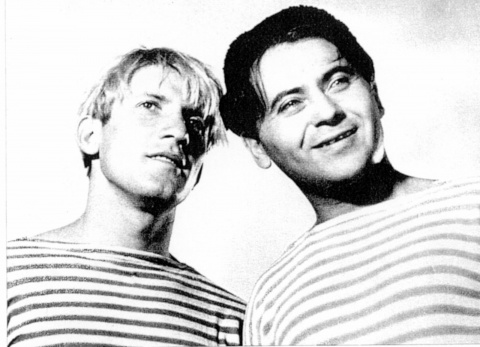 In spite of his own insistence that director Boris Barnet might be “heretically counterproposed” as the “greatest of all Russian filmmakers,” [1] and the consent of no less an authority than French critic and filmmaker Jacques Rivette who once proclaimed that “Eisenstein apart… Barnet must be considered the best Soviet filmmaker,” [2] British author and film critic Gilbert Adair concedes that Barnet “has never quite made it to the captain’s table of 20th century cinema.” [3] The reason for this neglect in part may begin with Barnet’s complex disposition within Soviet film history: though his directorial career began in the late silent era and extended unabated into the 1960s, Barnet belongs neither to the heroic age of the Soviet silent cinema with its montage filmmaker/theorists Sergei Eisenstein, Lev Kuleshov, Vsevolod Pudovkin and Dziga Vertov, nor to the Russian Thaw (Mikhail Kalatozov, early Andrei Tarkovsky) and its aftermath in the Soviet Republics (Armenia’s Sergei Paradjanov, Georgia’s Otar Iosseliani). In other words, he is not a figure properly of either of the Soviet cinema’s golden ages. Rather, Barnet seems to map more closely onto another, far less esteemed period in the nation’s cinema: namely to the brand of film practice, Socialist Realism, that became mandatory under Josef Stalin. Even so, the best of Barnet’s work from this period – and above all, By the Bluest of Seas (1936) – fits as uncomfortably within the parameters of Socialist Realism as do his silent masterpieces within the tendencies of the Soviet montage cinema. Ironically enough, it is perhaps his final masterwork, 1961’s Alyonka, that best summarizes its age, no doubt because the Soviet cinema had finally caught up to Barnet, not Barnet to his nation’s cinema.
Still, if Barnet fails to exemplify the center of Soviet film practice at its best (particularly in its prewar phase) it is precisely this incongruity that determines the superior quality of his art. Following a short career as a screen actor that began with Kuleshov’s 1924 The Extraordinary Adventures of Mr. West in the Land of the Bolsheviks – perhaps the clearest Soviet influence for Barnet’s early slapstick phase – Barnet directed his “Keatonesque” first feature, 1927’s The Girl with the Hatbox. [4] From this farcical debut by the “father of Soviet comedy,” Barnet’s career-defining emphasis on the emotional lives of his protagonists is already present, as is a structure (and thematic platform) that he will reuse in By the Bluest of Seas: the love triangle. [5] (Abram Room’s less comic Bed and Sofa, from the same year, importantly celebrates the same theme via a ménage à trois structure.) Hence, The Girl with the Hatbox rejects the practice of the collective protagonist that emerges in The Battleship Potemkin (Eisenstein, 1925) and The End of St. Petersburg (Pudovkin, 1927) ahead of Stalin’s related directive.
Barnet’s rarely-screened third feature, The House on Trubnaya Square (1928), exceeds the excellent Girl with the Hatbox in every respect – not the least of which for its’ comic set-pieces: the pounding out of rugs in the tenement becomes hotly contested; the film stock is arrested as a peasant girl is about to be hit by a streetcar, before being reversed in order to explain how the duck she is chasing has arrived in the city; and lastly, dolls respond to this escaped duck via the film’s cutting, as if to lampoon Eisenstein’s intellectual montage. Moreover, The House on Trubnaya Square looks forward to Vertov’s The Man with a Movie Camera (1929) in its exposition of a city waking. Of course, Barnet’s city, though ravishingly photography – particularly after a rainfall has wet its streets – is populated significantly with dingy apartment houses that do as much to mock Soviet living conditions as will Ernst Lubitsch’s latter-day Ninotchka (1939). Indeed, it is here, as well as in Barnet’s sympathetic portrayal of his simpleton female protagonist, that the director’s subversive program materializes. Thus, it contains all of those elements that make the director’s cinema so singular within its national context: The House on Trubnaya Square is critical, funny, free and pictorially stunning. For this writer at least, Barnet’s silent opus is one of the greatest Soviet pictures of the 1920s; perhaps its only true equal is Vertov’s The Man with a Movie Camera.
Nevertheless, as perfect a comedy as it may be, The House on Trubnaya Square does not quite mark the director at his absolute peak; this distinction belongs to his mid-1930s masterpiece, By the Bluest of Seas. The film opens (and closes) with what are arguably the most beautifully-shot seascapes in the history of cinema: Barnet and cinematographer Mikhail Kirillov’s camera captures the region’s luminous sunlight as it refracts through the salty air and dances off the translucent Caspian Sea surface. As the surf explodes in slow motion into the misty heavens, the image track becomes as sensuous as that in any visual medium, exposing the film’s intention to procure icons of unsurpassed natural beauty. By the Bluest of Seas might just be said to improve upon the natural world.
Presently, a man is pulled from the inland sea and the spell of the film’s breathtaking beauty is momentarily suspended. Narrative will follow, as will pleasures other than those of looking. Indeed, as the aforesaid gentleman is pulled from the tepid saltwater he warns his savior that he is ticklish, which therefore almost immediately establishes the film’s jocular tone. More slowed footage of the staggering seascape follows, as does an image of the pair dozing in their vessel, before they reach a remote island that will be their home until the pair return to the sea at the picture’s end. With this retreat, Barnet reprises the same human-less subject of his opening imagery, framing what will be otherwise a love triangle – or more properly quadrangle – narrative. In this respect, Barnet seems to follow the lead of Ukrainian master Aleksandr Dovzhenko’s great Earth (1930).
Where Barnet departs from Dovzhenko, and indeed from so much of the cinema of the era, is in its apparent lack of an ideological program, apart again from the subtle dissent implicit in the sacralizing of individual feeling. Upon reaching the shore, our two shipwrecked sailors, one light-haired (Nikolai Kryuchkov as Alyoshka) and one dark (Lev Sverdlin as Yussuf), quickly fall for blonde beauty Misha (Yelena Kuzmina). Staying on to work in the island’s kolkhoz – though Alyoshka’s heartache sidelines him for a time – the pair vies for the attention of their buxom object of desire. She returns their interest with a broad, heart-rending grin, and even a few joy-filled kisses, though ultimately her heart belongs to a missing third. Amidst the film’s ever-palpable eroticism – By the Bluest of Seas is the sexiest of Soviet films [6] – Misha holds out hope that he will return, that he will in effect come back from the dead, transforming By the Bluest of Seas into something of a resurrection story. (As Iosseliani once claimed, Barnet’s picture is a monument to “desire and fidelity.”) [7] Yet, her faith might just mean heartbreak for both of our head-over-heel male protagonists, who have spent the film’s duration crooning of and for their love and dancing shirtless for her attention. Indeed, Barnet’s love quadrangle insures that someone will get hurt.
In the far-removed world of By the Bluest of Seas, the fate of the human heart proves infinitely more consequential than the abstract good of the collective. Life is about love, not labor – just as By the Bluest of Seas is itself about the “love of life.” [8] Accordingly, Barnet’s picture consistently manifests joy across these many emotional pitfalls. By the Bluest of Seas is musical-comedy not only in form, but also in tone. This is to say that while melancholy may be present (and real) in Barnet’s film, it is worn as lightly as the film’s dissent; each remains hidden beneath the film’s shimmering, sun-dappled surfaces. Call it the Barnet touch.
In spite of everything that has been said, By the Bluest of Seas nonetheless remains a surprisingly difficult film to champion, let alone to write about, no doubt because its pleasures are so pure. To any detractors that it may have, present or future – and these fictional “detractors” would argue undoubtedly against its greatness, not its goodness – let us invoke our same original authority, Jacques Rivette, in the context of his remarks on one-time neglected giant of the cinema, Howard Hawks: “the evidence on the screen is the proof of [his] genius.” [9] In the example of By the Bluest of Seas, a better way to state it might be to say simply: the evidence is on the screen. That is, whether one cites the filmmakers’ land and seascape photography, the bodily and performative representation of desire and feeling or the emotional stakes for which the protagonists are playing, the unadulterated pleasures of Barnet’s film are there for those with eyes to see and hearts to feel. This is a film with which to fall in love.
Following By the Bluest of Seas, Barnet’s cinema would not remain so “refreshingly ideology-free,” beyond even his compulsory foray into patriotic subject matter during the Second World War. [10] (The most significant Barnet film omitted until now has been his 1933 Okraina [a.k.a. The Outskirts], which does offer a politically-inflected message in its critique of war; then again, this anti-war theme can be read rather easily along the individualistic lines sketched above, and does little therefore to illuminate his relationship to imposed Socialist Realism.) In his 1951 Bountiful Summer, to cite just one example of the director’s latter-day politicization, “comedy” and “propaganda” are joined to tell the story of a “utopian Ukrainian community” – save for the comedy, this is very literally Dovzhenko terrain. [11] However, with his penultimate Alyonka a decade later, Barnet renews By the Bluest of Seas’ Romanticism in Soviet Asia (the eponymous pre-teen heroine ranks as one of film’s most endearing romantic leads), its predilection for landscape photography (here passing over the golden surfaces of the Steppes), the slapstick origins of his cinema (he speeds up much of the comical classroom anecdotalizing) and finally his characteristic subversive individualism (again the headstrong Alyonka or the trapped housewife, who hangs a Reubens print on her wall to great derision). And then there is the fact that Alyonka is, above all else, hugely entertaining – a quality that it shares with the director’s best, whether it is The Girl with the Hatbox, The House on Trubnaya Square or his supreme By the Bluest of Seas. To refuse to admit to this is to “refuse to be satisfied by proof.” [12]
Update (4/18/2008): Having now seen the film for a third time, I regret not discussing the film's transitional-phase sound. To summarize, By the Bluest of Seas alternates between long, silent passages, often accompanied by recorded music, scenes featuring post-sync dialogue with little to no ambient sound and added intervals featuring individuated sound effects. While this entails a fairly standard transitional product, By the Bluest of Seas' sound strategy reinforces its narrative freedom to combine toward a remarkable formal roughness - not unlike Jean Vigo's L'Atalante (1934). In fact, both films' soundtracks attain a poetic quality, as for instance in the Soviet picture when Misha's act of ripping off her necklace (presented in slow motion) is shown without sound. Much more could and indeed should be said, though at least by making this addendum, I hope to provide a better sense of the film's tone.
Also, in my attempts not to include spoilers, I have underplayed the film's Christian implications. So, to warn of the presence of spoilers now, let me just say that this is not simply a film that trades on faith, or that we have appeals to the male leads on the basis of how they might feel if the situation was to be reversed, but further, a resurrection occurs with Misha's return from the sea: her prolonged reemergence from the surf (amidst the mourning of her death by the members of the "Lights of Communism" kolkhoz and our two protagonists) provides one of the film's most dream-like touches, and one of its greatest outpourings of joy. Also, her return to and then departure from the farm's great hall initiates one of the film's finest comic set-pieces: the awarding of a suit to Yussuf, which Alyoshka uses to get close to his Misha's in the dark-haired gentleman's forced absence. By the Bluest of Seas indeed extends the slapstick humor of its silent antecedents, which is a quality again that is reinforced by the picture's silent-sound hybridity.
[1] Gilbert Adair, “By the Bluest of Seas” in Film: The Critics’ Choice, ed. Geoff Andrew (New York: Billboard Books, 2001): 158.
[2] Jacques Rivette.
[3] Adair, 158.
[4] Ibid.
[5] “The Extraordinary Mr. Barnet."
[6] Adair, 158.
[7] Ibid.
[8] Ibid.
[9] The full quote reads “the evidence on the screen is the proof of Hawks’s genius.” Jacques Rivette, “The Genius of Howard Hawks” in Cahiers du Cinéma: The 1950s – Neo-Realism, Hollywood, New Wave, ed. Jim Hiller (Cambridge, Massachusetts: Harvard University Press, 1985): 126.
[10] Adair, 158.
[11] “The Extraordinary Mr. Barnet."
[12] Here the actual quote is as follows: “you only have to watch Monkey Business to know that it is a brilliant film. Some people refuse to admit this, however; they refuse to be satisfied by proof.” Rivette, 126.
Monday, April 14, 2008
Michael Snow & the 1970s Aesthetic of Excess: La Région centrale (1971)
 If 1970s film aesthetics was defined by a single common feature, it was the principle of excess. In Hollywood, this quality of excess manifested itself in the further roll-back and transgression of Hays-era prohibitions, leading not only to the so-called Hollywood Renaissance of the late 1960s and early 1970s, but also to the well documented explosion of exploitation cinema. In Japan, the X-rated pink movies of the era bested Hollywood's comparatively mild attempts to create a morally retrograde cinema. India witnessed the emergence of a relatively artless blockbuster cinema to compete with similar developments in Hollywood excesses in their own right - while Europe seem to discount the concept of popular cinema altogether. Indeed, in that latter context, the art film experienced its least commercial instantiation with running times often exceeding the 180-minute mark: Andrei Tarkovsky's Solaris (1972) comes in at a lean 165-minutes when compared with Céline and Julie Go Boating's (1974) 190 minutes, Jeanne Dielman's (1976) 201 minute-length, The Mother and the Whore's (1973) 210 minutes, the four hours of Theo Angelopoulos's Travelling Players (1975) and Manoel de Oliveira's Doomed Love (1979), and of course, most spectacularly of all, Jacques Rivette's 773 minute Out One (1971) and its 4-hour abridgement, Out One: Spectre (1972).
Along with Stan Brakhage's Scenes from Under Childhood (1967-1970), Michael Snow's 180-minute La Région centrale (1971) extends this principle of excess to the avant-garde. Of course, it is not simply for the film's punishing duration, but more importantly for the scope of its ambitions - another era hallmark - that La Région centrale rates as one of the defining examples of 1970s film art. Like the cinema of Rivette, Snow's concerns itself foremost with allegorizing his medium's basic ontology. Before expanding on the particulars of this process, however, a brief description of the film's singular technique might be helpful. From IMDb:
From the start, we see a series of fluid, spiraling camera movements punctuated by jerky in-camera reframings. The shadow of the aforementioned apparatus is visible on the frozen ground. Shortly, the view shifts from a Smithsonesque ("Spiral Jetty") pebble field to the horizon of this Northern Québec locale. As the film continues to unspool, the pre-programmed 'routines' slowly omit more and more of the icy, light blue sky until we are faced with this barring-less color field. At this juncture, the camera movement of the prior passages has become virtually invisible, though it is equally clear that the same strategy continues (which the return of the horizon will soon confirm). In the meantime, Snow's image has collapsed into virtual abstraction, rendering the texture of the grainy 16mm stock increasingly visible.[La Région centrale was] entirely shot using a robotized camera set on the top of a mountain in the Canadian wilderness - in winter. The camera was mounted on a mechanical arm that could move in any direction (even upside down). Using instructions recorded on magnetic tape, the filmakers could control the arm's movement, creating short "routines" that had do be checked and programmed daily. During the entire movie the only sound heard are mechanical blips and electronic noises synchronized with the camera movement...
So too are we made aware of the camera's lens in the extensive flaring that characterizes this and a number of the film's subsequent 'routines.' In these, moreover, the glass surface becomes progressively dirtier, thus giving us a sense of a world delimited by the lens's impermeable boundary; the camera at this moment is more than the lens - it is a behind the glass as well.
The physical properties of the camera, however, are made clearest still in a series of jagged, diagonal vectors that imitate a bouncing when the camera quickly shifts directions after reaching the ground line. In these moments, the camera's physical volume, its embodied quality in essence, is made manifest: the camera can only move through negative space; its lower limit is the same as the human body - even as it seems to travel freely through the heavens.
Speaking of the camera's export to the upper reaches of the visible, Snow begins by offering us progressively larger glimpses of the Québec skies again before thrusting into the deep blue. Thereafter, Snow offers us segments of each splitting the screen, first horizontally and then vertically. With the latter configuration in particular, especially once the camera movement is sped up to the point of abstraction, Snow imports a sense of his mise-en-scène as film stock, passing through the projector in a succession of moments too quick to glimpse on the atomic level of the individual frame. In a similar passage rapidly skimming the surface of a mountain lake, La Région centrale mimes an image stream, run too quickly to be examined, but theoretically subject to a slowing that could again make the image readable once more. What we have is projection in short.
Snow's work, in sum, highlights both the element nature of the medium - its division into discrete frames unspooled too quickly to be seen - and again the process of projection itself, with landscapes running horizontally and vertically before our eyes, at an ever-changing pace. In this respect, La Région centrale bares more than a passing resemblance to the work of Brakhage, from Anticipation of the Night (1958) onwards. This particular film is echoed in the film's brief night-time segment with the moon swinging quickly across the upper right corner of the frame. In fact, as we see this single, luminous object crossing the screen, its projection like a flashlight broaching an otherwise pitch black theatre, we are made aware of its trail scorched onto our retinas in its absence. Metonymically, we are reminded of the film's winter landscape, out-of-view, but still present in our collective remembrances. No less than Brakhage, La Région centrale is about the act of seeing.
As the film reaches its conclusion, Snow's abstraction becomes even more pronounced with a thin band of land briskly moving in and out of our view. On this occasion, a second of the director's work, Mothlight (1963), serves as a reference. However, in those moments of purest absence, the films of Paul Shartis emerge as the closer point of comparison, as for instance the filmmaker's N:O:T:H:I:N:G (1968), which seems to counter Wavelength's arguments for an ontology of cinema emphasizing space with one that highlights the fundamental work of light in the medium. (I was fortunate enough to see both films on a Madrid double bill eight years ago - one of the finest avant-garde double features I suspect I will ever see.) In this regard, La Région centrale positions itself as summa for the North American avant-garde of the previous two decades, while reframing this tradition within the newly emergent aesthetic of excess that would characterize the rest of the decade.
In the end, La Région centrale is the spiritual twin of Jacques Rivette's Céline and Julie Go Boating (1974) and that film's allegorization of the filmmaking process. Then again, if there is greater emphasis on the act of creation, of invention in Rivette's subsequent opus, Snow's film emphasizes the projected image and therefore the experience of film viewing itself. (So they are fraternal twins, I guess.) In other words, Rivette seems more concerned with the making and Snow with the seeing. Of course, this is not to limit Snow's ambitions: La Région centrale further makes us aware of our place on this planet, the workings of gravity and its stipulated absence, and finally this planet's revolving trajectory through the heavens. Snow's masterpiece is not only reflexive, it's cosmological. There is, in other words, an excess of ambition here.
Subscribe to:
Posts (Atom)