Abbas Kiarostami'sCertified Copy(Copie conforme), the director's first feature-length, non-experimental fiction filmmaking since his 2002 Ten, and his only to date to be shot outside his native Iran, confirms or rather reaffirms the filmmaker's place at the absolute pinnacle of post-1960s international art cinema, through its re-purposing of both the director's own previous forays into the border territory between fact and fiction and also the very European modernist art cinema of which Kiarostami has proven the most notable inheritor. Recalling foremost Roberto Rossellini's fluid, epochal examination of marital stress and miraculous renewal, Viaggio in Italia(1954), a film whose influence on the director has been crystalline since Kiarostami invented his own moving vehicle idiom in the early 1990s; the early 1960s period work of the former's high modernist countryman and direct artistic descendant, Michelangelo Antonioni; and finally, but certainly not least of all in terms of resemblance, Alain Resnais'sparable of uncertainty, Last Year at Marienbad (1961), Certified Copy finds its fiction as Juliette Binoche (as French ex-pat Elle) and William Shimell (as English author James Miller) traverse the country roads and villages of the film's rural Tuscany, inventing a fifteen-year marriage as they ostensibly embark on their first afternoon together. Unlike as in Resnais's topical source, however, with which the film shares an unclear past, Shimell's Miller does not resist Binoche's fabrication, but instead playacts in his assigned role as inattentive husband and frequently absent father, before being asked to make the intra-film fiction a narrative fact as the couple arrive at the (improvised) site of their "honeymoon." In keeping with the director's signature technique of constructing unfinished endings, it remains for the spectator to decided whether Binoche and Shimell replace their invented pairing with a real coupling as the film fades to black - in this sense replicating Rossellini's marital restoration - or if instead Shimell shatters the fantasy in order to catch his nine o'clock train.
Certified Copy opens with a static figure-less framing of Shimell's eponymously titled tome propped up on a rectangular table between a set of microphones. With the din of voices emerging beyond the extremely limited opening frame, Kiarostami immediately constructs a distinctive off-camera field, thereby renewing his most consistent formal obsession. Following an introduction apologizing for his delay, Shimell's tardy Miller soon appears and thus commences his lecture on the subject of his book, originals and copies (in art), with his thesis favoring the historically neglected latter. (Miller is a fairly obvious surrogate for Kiarostami in Certified Copy, given the director's own presence as a celebrated visiting auteur.) Certified Copy accordingly revisits one of Kiarostami's cardinal subjects, namely the difference between real and fake, which documentary-fiction hybrid Close-Up (1990) famously took up for its presentation of the trial of real-life Mohsen Makhmalbaf impersonator Hossain Sabzian. As in Kiarostami's deeply-influential 1990 feature, Certified Copy thus invites the question of what constitutes "art," though its answer will prove less directly relevant to the director's latest than it is for the earlier text. Here, the subject of real and fake, analogized from the fictional book's treatment of works culled from the visual arts, is displaced ultimately onto the relationship of Elle and James, with the fictional possessing the same transformative power for Elle as it does for Hossain, whose peformative act she replicates in pursuit of her own similarly elusive happiness.
However, it is less Sabzian than Ten's divorced, single-mother taxi driver, Mania Akbari, who provides the more immediate, and indeed initially apparent source for Binoche's Elle (though Elle decidedly lacks the prior feminist heroine's noteworthy strength). In particular, it is Elle's relationship with her precocious, taunting son (Adrian Moore), a near replica of Ten's Amin, which most clearly evokes the earlier source; in Certified Copy,the video game-distracted tween memorably accuses his mother, much to his own delight, of romantic intentions toward the English author, leading Binoche's character to rush off in great frustration. Of course, Elle's son proves perceptive in this instance, though it will only be after a grandmotherly restaurateur mistakes James for Elle's husband that the latter will begin to inhabit the role of her companion's long-suffering wife (and in this respect, to acknowledge her romantic interest). While, the exchange between the older and the younger woman remains comfortably within the register of the white lie, Elle and James's interactions provide the film with its more complex parsing of the real and the fake within the contours of male-female relations, where in the words of film scholar Lisa K. Broad, it is as easy for this new couple to become long-married spouses as it is for them to inhabit the roles that their relationship would conventionally dictate. That James moreover may have noticed Elle in her daily interactions with her son, and consequently that this may have prompted the book, further suggests a differing level of intimacy than their first afternoon together would typically compel.
Elle's aforesaid exchange in the restaurant notably provides the first of two prompts for her fictional engagement with James: in this case, it leads to their initial rehearsal as husband and wife. A second sighting of a presumably long-married couple (strolling ahead of them along the village's cobble stoned streets) leads to Elle's consequent identification of a nearby hostel as the location of their 'honeymoon.' Clearly, the couple reminds the female lead of her loneliness, leading to her fiction-based attempt to remedy her want - in much the same way again that Hossain sought to improve his own circumstances following an initially innocent falsehood. In the segment that follows to close the film, the viewer is invited not only to complete the picture by deciding the fate of their relationship - the same ultimate choice left to the viewer of the director's supreme masterwork, Through the Olive Trees (1994); then again, Through the Olive Trees offered a clue to Kiarostami's affirmative choice in its use of an upbeat musical accompaniment, whereas Certified Copy seems to lack the tipping of the director's hand, save perhaps for the final allusion to Viaggio in Italia - but also by averring whether or not the pair will copulate. Indeed, sex moves subtly into the foreground in the director's first non-Iranian fiction feature, having emerged from the deep shadows of Ten, where the driver transports a prostitute whom the viewer thereafter sees in the deep recesses of the frame negotiating her trade. Binoche's natural, straight-forward sexuality and her intense romantic longing accordingly introduce a new element into Kiarostami's work: sex.
Of course, it is the fact that Certified Copy was shot outside of Iran that allows for this development in his oeuvre (which was again present in socially conscious rather than romantic terms in Ten). Hence, the director's first attempt at ex-patriot filmmaking yields more than allusions to Kiarostami's sources in Italy and throughout Europe, an appropriate cultural background for his discourse on originals and replications (the Italian peninsula, home to the greatest imitators of Hellenic artistic tradition) and a new set of cypress-covered landscapes, through which his automobile snakes as his couple antagonistically gets to know one another by discussing the philosophy of copies - Certified Copy is in this last sense Richard Linklater redux, with its principles getting off to a very uneasy start. Europe in the end provides the director with the opportunity to add a new dimension to his body of work that he has handled with customary assurance. While Kiarostami is by no means the only recent example of an Asian filmmaker plying his trade in Europe - the Iranian follows contemporaries Hou Hsiao-hsien, Tsai Ming-liang and Hong Sang-soo, among others - the director's Certified Copy is the most achieved of these recent efforts, not simply because it transposes its director's aesthetic (including a near Kuleshovian use of close-up that translates the director's work in Shirin, 2008) and set of concerns in tact, filtering these through an explicit set of appropriate references, which certainly the aforesaid do as well, but because it has permitted its' director to make present what was absent, to construct an even more robust portrait of the world than he already has. Certified Copy is no minor achievement for one of the medium's greatest masters.
For the list-lovers among you, here are my choices for Abbas Kiarostami's ten best.
Radu Muntean'sTuesday, After Christmas(Marti, dupa craciun), from an Alex Baciu, Muntean and Razvan Radulescu screenplay, opens on a tight, two-shot framing of the graying, newly middle-aged Paul (Mimi Branescu) and the lithe, twenty-something, blond Raluca (Maria Popistasu) as they lie in each others' arms, nude, post-coitus. Muntean's camera trains on her milky, mole-spotted flesh and her light-colored nipples, as well as his furry upper body and swelling stomach as they exchange pillow-talk for an extended duration. As the couple begins to shift uncovered across the bed, Muntean re-frames his pair without cutting away, refusing any editing for what proves the film's opening sequence-shot. In this way, Muntean introduces a maximal degree of visibility and carnal, bodily presence from his narrative's outset, while also registering the long-take technique that has become the principle marker of the Romanian New Wave's group style, emergent in the half-decade since Cristi Puiu'sThe Death of Mr. Lazarescu (2005). With a title to correspond, Tuesday, After Christmas's incipient segment suggests the same temporal obsession as is evinced within Lazarescu, Corneliu Porumboiu's12:08 East of Bucharest - Muntean subsequently refers to the 2006 feature by name - Porumboiu's assured follow-up Police, Adjective (2009), and Cristian Mungiu's 4 Months, 3 Weeks and 2 Days (2007).
However, though Muntean continues to favor takes of an often exceedingly long duration, it is less time that remains Tuesday, After Christmas's principle formal interest, than it is space, and in particular off-camera space, as the director's narrative of marital infidelity unfolds with one or two members of the triangle excluded in most of the film's minimally cut scenes. As such, the film's opening proves the negative image of the narrative to follow, a moment of abundant presence - where relationships and thus exclusions have not yet been identified - in a film that consequently, overtly signifies absence; indeed, as Muntean's film proceeds, the viewer becomes increasing aware of those excluded from any given set-up, whether it is Raluca, Paul's wife Adriana (Mirela Oprisor) or even the male lead himself. The director emphasizes said absence not only by centering most scenes around two of the triangle's three parties, with the third at times referenced (or in one definitive moment, rung on the phone), but also in visually excluding figures within scenes in which they make an appearance. Among the notable examples are Raluca's delayed appearance when Paul visits her at her mother's - Paul is left seated beside the hostile older woman, catercorner at a small square table, within a constricted two framing - and even more, a multiple-shot set-piece in which the trio, along with Paul and Adriana's charismatic, sharp-tongued tween daughter, appear at Raluca's dental office for the young girl's orthodontal consultation. Here, Muntean's choreography expertly balances on-screen with off, removing from view and then fixing on the various members as they and the camera move about the interior.
Likewise, the faces of the performers prove pivotal throughout this passage, with the viewer searching for signs of recognition in Oprisor's expressions, and intimations of thought processes in Branescu's and Popistasu's. Ultimately, the film's revelation of marital infidelity does not occur here, but rather in a later, off-handed exchange featuring Paul and Adriana at home alone. With Paul confessing that he has met someone else, Muntean orchestrates the scene in a characteristic set of two-shots, with his couple alternately turned away from the camera and facing the apparatus in three-quarters view. While Adriana accordingly confronts her husband, insisting on the ugliness of his actions, Oprisor's performance does not succumb to histrionics, but instead settles into an under-played, if nonetheless forceful, wounded defiance that perfectly suits her reasonable, characteristically good-humored wife and mother. Though it is undoubtedly the most impacting of the film's performances, therefore, Oprisor's is by no means the only one of note in the uniformly well-played Tuesday, After Christmas. Of course, much of the credit here belongs to Muntean, who has not only guided the aforesaid set of strong performances, but has further sketched, along with his fellow screenwriters, a singularly witty retinue of bourgeois characters. Tuesday, After Christmas thusly offers further evidence of French New Waver Eric Rohmer's creditable influence over Romania's new cinema.
Under the same inspiration, Tuesday, After Christmas likewise proves a deeply moral work, not only in its assent to Adriana's charges against Paul, but in Muntean's narrative construction following the revelation. In the film's concluding segments it is Raluca who is conspicuously absent, with Tuesday, After Christmas's emphasis becoming Paul as he moves into his lover's small flat, and his extended family (Adriana included) for one final holiday celebration. In this concluding scene, as Paul and Raluca discuss their plans for disclosing their separation in the foreground of the frame, we hear their unaware daughter and his parents as they enjoy their Christmas off-camera - the last that they will enjoy as an intact unit. As the film moves to its open ending, its stopping point, Adriana stands beside her father-in-law as they both look off-screen left toward a group of unseen carolers performing for the off-camera little girl and her grandmother (even as Paul clandestinely places his daughter's gifts from Santa under the tree in an adjacent room). At this juncture, the film's off-screen becomes not only the unseen visually field and characters, or even the still absent Raluca, but a future moreover - referred to further by the date of the film's yet-to-come title - that will foreclose against moments of unambiguous happiness for the picture's pre-adolescent female, Paul's parents and Adriana herself. Tuesday, After Christmas ultimately insists not on what Paul will gain in trading up for the attractive younger woman, but on whom his choice will impact - the sole focus beyond Paul as the film progresses toward its end.
In closing, it remains to be said simply that Tuesday, After Christmas represents an unusually high level of filmmaking in its thematically inspired emphasis on off-screen space (to translate the moral implications of its adulterous subject); Muntean's film no doubt will prove - if it hasn't already - to be one of 2010's unqualified festival-circuit highlights, which is to say one of its better films.
If the cinema was born on a train loaded up with all the promises of modernity, it seems content to spend its twilight years adrift at sea. With Film Socialisme, Jean-Luc Godard joins fellow NYFF staples Aleksandr Sokurov and Manoel de Oliveira in creating a ship-bound fable that serves as an elegy both for film as we know it and for the western civilization that gave it birth. In the first, and most evocative of the film’s three parts, Godard – ever a devotee of montage – creates a metaphoric vessel that is at once an Ark and a Ship of Theseus. (A philosophical thought experiment concerning identity across time, the Theseus paradox involves a ship whose various parts are destroyed and replaced until no original material remains. And yet one is still inclined to say that the identity of the ship remains intact.) In the same way, the cinema seems to have incorporated myriad new technologies while allowing the celluloid-based medium with which it was initially identified to fall by the wayside.
In much the same way that Dziga Vertov assembledMan With a Movie Camera’s (1929) virtual city from fragments of different places, Godard fashions his film’s cruise ship out of bits and pieces of digital footage shot on camera phones, consumer grade DV, and luminous HD. Ironically recalling and perhaps standing in for the richness of ‘real’ film, the HD passages, often scored to a haunting string sound track, take on a veneer of acute if unearned poignancy. While Godard has long explored the effects that can be achieved by juxtaposing sounds and images, the conjunction of different kinds of digital images adds a new dimension. For instance, the seamlessness of the HD images makes the consumer grade footage seem sometimes disturbingly immediate, while the heavily pixilated camera footage takes on an almost abstract quality by comparison. The shimmering tension that arises from the convergence of the diverse media recalls Eisenstein's notion of the overtone – an abstract aesthetic element that derives from the process of image juxtaposition without inhering in any of the images themselves.
While Film Socialisme is distinguished in large part by its commitment to an all encompassing multiplicity and heterogeneity, the film as a whole can be viewed as questioning the relationship between concrete parts (individuals, images) and imagined wholes (nations, families, art forms, industries). However, the result of this inquiry is frequently obscure or unsatisfying. Ultimately, Film Socialisme’s form is more eloquent than its content. While the brusque "No Comment" that ends the film seems to foreclose on future political discussion, the silent dialogue Godard opens between desperate incarnations of the cinema speaks to the director's continued aesthetic relevance.
Warning: the following post contains spoilers. Also, a very special thanks to film scholar Lisa K. Broad for her substantial contributions to the writing of this piece.
Thai auteur Apichatpong Weerasethakul'sUncle Boonmee Who Can Recall His Past Lives opens in a silvery day-for-night, framing a long-horned steer as it crosses through the verdant edge of a forested landscape. A second set-up offers a set of picnickers, briefly presaging one of the film's subsequent cardinal set-pieces, before the film moves into the enveloping jungle with a loin-clothed hunter addressing the animal of the open. Apichatpong follows these with a piercing red-eyed creature stalking the same nocturnal landscape. Thereafter, the narrative shifts into an automobile, with the film's consequent principles sharing the interior as the vehicle crosses the Northeastern Thai countryside. As the filmmaker alternates between close-ups of the passengers and static long framings through the car's front windshield, Apichatpong calls to mind his 2002 breakthrough Blissfully Yours in what accordingly proves one of a series of references that will construct the following passages. In this way, the director immediately offers a counter-interpretation to the film's title: the past lives on display are not only those of Boonmee - the opening sequence presumably offers an example with Boonmee either the reincarnation of the steer or of the hunter - but of Apichatpong himself, with fragments of the auteur's corpus repeatedly returning throughout the film's 113-minute run-time.
A second example of Apichatpong's cinematic reincarnation occurs in the next scene, wherein the director reuses not only the rural landscape of his 2004 Tropical Malady, replete with its covered outdoor space, but also that film's first-half lead, Tong, who as in the earlier film is once again embodied by Sakda Kaewbuadee. Syndromes and a Century's(2006) Jenjira Pongpas likewise makes a re-appearance, though in her case under the name (Auntie) Jen, rather than as the earlier work's Pa-Jane. Indeed, it is more in Apichaptong-newcomer Uncle Boonmee's (Thanapat Saisaymar) kidney treatment, a detail gleaned from the life of the director's of physician father, that Syndromes reasserts its place among Uncle Boonmee's cinematic past-life sources, as well as in the antiseptic hotel room (befitting the 2006 work's urban second part) that closes the director's latest. Here, the viewer sees Tong and Jen suddenly doubled in super-imposition, leaving to eat dinner at a garishly designed, over-loud restaurant - as their second selves remain glued to their television screen. In this respect, Apichatpong re-introduces the forking-path, doubled narrative structure that emerges strongest in Tropical Malady and Syndromes and a Century (in addition to its slightly less conspicuous instantiation in Blissfully Yours),albeit only at his latest's close. Hence, Uncle Boonmee Who Can Recall His Past Lives does not adhere exactly to the two-part, bifurcated constructions that distinguished his trio of 2000s masterpieces, and defined in some sense, along with the work of Hong Sang-soo in Korea, the art cinema for the decade as a whole.
Instead, Uncle Boonmee Who Can Recall His Past Lives's fluid fabulist registrationsuggests an exceedingly appropriate return to the director's "exquisite corpse" first feature, Mysterious Object at Noon(2000) - 'appropriate' given the more recent film's governing interest in origins, be it those of the forms and places of the eponymous uncle's past lives, the director's prior cinematic efforts and influences (including those of the Thai soap opera) and even of the cinema itself. In one of the latest film's most staggering set-pieces, preceded immediately by an uncharacteristic hand-held follow through the jungle, the trio of leads enter an explicitly originary, primordial cave, with primitive paintings decorating the rock walls and gemstones magically glittering overhead. Through this space, an automatic metaphor likewise for the cinematic art in its evocation of Platonic shadow play, Apichatpong suggests the origins of his and all (cinematic) art; the spectator sees as the director's figures, filmed from above as they lie against a bright limestone backdrop, suddenly break from the slumber, in essence animating the cave paintings spotted only moments earlier. This indeed follows on Uncle Boonmee's avowedChris Marker moment - which is to say its clearest acknowledgment of film's still photographic origins - with a series of stills, taken from the filmmaker's "Primitive" instillation (of which Uncle Boonmee is the culmination), providing the visual counterpoint to the titular figure's voiced-off dream.
A second self-contained dream-encoded passage occurs with the on-screen, cinematically self-reflexive fable of the princess, subsequently pleasured by a catfish, at the water's edge. Here, Apichatpong transitions to the sequence's day for night, marking one of the film's six disparate stylistic regimes (each culled from a separate real), immediately upon showcasing Tong lying in a hammock. The viewer is invited in this instance to read the scene as a dream, with Tong's status as Apichatpong's closest narrative surrogate implying that the set-piece is a product of the director's fiction, even as he or she also assumes that the un-spooled is another of Boonmee's past lives. As such, Uncle Boonmee Who Can Recall Past Lives presents multiple, porous and concurrent ontological registers, befitting the film's intrinsic Surrealism (considering again its solicitation of Mysterious Object at Noon's narrative organization).
Then again, it is less the film's depiction of surreality in the traditional meaning of the dream than it is its configuration of local animist myth and superstition - as for example when both Boonmee's dead wife and his transmogrified (Monkey Ghost) son appear at their ultimately comic al fresco dinner - that insures the work's true singularity. Apichatpong reinvents not only his narrative structure to process Boonmee's Buddhist procession of past lives, along with the director's (cinematic) own, but also the film's relationship to the material world, validating the presence of apparitions and their communion with the living through their co-equal presentation. Uncle Boonmee Who Can Recall His Past Lives, in other words, thoroughly reinvents film language, what it allows as possible and how it depicts this possibility - Uncle Boonmee does not simply replicate Tropical Malady's doubled form with one-part accordingly claiming a metaphoric valence; rather, the director's latest offers the folkloric to fully permeate the presumed real - in order to facilitate its parallel presentations of reincarnation, the spirit world, human subjectivity and even the director's auto-biography and artistic history. For the writer of this piece, Uncle Boonmee appears at first glance to be Apichatpong's career best, and quite conceivably the strongest new work of cinematic art in some years.
David Fincher's The Social Network, from an Aaron Sorkin adaptation of "The Accidental Billionaires," Ben Mezrich's 2009 account of the contested founding of Facebook, resolves itself by insisting that Jesse Eisenberg's Mark Zuckerberg is not in fact an "ass-hole," in spite of a cold open that provides seemingly incontrovertible (and indeed explicit) evidence to the contrary, and a storyline that does little to dispel the impression. Rather, Zuckerberg is assured that he is "just trying so hard to be" the aforesaid, having adopted the posture first in an Anglo-Saxon Harvard world in which his Hebraic origins are a social deficiency, and thereafter in his pursuit of a billion-dollar valuation, following the lead of hard-partying Napster creator Sean Parker (Justin Timberlake). Mark's character failings and in particular his willingness to double-cross his friends and associates is linked finally to his lack of official social acceptance in one of Harvard's "final clubs," while the impetus for the multi-billion dollar company itself continues to the film's end to possess a romantic dimension, with Mark sending ex Erica (Rooney Mara) a friend request (which he monitors by frequently refreshing his site) following one of his legal depositions. Fincher and Sorkin's The Social Network therefore provides an explanation for Zuckerberg's behavior, the question of his asshole-ness, rooted entirely in the traumas of his early Harvard years. As Orson Welles's Charles Foster Kane finally pines for his lost youth inCitizen Kane(1941), for a time before his great wealth and monumental ambitions, so does Zuckerberg thirst for his lost love, from a similar juncture situated before his rise.
That Fincher identifies a single object of romantic longing at the core of his male protagonist's experience insures that The Social Network shares at least some common ground with the director's previous The Curious Case of Benjamin Button(2008). However, it is much less his strategies in Benjamin Button than those of his superior Zodiac(2007) to which Fincher is returning in The Social Network. As with Zodiac, Fincher's latest provides a real-life variation on an earlier, fictionalized cinematic source: for the 2007 film, it was Don Siegel's fully fictional transcription of the "zodiac" killings,Dirty Harry(1971), which the director revises in light of the known facts of the same case, while for The Social Network,it is Welles's veiled treatment of the life of media mogul William Randolph Hearst that provides a point of embarkation for examining that of the latter-day, on-line impresario Zuckerberg. In both Fincher films, each based on a work of recent non-fiction, the director restricts himself to the recounted histories of his real-life subjects, depicting only those killings on screen for which there were witnesses in Zodiac, and sketching Zuckerberg's life through the deposition testimonies that enable the film's flashbacks. (It is for this reason that the often uncommunicative Zuckerberg - when he is not dressing-down his countless intellectual inferiors, that is - begins to recede from his own biography.) Each film attempts to produce a reasonable solution to an open question: who is the Zodiac and what was Zuckerberg's malfeasance?
Where the two films diverge foremost is in their respective relationships to their sources. Whereas Zodiac seeks to critique the vigilante premise of its Dirty Harry source in elevating due process over the questions of victim's rights and public safety, and by highlighting the epistemological uncertainty endemic in treating an unsolved case, The Social Network more or less refreshes Kane, adopting that film's shuffled chronology in its recounting of Facebook's contested history. For his latest, Fincher structures his narrative through a pair of parallel depositions, comparable to Citizen Kane's archive and interview prompts, which in the former, as in the latter, seek in some sense to clarify the film's opening: why or is Zuckerberg an "ass-hole?" What is "Rosebud?" Though he is undoubtedly responding to richer material with the (still somewhat over-valued) Welles than he is with the (still somewhat under-appreciated) Siegel, the fact that he and Sorkin opt for the same virgin, comprehensive explanation for The Social Network that Welles did for Kane suggests the 2010 film's comparative limitation (versus the revisionist Zodiac). Where The Social Network could have truly shown some film historical ambition in challenging Welles's slightly pat solution to the Kane/Hearst paradox, it offers instead the same all-encompassing answer. In any case, Fincher reveals the same small-'r' romanticism that he showcased in Benjamin Button.
In additional auteurist terms, The Social Network again highlights the centrality of lighting (particularly of an overhead, neon variety) that is visible in the director's oeuvre from Se7en (1995) onward. In contrast to a Welles, for example, whose spaces often organically disclose his narrative's themes - much more than for its subject, Citizen Kane's greatness originates in the meaning that Welles introduces into Gregg Toland's deep focus compositions through his organization of figures - in Fincher, disbursement of bodies in space often seems to be of only secondary importance, with a very classical shot/reverse-shot decoupage predominating. Instead, the director secures his mimetic effects largely through his choices of illumination, often favoring sickly green or warm yellow filters that inflect his mise-en-scène with a particular mood, while also commenting on aspects of the psychology of his characters. That the director would favor the creation of meaning in visual tone rather than in the organization of a spatial field recalls Fincher's start as music video artist, where that form's conventional aversion to the long-take militates against the sorts of spaces in which Welles reveled. Of course, Trent Reznor's participation (in collaboration with Atticus Ross) as the creator of the film's soundtrack likewise reaffirms Fincher's music video past, not only on a filmographic level, but also for the manner in which meaning is conveyed through the film's scoring: to take just one example, Eisenberg's post-breakup, anguished cross-campus flight, through seductively elegant Ivy League surroundings, is suitably mimicked by Reznor and Ross's simultaneous inclusion of a melodic piano theme and overlaid discordant soundscaping. Sound and image act in complete concert, in other words. This is the total art of the music video artist.
The Social Network accordingly represents both the latest iteration in Fincher's perpetually more impressive career body of work - upon a first viewing, this writer would rate the film a shade below Zodiac perhaps, but the equal certainly of anything else the director has done to date - and a work that benefits greatly from its collaborators. (Again Citizen Kane is not an altogether unfruitful point of comparison.) Most notable among these are Sorkin, particularly for his perceptive, rapid-fire dialogue; Reznor and Ross once again, not only for their thematically organic, multi-layered scoring, but for their occasional sense of humor; Armie Hammer as twin Aryan specimens, the Winklevoss's; and finally Eisenberg himself who brings far more in his caustic embodiment of Zuckerberg for instance than Brad Pitt did previously as Benjamin Button's eponymous cipher. Even when hunched over or staring blankly out at a sudden rain - and thus only fractionally engaged with the world around him, which Mark admits to being in one of the film's sharpest edged exchanges - Eisenberg exudes a sense of the ass-hole (or wanna be ass-hole) at the center of Fincher's real-world biopic.
Ben Affleck's The Town, from an Affleck, Peter Craig and Aaron Stockard adaptation of Chuck Hogan's novel "Prince of Thieves," distinguishes itself from Hollywood's comparatively recent set of Bostonian Irish mafia A-pictures, Clint Eastwood's late-period masterwork Mystic River(2003) and Martin Scorsese's Academy-endorsed, nihilistic divertissementThe Departed (2006), through its exceedingly precise rendering of its Charlestown setting. Affleck registers the once predominately working class redbrick district through a series of aerial takes that frequently juxtapose the North Boston neighborhood in the lower foreground against the city center receding behind Christian Menn's Bunker Hill Bridge, and in a series of depressed and depressing locations that include abandoned ice arenas, gravel pits and housing projects. Indeed, The Town proves fundamentally geographic in its orientation and its intention, sketching the neighborhood and its parasitic relationship to Greater Boston (as the point of origin for a nationally unparalleled population of armored vehicle and bank robbers). On the most basic level, the multi-hyphenate's latest suggests a filmmaker working to stake his claim as the Boston auteur, forging a body of work that attempts to procure a robust sense of the city, from Gus Van Sant's Good Will Hunting(1997), through to Affleck's own Boston-based policierGone Baby Gone(2007) and his 2010 latest. Affleck may yet prove a New England parallel to Gotham's Scorsese, albeit in a very nascent stage in his career; or more conservatively, he may become to his hometown what Paul Mazursky, whose An Unmarried Woman (1978) mapped New York far better than most, once was to his.
Ultimately, what Affleck presents is his city's myths, in this case Charlestown's criminal disrepute, which the director filters through an exceedingly familiar moral relativism. His city's thieves, even those who enjoy their line's brutality (Jeremy Renner), are naturally never without positive qualities (with loyalty being the default). If The Town is therefore highly conventional in the moral code it depicts, so too is the tenor of the film's narrative focalization, with the spectator heavily invested in the fate of Affleck's bank robber cum kidnapper Doug MacRay. In the director's hands, the potential imminent revelation of Renner's neck tattoo offers a virtually Hitchcockian example of suspense, equivalent in effect to Sabotage's(1936) public transport explosive, with Doug's freedom and romantic happiness perilously hanging in the balance. In the end, however, Affleck opts to insure only one of these two for his MacRay, leaving the second open to speculation in a concluding set-piece that seems to be lifted directly from Frank Darabont's The Shawshank Redemption(1994). That Affleck would favor such a source at this pivotal moment reinforces his own ambitions with The Town: to create a well-crafted piece of A-picture storytelling (of the sort that would largely disappear in the early 2000s, save for an occasional Mystic River). In other words, Affleck produces a largely edge-less work of the middle, where the director's able regulation of pace and his fine direction of actors - extending beyond those mentioned to a plausibly 'rode hard and put away wet' Blake Lively; her Oxycon-abusing, Irish-American single mother proves the ideal role for the alluring young starlet's overbite - remain its most memorable virtues. Other that is than the film's urban geography.
With the length of my inactivity on this website, save for a new design necessitated by Tativille's illegibility on certain platforms, beginning to become something of an embarrassment, however slight, I would like to offer my seemingly annual mea culpa and promise of increased attention for the months ahead. While naturally much of my neglect can be attributed to a relatively full summer and early autumn schedule, this alone does not explain my invisibility on this site, at least not entirely. There is indeed an important factor beyond my various academic commitments that has prevented me from writing more: I haven't had that much to say. Though certainly a general dulling of my mind is partially to blame, I would insist, nonetheless, that cinema has done very little the past few months to merit my recreational interest. On those few occasions when I have found myself engaged by new or newish works, Alamar, The Father of My Children, Inception, La libertad (2001), I have taken the time to write down my thoughts, or minimally to transcribe the superior insights of my wife - for which I inevitably take co-credit. (An exception to the former rule was the very fine I Am Love, which Lisa and I saw near the end of its run, in the midst of my summer class. My single paragraph on the film can be found here, included among my retrospective choices for the "ten best" films of 2009. I regret not committing a longer piece to the film.)
Such occasions, however, have been quite few. Other than Inception, the American film of the summer almost certainly was Toy Story 3, provided both its top rank at the box office and the near ubiquity of its critical admiration. Yet it was the "near" in this case that was the most interesting part for me, perhaps even more than this good though arguably unexceptional feature itself, and especially the vehemence leveled against its lone public detractor, Armond White, which approached shocking levels. White dared to question a work whose popularity, I would aver, has at least something to do with its capacity for making teenage boys feel sentimental, and perhaps to shed their first post-pubescent, movie house tears. The summer of 2010 also featured the belated release of 2009 festival favorite Wild Grass, which saw Alain Resnais morph into a poor-man's Pedro Almodóvar, and in the process land last year's opening night slot at the Lincoln Center event - not what I was hoping for following the director's elegant, confessional career peak, Private Fears in Public Places (2006). Beyond the latter, the summer's biggest downer was the usually more reliable New York Asian Film Festival, which even so, at the very least offered Sammo Hung in the flesh, and his strong Eastern Condors (1987) on the screen.
In my own personal exploration of cinema's past, abstracted from 2010, the past eight months have been less notable than the previous twelve, thanks in no small measure to the extraordinary amount of superlative Pre-Code Hollywood cinema I finally caught up with in 2009. One of the aforesaid era's high points that I did manage to see theatrically this year rather than last was Harry d'Abbadie d'Arrast's outstanding Laughter(1930), which accordingly I would rank alongside La libertad and Maren Ade'sEveryone Else (2009) as one of the year's best. Otherwise, it has been a year of more mediocre fare for this writer, mostly for reasons pertaining to my dissertation research, which over the course of the year focused first on Hollywood in the immediate post-World War I years, and then at the advent of synchronized sound. In other words, I have seen a lot of Cecil B. DeMille - and more recently Alan Crosland - in 2010: interesting enough, and certainly notable from a film historical point-of-view, but hardly appropriate to a site devoted mostly to international art cinema. Not that DeMille and Crosland fail to qualify as cinema or art. Rather, I acknowledge that most readers who find this site thanks to something I have written on Lisandro Alonso or Manoel de Oliveira may not care so much about slightly above average Hollywood works from 1919 or 1926; and to be honest, I am not so sure that I have more to say about these films than the brief mentions I make in my research.
Ultimately, for American cinephiles of the sort that I imagine read Tativille, this year, which is comprised of the truly vital, important work that will premiere somewhere in the world in 2010, has not yet begun. Up to now, we have been experiencing the filmic foam following 2009's rather smallish wave, with the sporadic appearances only (now more than ever) of passable studio filmmaking. 2010 in particular promises foremost to be the year of the latest by Apichatpong Weerasethakul, a comeback from Abbas Kiarostami, another final film by Manoel de Oliveira, not to mention any number of unexpected pleasures from terra incognita (to steal Film Comment's expression). Well, not really any number. James Quandt seems to be fairly accurate when he speculates that “any given year turns up ten, maybe twenty good-to-great films, if we’re lucky.” (This assumes, I think, that by 'good-to-great films' he means work at a higher level, though not necessarily that of the masterpiece.) With the arrival of the New York Film Festival later this month, that higher level will again begin to emerge, and 2010 will finally commence. With that soon-to-be eventuality, I too pledge to return to this site with increase frequency, charting once again where cinema is in this new year, 2010.
Released in the summer of 1980, one week after the conclusion of that year's Presidential primary season and, coincidentally, the premiere of the similarly Western-themed, John Travolta-vehicle Urban Cowboy (1980, James Bridges),* Clint Eastwood'sBronco Billy (1980) provided a seismic portrait of America at its time of release, worn down by a loss of confidence following its defeat in Vietnam, a loss of trust following the revelations of criminal conduct in the White House with Watergate and a loss of material wealth after four years of "Carternomics," but resilient, nonetheless, and optimistic that a better future awaited the country. Indeed, the America presented in Bronco Billy is a nation at its latter-day nadir, with its symbols stripped of their power and popularity, and its institutions drained of their contemporary relevance, though an America nevertheless where forgotten men and women keep the faith as they cling to the archetypes of a greater past with a view to remaking the future in the same image. Eastwood's filmaccordingly would prove the ultimate expression of its year, mirroring the optimism (in the face of years of decline) of the GOP's landslide victor Ronald Reagan, while putting forth another story of underdog success following the previous winter's "miracle on ice."
At the same time, Bronco Billy looks backward to another moment of patriotic renewal amid widespread dissatisfaction with the nation's current course: namely to the first years of Franklin Delano Roosevelt's tenure, deep within the doldrums of the Great Depression. Citing, according to film scholar Lisa K. Broad, the flag-waving denouement of Warners' Footlight Parade (1933, Lloyd Bacon) and the socio-economically mismatched pairing at the center of Frank Capra's screwball classic It Happened One Night (1934), Eastwood renews the latter genre within the context of a traveling Wild West roadshow that pays nostalgic homage to a disappearing 'Cowboys and Indians' folk history. Eastwood's Billy, a former shoe salesman from New Jersey, is himself the last of the cowboys, or more precisely, its closest contemporary equivalent, plying his horsemanship and serious firearm acumen under an initially desolate big-top. He plays as a cowboy, in other words, as Eastwood would frequently from his work with Sergio Leone on - and he does so under the tent in a self-consciously poor performance style, an ingratiating feature that would carry over into the subject matter of the director's subsequent, high-Cold War Firefox (1982). Ultimately, the initially inglorious fate of the Bronco Billy Wild West show matches that of the Western genre, and indeed the trajectory of the nation itself, inasmuch as it shares the positions of each well beyond their respective heydays. America's great mythic form, and in a sense the very idea of America, seems to have lost its power as Bronco Billy commences.
So too has its principle institution: marriage. In the same small Idaho town in which Billy and company arrive on their perpetual tour of flyover country, Sondra Locke's Antoinette Lilly (an heiress in keeping with its It Happened One Night source) and fiance John Arlington (Geoffrey Lewis) appear in order to secure a quickie marriage to insure Lilly's inheritance of millions: the virginal, frigid, WASP-ish Antoinette must marry by age thirty to prevent her disinheritance. Of course that she remains unmarried at this age was by no means outside period norms, even if her absent sexuality was; nevertheless, marriage has become purely contractual in Bronco Billy, less a socially beneficial institution than a legal obligation entered into in this case solely for financial reasons. Hence, when on their wedding night Arlington seeks his wife's company, she refuses coldly and flatly, thereby calling to mind both the patrician intoning of Katharine Hepburn and also Jean Arthur's cold-cream confrontation of Joel McCrea in The More the Merrier(1943, George Stevens). Locke is the latest in this icy tradition, with her stiff performance style either satisfying, particularly in contrast to Eastwood's smooth showman (as it is for this writer, certainly) or not.
In the end, Antoinette will be sexually awakened by Billy, in this regard reversing the genders of Eastwood's earlier, more extensive sexual revolution-era foray into the subject - his under-appreciated, largely atypical Breezy (1973), which itself followed on the hot-house adolescence of Don Siegel's The Beguiled(1971) - though only at her pace, and only after Eastwood saves her from would-be sexual predators. (In this latter respect, Bronco Billy joins with any number of Eastwood's works from The Outlaw Josey Wales [1976] onward, where a woman is saved from or the victim of sexual assault.) However, until this coupling occurs, which finally doubles the renaissance of the Wild West show itself - America's institutions are thusly reborn - Eastwood's narrative remains a battle-of-the-sexes, in much the same manner as his previous actioner The Gauntlet (1977), which similarly co-starred Locke, albeit as a prostitute/state's witness rather than as a sexless New York socialite.
The Gauntlet indeed provides an instructive point of comparison for the more optimistic Bronco Billy: while both films underline a loss of institutional confidence - in The Gauntlet, agents of the federal government open fire on Eastwood's officer and Locke's witness, thus accented the state's corrupt-ability (by those forces that would seek the latter's death) in the aftermath of Watergate, along with the state's lack of concern for its own citizen's lives (on the heels of the Vietnam War) - the 1980 picture, made again at a very different cultural moment, offers the possibility of their redemption.
In Bronco Billy, the seeds of restoration are first sown in the director's Howard Hawks and specifically Rio Bravo(1959)-inspired collective of societal cast-offs, genuinely forgotten men and women - an ex-con African American, Native American (and his "Squaw"), a Vietnam deserter, a middle-aged man with a hook and the tenement-born Billy himself - who travel the West playing not only to small and only sporadically adoring public's, but also free of charge, and annually, to an orphanage and an insane asylum. Theirs is a community-centered, Middle American model that compares decisively with the East Coast elite background from which Antoinette comes - and to which Eastwood returns in a set of cross-cut passages, one of the director's favorite, and most frequently recurring narrative strategies.
The group home ultimately comes to Billy and company's aid, sewing a replacement tent constructed entirely of American flags, after a fire destroys Billy's big-top. In the concluding passage to follow, with Locke rejoining the group at the last minute after a brief departure precipitated by the revelation of her identity at the asylum (she had been assumed not only dead but murdered by Arlington, who confessed to the crime in an attempted money-grab), the film's opening set-piece is inverted, with the former's diminutive crowd now a full and enthusiastic house, and its set of miscues, another metonymy of America's recent deficits, replaced by perfect execution.
With their show coming to an end, Billy, flanked by his compatriots, looks directly into the camera, where he pleads with all the "little partners out there" to eat their oatmeal every morning, listen to their parents because they know best, and to say their prayers every night. With this he adds an "adios amigos," at which point he leans into Locke for a kiss. In this regard, Bronco Billy closes with affirmations of those areas of American life that had experienced significant stress in the decade-plus that preceded 1980 - the family, faith and presumably even marriage - and he does so through the mode of direct address, a fitting technique for the film's campaign year. America's institutions, Bronco Billy clearly suggests, might again be renewed.
Eastwood then cuts to an exterior of the flag-constructed interior with John Phillip Sousa's "Stars and Stripes Forever" playing as the camera continues to pull backward. Accordingly, Eastwood makes clear that his subject throughout Bronco Billy has been America itself, much as it is in so many of his works, though never quite this explicitly, with the nation's fate tied to the restoration of the aforesaid institutions, and with a faith in America, patriotism in other words, once again possible. Importantly, Eastwood would reuse the Sousa piece in his consequent Heartbreak Ridge (1986), another key artistic threshold in the nation's progress out of its post-Vietnam malaise. In the latter work, powered by a charismatic lead turn by the director (much like Bronco Billy, where it remains to be said that Eastwood does really fine work in front of the camera), the warm reception of the military following a Grenada-like overseas engagement restores the last of America's most assaulted institutions. Heartbreak Ridge, much like Bronco Billy, proves highly articulate of America's sense of self in the Regan-dominated 1980s.
No less importantly, Bronco Billy also emerges nearer to the center of Eastwood's work than it may at first appear. Bronco Billy offers another self-reflexive treatment of the Western genre that Eastwood, as much as any figure, has dominated in its later stages, while presenting an early archetype of the artist-centered work, see also Honkytonk Man (1982), Bird(1988) and White Hunter, Black Heart (1990), which would provide the core of Eastwood's directorial work in the decade to come. Indeed, with America's symbols restored to more culturally secure positions in the dozen years to follow, Eastwood would significantly depart from representing the nation in times of crisis, moving instead toward a group of films that concerned his vocation as an artist, and at times his failures as a father. His return to America's present, post-Heartbreak Ridge, ultimately would have to wait for his Dan Quayle/"Murphy Brown"-era masterpiece A Perfect World(1993).
Note[*]: Coincidentally, as it features an excellent Merle Haggard cameo and country-style music co-written by Eastwood.
Indisputably the movie of the present moment, though perhaps not entirely of its moment, Christopher Nolan's Inception is even more, and more importantly, the film of its writer-director's career, distilling Nolan's thematic concerns, style and signature narrative constructions within its single, "A"-picture shape. For good or ill, and it is indeed both, Inception contains all of Nolan's cinema - often not simply through allusion, but in visual citation as well - construed in a form that intermittently engages with the digital-age cinematic medium. Ultimately, it is on this last level that Inception proves of greatest interest to this piece's writers, at once extending the late 1990s, early 2000s engagement with the ontology of the analog-digital hybrid, while staking the director's place on the personal-impersonal artistic continuum.
In this latter respect, Inception joins David Fincher's own recent career-peak Zodiac (2007) in favoring its maker's effacement, albeit in a form subsumed by subjectivity, rather than by Fincher's comparatively fact-based approach. In Inception, Nolan introduces the question of the artist's place in the incursion of artist-surrogate Leonardo DiCaprio's memories into CillianMurphy's dream world - where the aforesaid seeks, along with his colleagues, to implant an idea at the behest of Ken Watanabe, Murphy's Far East corporate rival. (Following in the pattern of Memento [2000], Inception introduces the concept of the idea as "virus," as an all-consuming contagion that remakes the individual.)As DiCaprio's dead wife, Marion Cotillard, comes to disrupt her husband and his co-conspirator's work of inception, and with the couple's children more benignly present on repeated occasions, Nolan constructs a narrative where the personal not only challenges but in fact threatens to destroy the work of creation at hand. In order to successfully implant the idea, to create Murphy's recollection ex nihilo, DiCaprio is forced to resist his own traumatic past - his subjectivity, in other words.
In more straightforwardly psychoanalytic terms, trauma proves formative for Nolan's latest, where the director's leads mine progressively deeper into human interiorty, seeking those secrets that are quite literally, in the film's science-fiction world, locked away within vaults. In its exploration of a repressed past, Inception particularly recalls the filmmaker's retrospectively cardinal psychoanalytic prequel, Batman Begins (2005), as it does DiCaprio's previous pairing with Martin Scorsese, Shutter Island(2010); DiCaprio himself seems in the incipient stages of establishing his own authorial voice. Batman Begins also generates one of the more obvious citations in Inception, with the former's Tibet set-piece returning as a cite of Freudian extraction. On the other hand, the director's behemoth box office follow-up to said reboot, The Dark Knight (2008), proves most formative for the low-key visual design of Nolan's current feature: The Dark Knight's warm golden light once again radiates through Inception's mahogony-paneled interiors. Present likewise is the 2008 film's reliance on a Griffithian form of cross-cutting, which in Inception, as in Peter Jackson's capstone to his 'Lord of the Rings trilogy,' The Return of the King(2003), sets a new standard in its activation of multiple, simultaneous narrative stages. This trio of contemporary blockbusters accordingly signals a return of Hollywood's repressed feature-film origin, The Birth of a Nation (1915).
Inception, however, adds a new dimension to the technique, thanks to its multiple dream-within-a-dream scenarios, each of which possess their own temporal schemas. Thus, an extended battle sequence in one dream-scape occupies the same relative story duration as a van's drop from a lift bridge. In this regard, Nolan again returns to the American cinema's original master, whose cross-cutting once pitted a cross-town traversal in The Drive for Life (1909) with the time it would take to raise a single piece of poisoned candy to its heroine's lips - in both Nolan's and Griffith's work, a Hollywood ending ensues. Of course, Inception explains its adoption of proto-classicism's temporal distensions through its science-fiction conceit; Nolan naturalizes Griffith's improbable last-minute rescues. Inception's narrative structure, like The Prestige's (2006) subject matter, returns to cinema's relative nascence.
The Prestige similarly proves a precursor for Inception's fable of the ontological loss of innocence, where the original sin of the copy begins the work of robbing the individual of his or her sense of reality. In the director's current work, the infinite regress dovetailing from waking life invites a skepticism that at least in one instance proves fatal. In this sense, Inception offers an allegory for the cinema not simply within the present digital age, but also inclusive of its proto-chemical mode. Still, Inception does belong meaningfully to the digital and new media moment, presenting a world that is wholly created, however uniformly photo-real, while also adopting video gaming's logic of immersed multiple lives. Consequently, Inspection repeats the narrative pattern instantiated previously by David Cronenberg's eXistenZ and the Wachowski Bros.'s The Matrix (both 1999), albeit from within rather than on the threshold of the digital revolution.
Writer-director Pedro González-Rubio's Alamar (To the Sea, 2009), one of the past year's unequivocal festival-circuit breakthroughs, pursues the same unmarked path between documentary and fiction as another of these writers' favorite 2010 New York premieres, Lisandro Alonso'sLa libertad (2001). In González-Rubio's seventy-three minute feature, as in Alonso's similarly undersized debut, the narrative focuses upon the rituals of its non-fiction leads within a rural Latin American backwater. Unlike in La libertad, however,which Alonso grounds in his protagonist's work environment, Alamar centers on Jorge Machado (as himself) as he travels on holiday with his young son Natan Machado Palombini to the Chinchorro-reef Caribbean home of his father, played by Nestór Marín. Hence, Alamar presents its human subjects, save for the grandfather, in a world that is removed from their typical daily habits, though Jorge is clearly conversant with his father's routine. Alamar thusly concerns itself within an exceptional moment in the lives of father Jorge and son Natan, as they vacation together before the latter returns to be with his mother in Rome - and even of Nestóras he receives his absent son and grandson - rather than with the everyday monotony that characterizes La libertad.
Indeed, it is Alamar's externally imposed spatio-temporal unity - its holiday, or idyll structure - that lends it a sense of fictionality. However, the events contained within these loose narrative boundaries seem to unfold with a kind of naturalistic grace that feels entirely unconstrained. While La libertad consciously privileges the messier, more elemental aspects of man's relationship with nature, positioning itself at the mythical apotheosis of neo-realism, Alamar strips away the rough edges of subsistence living, creating the kind of shimmering, romantic lyricism that Robert Flaherty sought among the natives in Nanook of the North(1922). Not coincidentally, then, La libertad, despite its eminent naturalism, somehow feels more fictional than Alamar's Edenic ethnography.
If Alamar therefore injects less ambiguity into the relation that it procures between fiction and non-fiction, it nevertheless captures its real-world spaces not in conventional 16 or 35mm, but in a DV that ratchets up the film's gorgeous sea-green waters and pink sunsets to an almost preternatural degree. González-Rubio's intense daylight features significant bleaching, thereby providing a canvas upon which the circling scavenger birds appear about as real as the namesakes of Alfred Hitchcock's The Birds (1963). The director's camera work likewise follows its leads as they take their trade underwater, capturing the vibrant, undersea life of the world's second largest coral reef. As Michael Mann's Miami Vice (2006) and Nuri Bilge Ceylan'sClimates(2006) have before it, Alamar's breathtaking vistas reveal the digital cinema's unique, medium-specific capacity to exquisitely render both sea and sky in a profusion of vivid color and fine-grained detail that seems almost on occasion to exceed the real.
If the film's landscapes provide a poetical excess of beauty, its representation of the process of fishing endows an often painstaking and patience-trying trade with a fantastic sense of ease and pleasure. In Alamar's magical realist universe, each cast of the fishing line almost instantly brings in a gleaming, exotic fish, just as every dive concludes with a ruddy, oversize lobster. The fruits of the catch invariably provide rustic cuisine of the highest order, which again is very different from the pot that La libertad's lead returns to daily, or to the armadillo from which he gleans a very perfunctory meal. In this respect, as in the film's varying depictions of labor - Alonso's film discloses nothing if not the banal details of its lead's very small-scale logging operation - Alamar proves to be an almost anti-La libertad, despite the two films' immediate similarities. Where the earlier work emphasizes the labor performed by its subject, thereby proving ceaselessly ordinary, however novel it may be to many viewers, the later is anything but, erasing the hardships of the work in a world that verges on becoming fantastic. In other words, while the Sisyphean labors of the La libertad's man-in-nature come to take on a mythic cast, Alamar presents a kind of ultra-masculine fairy-tale.
To this latter end, the film's trio occupies a home constructed on stilts over the turquoise water, with a crocodile circling beneath the structure in search of scraps. (In a moment reminiscent of film theorist André Bazin's description of the danger posed to a child in the 1951 British film, Where No Vultures Fly, Natan does get perilously close to a crocodile at one point, with the child's father and grandfather causally, laughingly warning the young boy as they sand their gleaming white boat at the water's edge.) An ibis that they nickname "blanquita" not only visits their home repeatedly, becoming something of an ersatz pet to the child, but is even trained by Jorge to wait patiently for a handful of food. There is something perfect about the world they construct apart for these two weeks; the film very much veils itself in their fond recollections of the vacation.
Of course, Alamar does depict a very transient moment in their lives, before they will once again separate, with the child returning to his mother in Italy. (The film opens with black-and-white footage and then voiced-off stills that detail the family's current estrangement.) Jorge has a very small amount of time with his son, which he makes the most of by tenderly holding the seasick child on his lap as they first travel to the house on the sea and when they wrestle under the hammocks that they sleep on nightly. If Alamar does offer a sort of paradise for the film's three male generations, it is a momentary one only, one that will conclude before the film's seventy-three minutes. The writers of this piece would like to thank R. Emmet Sweeneyespecially for his strong and insistent recommendations of both Alamar and La libertad.
Receiving its New York premiere this past weekend in conjunction with the just-completed 2010 Robert Flaherty Seminar, Argentine filmmaker Lisandro Alonso's La libertad(2001), the 1975-born director's first feature, provided a fit course for international modernist art cinema in the years immediately following the Abbas Kiarostami-dominated 1990s. With Kiarostami redrawing the boundaries delimiting fact and fiction from Close-Up (1990) onward, La libertad emerges as a sensible extension of the aforesaid's ontological interest, providing a work that is properly speaking neither fiction feature nor documentary. La libertad's grounding in the factual - its non-professional lead performs actions belonging to his daily ritual - insures that this is not fiction filmmaking as it is conventionally defined, while the film's lack of explanation equally argues against its status as documentary. If anything, La libertad suggests a form of semi-fictionalized cinema that is separated from more traditional fiction film by the gulf of non-fiction; in specifying so little, La libertad becomes something other than the non-fiction that a description of its scenario might suggest otherwise.
After the black and red credits and heavy industrial-style scoring that have since become a discordant signature of Alonso's, La libertad opens on Misael Saavedra as he performs the tasks of a lumberjack: the young male fells trees, stripping the bark off the dead trunks with his forearms pulled tight as he flicks the steel blade against the thin outer layer. The viewer can almost feel the vibrations of the axe handle that accompany the thud of the blade as it catches in the thick trunk. Alonso's camera remains fixed on Misael, often in longer compositions and extended duration takes, as he repeats the same practice on a number of the locale's leafless trees, both fallen and standing, before leaving for the shade of his camp and a meal from an iron pot. Once he finishes, pushing the remnants of his lunch back into the same pot, Misael leaves his shaded exterior, covered by a sheet metal roof that also provides its waist-high fencing, the film's subject lies in the dark of his exposed bedroom with his gaze directed outside his makeshift hut.
At this juncture, Alonso's camera peels off from his lead, moving independently to a wire fence that closes off an adjacent field. As such, Alonso intimates the presence of his own narrational position within the film, separating subject from apparatus for the remaining duration of the take. Upon the conclusion of this visual diversion, Alonso returns to Misael who subsequently meets a man and his son after they pull up in an empty pickup truck. After loading the flatbed, Misael rides on the bare logs, with his hand resting on the neck of a panting dog. Throughout this sequence, Alonso awakens his viewer's sensory memory, calling to mind the smooth textures of the logs covered in fine sawdust, the warmth of the animal's neck and its angular shoulder bones. In this way, La libertad prefigures Alonso's outstanding recent Liverpool(2008).
Ultimately, Misael continues on alone in the truck, finally reaching a rural lumberyard where he sells the object of his work - below the price that he seeks initially. Having concluded his sale, he purchases gas and supplies at a petrol station, before returning finally to the same improvised homestead. Building a large bonfire, Misael sits staring into the camera - thus again enunciating the film's apparatus - which accordingly reenacts the shot that opened the film before the loose narration commences in earnest with the lead's work. In this respect, Alonso invites the viewer to consider the film's depiction of work as routine, as a repeated set of gestures carried out before the film begins and after the picture concludes. Here again Liverpool comes to mind. In total, La libertad constitutes a form of cinematic portraiture, procuring an abundant sense of Misael's daily life, featuring not simply the actions performed on the job - though this does constitute the majority of the film as it would presumably Misael's waking life - but also the tactile sensations of these experiences and even those acts that are typically elided from feature and documentary filmmaking alike, whether it is riding in and driving the truck, preparing his meal (including his very ethnographic butchering of an armadillo, a scene that is essentially replayed in his masterpiece Los Muertos; 2004) or even defecating as he crouches toward the bottom of the frame. In this latter instance, the viewer hears though does not see said act, which Misael prepares for by clutching sheets of tissue paper in his fist. La libertad in sum seeks to comprehensively portray what Misael's life is like as he lives alone in the film's isolated rural setting.
Indeed, it may just be the solitary character of Misael's existence that provides the film with its most distinctive quality. The great majority of Alonso's seventy-three minute feature frames Alonso alone, where, save for his singing of a single song, he remains silent. The film itself, though it features an abundant ambient soundtrack, which attracts the viewer's attention as much as does the image track, likewise trades on Misael's silence, with the additional exception of the passages at his homestead where he turns on his hand-held radio. Alonso thusly identifies the experience of being alone as a silent one, where the viewer gradually becomes aware of Misael's lack of speech and the need for communication that will manifest itself in his moments spent listening to his radio, his brief conversation with the gas station worker, a phone call to a friend and even to his song declaimed as he crosses the field in late afternoon. By comparison, writer-director Rolf de Heer's Ten Canoes(2006), co-directed by Peter Djigirr, which like La libertad premiered in the Un Certain Regard section of the Cannes film festival, abounds with speech, featuring a voice-over in English depicting the events occurring in not one but two pasts of increasing remoteness from the opening's present. In the first of these historical settings, an on-screen narrator (David Gulpilil) tells the same extra-diegetically told story in Aborigine to his fellow tribesman (Jamie Gulpilil), whom he suspects of coveting his wife. The story told on-screen is intended therefore as a parable for the young man, with the same actor playing his earlier, covetous counterpart. As Ten Canoes proceeds in its telling of this story, the filmmakers frequently shift between the film's two pasts and at times even the present, featuring black-and-white for the earlier past and color for the both the present and more frequently the distant past. While there is an inelegance to de Heer and company's visual choice in this respect, their strategy does at least insure maximum intelligibly. Indeed, Ten Canoes' non-sequential narrative structure is not adopted to disorient the film's spectators.
Rather, de Heer and his fellow filmmakers utilize multiple temporalities in order to provide a historical framework for the stories being told. Specifically, Ten Canoes pursues a form for the representation of its Aboriginal people's oral history, in this case literally passed down from the past depicted in the black-and-white to the present, with narrators at both historical stages sharing the same story. In this regard, Ten Canoes represents a remaking of film language no less than does La libertad's poeticsub-documentary narrative minimality, through a form of incessant narration that almost completely eschews mimesis (the act of showing rather than telling); in this sense it is the very opposite of La libertad that shows everything and provides no commentary. Instead, de Heer and company's film uses its image track to illustrate both the story being told twice - a mark of another major direction in twenty-first century modernist art cinema, as instantiated by the works of Hong Sang-soo and Apichatpong Weerasethakul - and also the ethnographic details, the spectacle articulated by the off-screen narrator that emerge throughout the goose egg hunt on which the on-screen narrator shares the film's oral history.
In his essay “Thomas Cole: Landscape and the Course of American Empire,” written for the National Museum of American Art’s 1994 exhibition “Thomas Cole: Landscape into History,” Allan Wallach argues for a “mythic-historical narrative” in the artist’s landscapes.[1] According to the author, “this narrative… unfolds in three stages: in the first, there is the wilderness untouched by European culture (Kaaterskill Falls); in the second, white settlements and outposts appear (The Hunter’s Return); finally, the wild terrain of the frontier is transformed into pastoral or Arcadian landscape (View on the Catskill).”[2] Moreover, “each stage implied the next. The trackless wilderness would be explored, cleared, and settled; log cabins would be built only to be replaced by prosperous farmhouses.”[3]
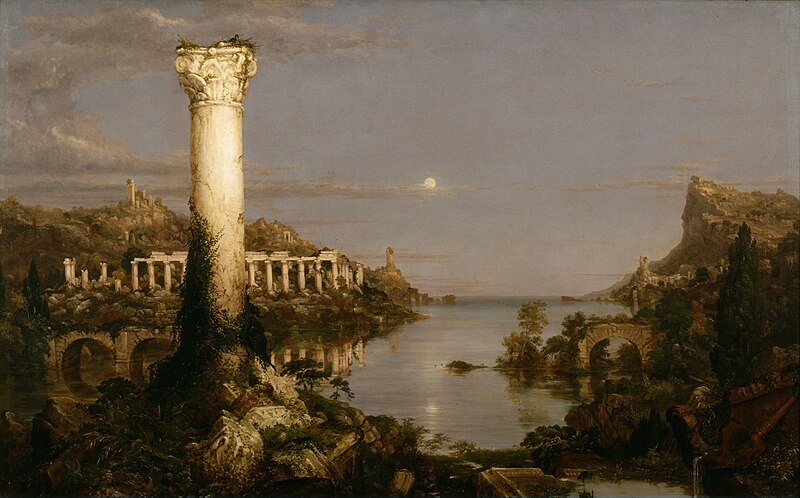
By the time of Andrew Jackson’s election as the seventh President of the United States in 1828 – and the first to bare the mantra of Democrat singularly – each of the three above phases were clearly manifest in the historical transformation of the North American continent. So too were the first and second scenes from the artist’s 1834-36 “The Course of Empire.” Of course, it would take an additional five-plus years of Jacksonian democracy to draw out the “deep-seated historical pessimism” that was visible in the third through fifth panels of this same monumental artifact – and which would characterize his later landscape works, including those mentioned within the previous ‘mythic-historical’ program.[4] With ‘The Course of Empire,’ Cole’s attitudes toward Jacksonian democracy and “utilitarianism” were made unequivocal: each would “lead the nation to disaster.”[5] Consequently, no Cole landscape painted on either side of this grandiose cycle could be interpreted thereafter without being measured against it – whether it was the pre-Arcadian and Arcadian views of a Pre-Jacksonian America or the more apocalyptic scenes that culminated in Desolation (see below).
A second cycle hints at a different transformation in Cole’s view of the world, which nonetheless was just as shaped by the exigencies of Jackson’s America. By the middle 1830s, Cole began attending St. Luke’s Episcopal Church in Catskill.[6] According to biographer Louis Legrand Noble, Cole commenced church member shortly after his return from Europe in 1842, the same year he painted his deeply religious set of four panels collectively titled “The Voyage of Life.”[7] Hence, Cole’s turn toward organized religion coincided with the “increasingly religious temper of the Jacksonian period,”[8] and specifically with the Second Great Awakening, which dominated American religious life into the late 1840s.[9]
The Course of Empire: Desolation (1836)
Further, it was in this same period that Cole “came to see in Christianity’s promise of individual salvation a personal resolution to society’s seemingly unresolvable crises,” as would be exemplified for instance in ‘The Course of Empire.’[10] To quote Wallach once again, “from then on his interest in religious issues grew rapidly, while the social and historical concerns that animated his art during the 1820s and 1830s diminished or disappeared.”[11] The vine covered ruins of a decimated civilization were replaced within less than a decade by a castle in the sky.
If it is possible therefore to compose a narrative whereby Cole first responded to the problems posed by Jacksonian democracy and then by those highlighted in the Second Great Awakening, the question remains what precisely were the issues or concerns that confronted Cole in the few years that preceded the election of President Jackson. Indeed, one might even ask, and perhaps one needs to do so first, whether Cole became a critical artist on the occasion of America’s transformation following the election of Jackson, or whether this tendency – in whichever way it might have been directed – was already present in this earlier phase of the painter’s career? In other words, might Cole have experienced a third period prior to the rise of Jackson and the Democratic party in 1828?
The subsequent essay addresses this question by considering two of Cole’s works in greater detail, The Clove, Catskills and Sunny Morning on the Hudson, both of which date to 1827 (and both of which are reproduced below). In each of these two canvases, a middle-ground mountain face, cast in shadow, bisected by a second mountain or set of mountains, obstructs the spectator’s view onto an expansive valley rendered lower than the paintings’ chosen point-of-view. In my reading of the works, however, Wallach’s social and historical narrative fails to account for the peculiarity that is manifest in these canvases. In fact, the genesis of the following piece was the simple question why does Sunny Morning on the Hudson look the way it does? Hence, this essay intends to answer that question above all others.
In so doing, I will also ask whether Cole’s subsequent work offers any clues to interpret these seemingly obscure, historically-transitional works (that is from a Federalist to a Jacksonian America), in much the same way that ‘The Course of Empire’ inflects the political content of Cole’s other landscapes. Moreover, I will trace the semantics of the above move, emphasizing what it means to leave hidden significant portions of these spaces, by eliciting comparisons especially to Cole’s disciple Frederic Church. I will begin however by creating a baseline for Cole’s pre-Jacksonian corpus with his works of 1825-27.
Lake with Dead Trees (Catskill) (1825)
1825-1827: Cole & Claude Lorrain
As Wallach has indicated, Cole “from the beginning of his career… frequently employed the conventions of pastoral or Arcadian landscape, long associated with Claude Lorrain, for portrayals of rural scenery.”[12] The author cites the example of an 1826 “view” of William G. Featherstonhaugh’s estate, where the artist “employed a basic Claudian formula in painting a serenely horizontal composition, with a single framing tree, in which sheep – the sine qua non of pastoral landscape – graze placidly in a newly cleared pasture overlooked in the distance by Featherstonhaugh’s country mansion.”[13] Indeed, this formula characterizes many of the artist’s earliest canvas. To this end, Cole painted a second landscape, View near Catskill (1827), which similarly figures a group of three grazing sheep on a small grass and pebble covered incline before a placid pond. Likewise, there is the instance of the painter’s even earlier Lake with Dead Trees (Catskill) (1825), where Cole substituted deer for the later canvases’ sheep: the buck on the left is caught staring to its right, its figure framed by three separate fallen trees that form a triangular shape around the animal, whereas its companion trots off to the right in front of the perfectly still, earth-toned pool. In short, Cole was procuring a profoundly Federalist vision of America, represented in a picturesque mode, which in instances such as the Featherstonehaugh canvas “centered on the preservation of aristocratic privilege and traditional property rights.”[14]
Still, it is essential to affirm the role that identity-formation played in these earliest canvases. As Wallach points out, the “taste for landscape,” not more than thirty years old in the Americas, was the sole purview of the aristocracy of the time.[15] As such, Cole, who “had learned to think of himself as a gentleman… whatever his actual circumstances, his belief was unshakable,” would have found an avenue of social-mobility in these canvases.[16] Under the serenity of Claude, the painter’s master and the artist he would later crown “the greatest of all landscape painters,” Cole could create works that befitted his Federalist patrons’ tastes as well.[17] In other words, as expressive as these works are of a particular ethos, it might be just as possible to read these earliest canvases as efforts in imitation that nonetheless found an audience and launched the artist’s career. That is, they represent Cole’s desire to become an artist, even a great artist, more than they do his vision of social and historical circumstances. Only later, with the explicit critique of his post-Jacksonian corpus, does it become clear that Cole is creating out an effort to summarize the political landscape – and in its case the decline of the American civilization. For the time being, the American republic seems more secure.
River Landscape with Apollo and the Cumean Sibyl (c. 1655)
1827: Cole and Salvator Rosa
Importantly, Cole’s work would soon bare a greater resemblance to that of Salvator Rosa, marking the painter as an inheritor to the tradition of the sublime rather than to the Burkean beautiful of Claude: to this end, Wallach points out that “during the 1820s Cole was considered the ‘American Salvator’ in recognition of the extravagant sublimity of many of his early landscape paintings.”[18] However, when Cole himself saw the painter’s work in his 1832 visit to Italy, he claimed to be “disappointed:” “Salvator Rosa’s is a great name… he is peculiar, energetic, but of limited capacity comparatively.”[19] In fact, it was precisely at this time that he affirmed his belief that “Claude, to me, is the greatest of all landscape painters: and, indeed, I should rank him with Raphael or Michelangelo.”[20] Not surprisingly then it was “during the 1830s… when a new tranquility began to manifest itself in [Cole’s] art, [that] he became the ‘American Claude’ – or as one writer put it, ‘our ‘American Claude.’’”[21]
Yet to return to the possibility of Salvator’s inspiration on Cole’s art, which appeared obvious in contemporary judgments of the painter, the American-based artist’s two mountain-centered compositions of 1827, Sunny Morning on the Hudson River and The Clove, Catskills, do seem to confirm the comparison. Once again, in each, the spectator’s view of an expansive flat field, well below the adopted point-of-view, is obstructed by a mountain or set of mountains that fill the image’s near middle-ground, even as they are in part or in whole cast in deep shadow, thus reducing the detail of this facing landmass. Similarly, Salvator’s River Landscape with Apollo and the Cumean Sibyl (c. 1655) positions a mountain mass in the furthest recesses of its right foreground, thereby occluding the path of the river which snakes behind this geological formation. As if to highlight this obstructed space, Rosa introduces small swaths of yellow around the outer edges of rock and upon the water itself. As such, the spectator is cued into reading this hidden space as the point of origin for a light source that is only hinted at within the composition proper. In a sense, the most visually dramatic component of the landscape – a sunset over the serpentine river – is denied to the spectator. Rather we are given intimations of a phenomenon that is far more visually resplendent than the one which the painter has depicted.
So too has Cole chosen to eliminate the most spectacular vantage in exchange for an image that is far less awe-inspiring, particularly in its orientation of the viewer’s point-of-view to the landscape. Of course, Salvator’s painting frames a mythological exchange within the setting in much the same way that two more of Cole’s canvases from the same year treat a historical scene within a space that denies its spectator the most dramatic possible vistas. The first of the two historical panels, Scene from “The Last of the Mohicans”: Cora Kneeling at the Feet of Tamenund (see below), commissioned by Daniel Wadsworth, represents an assemblage of the eponymous tribe on a stone platform hanging above a deep precipice.[22] Behind this found proscenium – and a pair of shadow-covered rock outcroppings that back the platform – the landscape again falls significantly. As such, Cole has adopted a point-of-view – in its case, the viewer is positioned above the platform – which once again denies the most dramatic vantage onto this locale, while also greatly reducing the detail and therefore the narrative legibility of the distant middle-ground figural assembly. In other words, Cole’s choice of vantage denies both a clear view of the drama rendered on canvas and also of the dramatic landscape above which these persons hover.
Cole’s other major historical landscape of 1827, Landscape Composition, St. John in the Wilderness, which was purchased by Wadsworth as well, similarly utilizes a rock out-cropping to stage a fictionalized historic encounter. In its case, the platform is divided into two elevations: on top of the first, a single figure points to a lone cross; a golden afternoon side light hits this higher elevation, the figure and cross. Below, a series of figures look above to the evangelist, presumably, occupying the shrub-covered rocky promontory. Palm trees extend from the edge of this platform, and line the spot-lit valley below, exoticizing Cole’s fictional Israel.
Scene from “The Last of the Mohicans”: Cora Kneeling at the Feet of Tamenund (1827)
Visually, this promontory again blocks the viewer’s vantage onto the valley beneath the theatrical grouping, though our point-of-view is in this case beneath the platform. Then again, the tops of trees emerge beneath the spectator’s imaginary position, securing a placement that seems to hover in mid air. As with Scene from “The Last of the Mohicans”: Cora Kneeling at the Feet of Tamenund, Cole has dispensed with the ground-level perspective of Salvator, thereby violating “traditional prohibitions against rendering a view from a high vantage point,” as the artist would do even more famously in 1836’s The Oxbow.
By comparison, both The Clove, Catskills and Sunny Morning on the Hudson River occupy positions on the ground of their respective landscapes, though in the case of the latter it is a position close to a rocky cliff’s edge, perpendicular to a shadow-covered mountain. Moreover, there is a stone ledge at the edge of the cliff that compares to the rocky platforms in the historical paintings, though it is a rocky promontory in The Clove that appears closer to the mythic landscapes. In both, these geological figures are lit theatricality – that is the exact source seems to exceed the canvas’s natural lighting – as is also the case with the natural platforms in Landscape Composition and Scene from “The Last of the Mohicans.” However, absent the human subjects of the historical compositions, this choice of lighting marks the platforms the artist has chosen not to adopt, the more dramatic views that have been denied the spectator.
Parenthetically, it should be noted that this feature of a rock platform appears in a third figure-less canvas from the previous year, Mountain Sunrise (1826). In this work, which in some sense offers a template for the more radical Sunny Morning, Cole has figured a free-standing rock ledge in the deep middle-ground of the composition, highlighting its tip and the facing stone cliff with the same sort of theatrical lighting that appears in The Clove and especially Sunny Morning. In the background, behind a shadow-covered wooded mount, the day begins to break, producing a yellow light that spreads across the horizon and infuses the clouds that bracket the sunrise with a pinkish tint. Here, as we will see in Sunny Morning, the subject of the sunrise is removed from the spectator’s view.
Sunny Morning on the Hudson (1827)
Sunny Morning: Connoting the Un-Visible
What we do see in Sunny Morning is the shadow-darkened face of a rounded, evergreen-covered summit, crowned on the top and encircled to the right by cottony cumulus fingers. In both places, Cole directs our attention around the edges of the geological figure to the sunny front face of a valley that of course we can never reach. On the other side of the mountain, we can see the light brightened horizon, thus confirming that indeed the object of the picture’s title – the sun in the morning – is located outside our view: both behind the mountain, and to the left of the image itself. Ironically, our position is figured at precisely the place where we can least experience the eponymous subject of the art work. Rather, we are given a theatrically-lit, natural viewing platform in the foreground and a mountain face opposite the illumination just beyond. It is behind this seemingly misplaced viewing platform and the occluding mountain that the film’s dramatic content resides. Indeed, Cole’s panel is a remarkably dark rendering of the subject of morning light.
So what than can be made of Cole’s decision to deny his spectator the view of the Sunny Morning that his title announces? Why are we made to view a mountain cast in shadow from close up, rather than either the phenomenon signified or the expansive space over which this event is occurring? While Cole’s debt to Salvator must be noted, certainly this lineage does not tell us everything we wish to know, particularly again as Salvator’s compositions at least figure foreground mythical subject matter, making his blocking geological figures backdrops – even as they imply a segment of the world depicted that remains beyond our vision. Again in Sunny Morning and The Clove (to a lesser extent, perhaps) all that remains is the obstruction, this portion of the world not seen.
Then again, it is worth noting the connotative value of the object selected to complete this task – the mountain – for the artist. According to Noble, in comparison to Niagara specifically, mountains for Cole “were symbols of the eternal majesty, immutability and repose, which no cataract could ever be.”[23] The author continues:
The mountain, with a fullness of might in itself, is yet mightier as one of an innumerable brotherhood, in each of which you behold an image of everlasting repose – from its summit can escape into the infinite, and upon the perpetual rocks hear voices from the bosom of inwrapping clouds, talking of the presence of the Almighty, and say, with both a lowly sense of your own present littleness and restlessness, and a lofty sense of your immortality and final rest, “it is good to here.”[24]
In a word, the mountain figures presence, but even in more ‘as one of an innumerable brotherhood.’ It is at once an aesthetic object in its own right, engendering contemplation and appreciation; and at the same time, the mountain acts as an interface, a place of meeting between the physical and metaphysical, upon whose summit one can ‘escape into the infinite,’ and upon whose ‘perpetual rocks [one can] hear voices of inwrapping clouds, talking of the presence of the Almighty.’
This latter metaphor of the ‘inwrapping clouds, talking of the presence of the Almighty’ seems particular apt a description for Sunny Morning’s mediating function, inasmuch as they lead us from the mountain, from its eternal, unshakable presence, back to the absence, to the un-visible rather than the invisible – that is, to a world whose existence is manifest, but outside the represented universe of the painting. With these ‘inwrapping clouds’ encircling the conical object, as with the river whose course the same figure obscures, we are assured of a presence that we simply cannot see. In short, the mountain generates meaning doubly: first, as a signifier of God’s presence in his creation; and second, as a figure of obstruction, of an object blocking a world not seen but one that most certainly exists.
The Voyage of Life: Manhood (1842)
“The Voyage of Life:” Making Visible the Un-Visible
While this representation of a world not seen repeats in many of the artist’s canvases, it is perhaps even more significant – as it reveals the scope of Cole’s interest in the subject – that the artist moves to make visible this unseen world in his second major cycle, “The Voyage of Life” (1842). Again, deeply religious in both subject matter and tone, Cole completed this cycle at roughly the same time he began his church membership. Here, supernatural presence unequivocally enters Cole’s canvases: an angel with a glimmering halo accompanies the infant in Childhood; the same figure points the way to a heavenly city in Youth; with the human figure in Manhood kneeling in supplication, the same ethereal guardian looks down from heaven (even as further figures are rendered in the gray clouds above); and in Old Age, this guardian reappears with a second to presumably lead the everyman to his new home in the light.
Therefore, the physical and the spiritual have come to occupy the same pictorial space in this series of highly allegorized landscapes. Whereas The Clove and especially Sunny Morning suggested the Divine in its representation of the figure of the mountain and in the un-seen reality that object obstructs, ‘The Voyage of Life’ leaves nothing to implication. There is in this latter series of canvases an unwillingness to be mistaken, and for its religious content to go unnoticed. The world hidden to our view in the former compositions here becomes the ‘cloud-built palace’ as Cole himself described it.[25] In fact, to this latter point, it is not simply that Cole reduced the ambiguity in his landscapes, but that he produced descriptions of each of the scenes, so as to leave none of its meaning up for debate.[26]
Furthermore, ‘The Voyage of Life’ depicts an interventionist God: here, heaven and earth remain in constant communication, be it in the mediating presence of the Guardian Spirit – both with the child, pointing the way to the heavenly city, listening to the prayers of the endangered protagonist or leading the way to the other world – or once again in the combination of physical and metaphysical spheres in a single space. And as the white-waters of Manhood have given way to the calm pool of Old Age, the heavens seem to answer the man’s prayers. By contrast, images such as The Clove and Sunny Morning fail to embellish the non-visible world they depict and to make visible what is invisible. God can be known through what he once made, not through his present intervention. If anything, the divine being of these early landscapes is fundamentally deist, while the God of ‘The Voyage of Life’ is active.
So while God is present in Cole from the first, it is only with his deepening devotion to the faith that the hidden is made manifest, that what has always been is now made clear and unequivocal.
A View of the Mountain Pass Called the Notch of the White Mountains (Crawford Notch) (1839)
The Hidden and the Horizontal in Cole
Importantly, the subject of an unseen presence does not entirely cease with Cole’s ‘Voyage of Life’ cycle. In his A View of the Two Lakes and Mountain House, Catskill Mountains, Morning (1844), Cole represents a lone figure in the lower left foreground, standing upon the bottom of two rock platforms. He gazes off toward his and the composition’s left, in the direction of the sun that illuminates the mountain face that bares the eponymous Mountain House. Likewise, on the right half of the composition, two long, narrow, parallel lakes extend toward and perhaps beyond the right edge of the composition. While the two arched trees on either foreground edge of the painting ostensibly frame this picturesque setting, the tree on the left reinforces the direction of the human figure’s gaze, leading the spectator’s off the canvas toward the unseen. A real place beyond the canvas is conceived, and so therefore is a metaphor for the metaphysical.
The motif of the lakes on the right half of the composition is further picked up in canvases such as Catskill Mountain House: The Four Elements (1843-44; also post ‘Voyage’), where the same parallel lakes extend over the right edge of the canvas in a pair of powerful horizontal planes. This same horizontality is also evident, though implicitly, in the earlier A View of the Mountain Pass Called the Notch of the White Mountains (Crawford Notch) from 1839. Here the titular notch emerges at the base of a towering mountain face, between two lower sections of rock. The mountainous section on the right particularly stands out from the background stone inasmuch as the former is covered in green pines, while the latter is rendered in duller earth tones. Between these two geological formations, a strong horizontal plane extends to the right and eventually past the towering background mountain. Here we have a strong sense of a plane that we cannot see but whose presence is nonetheless manifest.
Crawford Notch in this way possesses more than a passing resemblance to View of Delft, one of the rate landscapes of a second seventeenth century artist, Jan Vermeer. In that artist’s atypical work from ca. 1660-61, once again the spectator is confronted with an occluding foreground rendered at ground level, and covered in shadows, which accordingly blocks the recessive planes of the city’s flat topography. Here and there snatches of the cityscape are visible between the facing structures, but largely the city remains hidden to the spectator. In a more conventional (for the artist) genre setting, a second composition secures a similar effect, 1870’s The Love Letter. In its case, the framing doorway both highlights the work’s human subject, and also renders space invisible before us. It works like the mountains or the front row of structures in Delft. Here, as in so many of the artist’s compositions, a strong sidelight breaches the space, thus calling attention to its off-canvas point of origin – or, once again, rendering real a world beyond our perception.
Twilight in the Wilderness (1860)
Frederic Church: Naturalizing Cole
While Vermeer’s work may be more analogous to Cole’s than it is causally linked, Frederic Church’s intimate connection to the older American landscapist is well-documented.[27] At the same time, it is a similar interest in making manifest the invisible that concerns both Vermeer and Church. In Church’s case, however, it is principally in the landscape idiom – in most cases naturalized, unlike Cole’s ‘The Voyage of Life’ or even ‘The Oxbow’ with its Hebrew script on the hillside in the far distance – that he achieves this end. Accordingly, one might look for example to Church’s 1847 Scene on Catskill Creek: in this canvas, Church presents the placid waterway framed on the left by a picturesquely felled dead tree and on the right by a tall, cropped deciduous. Along its left edge and low on the horizon, the sun is barely made visible. Nonetheless, its excessive luminosity infuses the right half of the image, thereby calling attention to this light source, and equally to the occluded and cropped space that the orb inhabits. Church is making known another reality, through both the mediating object of the sun and also the composition’s guillotine framing on the right side – where another world seems to seep into the frame.
A more spectacular instance of this strategy can be found in Church’s Twilight in the Wilderness from 1860. In this canvas, we are once again provided a strong horizontal obstruction in the manner of the View of Delft and Crawford Notch, with the low-rising mountains blocking Church’s conspicuous horizon. Over the furthest range, the sun is barely made visible once again with a shimmering white light hugging the craggy peaks and a golden yellow radiating above the first hue. The illuminated world beyond the horizon, and indeed the heavens themselves, reaches into the landscape of Twilight in the Wilderness, entering through the sun’s orbital interface.
Then again, it is less in this recurrent motif than it is in the rich salmons and oranges that ordain the dark clouds that cut through the navy sky that the painting’s metaphysical presence is made clear. Church’s world shows God at his most aesthetic: he, instantiated on the horizon-line in a radiant glory, is the painter of this sky that Church faithfully depicts. It is as though this other world has broken through into the terrestrial world, passing through the horizon-bound point of intercession. Or, Church has exploded the obstruction itself, creating a world where the earthly and the divine commingle. And it is a world that is naturalized.
What is significant here is that Church largely follows the same trajectory as Cole, though they achieve roughly the same ends by different means. If both, early in their careers, utilize the same logic of obstruction and occlusion to indicate a world beyond what we see, their investment of this invisible in the pictorial space differs in the elaboration later in their respective corpuses: whereas Cole makes physical the metaphysical heavenly city, Church leaves the trace of the divine in the adornment of a natural world whose beauty far exceeds everyday phenomenon.
The Clove, Catskills (1827)
Conclusion
But what does this tell us again of Sunny Morning and its 1827 corollary The Clove? Simply that in Church, as in his inspiration Cole, each canvas negotiations the terrestrial and the extra-terrestrial, the earthly and the divine. These elements may be subsumed by other subjects, as with a later Cole such as The Oxbow, but they remain nevertheless keys – and perhaps the most important keys – to understanding each artist. After all, what can these paintings tell us of an America they largely refuse to depict? Again, considering the painters 1836 canvas listed previously, we would seem to have a clear contraposition of wilderness and civilization rendered on the left and right halves of the image respectively, with the Hebraic writing behind to provide the canvas with an added religious dimension. However, with Sunny Morning and The Clove there is no similar allegory for historical progress inasmuch as we are viewing a space at the same stage of un-civilization.
What we have instead is the religious rather than the political axis of Cole’s art taking precedence. To summarize, these canvases of 1827 give us the writing in the distance, an indication of the presence of the divine, stripped of the allegorical content in the fore and middle grounds. In the foreground of these works we have viewing platforms that are either not adopted (as in The Clove) or which generate a view that provides minimal impact (as in Sunny Morning). In the middle distance we have the occluding mountains, the makers of meaning in these works, the very trace of God that Cole makes so explicit thereafter, and the figures that nonetheless keep him hidden from view. And in this invisible background we have the creator of these mountains, indicated by a world we know to exist but which has been forever elided from our view.
[1] Allan Wallach, "Thomas Cole: Landscape and the Course of American Empire" in Thomas Cole: Landscape into History, ed. William H. Truettner and Wallach (New Haven: Yale University Press, 1994), 64.
[2] Ibid, 64-65. [3] Ibid. [4] Ibid. [5] Ibid. [6] Ibid, 98. [7] Louis Legrand Noble, The Life and Works of Thomas Cole, ed. Elliot S. Vesell (Cambridge, Mass.: The Belknap Press of Harvard University Press, 1964), 252. [8] Ibid. [9] Sean Wilentz, The Rise of American Democracy (New York: W. W. Norton & Co., 2005), 266. [10] Ibid. [11] Ibid, 98. [12] Ibid, 70. [13] Ibid. [14] Wallach, "Thomas Cole and the Aristocracy" in Reading American Art, eds. Marianne Doezema and Elizabeth Milroy (New Haven: Yale University Press, 1998), 80-81. [15] "Thomas Cole: Landscape and the Course of American Empire," 28. [16] "Thomas Cole and the Aristocracy," 83. [17] "Thomas Cole: Landscape and the Course of American Empire," 70. [18] Noble, 125. [19] Ibid. [20] Ibid. [21] Wallach, 70. [22] Robert Gilmor commissioned a second, slightly smaller (25 x 31 in. to 25 3/8 x 35 1/16) canvas on the same subject which Cole completed the same year (1827). I have chosen to highlight the Wadsworth for its similarities to the St. John canvas that I have described subsequently. In any case the Gilmor composition features the same elision of the dramatic that is characteristic of the other two 1827 pieces. [23] Noble, 73. [24] Ibid. [25] Ibid, 215. [26] Reprinted in Noble, 214-216.
[27] In a letter reprinted by Noble it even seems that he was to give Cole's son a drawing lesson. Ibid, 272.