Wednesday, December 11, 2013

New Film: Stray Dogs & 12 Years a Slave

Following the Berlin and Cannes premieres of Wong Kar-wai's The Grandmaster (2013) and Jia Zhang-ke's A Touch of Sin (2013) respectively, films that in both instances conceivably merit the title of best in competition, Venice witnessed the debut of a third, prodigious masterpiece of the Sinophone cinema that looks to be the unequivocal equal of the first two, and again a leading pick for the best of its fest. Tsai Ming-liang's Stray Dogs (Jiao you, 2013), from a Tung Cheng-yu, Song Peng-fei and Tsai screenplay, matches The Grandmaster's overriding temporal obsession and A Touch of Sin's encyclopedic inscriptions of space with its own exceptionally rigorous study of physical presence, of the spatialized experience of time that is no less the (story-based) cinema's fundamental subject and substance. Or, to put it another way, Stray Dogs is all about the occupation of spaces, whether it is lightly surreal urban architecture that provides the film with its indelible, post-deluge setting - Tsai expressly personifies these places - or the exceptionally marginal edge of the capitalist economy where the film's protagonists live their unendingly difficult lives.

Tsai sets the template immediately, providing, in the first of the film's exquisite (and exquisitely slow) sequence-shots - Tsai's visual constructions find the director at the absolute peak of his powers - a formally re-focused emphasis on patient observation, on a multi-sensory exploration of the decomposing mise-en-scène, which will lend the sudden kick of a sleeping child something approaching narrative significance. Both Tsai's obliquely staged, elegantly lit landscapes of a rain-sodden and wind-swept Taiwan, and his unshaven close-ups of patriarch Lee (Lee Kang-sheng) ironically serving as human advertising for new housing, unfold over a matter of minutes rather than the seconds that they would cover more conventional art-house fare. Invested with phenomenological force thus, Tsai creates a marginally narrative cinema, however lacking in dramatic action and verbal exposition for the most part, which draws more on the visual arts, ultimately, than it does on literary and theatrical (read: temporal) media. In fact, in the film's final set-piece, Tsai evacuates his long-take imagery first of human presence, and consequently, of ambient sound, leaving only a monochromatic mural in the rear-distance as his visual field becomes little more than filmed visual art.

The Taiwanese master's profoundly painterly idiom spreads across a series of discrete set-pieces that slowly disclose the film's human subjects: single-father Lee, his two children (Lee Yi-cheng and Lee Yi-chieh) and the unidentified mother or motherly figures (Yang Kuei-mei, Lu Yi-ching and Chen Shiang-chyi; all three have collaborated with director previously) who move into and out of their orbit. Stray Dogs centers on the family's meager, mundane existence, depicting their daily struggle to satisfy even their most basic needs, from the shelter they find in a grim single-room space to the grimy public lavatory where they brush their teeth and wash their feet - in the trickle that escapes from the bathroom plumbing. Tsai fills his film with the quotidian, with the ways in which the Lee family subsides and spends their days on the most distant margins of the Taiwanese economy, be it again in the work to which the semi-homeless Lee is subjected, or the childhood fantasies that the young heroine pursues in the film's gorgeously lensed supermarket, a vast space of reflective surfaces and painstakingly curated displays. Stray Dogs similarly concerns itself with biological necessity, with the acts of eating, sleeping and even urinating (all of which the films' actors do in full view of the spectator).

As befits this subject, which is to say as is appropriate for characters who struggle to maintain without any hope of economic advancement or personal progress, Stray Dogs proves a comparatively static experience, for most of its two-hour plus running time at least. This will change, at least momentarily, following the film's most memorable (and certainly discussed) set-piece, Lee's violent, inebriated, psychoanalytically ripe fondling and consumption of his daughter's toy cabbage head - a cousin as it were to The Wayward Cloud's (2005) even more shocking watermelon. Following this outpouring of abject despair, Tsai will momentarily break from the everyday, as the film's focal patriarch, in a passage reminiscent and worthy of Kenji Mizoguchi - a key source for Tsai's compositional strategies - leads his children to the water's edge in the midst of precipitous nocturnal downpour. Melodrama, in other words, will make a brief but impactful cameo.

In the extended (concluding) flashback that follows, the Lee's reemerge within an ultra-modern domestic interior that was devastated by the act-of-god that has occurred before the film's narrative begins. Here, in this once comfort-filled setting, there is at least some sense of the upper middle-class experiences and modern conveniences that the family has heretofore lacked, whether it is the homework that the children work on in the presence of their mother (presumably) or the illuminated leather chair in which Lee relaxes. The flood-decimated flat, however, discloses the fundamental sickness that inflects this bourgeois family - a thematic motif that is confirmed in one of the film's rare moments of exposition, and which the viewer is led to speculate may be connected to the male lead's apparent alcoholism. This displaced emotional devastation will come to the fore, moreover, in the film's staggering thirteen minute-plus static penultimate camera set-up, a scene, which in its divergent gazes and multi-planar staging, calls to mind the interpersonal alienation of the director's outstanding Vive l'Amour (1994). Indeed, in the emotional terrain it explores, its predilection for narrative experimentation, its implicit political discourse and even in its occasional recourse to the surreal, the very great Stray Dogs will keep the same modernist faith as the aforesaid late twentieth-century masterpiece.

If in spirit Stray Dogs belongs most to modernism's (twentieth) century, Steve McQueen's 12 Years a Slave (2013) finds its inspiration in the nineteenth, and not simply by virtue of its slave-era subject. Based on freeman Solomon Northup's published 1853 account of his kidnapping and subsequent decade-plus as a slave in the Antebellum South, McQueen's third theatrical feature reverberates, as Tativille contributor Lisa K. Broad has smartly observed, with the tropes of nineteenth century melodrama. 12 Years a Slave indeed hinges on that most Hugoesque of concerns - here it is worth remembering that Northup wrote his memoirs in the very specific discursive context of the mid-nineteenth century - namely, a concealed identity that provides the key to the hero's future happiness (and in this particular case, his freedom). The (legally sanctioned) breakdown of the family and the moral compromises foisted upon Lupita Nyong'o's Patsey, which is to say two of the greater sins perpetrated by an ostensibly religious, thoroughly wicked public, only deepen the emotional impact of McQueen's period melodrama.

Of course, 12 Years a Slave is also a movie of its moment, of an increased interest in the abhorrent institution of Trans-Atlantic slavery, in the midst of the Obama presidency, that in the past year has beget the uniformly rich Lincoln (2012), Django Unchained (2012) and Chris Eska's indie The Retrieval (2013). 12 Years a Slave adds an extreme sense of visceral pain - aided by ear-splitting sound-cues - and a searing sense of injustice to this latest American feature-film cycle, as well as a carefully observed lyricism and sensitivity toward duration of which McQueen makes discerning use (as for instance in the film's extraordinary long-take lynching scene). Though not ultimately among this writer's choices for the year's best, 12 Years a Slave nonetheless would make a perfectly respectable choice for 'Best Picture' - much as Lincoln or the superior, if less-than-safe Django Unchained would have one year ago. While in recent years Oscar seems to have perfected the selection of films that would quickly enter the annals of its most uninspired favorites, 12 Years a Slave in the end may be too much (and too obvious a film) for the middle-brow body to ignore.

Thursday, November 21, 2013

"I like these Anglo-Saxons": In Consideration and Great Appreciation of William A. Seiter's Professional Sweetheart

Bowing at Radio City Music Hall in July 1933, an apt setting for the New York premiere of RKO's radio-sponsorship send-up, Professional Sweetheart, director William A. Seiter's early Ginger Rogers vehicle appeared in the latter stages of an epochal cultural transformation of which Seiter and his playwright screenwriter Maurine Watkins (Chicago, 1926) seemed almost uniquely discerning. Defined by a rising consumer capitalism, anti-immigration sentiment and increasingly liberal sexual mores, the immediate postwar years represented what would prove the last glorious gasp for the nation's long dominant Protestant mass culture - sociologist E. Digby Baltzell has named this the "Anglo-Saxon Decade" - though it would be an apogee that already contained the seeds of its own decline, a fall that would be felt acutely with the imminent rise of the more heterogeneous New Deal coalition. Professional Sweetheart, released in the earliest stages of the latter's ascendancy, observes the conflicts or space between prewar heterogeneous Protestant culture, here a lucrative commodity sold to denizens of the nation's "Corn Belt," and both a newer urban secular American Protestantism and an emergent Rooseveltian cultural multiplicity.

Rogers's radio spokeswoman Glory Eden is both cultural product, she is said to represent "the lost innocence that went out with the war," and also a site for the contradictions that had since developed among the nation's historically dominate Protestant faction. Billed as "The Purity Girl" for wash-cloth king Ipswich's "Ippsie-Wippsie Radio Hour," Glory's public persona is closely monitored and managed by her corporate handlers: she is ordered "certified milk" for the sake of the hotel's nosy staff, is forced to wear a modest nightgown for a matronly interviewer (Zasu Pitts as Elmerada), and is denied every postwar vice - be it drink, cigarettes or jazz. In private, however, would-be wild-child Glory demands sexy underwear and fantasizes about transgressive trips to Harlem. Belying her image spectacularly, Glory contends that she wants to go "the Devil," preferably with an international playboy; she wants to "sin and suffer," ruing that "now I'm only suffering." There is, in other words, a substantial disparity between Glory's wholesome public image, her commodified self, and what is in effect the acculturated postwar reality she embodies.

This gap is made possible by the lax censorship standards that obtained in Hollywood before the implementation of the Hays Code one year later. It is also indicative of a larger project that Seiter, in a measure of his considerable artistic imagination, pursues throughout the highly accomplished Professional Sweetheart. In the opening studio set-piece, where we are first introduced to our 'Purity Girl,' Seiter makes use of sound perspective to express the discrepancy between the ad campaign that reaches the airwaves and those who are producing the 'Corn Belt'-targeted program: as the camera surveys the studio space with Glory on-the-air, we see (but don't hear) the show's host berating a producer behind a thick pain of glass. That is, we see the reality that is concealed behind the kitschy 'Ippsie-Wippsie Radio Hour' that we, and Middle America, hears. Similarly, Glory's consequent on-air wedding again plays on radio's image-less ontology, with the broadcaster effusively describing the couple's gifts - even as Seiter's tracking camera discloses the far less impressive truth - while also lamenting the fact that they are not on television (in what is therefore a very early reference to the new medium). Seiter's pre-Code cinema shows the reality that 'The Purity Girl' radio spots conceal.

In an attempt to protect the restless, sex-starved Glory's small-town image, Gregory Ratoff's Ipswich namesake, along with his two protégées, Frank McHugh's Speed Dennis and Franklin Pangborn's Herbert Childress - which is to say, a thickly-accented non-native, Irish newsman-type and coded homosexual; there is again a different ethnic reality that the film's fake, commodified purity obscures - conspire to identify a suitable mate, "an Anglo-Saxon from the Corn Belt" as one of the men puts it. From her coterie of admirers, and much to Herbert's initial chagrin - Pangborn would prefer a blond - they choose Daniel Boone-figure Jim Davey (Norman Foster), a hulking Kentucky native of Anglo-Saxon (read: American or Scotch-Irish) ancestry. A real white American, in other words. When Speed travels to the "home of the purest Anglo Saxons" to recruit the unsuspecting Jim, McHugh's character insists that he not wear his "store cloths," but instead his rural, hunting garb in a further attempt to construct his own wholesome Middle-American (and indeed, pre-twentieth century) persona. Following their on-air nuptials, which Glory wrongly assumes will be her ticket to worldly pleasures, Jim whisks his new bride back to his back-country cabin, to the quieter life that he presumes every woman wants.

While Glory initially expresses satisfaction with her new life, her on-air displacement by another member of a charter demographic of the New Deal coalition, her black maid Vera (Theresa Harris) - when listening to Glory's replacement, Jim tellingly notes of her more jazz vocal inflections: "say, she makes you feel kind of, say they shouldn't let her do that on the air" - spurs Rogers's lead to return to her star-making role. (Seiter accordingly initiates a discourse that his subsequent Sing and Like It [1934] would pursue to an even greater degree: namely, the conflict between the life of the artist and that of a more banal, familial existence; in the latter comic feature, Pitts's modestly talented heroine, to be generous, resigns herself to the fact that she will have to sleep with one of his producers - a belief that she most certainly is alone in holding.) Returning back to New York, Glory and Jim now share the microphone in what will thus represent a détente of sorts between Jim's simpler prewar ('Corn Belt') world and Glory's more liberal postwar (urban) present.

***
Professional Sweetheart represented Ginger Rogers's first role and starring performance for RKO, following her previous contract work for Warner Bros. (which concluded with her breakthrough appearances in 42nd Street and Gold Diggers of 1933 earlier that same year). It was of course beside Fred Astaire at RKO that Rogers built her enduring reputation, beginning in yet another 1933 production, Flying Down to Rio, which was conceived originally as a Dolores del Rio vehicle. Professional Sweetheart was itself received as a Ginger Rogers film, despite her relatively short résumé, with Variety noting that the film "demonstrates again, as she has before, that light comedy is her apple pie." (7.18.1933)  Reviews were indeed generally positive, with The New York Times's Frank S. Nugent arguing that "Miss Rogers has rarely been more entertaining" and that "RKO Radio, which sponsored the picture, merits a vote of thanks for an entertaining comedy." (7.14.1933) Photoplay shared both sentiments in naming Seiter's film one of the "Six Best Pictures of the Month," alongside the aforementioned Gold Diggers of 1933 and the George Cukor classic Dinner at Eight. (Aug. 1933)  Though the film is largely unknown today, it is not for a general lack of critical appreciation in its own time.

Then again, there was at least one source of dissension: trade publication The Film Daily complained of Professional Sweetheart's "choppy story and mechanical treatment and situations," insisting ultimately that the RKO film was "very mild and unimportant." (5.27.1933)  To the latter point, there did seem to exist agreement that as pre-Code as it may now seem, Professional Sweetheart was in fact not prohibitively lurid for contemporary audiences, but instead was "wholesomely insane satire," as Motion Picture's more favorable review observed. (Sept. 1933)  That Professional Sweetheart presently appears, to its very benefit, to lack this same 'respectable' quality, above all speaks to the next two-plus decades of comparatively sanitized Hollywood practice. This is a racy, culturally irreverent studio cinema - before the Hays Code effectively suspended these birthrights - that continues to manifest a real daring in the true subject of its radio-world satire: an Anglo-Saxonism that had become a kitsch commodity in an increasingly pluralistic (newly New Deal) America.

Friday, November 15, 2013

36th Starz Denver Film Festival: The Great Beauty (2013)

Populated by the debauched, disenchanted or simply disinterested elite of Roman society – that is, by a decadent and fading aristocracy, counterfeit art-world celebrities, and endlessly prattling priests – Paolo Sorrentino’s latter-day Babylon revolves around Jep Gambardella (the great Toni Servillo in a career-defining performance), a successful journalist and frustrated former novelist with an acerbic wit and irresistible charm. Jep and his social circle are joined first in a pulsing discotheque on the occasion of the former's sixty-fifth birthday, an event that is celebrated with exuberant group choreography and conspicuous kitsch. So begins The Great Beauty’s (La Grande Belleza, 2013) unending progression of chic dinners, all-night bacchanalias and casual hook-ups, with Jep, “the king of the high life,” perpetually present as both participant and observer.

Borrowing both its decadent Roman subject and its episodic narrative structure, The Great Beauty stands as a soaringly ambitious and spectacularly successful update of Federico Fellini’s 1960 masterpiece, La Dolce Vita. Where Sorrentino’s luridly contemporary refashioning – a refreshing, in the image of 2008’s Il Divo, that obliquely speaks to the cascading corruptions of the Silvio Berlusconi era – departs most from the Fellini original, is in the age of its hero: the sentimental, lost love-obsessed Jep is two decades older than Mastroianni’s Marcello. Sorrentino’s sprawling feature is, in this respect, a decidedly Proustian affair, with Jep's man of supreme sensibility providing a modern-day stand-in for the French author's Marcel - while the appearance of his younger self, in an ingenious aquatic flashback, serves to replicate or at least echo the novelist's fluid structure of remembrance.

Though perhaps a shade less baroque than Sorrentino’s preceding David Lynch-inspired corpus (see 2006’s The Family Friend), the outstanding The Great Beauty remains a work of intoxicating stylization, with short lateral tracking shots and frontal framings joined by brisk montage. The film’s contrastive sacred and secular musical cues separately serve to bring out the contradictions of a Rome that is no less Sorrentino’s city-symphonic subject. A sizable leap forward, ultimately, for the director of the very fine The Consequences of Love (2004), The Great Beauty represents a viable contender for film of the year.

The Great Beauty screens at the Sie Film Center tomorrow, November 16, at 1:00 PM, with Sorrentino present to receive Maria and Tommaso Maglione Italian Filmmaker Award. Janus Films is distributing the feature in North America, with dates confirmed for Denver (11/29) and Minneapolis, among other cities. The above review has been adapted from my original 36 SDFF program notes.

Previewing the Directory of World Cinema: Belgium: The Broken Circle Breakdown, as reviewed by Jeremi Szaniawski (and Updated 2/23/2014)

The Broken Circle Breakdown

Studio/Distributor: Menuet Producties, Topkapi Films/Kinepolis Film Distribution,
Wild Bunch, Tribeca Film
Director: Felix Van Groeningen
Producer: Dirk Impens
Screenwriter: Johan Heldenbergh, Mieke Dobbels, Carl Joos, Felix Van Groeningen
Cinematographer: Ruben Impens
Production Designer: Kurt Rigolle
Editor: Nico Leunen
Costumes: Ann Lauwerys
Genre: Drama
Cast: Veerle Baetens, Johan Heldenbergh, Nell Cattrysse
Duration: 111 minutes

Year: 2013

Synopsis

Tattoo artist Elise (Veerle Baetens) and musician Didier (Johan Heldenbergh) fall in love at first sight; in spite of their differences, they are united by a love of music. Soon a daughter, Maybelle, springs forth from their union. Everything seems to be going well, but when Maybelle becomes seriously ill, the couple’s relationship is tested. Their worldviews, once harmonious, deteriorate as Elise’s religious leanings and idealism chafe against Didier’s militant atheism, with tragedy close at hand.

Critique

Felix Van Groeningen upholds the fascination with and will to emulate the American movie formula in Flemish cinema, yielding a tragic love story which retains a powerful grittiness in spite of its lush and sensuous representations. Finding his emotional substrate in American culture, the director adroitly reaches for the sentiments contained in bluegrass music, which makes for the most memorable moments of his latest film: who cannot respond in a somatic fashion to classic songs such as ‘Will the Circle be Unbroken?’ or ‘Wayfaring Stranger’, and its lineage of interpretations by great masters such as Joan Baez, Johnny Cash, Hank Williams, or Bill Monroe? These fabulous songs disarm the viewer, beautifully integrated as they are into the fabric of the film, which is filled with passion and heartbreak, joy and longing—sad yet uplifting all at once—just as the music it references.

Undoubtedly, Van Groeningen shows the knack he displayed in his earlier efforts, namely to combine relatively unexpected elements into a powerful whole. Here, bluegrass music goes hand in hand with the story of Flemish characters—and the pathos of American melodrama with more typically Belgian down-to-earth-ness. Much as the Strobbes were unconditional adorers of Roy Orbinson in the director’s best film, The Misfortunates / De helaasheid der dingen (2009), Didier and Elise are lovers of music, but also lovers tout court: they pair their erotic passion and familial love with their melomania, at least at first.

While the film complicates the cliché story about the rise and fall of a relationship through a jumbled chronological structure (a narrative technique which has served many a successful American film), it is in the bodies and voices of imperfect (and therefore human) beings that it acquires its actual credibility and worth. This could not have been achieved without fully committed and talented actors, and both Baetens and Heldenbergh live up beautifully to the occasion: the latter (upon whose play the film is based) is rock solid as a rugged, rationalistic but romantic bohemian soul, while the former dazzles with her beauty and sensuality, sensitivity and vulnerability, in a truly unforgettable performance, which alternate moments of seduction with an earnest fallibility bordering on comedy. Not least among the accomplishments of the stars is that they sing the bluegrass standards themselves. The result is nothing short of extraordinary, and the soundtrack to the film has become a best-seller in Europe, and even made a remarkable entrance into the bluegrass charts in the US.

If the performances are first class, if the cinematography and camera movements are lush and impeccable overall, if the editing by Nico Leunen (the husband of Fien Troch, another young Belgian director to follow) is outstanding, the story does lose a little bit of steam at the beginning of the second half, and several of the last scenes show some less inspired directorial choices, including one near the film’s end, centered on Elise’s confusion, which plays a trick on the viewer, which is ill-fitting considering the earnest tone of the rest. But the weakest moments come in the film’s social, ideological critique dimension, when it critiques fundamentalism and American politics (the figure of George W. Bush is twice seen on TV in a film which takes place over the years of his infamous presidency). This could possibly have made The Broken Circle Breakdown stronger but instead does it a disservice for lack of depth, particularly when Didier rants, in the middle of a concert, against religion and how it slows down progress and medical research. This scene, which probably worked fine in the play and from which it clearly is borrowed too literally, taking place on the stage as it does, falls flat and is awkward here, although it triggers the film’s final act. But most clearly it goes to show that the desire to keep the core ideological debate of the play (atheism vs religion, rationalism vs idealism) was neither a very good, nor a very successful, idea.

For all these reasons, The Broken Circle Breakdown remains strongest when its author stays clear of didactic and literal discourse or binary oppositions, and remains true to the tone of the songs: simple, deep and earnest, beautiful and heartbreaking--stories of how happiness seems ever elusive, or how, once reached, its fleeting nature can be as unbearable as the most shattering loss; and how excess of love can be as damaging as a shortage of it. Gladly there is no shortage of beautiful moments in the film, including the final scene itself, in which the personal evolution of Elise, expressed in her tattoos which elegantly tell the story of her relationship with Didier throughout the film, reaches a truly electrifying moment where music and cinema come together one last time.

Belgian cinema never was more prominent at the Oscars than this year, with two nominations (the irresistible Ernest & Célestine, made by Belgians Vincent Patar and Stéphane Aubier, is nominated for best animation feature), and never did it have a more likely candidate for best foreign film than The Broken Circle Breakdown. Not only because the film so skillfully embraces a beacon of American culture, but also because it manages to speak to the audience in a way that is at once accessible yet never simplistic—the essence of good entertainment. Regardless of whether the film goes on to win the statuette on March 2nd (something I would gladly put my money on), it is quite clear that Van Groeningen, who now spends a lot of his time in Los Angeles, with his flair for stylish cinema and unquestionable talent for working with actors, has made a place for himself on the international film scene (the director has already announced that his next project would star Matthias Schoenaerts, who was featured in Belgium’s previous Oscar nominated film, Bullhead (2011)). Let us hope that the circle of success, for the young director as well as the emulation he will foster within the greatest of small cinematic nations--and beyond--remains unbroken, at least for a little while longer.

Editor's Note: The Directory of World Cinema: Belgium, edited by Jeremi Szaniawski and Marcelline Block, will be available for purchase from Intellect Ltd. beginning in January 2014. In keeping with the recent emphasis of this site, The Broken Circle Breakdown also screened this past week as part of the 36th Starz Denver Film Festival.

Thursday, November 14, 2013

36th Starz Denver Film Festival Report Card

Borgman (Alex van Warmerdam, Netherlands, 2013, 118 min.)
Jan Bijoviet and his band of anarchic wood sprites enter the lives of a middle class family like a force of nature leaving chaos and destruction in their wake. Excellent, expressionistic sound design and engaging performances distinguish this absurdist satire on bourgeois alienation and repressed desire. 
Lisa’s Grade: A-

The Fifth Season (Peter Brosens and Jessica Woodworth, Belgium, 2012, 93 min.)
A visually stunning apocalyptic fable about the loss of connection between man and the natural world, The Fifth Season combines dark, deadpan humor with free floating environmental and political allegory. Young Belgian filmmakers Peter Brosens and Jessica Woodworth create painterly compositions - which are frequently suggestive of Pieter Bruegel and James Ensor - and multi-layered soundscapes that recall the work of Andrei Tarkovsky and Bela Tarr.
Lisa’s Grade: B+

Go Down Death (Aaron Schimberg, United States, 2013, 88 min.)
This singular work of DIY punk filmmaking unites Guy Madden’s anachronistic nitrate-era aesthetic, apocalyptic post-WWI iconography, and the mannered, circular dialogue of early 90s-indie auteurs like Hal Hartley.  Enigmatic and elliptical, Go Down Death, feels significantly longer than its 88-minute running time, but its combination of energy and intellect keeps the viewer engaged.
Lisa’s Grade: B

Grigris (Mahamat-Saleh Haroun, France/Chad, 2013, 101 min.)
Esteemed African filmmaker Mahamat-Seleh Haroun follows Grigris – an aspiring dancer with a paralyzed leg – from the city to the country as he attempts to earn a living and find romantic happiness. Haroun’s subtle direction highlights Souleymane Deme’s remarkable physical performance in the title role, while the film’s pastoral coda opens up new areas of meaning.
Lisa’s Grade: A-

Ilo Ilo (Anthony Chen, Singapore, 2013, 99 min.)
Set in the late 1990s, this warm and occasionally harrowing family drama from Singapore charts the increasingly uncertain fate of a middle class family and their Pilipino maid as the Asian financial crisis intensifies. Spare, but elegant cinematography and uniformly excellent, understated performances elevate this Cannes Film Festival favorite, which often recalls Edward Yang’s Yi Yi (2000).
Lisa’s Grade: A-  

Labor Day (Jason Reitman, United States, 2013, 111 min.)
Labor Day unfolds over six consecutive days, during which Josh Brolin’s sensitive escaped convict opens the hearts of reclusive divorcee, Kate Winslet, and her wide-eyed teenage son. This overwrought family melodrama combines hothouse sexual metaphor and heavy-handed sentimentality in a manner that over-powers the well-meaning performances of his talented cast.  At the level of style, Reitman’s signature shallow-focused cinematography denies the spectator’s gaze the freedom to move while cross-cut flashbacks confuse more often than they enlighten.
Lisa’s Grade: D 

The Search for Emak Bakia (Oskar Alegria, Spain, 2012, 84 min.)
First-time filmmaker Oscar Alegria lets chance be his guide as he attempts to discover the namesake of Man Ray’s experimental, Basque-language film Emak-Bakia. Quirky and charming – almost to a fault – The Search for Emak Bakia's unique and evocative audiovisual landscape is too frequently intruded upon by explanatory inter-titles. In its final 45-minutes, the film finds its footing as a bittersweet travelogue and meditation on the waning Basque language and culture.
Lisa’s Grade: B-


A Touch of Sin (Jia Zhangke, 2013, China, 125 min.)
A series of unexpected acts of violence coalesce into a sweeping political and economic indictment in the newest masterwork from 6th Generation auteur Jia Zhangke. An epic, cerebral, and visually striking trek across contemporary China’s diverse landscapes and cultures, A Touch of Sin gives Jia the opportunity to revisit the thematic terrain of several of his previous films.
Lisa’s Grade: A

Will You Still Love Me Tomorrow? (Arvin Chen, Taiwan, 2013, 104 min.)
A closeted gay man with a wife and young child, mild-mannered eyeglass salesman Weichung, finds his world upended by an unexpected romance in this sparkling comedy-drama from the Republic of China. Drawing on the conventions of the Hollywood musical, Chen’s lightly surreal flights of fancy capture the intoxication of new love. At the same time, the film also paints a detailed and touching portrait of a loving family in the midst of dramatic change. 
Lisa’s Grade: B+   

Monday, November 11, 2013

36th Starz Denver Film Festival: A Touch of Sin (2013)

Conceived as an oblique, 21st-century take on the wuxia (literally "martial hero") film, where that genre’s perpetual rendering of motion is transformed and displaced onto China’s exceedingly mobile, circulating workforce, A Touch of Sin (Tian Zhu Ding, 2013) divides into four fluid, gently overlapping parts, with each centering on an economically marginalized protagonist. Working from mainland China’s snowy north to its subtropical south, director Jia Zhangke presents a remarkably comprehensive and detailed snapshot of China's economic and cultural present. The film opens with Dahai (the exceptionally charismatic Wu Jiang), a poor laborer incensed by his village chief’s failure to make good on an earlier promise. Dahai ultimately responds with extreme, even shocking violence in a segment that will confirm the pattern for each of the film’s subsequent three sections.

'Confirm' rather 'establish' as Dahai's Shanxi-set opening segment is preceded by a thematically generative triple killing perpetrated by the film's second subject, Zhou San (Wang Baoqiang). With Zhou's brief entry into and disappearance from Jia's narrative, the Mainland master begins his work of creating a national space that extends - and more importantly, persists - far beyond the limits of the filmmaker's frame. In audio-visual terms, Jia reinforces this sense of great spatial expanse with an aurally dense off-camera field (that emerges again beyond the boundaries of the film's graceful widescreen compositions). In this respect, A Touch of Sin continues the formal project of Platform (2000) and Unknown Pleasures (2002), whose Shanxi setting the Dahai segment expressly shares.

Geographically, Zhou's second section shifts into the Chongqing municipal location of the director's Three Gorges-themed Still Life (2006), with Zhou arriving by ferry boat - Still Life's preferred form of transportation and another in A Touch of Sin's exhaustive variety of conveyances. With Zhou disappearing again into the vast Mainland off-screen, A Touch of Sin transitions to long-time Jia axiom Zhao Tao, as the actress's Xiao Yu faces an uncertain future with her married, factory-executive lover. After being assaulted by the latter's spurned wife, Xiao finds herself in an even more perilous confrontation in her spa workplace. In the consequent explosion of violence, Jia's film breaks most decisively from any semblance of naturalism, with Xiao striking down her aggressors in manga-inspired moment of Japanese sword-play - not that there aren't other moments of the surreal: see the tiger's non-diegetic roar.

In spite of its uncharacteristic, Takeshi Kitano-influenced eruptions of violence (the effect and meaning of these seemingly unconnected incidents slowly accumulates over the course of the film) the writer-director's latest remains recognizably his own, from the aforementioned articulations of off-camera space to the post-communist kitsch on sale in the film’s fleshy final segment, a set-piece that brings to mind another of Jia's impressive array of masterworks, The World (2004). As the filmmaker surveys his homeland’s deeply troubled materialist present, he provides an almost comprehensive catalog of his many emphases, whether it is the injustices that his actors suffer, the motivations for the violence that in each instance is based on real events or even the multitude of regions and dialects to which the director gives cinematic voice.

This is all to suggest that there is admirable conceptual completeness to A Touch of Sin, which also functions as a kind of mid-career retrospective for one of China's greatest living directors. Indeed, Jia's Cannes prize-winning latest is no less than a major masterpiece and one of the year's very best films.

This piece was modified by Lisa and myself from my original Starz Denver Film Festival program notes, available here. Kino Lorber is doing the good work of distributing this great film in North America.

Sunday, October 27, 2013

Previewing The 36th Starz Denver Film Festival

Since mid-July, the overwhelming majority of my film-viewing has been devoted to next month's Starz Denver Film Festival, first in previewing nearly forty festival submissions, and consequently in contributing program notes for more than thirty additional features. Over the next few weeks, this virtual space will be overtaken by the same project, with Lisa reprising last year's exceedingly popular SDFF Report Card, and both she and I contributing longer reviews when we are so moved. The reader may indeed rest assured that longer analyses of two of this year's unequivocal festival peaks, Jia Zhangke's A Touch of Sin and Paolo Sorrentino's The Great Beauty, will follow over the course of the coming weeks (as hopefully will other pieces for unexpected pleasures not yet seen). In the meantime, from the remaining thirty official selections that I have screened thus far, I have chosen the following six title sample as especially deserving the reader's attention and viewing resources.

Among the number of promising feature-length debuts included in this year's SDFF, none showed the formal intelligence and rigor of former critic Eddie Mullins's Doomsdays, an American indie slacker comedy that shades toward the truly anarchic and counter-cultural. (If you click through to the description of this or any title on the Denver Film Center website, you will notice, no doubt, my wanton self-plagiarism.) Displaying considerable consideration of alternative methods for telling a story in visual and spatial terms, Mullins relies almost exclusively on highly choreographed long-take set-ups, where a punch-line or plot-point is allowed to developed in a receding plane or on the edges of the frame. Indeed, for a film - home-invasion themed - where "being caught" is a constant source of suspense and especially comedy, Mullins has produced an art that privileges the commensurate act of seeing, and subtly encourages a more active form of spectatorship. If only a fraction of independent filmmakers showed the attention to form and stylistic ambition that Mullins reveals in his first feature, the American indie cinema would be a far richer field.

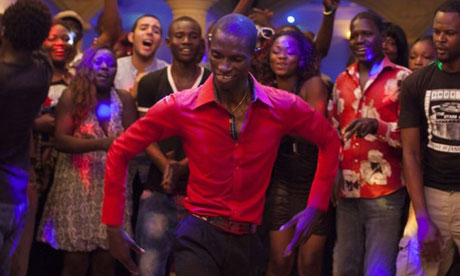
The mid-tier latest from one of the two most important Sub-Saharan African art-film directors to emerge since the mid-1990s - the other is Mauritania's Abderrahmane Sissako - Mahamat-Saleh Haroun's Grigris pushes the understated Chadian auteur of the exceptional Abouna (2002) and Daratt (2006) into novel feminist territory, as the film segues, in its final act, from the low-key nocturnal city to the bright, picturesque African savanna. (Antoine Heberle’s handsome cinematography was honored at this year's Cannes film festival.) However, like the aforementioned career highlights, a male lead remains focal, with Souleymane Démé's eponymous, physically impaired hero providing the haptic presence around which Haroun constructs his humanistic crime drama. In fact, the rhythmic advantage that Grigris makes of his disability - within the film's throbbing, neon-lit discotheque passages - provides Haroun's work with its most memorable and even transcendent moments of pure cinema.

Heavily atmospheric, elliptical and even dream-like, writer-director Daniel Patrick Carbone's feature-length debut Hide Your Smiling Faces provides further evidence of Terrence Malick's growing influence over the the latest generation of American independent filmmakers. Built around an incomprehensible summer-vacation tragedy that occurs within a verdant exurban New Jersey setting, Carbone authentically brings the homo-social interactions of a loosely connected group of teen and preteen boys to the screen, emphasizing the almost ritual violence - and threats of even greater harm - that defines their everyday existence. In its near complete absence of young female actors, moreover, Hide Your Smiling Faces is that very rare coming-of-age film where sex does not figure prominently in the equation. The young male mind is otherwise occupied in Carbone's quietly affecting, carefully calibrated indie drama.

Recipient of the prestigious Camera d'Or prize at this year's Cannes Film Festival - the first Singaporean feature to be honored by the French fest - Anthony Chen's Ilo Ilo finds unexpected emotional warmth in the unusual bond that forms between Teresa, a non-citizen Filipino maid, and Jiale, a serially mischievous eleven year-old bully. Conventional Asian art cinema in most respects, Chen's undeniably assured, semi-biographical debut nonetheless manages a national specificity that will prove most conspicuous in the corporal form of punishment that the charismatic young lead Koh Jia Ler receives before an audience of his classmates. The film's historical inscription of the 1997 Asian Financial Crisis contributes equally, though less distinctively, to Chen's construction of national identity, while also serving as the catalyst for the film's collapsing middle-class milieu (which the spectator witnesses alongside the picture's on-screen outsider surrogate Teresa).

A habitually enchanting film essay that above all submits to the surreal operations of chance, though in a fashion that is more whimsical than radical, Oskar Alegria's The Search for Emak Bakia seeks an answer to the origins of Man Ray's mysterious Basque-language film title, Emak-Bakia. Most meaningfully, Algeria's lightly experimental feature documentary represents an act of exhumation: of the forgotten meanings of an all-but-dead Euskara language and the even more obscure private histories - from table tennis-champion Romanian princesses to resurrected clowns - that Alegria's digressive approach manages to uncover. Yet another feature film debut, The Search for Emak Bakia is a surprisingly easy pleasure and one of the left-field discoveries of SDFF 36.

Award the Silver Bear (Alfred Bauer Prize) at this year's Berlin International Film Festival, former critic and occasional documentarian Denis Côté's Vic+Flo Saw a Bear provides early and relatively decisive localized evidence of Quebec's rumored 2013 boom. Centering on Victoria and Florence, a same-sex couple who seek refuge from their troubled pasts in the remote forests of the French-Canadian province, Vic+Flo Saw a Bear strings together a series of initially naturalistic set-pieces that alternate between mobile camera movements and conspicuously static set-ups. Throughout, Côté deftly affects an atmosphere of uncertainty and lingering dread, a sense that he imparts in no small measure through his mysterious and menacing cast of locals. This feeling is confirmed by the film's spectacularly sadistic, almost impossible to watch climactic act to which Côté's title obliquely refers. A flamboyantly surreal concluding flourish will follow in this award-winner from the fast-rising under forty.

Saturday, September 07, 2013

New Film: The Grandmaster (2013)

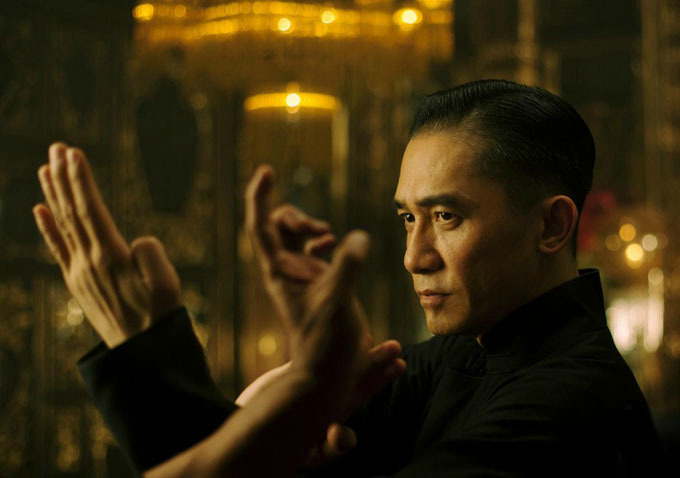
The first evidence or rather confirmation to reach the United States that two thousand thirteen belongs foremost to the world-class masters of the Sinophone cinema, Wong Kar-wai's The Grandmaster (Yi dai zong shi, 2013) is quite likely to prove the most unambiguously pleasurable achievement in Greater China's very big year. An epically structured, elegantly staged Ip Man biography that opens on the brief 1930s rapprochement of China's northern and southern martial arts schools, Wong's first magnificent feature in six years soon develops into another of the auteur's signature star-crossed opuses, with Tony Leung's Wing Chun grandmaster falling for the exceedingly skilled daughter (Zhang Ziyi) of an aging northern legend. Following Ip Man's ceremonial defeat of the latter in the opulent, mirror-filled interior of the Golden Pavilion, a brothel and martial arts social club in the Cantonese city of Foshan, the hero and heiress Gong Er stage their own combat exhibition, despite period prohibitions that forbid women from fighting.

The resulting set-piece represents not only one of Ip Man's few matches with an equal, but indeed the lone occasion in which he is bested by an opponent. Of course, it comes in an exchange that Wong infuses with an ecstatic sensuality, where Ip Man clasps the female lead's wrist and where Gong Er circles above her fellow combatant, as their faces come within a hair's breadth of touching. With hand-to-hand combat thus providing a metonymy for the sexual act, Ip Man and Gong Er's exchange proves one of The Grandmaster's rare consummated unions, where two appropriately paired figures meet, in Wongian discourse, at precisely the right time of life.

The married Ip Man's consequent attempts to renew his relationship with Gong Er are thwarted first by the sudden onset of the Japanese Occupation, and later by Gong Er's private vows to avenge her father's death. Their time, in other words, will never again be right - in much the same way that the Ip Man's various master opponents all-to-often challenge the Southern hero far too late in their own professional existences. In this regard, The Grandmaster morphs into a martial arts variation on the filmmaker's middle-aged masterpiece, In the Mood for Love (2000): Ip Man and Gong Er's time will pass before they (in their case) renew their acquaintance in the colorized Hong Kong of the early 1950s. Fate will prevent their permanent romantic happiness.

As the above attests, The Grandmaster, like every great Wong, is all about time. Time as it is refracted through Ip Man and Gong Er's frustrated romance or in Ip Man's equitable and ill-matched contests alike, but time also it is expressed in Wong's archetypal aesthetic, in the step printing process and slow motion effects that filters and pulls time apart, investing the instant and the momentary - which is to say the true substance of Wong's art - with an added weight. The film's focalized temporal register is also felt in the de-saturated photos that freeze similar points-in-time, not to mention in the voice-over narration that implies some indistinct point in the future from which Ip Man in particular reminisces about his great unfulfilled love. The Grandmaster, in short, is at once an object of temporal manipulation and reorganization and an attempt, however vain, to recapture time that has been lost.

Wong's visual strategies equally serve the filmmaker's excessive attention to surface appearances and his commensurate fetishism: in the film's expert opening action set-piece, a cascade of individual raindrops slice off the side of Ip Man's brimmed white hat, thus providing as concentrated a site for pure spectacle as the combat itself (which in the scene's under-lit staging will prove more two-dimensional than three, more a matter of surface than of depth). In the amber corridors of the Golden Pavilion and on the snowy rail platforms of the north, Wong turns his attention to the way in which his performers' footwear slides across the hardwood and through the light powder, again making extensive use of slow-motion to emphasize his visual subject. Finally there is the film's truest fetish of all, the coat-button that Ip Man saves and ultimately gives to Gong Er to commemorate the reunion that the Occupation repressed. It is in other words visual evidence of his enduring passion.

For all its interest in the interior and the imagistic, The Grandmaster makes skillful use of the more conventional features of film language. Indeed, in what might be termed Wong's post-classicism, the director makes special use of his block strategies within his shot/reverse-shot editing chains: as Gong Er and her father's former protegee face off in one of the film's most heated confrontations, each occupies the edge of the frame  that they look off, thus visually implying their increased interpersonal aggression. Likewise, when Ip Man and Gong Er meet for the last time, Wong sets each of the two characters in the same left-center position in the wide screen, suggesting the same affinity that the narrative otherwise establishes. Wong accordingly makes master (if intensified) use of classical continuity editing.

Elsewhere one might cite the film's sterling star chemistry, vivid secondary characterizations, assured hand-to-hand stagings and moving musical cues as evidence of Wong's supreme mastery of a convention mode of screen entertainment - to augment Wong's always personal discourse. Recalling the epic early 1990s pinnacles of China's Fifth Generation, not to mention Hou Hsiao-hsien's supreme Sino masterpiece, Flowers of Shanghai (1998), The Grandmaster is both the latest ecumenical attempt at forging a combined Chinese identity in its shared historical experience and also a founding-myth narrative for Wong and Leung's Hong Kong home.

This piece was co-authored by Michael J. Anderson and Lisa K. Broad.

Saturday, August 17, 2013

New Film: The Hunt & Drug War

A Kafkaesque scenario of the agonizing injustices inflicted upon a kindergarten teacher falsely accused of child sex abuse, Thomas Vinterberg's The Hunt (Jagten, 2012), from a screenplay by Tobias Lindholm and the director, perceptively details the extra-legal apparatus that punishes the middle-aged lead for a single, indiscriminate allegation. The Hunt's inscription of inequity hinges on the fictive testimony of six year-old innocent Klara (Annika Wedderkopp), who in a bout of pre-pubescent sexual jealousy, repeats an explicit utterance of her older brother. Her testimony, however off-handed - and even after she contritely disavows her claim, on more than one occasion - is considered unimpeachable by those in her care: children, as we are reminded repeatedly, never lie. It is on this basis, in accordance with this false proposition, that Lucas (Mads Mikkelsen) is stripped of his teaching job and violently ostracized from the film's small-town (Danish) society. There is no place for due process when it comes to protecting society's most vulnerable from transformative trauma - even when this means destroying the life of the innocent, and implicitly, those he holds closest. The Hunt, in other words, imagines the subject of the director's outstanding The Celebration (Festen, 1998), the absolute peak of the Dogme 95 cycle, from the position of the accused rather than that of the accuser.

The Hunt accordingly presents a problem without an easy solution - blindly believing Lucas is no more advisable from the standpoint of crime prevention, even if in this case we know it would lead to a just outcome, which is to say narrative satisfaction. In this same regard, The Hunt finds itself in a difficult position vis–à–vis its dramatic resolution: either injustice continues to obtain or the apparatus that insures it implausibly collapses. Without being too explicit or direct, Vinterberg and Lindholm find a placating means of having it both ways, of having justice restored while maintaining the film's enraging extra-legal (semi-vigilante) apparatus. However imprecise the allegation, and however faulty the film's initial process of verification - the case is made through a series of leading questions that encourage Klara's assent - the accusation can never be unmade; suspicions can never be completely allayed.

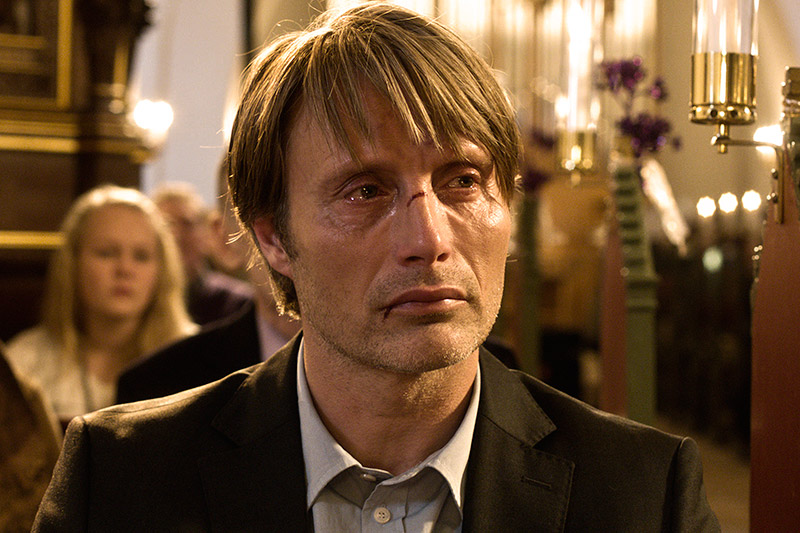
As the above no doubt attests, much of The Hunt's strength resides in its scenario, in the extreme injustice that Vinterberg and Lindholm credibly bring to the screen. Of course, The Hunt relies equally on the achievement of its actors, beginning with the Cannes-laureled Mikkelsen, who exquisitely emotes the arch of his excruciating experience just beneath his controlled surface countenance. Admirable too, among others, are Wedderkopp as the troubled Klara, Susse Wold as the school supervisor who spearheads the investigation-cum-persecution and Alexandra Rapaport as Lucas's nascent, non-native love interest. Visually, The Hunt cues into the film's generative performances, with the filmmakers' hand-held framing and accentuating zooms the most common and clichéd of Vinterberg and cinematographer Charlotte Bruus Christensen's storytelling strategies; there is, in this sense, a remnant of The Celebration's appreciable amateurism. Longer establishing set-ups gracefully render the handsome late autumnal setting that provides the site for the film's eponymous activity, a mid-December snow that strikes wonder into the young Klara and the luminous candlelit church where an inebriated Lucas finally confronts his estranged best-friend Theo (Thomas Bo Larsen), Klara's justifiably aggrieved father. On balance, Vinterberg's The Hunt is certainly laudable work.

I would be remiss were I not now also to offer a word or two in appreciation of Johnnie To's very solid Drug War (Du zhan, 2012), the rare title from the 'Milky Way' master to receive proper commercial distribution in the United States (thanks to upstart Well Go USA). The Chinese-Hong Kong production finds To and company back on Election 2's (2006) Mainland, and in similar organized-crime territory, as a team of undercover officers, with the aid of Louis Koo's informant Timmy Choi, seek to bring down a major trans-Asian meth ring. As is true of the director's best work (The Mission, 1999; Exiled, 2006; and Sparrow, 2008), the success of the film is imbricated in the design and actualization of its comedic and dramatic action-centered set-pieces - which is to say in the true substance of To's modular art. Where Drug War really elevates itself above median Milky Way fare, though I would not go so far as to say that this is one of the director's very best, is in the self-reflexivity that the filmmakers infuse in these passages, whether it is Captain Lei and Choi's (Sun Honglei) literal re-playing of an undercover meeting with Lei shifting identities from one to the next - we have here both an emphasis on role-playing and an occasion for rehearsal, therefore - or the appearance of the deaf brothers, whose visual communication provides an ideal object for optical surveillance. Drug War impressively is about the medium-specific dimensions of its undercover and surveillance subjects.

Of course, To's film, a 105-minute Canto-pop variation of HBO's The Wire, is also about the 'war' of its title, an effort that is shown to be futile in the film's final doubling plea for clemency. This comes on the heals of climactic shootout where To's blocking actively encourages confusion, where cop and criminal, following the film's undercover story line, tend to become indistinguishable. Though thematically appropriate at this juncture, this basic lack of clarity will at other times prove Drug War's most notable deficiency. 

Friday, July 19, 2013

Le grand amour: The Erotic Imagination of Pierre Étaix

Staged, in often voiced-over vaudevillian silence, as a series of recollections, desires and contingent realities that collectively map the mental geography of actor-director Pierre Étaix's middle-aged lead, Le grand amour (1969) is indeed a cinema of the male mind, overcome by the obsessive passions that the first sight of Nicole Calfan's eighteen year-old Agnès inspire. Perfectly cast for the spaces that give her grin its wink-like, corrupted adolescent appearance and for the slim shape of her calves as they extend between her sculpted knees and the straps of her black Mary-Jane's, Calfan provides the spectacular sensual presence around which Étaix constructs his digressive imaginings of an adulterous alternative.

In the first of these passages, with Étaix's Pierre drifting into a dream-filled sleep, Le grand amour presents its married male lead rolling over a tree-lined country road on his identical twin bed. As an ethereal vocal combines with the scene's organ score, Pierre passes silently among his fellow mattress-motorists, ultimately reaching his objet du désir as she waits roadside, her short pink negligee fluttering in the gentle breeze. Deliberately, she softly slides her bare legs into Pierre's mobile bed; her much older companion tucks her in and pulls her close as the silently shot, five minute-plus passage continues first on the congested rural thoroughfares, and then in an idyllic wooded park. After the couple finds momentary pause in a private glen, they motor back magically to Pierre and Florence's (Annie Fratellini) master bedroom, thus bringing to its conclusion the most classically surreal moment of screenwriters Étaix and Jean-Claude Carrière's fourth feature-length collaboration.

Elsewhere it is the daydream, the waking fantasy and speculative reflection that provides Le grand amour with its many ruptures from mundane reality. Even prior to Agnès's second-act appearance, Étaix fills his film with sight gags that originate on some level in his character's mind, be it in the kneeling arc of ex-lover brides that take Florence's place or in his spatial alternations between the café's interior and terrace as Pierre struggles to remember where he first spotted his betrothed. (The latter provides occasion for one of a set of comic breaks from the ontological space of Pierre's mind, as a frustrated waiter demands that the lead decide whether he wants to be inside or out.)

Of course, it is not only Pierre's mental activity that finds expression, but that of his circle, including best-friend Jacques (Alain Janey), who speculates on ways to end the factory executive's marriage to Florence - though not without Pierre correcting Jacques's more improbable suggestions (as described by the on-screen, contingent comedic scenarios). It is indeed in Le grand amour's comedy of imagination that Étaix and Carrière bridge the gap between their two most prominent former collaborators: Jacques Tati for Mon Oncle assistant director Étaix - Le grand amour's opening church set-piece offers an especially Tatiesque, gag-heavy comedic aural-scape, with sound effects employed for the purposes of distraction - and Luis Buñuel for the Belle de jour screenwriter.

Le grand amour in fact anticipates another of Carrière and Buñuel's imminent pairings, The Discreet Charm of the Bourgeoisie (1972), in both its digressive subjective structure and also its upper middle-class milieu. The latter provides amble opportunity for parody, as, for example, in one of the film's most original and ingenious set-pieces: the early gossip scene. Here an inconsequential, chance crossing of paths between Pierre and an unidentified female pedestrian escalates in each malicious retelling - as visualized in the passage's progression of pantomimed meetings - until an overweight middle-aged woman, with pastry spread slovenly across her chattering mouth, tells of the couple's clandestine lovemaking behind a bit of park shrubbery. Generally more benign elsewhere, Étaix's bourgeoisie are the authors of the banality that Pierre endeavors to escape with the exquisite Agnès.

Not that Pierre doesn't immediately appear happy (or is in any genuine sense unsatisfied) with the wife and job he never wanted. (Florence and the factory, it should be noted, come together in a large, red-framed portrait that absolutely dominates the mise-en-scène of Pierre's office.) Rather, Agnès offers a pure object of erotic desire, who as it happens threatens his respectable middle-class existence. Le grand amour, however, will prove far less morally anarchic than Carrière's collaborations with Buñuel: Pierre indeed realizes that he and Agnès are incompatibile after she repeats one of his earlier deflections during their one arranged rendezvous. Dropping her off in his newly purchased cherry-red sports car, Pierre confesses that he no longer loves her, bringing their just embarked upon courtship to an abrupt close. In the concluding passage that follows, Pierre joyously reunites with his vacationing wife, Fratellini's attractive in her own right and far more age appropriate Florence, in a comparatively conservative affirmation of the sacramental institution.


***
Off-screen, it bears mentioning, as a closing point of trivia, that Étaix and Fratellini would marry the same year that Le grand amour was released (1969), beginning a union that would continue until the actress's death in 1997. Fratellini, as such, would not survive to see Étaix's belated re-discovery in 2010, when Le grand amour received its first public screening in forty years at the Cannes International film festival. For this writer, Étaix has been 2013's biggest revelation - welcome evidence that Tati was not alone in his great comedic art in the 1960s, but that he instead inspired another major director of that same period - thanks to a spring program of the filmmaker's work at the Denver Film Society and the Criterion Collection's release of the Pierre Étaix box set in April. Along with the signature Yoyo (1965), the film that the massively over-praised, Academy award-winning The Artist (2011) should have been, Le grand amour might just be the director's greatest achievement.

Let me offer a special thanks to Lisa K. Broad for her insights included in this essay.

Wednesday, July 03, 2013

New Film: Before Midnight (2013)

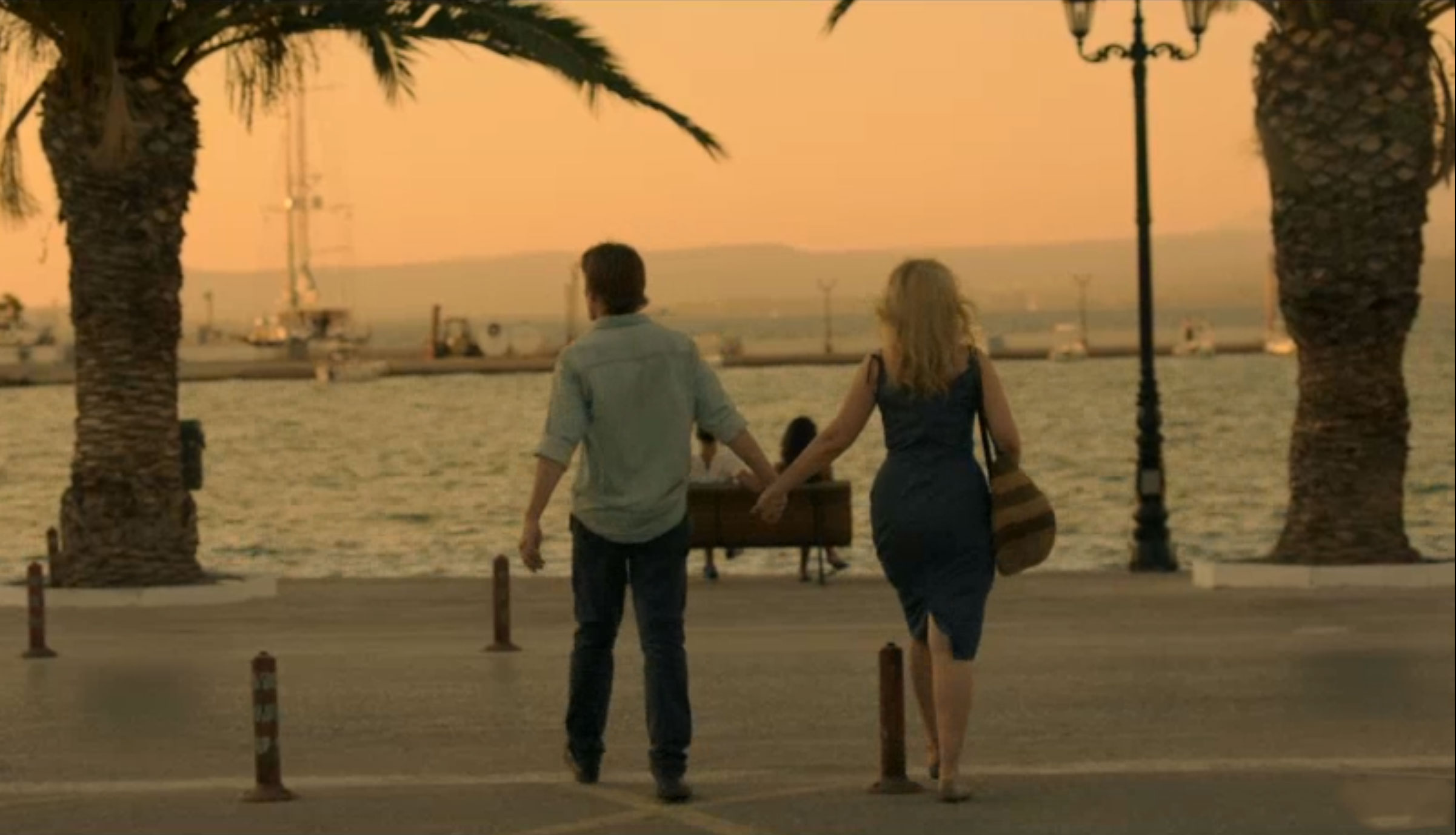
The consensus selection for the best new film of 2013, six months in, Richard Linklater's Before Midnight conceivably brings one of the recent screen's richest franchises, such as it is, to a courageously corrosive close: eighteen years after early twenty-somethings Jesse (Ethan Hawke) and Céline (Julie Delpy) first became acquainted over a deeply romantic day and night (Before Sunrise, 1995), and another nine since the couple re-connected for a real-time afternoon reunion in Céline's Paris (Before Sunset, 2004), Before Midnight finds the pair on an ultimately argument-filled final day of an extended family vacation in Greece's Peloponnese. The bliss of first sight and rapture of a rekindled (elicit) romance is replaced in Linklater's latest by middle-aged negotiations of familial obligations and career ambitions - or, by the fallout of a passion pursued at all costs. Though it will in this sense prove quite different in the particularity of its subject and the perspectives it offers, Before Midnight emerges nonetheless as a sort of contemporary Symposium, with an extended dinner table conversation replicating the sequence of encomiums that lends Plato's work its structure. Jesse, Céline and (most of all) their Greek dining companions present their twenty-first century standpoints on the differences between the two sexes and (cf. Aristophanes's memorably oddball speech) the romantic economy and virtues of the two, remaining separate or becoming one.

Before Midnight, no less than its predecessors - let us say here that until further notice, Linklater's reputation deserves to reside with these three outstanding efforts - is a talking cinema, most of all. It is in this sense a displaced object of the director's 1990s, of a not-too-distant age in which the mind still seemed a worthy competitor to the body, our own present day's all-consuming concern. More importantly, judging from the film's visual and verbal signposting, is the largely European tradition that Before Midnight extends. Foremost among Linklater and co-screenwriters Delpy and Hawke's sources is Rossellini's expressly referenced Viaggio in Italia (1954), which provides not only an overarching thematic and structure in its inscriptions of mid-life marital tensions (and a final-act romantic resolution), but also presaging passages of conversation, be it Before Midnight's single-take, front-seat two-shot or the couple's speculative perambulation (where mention is indeed made of the mid-century masterpiece's Pompeii set-piece). Visually, in the blocking and reverse-field cutting of its seaside sunset, and verbally in its aforementioned moment of dinner-table dialogue, Before Midnight equally calls to mind Eric Rohmer's very great Le Rayon vert (1986). In fact, we might look to Le Rayon vert likewise for an ancestor to Delpy's occasionally (if not often) unlikable or irritating lead - given especially that Rohmer's female star, Marie Rivière, also earned a co-writing credit for her work in the aforementioned, dialogue-centered feature. Rivière's Delphine, in other words, provides the self-critical template for Delpy's auto-expression.

Following the romantic fantasies that structure the first two films, Before Midnight seeks instead to impart the unpleasant realities and work of their now long-term committed relationship. Linklater, Hawke and Delpy's film confronts and exposes, with the latter again taking the on-screen lead: in one of the series' most instantly iconic and memorable moments, Delpy remains topless for an extended duration as she begins to make love to her partner, answers a telephone call from Jesse's son Hank and then commences to argue with her lover after she fails to give him the phone. It is indeed in the protracted dispute that thus begins, an argument in which Céline decries Jesse's rational tone and wonders aloud if she no longer loves her Before Sunrise one-night stand, where Linklater's latest really shows its emotional weight. As surpassingly clever as the consistently self-reflexive first hour may be, with its conspicuous fictional doubling of the first two films in Jesse's name-checked novels - though it might also be argued that the ESL dialogue does not always provide an entirely adequate match - it is the force of the film's hotel-room finale that insures Before Midnight's greater achievement: as the richest and most mature film about heterosexual relationships since Maren Ade's Everyone Else (2009). 2013's midpoint critical hit feels destined for end-of-the-year, list-season domination.

This piece was co-authored by Michael J. Anderson and Lisa K. Broad.

Sunday, June 23, 2013

New Film: You Ain't Seen Nothin' Yet / Vous n'avez encore rien vu (2012)

Seated in a marble-walled home cinema adorned with rows of plush black couches and over-sized armchairs, twelve French actors, each identified by his or her real name in a previous series of phone calls that convey the tragic news of friend and colleague Antoine d'Anthac's (Denis Podalydès) untimely death, respond to a televised performance of Eurydice, screened for their professional scrutiny as a sort of last will and testament by the deceased playwright. (As a second round of introductions during Antoine's pre-screening message to the assembled actors makes clear, all twelve worked with the director - within the fictional world of the film, that is - in at least one of his two prior stagings of the aforesaid play.) Michel Piccoli is the first to speak, repeating an audible on-screen line and then adding a second as he glances back at the high-definition set in a balanced, multi-figural medium close-up. As the scene continues off screen, Pierre Arditi turns to Piccoli as he phrases his own dialogue (as Orpheé) in response to his fictional father. Following another cutaway to the screen that the filmmakers frame with an elegant marble balustrade that functions equally as a found proscenium, Arditi and Piccoli continue in their remembered reproduction. With the arrival of the eponymous Eurydice (Vimala Pons in the filmed play), Antoine's two generations of female lead, Sabine Azéma and Anne Consigny (pictured), take turns repeating the heroine's opening line - and then reacting to their shared mother, Anne Duperey - as the spontaneous performance begins to to spread among the broader assembly.

As the staged version progresses on and off camera, Jean-Noël Brouté and then Azéma and Ardit (see below), stand to deliver their dialogue for their seated brethren. The latter two, Antoine's first Eurydice and Orpheé, accordingly turn to face one another as their intimate conversation continues - even as the rest of the room persists in watching the (now off-screen) televised version. As director Alain Resnais stages his two frequent collaborators on either edge of his CinemaScope frame - Azéma has been married to the director since 1998 - Mark Snow's orchestral score provides minor-key support for the suddenly emergent feeling emanating from the former legit leads. With Resnais and cinematographer Eric Gautier's camera finding the film's other Eurydice, Consigny's Orpheé, Lambert Wilson, rises from his former rear-ground position to join the whispering actress for a tender, face-to-face exchange. You Ain't Seen Nothin' Yet (Vous n'avez encore rien vu, 2012), in other words, hastens to divide into its two previous casts, which is to say, into the two worlds of experience that animate the thespians' responses to the filmed play-within-the-film.

At this same first-act juncture, Resnais's parallel performances begin to spread into the adjacent spaces of Antoine's Greek-inspired interior. A rear-projected train passes behind Azéma's Eurydice as the stagecraft of the earlier production starts to seep into Resnais's mise en scène. A brief cutaway to the on-screen performance is followed immediately by Azéma and Arditi return to the screening space in what will prove an early indication of the film's ontologically unstable mapping of memory, fantasy and external reality all. Indeed, as the increasingly off-screen contemporary play presses on, its impromptu re-imaginings by the assembled actors will occur not only before the screen or in corners of the large marble hall, but on a train platform and in a separate set of Marseilles bedrooms that disclose the differing, period-determined design strategies employed for the Azéma-Arditi and the Consigny-Lambert productions.

In each of these latter spaces, just as in his prior home-cinema exchanges, Resnais reproduces the shared memories of his two generations of performers, the histories that they lived in common by virtue of their co-inhabited times and places. As a subject for his fictional cinema, collective memory extends back to the beginning - and beyond (see Night and Fog, 1955; and Toute la mémoire du monde, 1956) - to the diagramming of the conversations, copulation and catastrophe of Hiroshima mon amour (1959) and, in negative, to the failure to remember a possible shared past that provides the plot for the filmmaker's follow-up, Last Year at Marienbad (1961). In the particular case of You Ain't Seen Nothin' Yet, Resnais gestures toward the parallel structure of his more recent stage-adapted masterwork, Private Fears in Public Places (2006), in rendering the overlapping personal histories of Antoine's successive casts in a series of cross-cut set-pieces that alternately push forward the anchoring Eurydice plot-line.

Consummately and constantly a cinema of memory and of the stage - the nonagenarian director's latest is in this sense alone a signature manifestation of his authorial identity - You Ain't Seen Nothin' Yet also adventurously brings to bear strategies drawn from an at times less reputable and much earlier film art, whether it is the aforementioned rear-projection, irises, Resnais's use of intertitles, his deployment of split-screen to showcase Mathieu Amalric (front row center) in both of the bedroom settings, or his predilection for allowing characters to dissolve from view once they've delivered their lines. Resnais calls on the fantastic language of film specifically to externalize and reclaim lost time. Then again, it will be a final act coup de théâtre, a sudden dramatic turn of events, that will push You Ain't Seen Nothin' Yet furthest beyond the everyday. With regard to this last narrative twist, suffice it to say that whatever the filmmaker in fact wishes or allows the viewer to believe with this revelation - and there is justification within the world of the narrative - he introduces a both/and logic, at least conceptually, that has long been the Marienbad filmmaker's purview. In Aristotelian terms, You Ain't Seen Nothin' Yet manages to be both comedy and drama in its closing moments, however unsatisfying this may prove to many a spectator.

Free in its employment of artifice (see also the expressionistic, Oliveiraesque swirling doorway set-piece that greets each of the villa's visitors) and in its willingness to open itself up to contradiction, You Ain't Seen Nothin' Yet is a work of advanced age in the best sense - and one, much unlike the substantially younger Michael Haneke's parasitic Amour (2012), which never succumbs to an act of loathing or pity for the experience. Though his actors are now past the ages of the characters they are portray, the spontaneous joy with which they throw themselves into their performances makes for a very different (and much richer) experience of encroaching mortality than Haneke's unsparing Palme d'Or. Of course, Resnais's semi-biographical 2012 Cannes debut - the filmmaker first attended Jean Anouilh's Eurydice seventy years ago and has been involved in around twenty of the source playwright's productions - is much more about life, and especially a life consumed by a passion for art, than it is death. Few subjects could be more appropriate to what is almost certain to prove one of the final masterstrokes of the nouvelle vague.

I would like to thank my viewing companion (and fellow Resnais lover) Lisa K. Broad for her significant contributions to this piece. Kino Lorber is doing the essential work of distributing the film in the United States. Upcoming dates include a July 24th screening at the Durango 9 in Durango, Colorado and July 26-27th screenings at the Museum of Fine Arts, Boston.